
Récupérer des fichiers sur un disque dur sous Windows 10
La perte de fichiers sur un disque dur peut sembler grave, surtout lorsque les données manquantes comprennent des documents professionnels, des photos de famille, des vidéos, des dossiers de projet ou des documents commerciaux. La bonne nouvelle, c'est que de nombreux fichiers peuvent encore être récupérés si vous agissez rapidement et évitez d'écrire de nouvelles données sur le même disque. Ce guide explique comment récupérer des fichiers sur un disque dur étape par étape, en passant par les méthodes intégrées à Windows, les options de sauvegarde et les logiciels de récupération professionnels.
Si vous avez perdu des données sur un disque dur interne, un disque dur externe, le disque dur d'un ancien ordinateur portable ou un ordinateur sous Windows 10, vous pouvez également consulter le guide complet de Amagicsoft guide de récupération du disque dur. Dans cet article, nous verrons par quoi commencer et comment Récupérer des fichiers sur le disque dur sous Windows 10, et lorsqu'un outil dédié comme Magic Data Recovery devient le choix le plus sûr.
Prise en charge de Windows 7/8/10/11 et Windows Server
Table des matières
Peut-on récupérer des fichiers à partir d'un disque dur ?
Oui, dans de nombreux cas, vous pouvez récupérer des fichiers sur un disque dur à condition que les données perdues n'aient pas été écrasées. Lorsque Windows supprime un fichier, il supprime généralement l'entrée correspondante ou marque l'espace de stockage comme disponible. Les données proprement dites peuvent rester sur le disque jusqu'à ce que de nouveaux fichiers occupent cet espace.
C'est pourquoi le timing est crucial. Plus vous utilisez le disque dur concerné, plus le risque est grand que Windows, des applications, des téléchargements ou des mises à jour du système écrasent les données supprimées.
Parmi les scénarios courants pouvant faire l'objet d'une récupération, on peut citer :
- Fichiers supprimés accidentellement
- Fichiers supprimés de la corbeille
- Fichiers perdus après formatage
- Dossiers manquants suite à des erreurs système
- Perte de données due à une corruption du système de fichiers
- Fichiers perdus sur un disque dur externe
- Documents, photos, vidéos, archives et autres types de fichiers qui ont disparu de manière inattendue
Cependant, aucune méthode de récupération ne peut garantir un résultat positif dans tous les cas. Si le disque dur présente des dommages physiques importants, émet des cliquetis, dégage une odeur de brûlé ou se déconnecte de manière répétée, cessez de l'utiliser et envisagez de faire appel à un laboratoire professionnel de récupération de données.
Que faire avant de procéder à la récupération de fichiers sur un disque dur
Avant d'essayer de Récupérer des fichiers sur le disque dur sous Windows 10, prenez quelques mesures de précaution. Ces mesures améliorent les chances de récupération et réduisent le risque de perte définitive des données.
Cessez d'utiliser le disque dur concerné
N'enregistrez pas de nouveaux fichiers, n'installez pas de logiciels, ne téléchargez pas de mises à jour et ne copiez pas de données sur ce même disque. Si les fichiers manquants se trouvaient sur le disque C:, évitez autant que possible d'utiliser l'ordinateur. Si les fichiers se trouvaient sur un disque dur externe, débranchez-le en toute sécurité jusqu'à ce que vous soyez prêt à l'analyser.
Ne formatez pas et ne réparez pas le disque dur au préalable
Windows peut vous demander de formater un disque avant de l'utiliser. Ne cliquez pas sur « Formater » si le disque contient des fichiers importants. Évitez également d'exécuter CHKDSK avant la récupération lorsque le système de fichiers est endommagé. Les commandes de réparation peuvent modifier les enregistrements de fichiers et compliquer la récupération.
Préparez un autre emplacement de stockage
Enregistrez toujours les fichiers récupérés sur un autre disque. Par exemple, si vous souhaitez récupérer des fichiers sur un disque dur D :, enregistrez les fichiers récupérés sur le lecteur C:, un disque dur externe ou un autre emplacement sûr. La restauration des fichiers sur le même disque peut écraser d'autres données récupérables.
Méthode 1 : Récupérer des fichiers à partir de la corbeille
Si vous avez récemment supprimé des fichiers d'un disque dur interne, la Corbeille devrait être votre premier réflexe. Cette méthode est rapide, gratuite et sûre.
Les étapes :
- Ouvrez la Corbeille sur le bureau.
- Recherchez le fichier ou le dossier supprimé.
- Cliquez avec le bouton droit de la souris sur l'élément.
- Choisissez Restaurer.
- Vérifier le dossier d'origine.
Cette méthode ne fonctionne que si le fichier supprimé se trouve encore dans la Corbeille. Elle ne sera d'aucune utilité si vous avez utilisé la combinaison Maj + Suppr, vidé la Corbeille, supprimé des fichiers sur des disques externes ou perdu des données après un formatage.
Méthode 2 : Récupérer des fichiers sur le disque dur sous Windows 10 à l'aide de l'historique des fichiers
L'historique des fichiers est une fonctionnalité de sauvegarde de Windows. Si elle était activée avant la perte de données, elle peut vous aider à restaurer d'anciennes versions de fichiers ou de dossiers.
Les étapes :
- Ouvrez l'explorateur de fichiers.
- Accédez au dossier dans lequel le fichier a été enregistré.
- Cliquez avec le bouton droit de la souris sur le dossier.
- Sélectionnez « Restaurer les versions précédentes ».
- Choisissez une version dans la liste.
- Cliquez sur « Restaurer » ou « Ouvrir » pour vérifier d'abord les fichiers.
Cette méthode est utile lorsque vous avez besoin de Récupérer des fichiers sur le disque dur sous Windows 10 après une suppression accidentelle, des modifications indésirables ou le remplacement d'un dossier. Cependant, cela ne fonctionne que si l'historique des fichiers ou les versions précédentes étaient déjà disponibles avant la disparition des fichiers.
Méthode 3 : Restaurer des fichiers à partir d'une sauvegarde ou d'une synchronisation dans le cloud
Avant d'utiliser un logiciel de récupération, vérifiez si vos fichiers se trouvent dans une sauvegarde ou sur un compte cloud. De nombreux utilisateurs oublient que les dossiers Windows peuvent être synchronisés avec OneDrive, Google Drive, Dropbox ou un autre outil de sauvegarde.
Consultez ces sites :
- Sauvegarde Windows
- Corbeille OneDrive
- Disques de sauvegarde externes
- Dossiers de sauvegarde sur le NAS
- Anciens disques durs d'ordinateurs portables ou de bureau
- Pièces jointes au courrier électronique
- Copies sur clé USB
- Dossiers d'exportation de projet
Cette méthode est souvent la solution la plus efficace, car elle permet de récupérer des fichiers intacts, avec leurs noms d'origine et leur structure de dossiers. Toutefois, s'il n'existe aucune sauvegarde, vous devrez procéder à une analyse plus approfondie du disque dur.
Méthode 4 : Utiliser la fonctionnalité de récupération de fichiers de Windows
Windows File Recovery est un outil en ligne de commande de Microsoft destiné à Windows 10 version 2004 et versions ultérieures. Il permet de récupérer des fichiers supprimés sur des périphériques de stockage locaux, notamment les disques durs internes, les disques durs externes et les clés USB.
Cette option peut s'avérer utile pour les utilisateurs avancés, mais elle présente certaines limites. Elle nécessite l'utilisation de commandes, une syntaxe de restauration correcte et un disque de destination distinct. Pour les utilisateurs lambda, le fonctionnement en ligne de commande peut sembler déroutant.
Voici un exemple simple :
winfr C: D: /regular /n \Users\VotreNom\Documents\
Dans cet exemple, l'outil analyse le lecteur C: et enregistre les fichiers récupérés sur le lecteur D:. Vous ne devez jamais restaurer des fichiers sur le même disque d'origine.
La récupération de fichiers sous Windows peut s'avérer utile lorsque vous connaissez le chemin d'accès ou le type de fichier. Cependant, elle n'est peut-être pas la solution idéale pour les utilisateurs qui recherchent une interface visuelle, un aperçu des fichiers, la possibilité de parcourir les dossiers ou un filtrage plus simple.
Méthode 5 : Récupérer des fichiers sur un disque dur avec Magic Data Recovery
Lorsque les fichiers ne se trouvent pas dans la Corbeille, que l'historique des fichiers n'est pas disponible ou que le disque a été formaté ou endommagé, il devient plus judicieux d'utiliser un logiciel de récupération spécialisé. Magic Data Recovery est conçu pour les utilisateurs qui ont besoin d'un moyen simple et efficace de récupérer des fichiers sur un disque dur sans commandes compliquées.
Vous pouvez le télécharger depuis le site officiel Magic Data Recovery page.
Prise en charge de Windows 7/8/10/11 et Windows Server
Magic Data Recovery intervient dans les cas courants de perte de données sur disque dur, notamment :
- Fichiers supprimés
- Disques durs formatés
- Dossiers perdus
- Erreurs dans le système de fichiers
- Partitions RAW ou inaccessibles
- Perte de données d'un disque dur externe
- Fichiers manquants à la suite d'opérations accidentelles
- Documents, photos, vidéos, archives et autres types de fichiers
Contrairement aux options de récupération standard de Windows, Magic Data Recovery analyse le disque sélectionné et affiche les fichiers récupérables dans une interface visuelle. Vous pouvez prévisualiser les fichiers avant la récupération, filtrer les résultats et restaurer les données vers un emplacement sûr.
Pourquoi la méthode Magic Data Recovery est utile pour la récupération de données sur disque dur
Magic Data Recovery est utile car il se concentre sur le véritable enjeu de la récupération : retrouver les données perdues avant qu'elles ne soient écrasées. Il prend en charge de nombreux cas de perte de fichiers et offre un processus simple pour les utilisateurs de Windows.
Les principaux avantages sont les suivants :
- Analyse approfondie des données supprimées, formatées et endommagées
- Aperçu avant récupération
- Prise en charge des disques durs internes et externes
- Options de filtrage et de recherche claires
- Récupération de nombreux types de fichiers
- Flux de travail simple pour les utilisateurs non techniques
- Transfert en toute sécurité vers un autre emplacement
Pour les utilisateurs à la recherche d'une solution de stockage sur disque dur plus avancée, Amagicsoft propose également un article dédié sur logiciel de récupération de disque dur.
Comment récupérer des fichiers sur un disque dur avec Magic Data Recovery
Procédez comme suit :
1. Téléchargez et installez Magic Data Recovery sur votre ordinateur.
Veuillez télécharger le logiciel à partir du site Web de Amagicsoft ou en cliquant sur le bouton de téléchargement suivant.
Prise en charge de Windows 7/8/10/11 et Windows Server
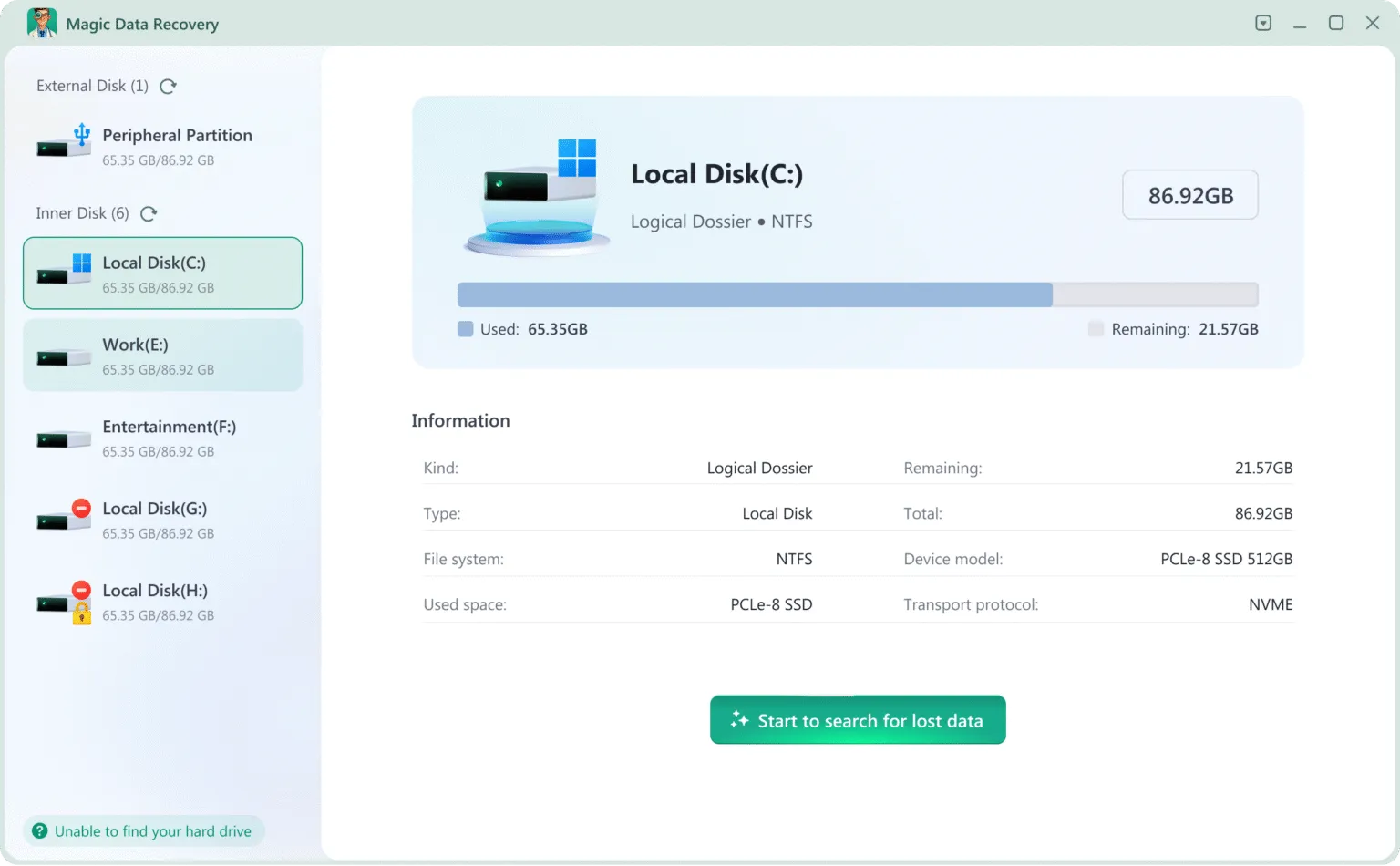
2. Connectez le disque dur et lancez Magic Data Recovery
Branchez le disque dur à votre ordinateur, puis lancez le logiciel pour sélectionner le disque dur dans la liste des périphériques.
3. Lancer un scan
Cliquez sur le bouton “Rechercher les données perdues” pour rechercher vos fichiers perdus.
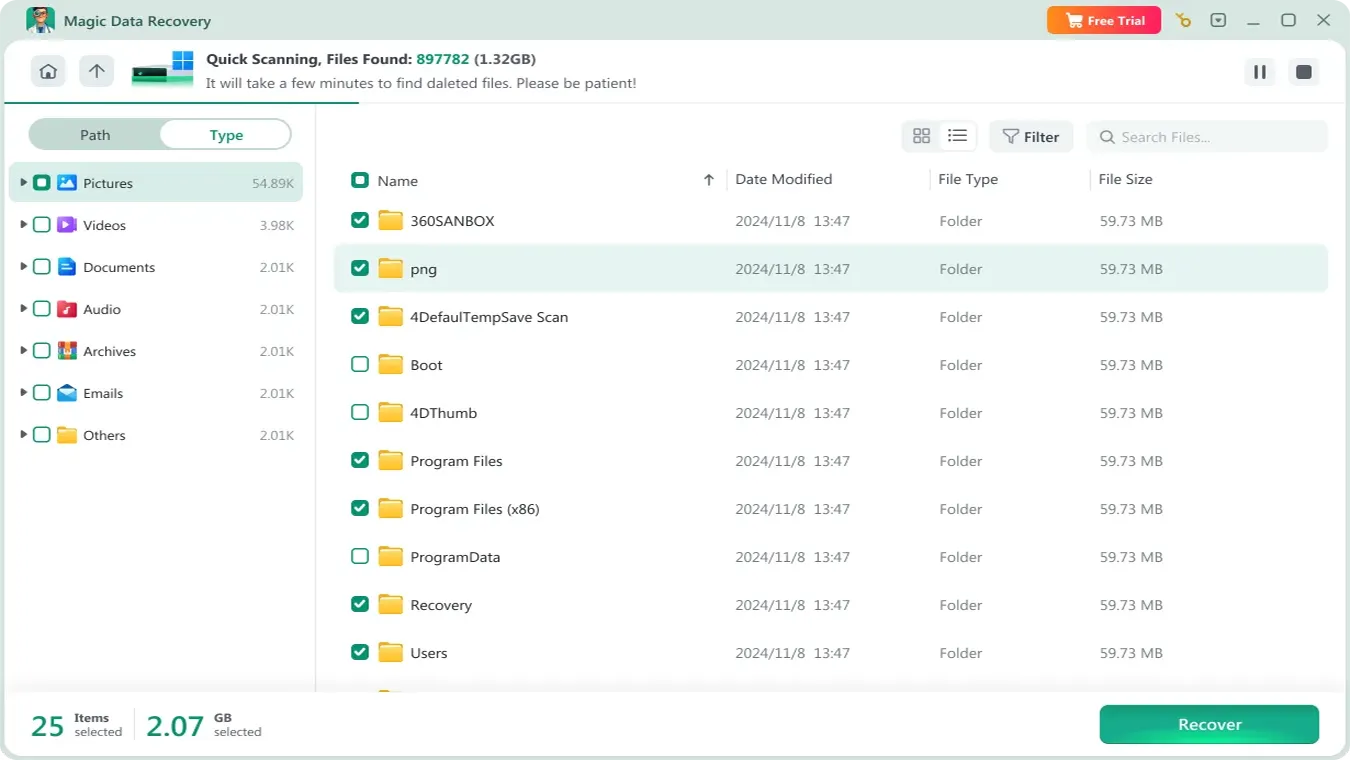
4. Prévisualisation des fichiers récupérables
Filtrez par type de fichier et prévoyez un aperçu avant la récupération.

5. Récupérer les fichiers en toute sécurité
Enregistrer les fichiers récupérés sur un autre périphérique de stockage.
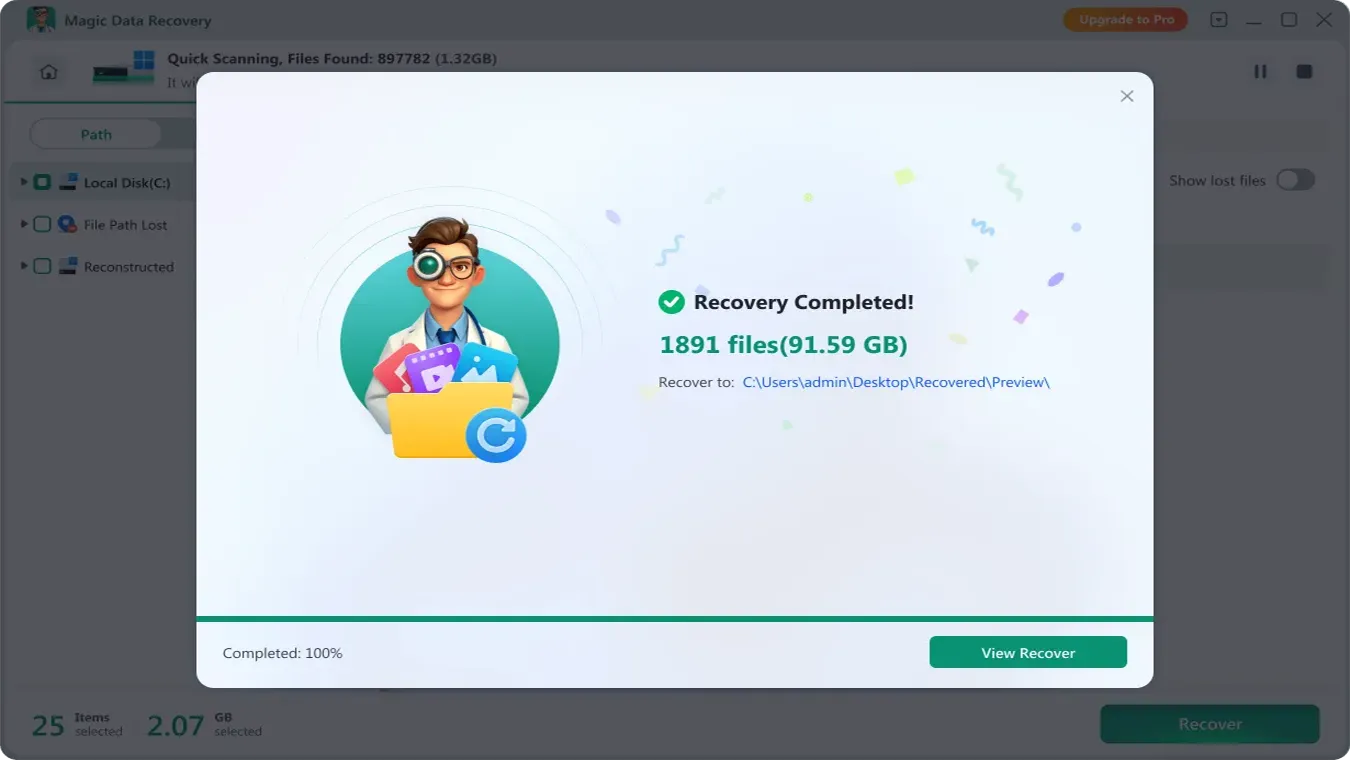
Par exemple, si vos fichiers supprimés se trouvaient sur un disque dur externe, installez Magic Data Recovery sur le disque interne de votre ordinateur. Lancez ensuite une analyse du disque externe et enregistrez les fichiers récupérés sur votre ordinateur ou sur un autre disque externe.
Si vous avez besoin d'un cas de figure plus précis concernant des fichiers supprimés, vous pouvez consulter ce guide qui explique comment récupérer les fichiers effacés du disque dur.
Méthodes gratuites ou logiciels de récupération : par quoi commencer ?
La meilleure méthode dépend de la manière dont les fichiers ont été perdus. Pour un simple fichier supprimé, il suffit parfois de le récupérer dans la Corbeille. En revanche, un disque formaté, une partition RAW ou un système de fichiers endommagé nécessite généralement une analyse plus approfondie.
Utilisez les méthodes gratuites de Windows dans les cas suivants :
- Le fichier a été supprimé récemment
- Le fichier se trouve toujours dans la corbeille
- L'historique des fichiers a été activé
- Une sauvegarde existe
- Le dossier contient des versions antérieures
- Vous connaissez le chemin d'accès exact au fichier et pouvez utiliser des commandes
Utilisez Magic Data Recovery dans les cas suivants :
- La corbeille est vide
- Le disque dur a été formaté
- Windows vous demande de formater le lecteur
- Des fichiers ont disparu à la suite d'une erreur du système de fichiers
- La partition est devenue RAW ou inaccessible
- Vous devez prévisualiser les fichiers avant de les récupérer
- La récupération de fichiers sous Windows semble trop compliquée
- Vous souhaitez un processus de récupération guidé
Si vous comparez différentes options gratuites, cet article de Amagicsoft sur récupération de données freeware pourra peut-être vous aider à comprendre les atouts et les limites des outils gratuits.
Les erreurs courantes à éviter lors de la récupération de données sur un disque dur
De nombreux utilisateurs réduisent leurs chances de récupération en prenant trop tôt des mesures inappropriées. Évitez ces erreurs avant de Récupérer des fichiers sur le disque dur sous Windows 10.
Installation d'un logiciel de récupération sur le même disque
Si les fichiers perdus se trouvaient sur le disque C:, n'installez pas le logiciel de récupération sur ce disque, sauf si vous n'avez pas d'autre choix. L'installation crée de nouvelles données et risque d'écraser les fichiers supprimés.
Enregistrer les fichiers récupérés sur le même disque dur
Enregistrez toujours les fichiers récupérés à un autre emplacement. Les réenregistrer sur le disque d'origine peut endommager d'autres données récupérables.
Formater le disque lorsque Windows vous y invite
Un formatage peut permettre de rendre le disque à nouveau accessible, mais il modifie également la structure du système de fichiers. Récupérez d'abord vos fichiers, puis réparez ou formatez le disque par la suite.
Exécuter la réparation du disque avant la récupération des données
Des outils comme CHKDSK Ces outils peuvent résoudre les problèmes liés au système de fichiers, mais ils peuvent également modifier les métadonnées. Si vos fichiers sont importants, commencez par analyser et récupérer les données.
Si le problème est lié à des enregistrements du système de fichiers endommagés, vous trouverez peut-être utile ce guide sur Récupération de la table des fichiers maîtres utile.
Comment améliorer le taux de réussite de la récupération de données sur disque dur
Vous pouvez augmenter vos chances en adoptant une méthode de travail rigoureuse.
Commencez par déterminer où les fichiers ont été perdus. Ensuite, cessez d'utiliser ce disque. Vérifiez ensuite les options de récupération simples telles que la Corbeille, l'Historique des fichiers et les sauvegardes. Si ces méthodes échouent, utilisez un outil d'analyse dédié. Enfin, enregistrez les fichiers récupérés sur un autre disque.
Conseils pratiques :
- Agissez dès que possible.
- Évitez de télécharger des fichiers sur le disque concerné.
- Utilisez un autre ordinateur si le disque système a subi une perte de données.
- Analysez l'intégralité de la partition, et pas seulement un dossier.
- Prévisualisez les fichiers importants avant la récupération.
- Récupérez d'abord les fichiers les plus importants.
- Remplacer un disque dur défectueux après la récupération.
Cette procédure garantit la sécurité et la cohérence du processus. Elle permet également d'éviter les erreurs courantes qui compliquent la récupération.
Quand les logiciels ne parviennent pas à récupérer des fichiers sur un disque dur
Les logiciels permettent de résoudre de nombreux problèmes de perte de données d'origine logique, mais ils ne peuvent pas tout régler. Si le disque dur présente des dommages physiques, vous devrez peut-être faire appel à un service de récupération professionnel.
Les signes pouvant indiquer une défaillance physique sont les suivants :
- Des cliquetis ou des grincements
- Le disque ne tourne pas
- Odeur de brûlé
- Chute violente ou dégât des eaux
- Déconnexions fréquentes
- Le BIOS ne parvient pas à détecter le disque
- L'ordinateur se bloque lorsque le disque dur est connecté
Dans ce cas, n'essayez pas de relancer l'analyse. Éteignez le disque dur et faites appel à un professionnel. Une utilisation prolongée pourrait aggraver les dommages.
Conclusion : la meilleure façon de récupérer des fichiers sur un disque dur
La meilleure façon de récupérer des fichiers sur un disque dur Commencez par la méthode la plus sûre et procédez étape par étape. Vérifiez d'abord la Corbeille. Essayez ensuite l'Historique des fichiers, les sauvegardes, le stockage dans le cloud ou la fonction de récupération de fichiers de Windows. Si ces options ne fonctionnent pas, analysez le disque à l'aide d'un outil dédié.
Pour les utilisateurs de Windows, Magic Data Recovery est un choix pratique car il prend en charge les fichiers supprimés, les disques formatés, les erreurs de système de fichiers et d'autres cas courants de perte de données sur disque dur. Il offre un flux de travail visuel, un aperçu des fichiers, une analyse approfondie et la récupération vers un emplacement sûr. Si vous recherchez une solution plus efficace pour Récupérer des fichiers sur le disque dur sous Windows 10, vous pouvez essayer Magic Data Recovery et vérifier si vos fichiers perdus peuvent être retrouvés avant de les restaurer.
Vous pouvez également revenir à la page de Amagicsoft guide de récupération du disque dur pour découvrir d'autres solutions de récupération de disque dur, des conseils de dépannage et des guides de récupération connexes. Si l'analyse détecte vos fichiers et que l'aperçu fonctionne correctement, vous pouvez poursuivre la récupération ou vous rendre sur le Page d'achat Magic Data Recovery pour débloquer la récupération complète.
Prise en charge de Windows 7/8/10/11 et Windows Server
Foire aux questions sur la récupération de fichiers à partir d'un disque dur
Puis-je récupérer des fichiers sur mon disque dur après les avoir supprimés ?
Oui, il est souvent possible de récupérer des fichiers supprimés sur un disque dur si les données n'ont pas été écrasées. Commencez par vérifier la Corbeille et l'Historique des fichiers. Si ces méthodes échouent, utilisez un logiciel de récupération pour analyser le disque. Cessez immédiatement d'utiliser le disque concerné afin d'augmenter vos chances de récupération.
Comment récupérer gratuitement des fichiers sur un disque dur sous Windows 10 ?
Vous pouvez essayer la Corbeille, l'Historique des fichiers, les versions précédentes, les sauvegardes, le stockage dans le cloud et la fonction de récupération de fichiers de Windows. Ces méthodes sont particulièrement efficaces lorsque les fichiers ont été supprimés récemment ou sauvegardés avant leur perte. Si le disque a été formaté ou est endommagé, les méthodes gratuites risquent de ne pas suffire et une analyse plus approfondie pourrait s'avérer nécessaire.
Puis-je récupérer des fichiers sur un disque dur formaté ?
Oui, il est parfois possible de récupérer les données d'un disque dur formaté si celles-ci n'ont pas été écrasées par de nouvelles données. N'enregistrez rien sur le disque formaté. Utilisez un outil de récupération capable d'effectuer une analyse en profondeur et restaurez les fichiers retrouvés sur un autre disque. Un formatage rapide offre généralement de meilleures chances de récupération qu'un écrasement complet.
Pourquoi ne devrais-je pas enregistrer les fichiers récupérés sur le même disque dur ?
Enregistrer les fichiers récupérés sur le même disque dur peut écraser d'autres données perdues qui se trouvent encore sur le disque. Cela peut réduire les chances de réussite de la récupération des fichiers restants. Utilisez toujours une autre partition, un disque externe ou un périphérique de stockage distinct comme destination de récupération afin de ne pas modifier le disque d'origine.
Le logiciel Windows File Recovery est-il efficace pour la récupération de données sur disque dur ?
L'outil de récupération de fichiers Windows permet de récupérer des fichiers supprimés sur les disques locaux des versions prises en charge de Windows 10, mais il fonctionne à l'aide de commandes en ligne. Il convient aux utilisateurs avancés qui connaissent le disque source, le disque de destination et les chemins d'accès aux fichiers. Pour les utilisateurs lambda, un logiciel de récupération graphique proposant un aperçu et des filtres est généralement plus simple à utiliser.
Magic Data Recovery permet-il de récupérer des fichiers à partir d'un disque dur externe ?
Oui, Magic Data Recovery peut analyser les disques durs externes connectés à un ordinateur Windows. Il permet de récupérer des fichiers supprimés, formatés, inaccessibles ou manquants lorsque le disque apparaît toujours dans Windows ou dans la gestion des disques. Pour obtenir de meilleurs résultats, évitez de formater le disque externe avant de l'analyser.
Que dois-je faire si mon disque dur émet des cliquetis ?
Cessez immédiatement d'utiliser le disque dur. Des cliquetis, des grincements ou des déconnexions répétées peuvent indiquer une panne matérielle. La récupération par logiciel n'est pas la solution la plus sûre en cas de dommages matériels importants. Éteignez le disque dur et envisagez de faire appel à un service professionnel de récupération de données, surtout si les fichiers sont importants et qu'il n'existe aucune sauvegarde.
La récupération des données d'un disque dur est-elle toujours couronnée de succès ?
Non, la récupération de données sur un disque dur n'est pas toujours couronnée de succès. Les chances de réussite dépendent du fait que les données perdues aient été écrasées ou non, de l'existence éventuelle de dommages physiques sur le disque et de l'impact sur le système de fichiers. Agir rapidement, éviter toute nouvelle écriture et utiliser la méthode de récupération appropriée peut considérablement augmenter les chances de réussite.

Jason a plus de 15 ans d'expérience pratique dans le secteur de la sécurité des données informatiques. Il est spécialisé dans les technologies de récupération de données, de sauvegarde et de restauration, et de réparation de fichiers. Il a aidé des millions d'utilisateurs dans le monde à résoudre des problèmes complexes de perte de données et de sécurité.