
Por que o $MFT é tão grande? Verifique e gerencie o uso do MFT do disco NTFS
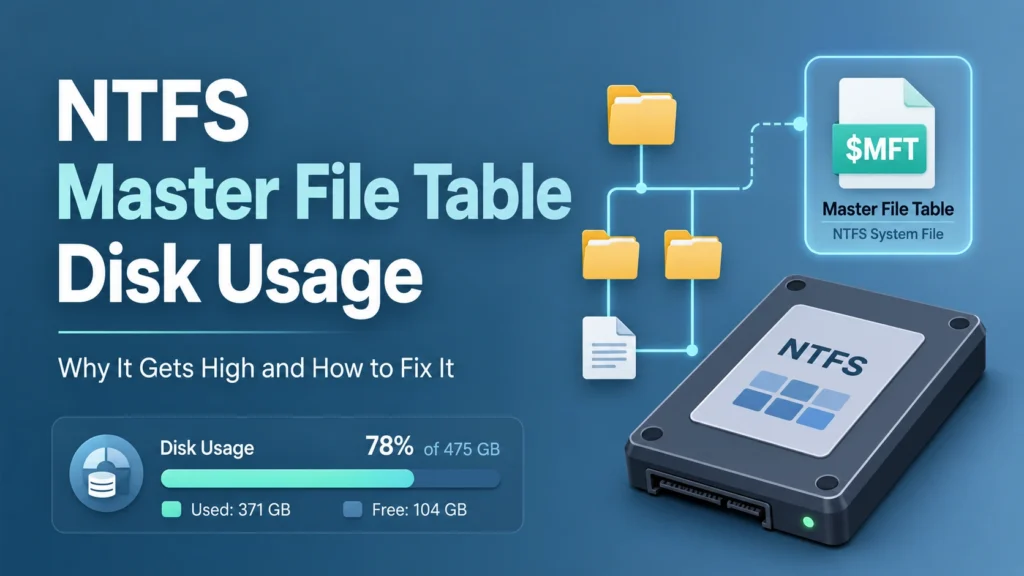
Se $MFT is taking up several gigabytes of disk space on an NTFS drive, it does not automatically mean something is wrong. The Tabela do arquivo mestre grows as Windows creates files and folders, and deleting those files does not normally shrink the MFT back to its previous size.
The important distinction is between the actual $MFT file, the reserved Zona MFT, and disk space that Windows may report as being used by other NTFS metadata. The MFT zone itself does not permanently take usable storage away from your files.
In this guide, we’ll explain why NTFS MFT disk usage becomes large, how to check the actual MFT size, whether you can shrink it, and when unusually high usage may point to a file system problem.
Índice
Quick Answer: Why Is $MFT Taking Up So Much Disk Space?
A large $MFT is usually the result of a drive having created a very large number of files over time. Every file and directory requires an MFT record. When files are deleted, those records can be reused, but the MFT normally keeps the disk space it has already allocated.
| Situação | O que isso significa | O que fazer |
|---|---|---|
| Large $MFT after millions of files were created | Usually normal NTFS behavior | No repair is normally required |
| Large MFT zone shown by a disk tool | Reserved area, not necessarily consumed space | Do not treat it as lost disk space |
| $MFT is fragmented | May affect file-system efficiency | Optimize the volume if appropriate |
| Disk usage suddenly becomes incorrect | Could indicate NTFS metadata or $Bitmap errors | Check the file system |
| You want to shrink a healthy $MFT | Windows normally cannot reclaim the allocated MFT space on a live volume | Avoid destructive action unless the space is truly critical |
What Does $MFT Disk Usage Actually Mean?
The Master File Table, or $MFT, is an NTFS metadata file that contains at least one record for every file and directory on the volume. If you only need a general explanation of its structure and purpose, see our guide to the Tabela de arquivos mestre NTFS.
For disk-space troubleshooting, however, three values should not be confused:
Actual MFT size: Disk space currently allocated to the $MFT file.
MFT Valid Data Length: The amount of valid MFT data reported by NTFS.
MFT zone: Space that NTFS tries to keep available for future MFT growth. It is not permanently removed from the free space available to normal files.
This distinction matters because some disk-analysis tools can make the MFT zone look like unavailable storage even though Windows can use that space when necessary.
Why Does the NTFS MFT Become So Large?
1. The Drive Has or Had a Very Large Number of Files
The number of files matters much more than their total size. A drive containing millions of cache files, build files, thumbnails, logs, or other small files may need a much larger MFT than a drive containing the same amount of data in several large files.
Each file or directory requires at least one MFT record, so creating large numbers of files causes the table to grow.
2. Deleted MFT Records Are Reused, Not Usually Removed
Deleting files does not normally shrink the physical MFT file. NTFS marks the corresponding records as available for reuse.
This explains why a drive that once contained millions of files can still have a multi-gigabyte $MFT even after most of those files have been deleted.
3. The MFT Has Become Fragmented
NTFS reserves an MFT zone to help the table grow contiguously. When the relevant areas of the volume become heavily allocated, the MFT may have to grow in additional locations.
Fragmentation and MFT size are related but different problems. Defragmenting the MFT can reduce fragmentation, but it does not normally reduce the amount of space already allocated to the MFT.
How to Check NTFS MFT Disk Usage
Before trying to reclaim disk space, confirm whether $MFT is actually responsible for the missing storage.
Aberto Prompt de comando como administrador e execute:
fsutil fsinfo ntfsinfo C:
Substituir C: with the NTFS volume you want to inspect.
Look for information such as:
- MFT Valid Data Length
- MFT Start LCN
- MFT Zone Start
- MFT Zone End
Do not assume that the entire MFT zone represents used disk space. The reserved MFT zone and the actual size of $MFT are different values.
You can also use Microsoft Sysinternals NTFSInfo or a disk-space analyzer to inspect NTFS metadata. If Windows Explorer reports significantly more used space than visible files account for, also consider other NTFS metadata, shadow copies, alternate data streams, and file-system errors.
Can You Reduce or Shrink a Large $MFT?
This is the most important point: a healthy MFT that has already grown usually cannot simply be shrunk on a live NTFS volume.
Deleting temporary files can prevent additional MFT growth, but it normally does not reclaim the MFT space that has already been allocated.
Clean Up Large Numbers of Unnecessary Small Files
Removing caches, temporary files, old build directories, or other collections containing huge numbers of small files can reduce future MFT growth.
However, do not expect the existing $MFT file to immediately become smaller after cleanup.
Optimize the Volume If the MFT Is Fragmented
Windows can optimize NTFS volumes and reduce MFT fragmentation in some situations.
This should be viewed as a fragmentation measure rather than a method for reclaiming MFT disk space. Defragmentation does not normally shrink an already enlarged MFT.
Use CHKDSK Only When File-System Errors Are Suspected
A large MFT alone is not a reason to repair the disk.
If Windows reports file-system errors, incorrect free-space information, or MFT/$Bitmap inconsistencies, CHKDSK may be appropriate. It can repair certain NTFS metadata errors, but it should not be presented as a normal method for shrinking $MFT.
Reformatting Recreates the MFT, but It Is Destructive
Formatting an NTFS volume creates a new file system and therefore a new MFT. This can reset an abnormally large historical MFT, but formatting also removes existing file-system structures and data.
For that reason, formatting should only be considered after important files have been safely backed up and when reclaiming the space is genuinely necessary.
Should You Change NtfsMftZoneReservation?
or most users, não.
O NtfsMftZoneReservation registry value changes how NTFS reserves space for future MFT growth. It does not shrink an MFT that has already grown and therefore should not be presented as a direct fix for high MFT disk usage.
Changing this setting may be useful in specialized environments that create extremely large numbers of files, but it is not a general disk-cleanup technique.
What If High MFT Usage Is Caused by File-System Corruption?
Normal MFT growth and MFT corruption are different problems.
You should investigate possible file-system corruption if the drive suddenly reports incorrect free space, becomes RAW or inaccessible, produces MFT-related errors, or shows inconsistencies between actual files and reported disk usage.
If important files become inaccessible, avoid formatting or writing large amounts of new data to the affected drive before deciding how the files will be recovered.
What If Files Are Lost During Troubleshooting?
If important files are accidentally deleted, lost after formatting, or become inaccessible because of file-system damage, stop writing new data to the affected drive.
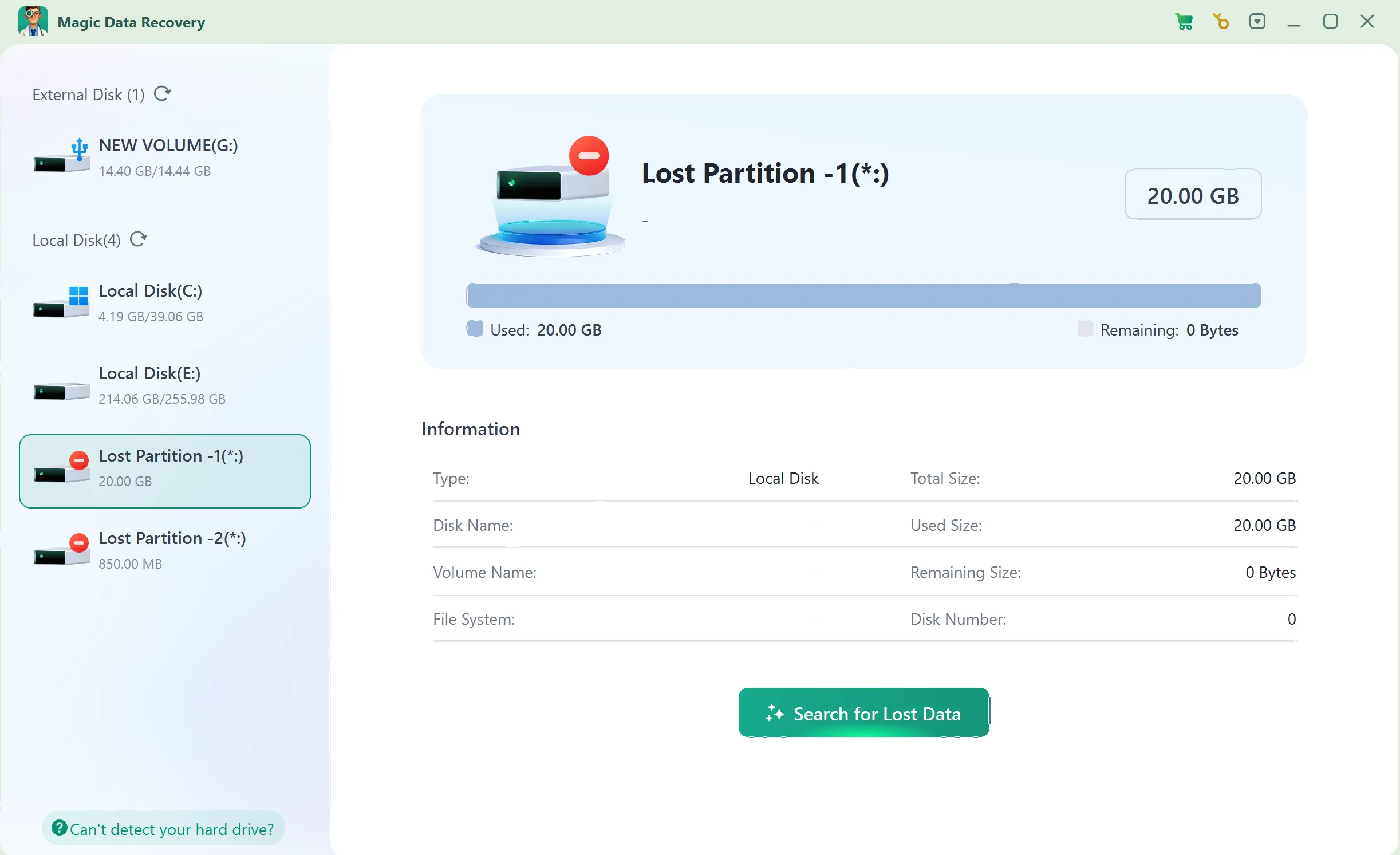
Nessa situação, Magic Data Recovery can be used to scan supported Windows storage devices for deleted, formatted, or otherwise lost files. Data recovery should be treated as a fallback for actual data loss, not as a tool for reducing normal MFT disk usage.
Compatível com Windows 7/8/10/11 e Windows Server
Conclusão: Recupere seu armazenamento hoje mesmo
Alta NTFS MFT disk usage is often normal on a volume that currently contains—or previously contained—a very large number of files. The most important thing is to distinguish the actual $MFT size from the reserved MFT zone and from other NTFS metadata consuming disk space.
Uso fsutil fsinfo ntfsinfo or an NTFS analysis tool to confirm what is actually using the space. Deleting files can slow future MFT growth, but it normally does not shrink space already allocated to $MFT. If disk-space reporting suddenly becomes inconsistent, investigate file-system errors before attempting destructive fixes such as formatting.
Perguntas frequentes - Uso de disco da tabela de arquivos mestre NTFS
Is a 10GB MFT normal?
Posso reduzir a MFT sem formatar minha unidade?
Normalmente, o Windows não permite que você reduza o tamanho físico da MFT depois que ela tiver crescido.
O que é o comprimento de dados válidos da MFT?
Por que minha unidade NTFS vazia ainda mostra espaço usado?
O CHKDSK pode reduzir o uso do disco da MFT?

Vasilii é um especialista em recuperação de dados com cerca de 10 anos de experiência prática na área. Ao longo de sua carreira, ele resolveu com sucesso milhares de casos complexos envolvendo arquivos excluídos, unidades formatadas, partições perdidas e sistemas de arquivos RAW. Sua experiência abrange métodos de recuperação manual usando ferramentas profissionais, como editores hexadecimais, e soluções automatizadas avançadas com software de recuperação. A missão do Vasilii é tornar o conhecimento confiável sobre recuperação de dados acessível tanto para profissionais de TI quanto para usuários comuns, ajudando-os a proteger seus valiosos ativos digitais.