
Como recuperar arquivos de um backup de imagem do Windows ou de um VHD
A Windows system image can save you from a failed drive or broken Windows installation, but restoring the entire computer just to retrieve one document feels excessive. Fortunately, you usually do not need to perform a full system restore. You can recuperar arquivos do Backup de Imagem do Windows by mounting the VHD or VHDX file inside the backup and opening it like another drive.
The situation becomes more complicated when the backup does not contain the file you need, the virtual disk will not mount, or the original files were deleted after the last image was created. In those cases, a solução de recuperação de arquivos excluídos may provide another path. Magic Data Recovery, for example, can scan the original HDD, SSD, USB drive, or backup storage device for files lost through deletion, formatting, or file-system errors.
This guide explains both situations: how to extract existing files from a Windows system image and what to do when ordinary backup recovery is no longer enough.
Compatível com Windows 7/8/10/11 e Windows Server
Índice
Quick Answer: How to Recover Files from a Windows Image Backup
If your Windows image backup still works, the safest approach is usually:
- Connect the drive that contains the WindowsImageBackup folder.
- Locate the .vhd or .vhdx file inside the backup.
- Abra o Gerenciamento de Discos.
- Selecione Ação > Anexar VHD.
- Mount the virtual disk, preferably as read-only.
- Assign a drive letter if Windows does not add one automatically.
- Open the mounted drive in File Explorer.
- Copy the files you need to another location.
- Detach the VHD after recovery.
If the file never existed in that backup, however, mounting the image cannot recreate it. You will need to check another backup or attempt recovery from the original storage device.
What Is a Windows Image Backup?
A Windows system image is a snapshot of one or more disk volumes at the time Windows created the backup. Unlike a normal file backup, it can contain Windows itself, installed applications, configuration data, personal files, and other selected partitions.
Windows stores image data inside virtual hard disk files such as:
- .vhd
- .vhdx
VHD stands for Virtual Hard Disk, while VHDX is the newer format commonly used by modern Windows versions. When Windows attaches one of these files, it treats the image much like another local disk. Microsoft confirms that Windows 10 and Windows 11 can attach VHD and VHDX files through Disk Management.
That behavior is what makes it possible to recuperar arquivos do Backup de Imagem do Windows without restoring Windows itself.
Where Are Windows Image Backup Files Stored?
A typical system image follows a structure similar to:
WindowsImageBackup\ComputerName\Backup YYYY-MM-DD HHMMSS\
Inside the backup folder, you may find several VHD or VHDX files because Windows can image several system-related partitions.
The largest file often represents the main Windows partition, but size alone does not prove that. If several images exist, mount them one at a time and inspect their contents.
Method 1: Recover Files from Windows Image Backup with Disk Management
Melhor para: Recovering individual documents, photos, folders, downloads, desktop files, or other data from a healthy Windows system image.
For most users, Disk Management provides the simplest way to recuperar arquivos do Backup de Imagem do Windows.
Step 1: Connect the Backup Drive
Connect the external HDD, SSD, or other storage device that contains your system image.
Before doing anything else, make sure the backup drive works normally. If Windows reports file-system errors or asks you to format the drive, do not format it. Formatting may make the situation worse.
For an especially important backup, consider making a copy before you work with the original image.
Step 2: Locate the VHD or VHDX File
Open the WindowsImageBackup folder and navigate through the computer-name and dated backup folders.
Look for files ending in .vhd or .vhdx.
If several virtual disks appear, start with the one that seems to contain your Windows data partition. You can safely detach it and try another if you choose the wrong one.
Step 3: Open Disk Management
Imprensa Windows + X e selecione Gerenciamento de disco.
Como alternativa, pressione Windows + R, digite:
diskmgmt.msc
e pressione Entrar.
Windows 10 and Windows 11 both include Disk Management as a built-in disk and volume management utility.
Step 4: Attach the VHD/VHDX
Em Gerenciamento de disco:
- Clique em Ação.
- Selecione Attach VHD.
- Clique em Navegar.
- Select your .vhd or .vhdx file.
- Ativar Somente leitura when possible.
- Clique em OK.
Using read-only mode is a sensible precaution because your goal is to extract data, not modify the backup.
Microsoft’s DiskPart documentation also supports attaching a virtual disk in read-only mode, which prevents write operations to that virtual disk.
Step 5: Assign a Drive Letter If Necessary
After Windows attaches the virtual disk, check File Explorer.
If the volume already has a drive letter, you can open it immediately.
If it appears in Disk Management but not in File Explorer:
- Right-click the partition inside the attached VHD.
- Selecione Alterar a letra da unidade e os caminhos.
- Clique em Adicionar.
- Choose an unused drive letter.
- Clique em OK.
Fazer não initialize or format the virtual disk if Windows unexpectedly prompts you to do so.
Step 6: Find and Copy Your Files
Open the newly mounted drive in File Explorer.
Personal data from a Windows system partition commonly appears under:
Users\YourOldUserName\
From there, check folders such as:
- Desktop
- Documentos
- Downloads
- Fotos
- Vídeos
- Música
Once you find the files, copy them out of the virtual disk to your current computer, another internal drive, or an external storage device.
This is the key distinction: you are extracting data from the image rather than modifying the image itself.
Step 7: Detach the VHD
After checking that the copied files open correctly:
- Return to Disk Management.
- Find the attached virtual disk.
- Right-click its disk label.
- Selecione Detach VHD.
- Confirme a operação.
Detaching the VHD does not delete the VHD file or the files stored inside it.
For most people trying to recuperar arquivos do Backup de Imagem do Windows, this completes the job.
Method 2: Recover Files from VHD Using DiskPart
Melhor para: Advanced users, administrators, or situations where the graphical Attach VHD option is inconvenient.
Windows also lets you recuperar arquivos de um VHD by mounting the image through DiskPart.
Aberto Prompt de comando como administrador, em seguida, digite:
- parte do disco
- select vdisk file=”D:\Path\To\YourBackup.vhdx”
- attach vdisk readonly
- volume da lista
- saída
Replace the sample path with the actual location of your VHD or VHDX file.
The attach vdisk command makes the virtual disk appear to Windows as a local disk. If the image already contains a usable partition and file system, Windows can expose its volume so you can browse the contents.
After attaching the image, open File Explorer and copy the required files.
When you finish, detach it:
- parte do disco
- select vdisk file=”D:\Path\To\YourBackup.vhdx”
- detach vdisk
- saída
DiskPart is useful when you understand disk layouts, but Disk Management remains easier for most users.
Method 3: Open a VHD/VHDX Directly in Windows
On some Windows systems, double-clicking a VHD or VHDX file can mount it automatically.
Once mounted, Windows assigns the image a virtual disk and you can browse it in File Explorer.
This can be the fastest way to recuperar arquivos de um VHD, but Disk Management gives you more control. For example, you can clearly see which virtual disk Windows attached, inspect its partitions, add a missing drive letter, and detach it afterward.
Therefore, if double-clicking produces an error or nothing appears in File Explorer, use the Disk Management method instead.
What If the Windows Image Backup Does Not Contain the File?
This is where many recovery guides become misleading.
A system image only contains data that existed in the selected volume when Windows created that particular image.
Consider this example:
You created a Windows image on June 1. You created an important Excel workbook on June 15, then accidentally deleted it on June 20.
Mounting the June 1 image cannot restore the workbook because that file never existed in the backup.
In this situation, repeatedly mounting the VHD will not help. Instead, you need to recover the deleted data from the drive where the workbook originally existed.
For more background on this distinction, see Amagicsoft’s backup data recovery guide.
Recupere arquivos perdidos com o Magic Data Recovery
Melhor para: Files that are not included in the Windows image backup but may still exist on the original storage device.
If the file you need was deleted after the last backup, accidentally formatted, or lost because of a file-system error, mounting the VHD will not help. In this case, you can scan the original drive with Magic Data Recovery.
Compatível com Windows 7/8/10/11 e Windows Server
The software supports common data-loss scenarios such as deletion, formatting, and file-system errors, and can recover more than 5,000 file types from HDDs, SSDs, USB drives, and other storage devices.
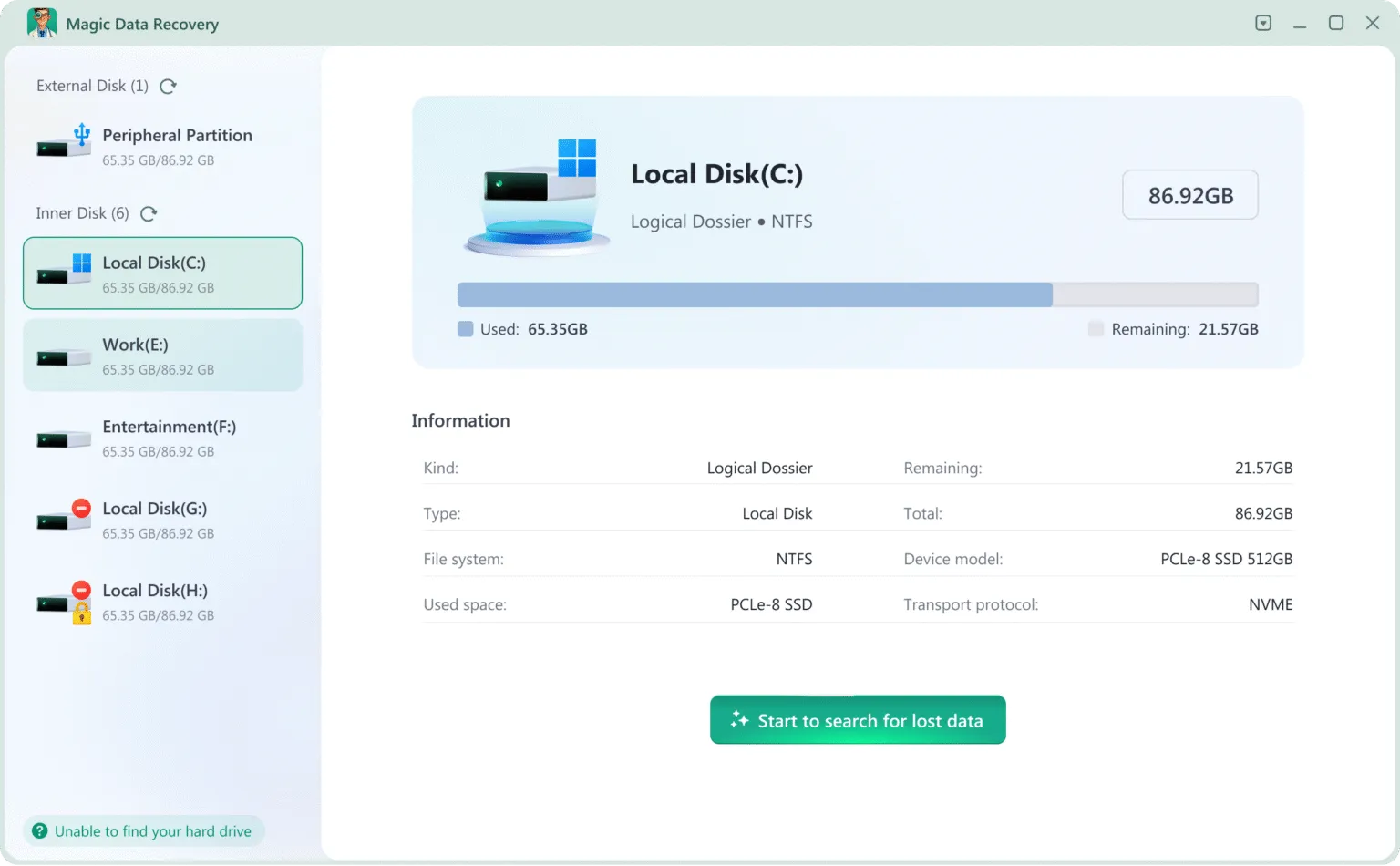
Simply select the original drive, run a scan, preview the files you need, and save recovered data to a different location.
Dica: Stop using the affected drive as soon as possible. New data may overwrite deleted files and reduce the chance of recovery.
Windows Image Backup vs. VHD Recovery vs. Data Recovery Software
Situação | Best Approach | Por que |
File exists inside a healthy system image | Mount VHD/VHDX in Disk Management | Fastest way to extract individual files |
You have a standalone VHD/VHDX | Attach the virtual disk and browse it | Windows can treat it like a local disk |
VHD appears but has no drive letter | Assign a drive letter in Disk Management | Makes the volume visible in File Explorer |
Need only one file, not the entire system | Mount the image instead of full System Image Recovery | Avoids overwriting the current Windows installation |
File was created after the backup date | Faça uma verificação na unidade original | The older image cannot contain a newer file |
Original file was permanently deleted | Use um software de recuperação de dados | Recovery must target deleted data rather than the backup |
Backup storage was formatted | Stop using it and scan the backup storage device | Continued use can overwrite recoverable backup data |
VHD/VHDX appears damaged | Preserve the original before troubleshooting | Repair attempts may complicate later recovery |
Common Problems When Recovering Files from VHD
VHD Is Attached but Does Not Appear in File Explorer
Open Disk Management and look for the virtual disk. If its data partition lacks a drive letter, assign one manually.
If Windows labels the partition as RAW or cannot identify its file system, do not format it simply to make it visible.
There Are Several VHDX Files in WindowsImageBackup
This is normal when the system image contains several partitions.
Mount them individually and inspect the contents. The largest VHDX often contains the Windows partition, but verify the folder structure instead of relying only on size.
Windows Says the VHD Cannot Be Attached
First, make sure the image file still exists completely and that the storage drive works normally.
If possible, copy the backup to healthy storage before further troubleshooting. Avoid repair, formatting, or conversion operations until you have preserved the original.
The Mounted Backup Is Missing Recent Files
Check the date of the system image.
A Windows system image represents a specific point in time. Any files created or changed after that backup will not appear inside it.
If the original file was later deleted, scan the original storage device instead.
Windows Asks to Initialize or Format the Virtual Disk
Cancel the operation.
Initializing or formatting a disk changes its storage structures and is not a normal part of extracting existing files from a healthy Windows image.
Should You Perform a Full System Image Restore?
Usually not if you only need a few files.
Full System Image Recovery restores entire volumes and can replace your current Windows installation, applications, settings, and files with the older state stored in the image.
Mounting the VHD is much less disruptive when your goal is simply to recuperar arquivos do Backup de Imagem do Windows.
Use a complete image restore when you genuinely need to recover the entire operating system or disk state rather than a document or folder.
Tips for Safer Windows Image and VHD Recovery
A few precautions can prevent a simple recovery job from becoming a larger data-loss problem.
Keep the original backup unchanged. If the files are important, work with a copy when practical.
Use read-only mounting. You only need to read and copy files from the image.
Never format an unknown virtual partition. Investigate why Windows cannot read it first.
Check backup dates before troubleshooting. A backup cannot contain files that did not exist when Windows created it.
Copy recovered files elsewhere. Avoid writing data into the mounted backup image.
Keep more than one backup generation. An older image may contain a deleted file that a newer backup no longer contains.
Você também pode conferir o Amagicsoft’s Windows backup and restore guide for broader backup planning advice.
Conclusão
If you still have a valid system image, the easiest way to recuperar arquivos do Backup de Imagem do Windows is to attach its VHD or VHDX file with Disk Management and copy the required data through File Explorer. The same technique works when you simply need to recuperar arquivos de um VHD without booting a virtual machine or restoring an entire Windows installation.
However, always check the backup date first. If the missing file never existed in the image, restoring or remounting that image cannot bring it back.
That is where a recovery-first approach becomes useful. Magic Data Recovery can scan the original storage device when files were deleted, formatted, or lost because of logical file-system problems. It complements backup recovery rather than replacing it.
For more guidance on files that have disappeared outside a usable backup, visit the Amagicsoft deleted file recovery guide.
Compatível com Windows 7/8/10/11 e Windows Server
Perguntas frequentes
É possível recuperar arquivos individuais a partir de uma imagem do sistema do Windows?
Sim. Você pode recuperar arquivos do Backup de Imagem do Windows sem precisar restaurar o computador inteiro. Conecte o arquivo VHD ou VHDX no Gerenciamento de Discos, atribua uma letra de unidade, se necessário, navegue pela imagem montada no Explorador de Arquivos e copie os arquivos específicos de que você precisa.
Como faço para recuperar arquivos de um VHD no Windows 11?
Para recuperar arquivos de um VHD, abra o Gerenciamento de Discos, selecione Ação > Anexar VHD, selecione o arquivo VHD ou VHDX e monte-o. Assim que o Windows atribuir uma letra de unidade ao volume, abra-o no Explorador de Arquivos e copie os arquivos necessários para outro local.
Onde fica o arquivo VHD no WindowsImageBackup?
Normalmente, ela fica na pasta “WindowsImageBackup”, dentro dos diretórios correspondentes ao nome do seu computador e às datas dos backups. Uma imagem do sistema pode conter vários arquivos VHD ou VHDX, pois o Windows pode fazer backup de várias partições necessárias ao sistema.
Preciso do Hyper-V para abrir um backup em VHD?
Não. Você não precisa executar uma máquina virtual nem habilitar o Hyper-V apenas para navegar pelos arquivos armazenados em um VHD. O Gerenciamento de Discos do Windows permite conectar arquivos VHD e VHDX diretamente, para que você possa acessar volumes compatíveis pelo Explorador de Arquivos.
Por que meu VHD montado não aparece no Explorador de Arquivos?
O disco virtual pode ter sido montado corretamente, mas não ter uma letra de unidade. Abra o Gerenciamento de Discos, localize a partição de dados dentro do VHD conectado e use Alterar a letra da unidade e os caminhos para atribuir um. Não formate o volume se o Windows não conseguir reconhecê-lo.
É possível recuperar um arquivo que foi excluído antes da criação da imagem do Windows?
Normalmente, não. Se o arquivo já tivesse desaparecido antes de o Windows criar essa imagem específica, é possível que o backup nunca o tenha capturado. Sua melhor opção é verificar um backup mais antigo ou fazer uma varredura no dispositivo de armazenamento original em busca de dados excluídos que possam ser recuperados.
E se o meu Backup de Imagem do Windows não contiver o arquivo de que preciso?
Verifique primeiro a data do backup. Se o arquivo tiver sido criado após essa data, a imagem não poderá contê-lo. Se o arquivo original tiver sido excluído posteriormente, uma ferramenta como o Magic Data Recovery pode ajudar, fazendo uma varredura na unidade original em vez de depender do backup desatualizado.
Should I restore the entire system image just to recover one file?
Usually not. A full image restore can replace your current system state with an older one. For one file or folder, mounting the VHD/VHDX and copying the required data is faster and far less disruptive.

O Jason tem mais de 15 anos de experiência prática no setor de segurança de dados de computador. Ele é especialista em recuperação de dados, backup e restauração e tecnologias de reparo de arquivos, e já ajudou milhões de usuários em todo o mundo a resolver problemas complexos de perda de dados e segurança.