
Recuperación de particiones perdidas en Windows: recupera particiones perdidas o eliminadas de forma segura

Una partición puede parecer perdida cuando desaparece su letra de unidad, la tabla de particiones está dañada o Windows muestra el espacio como «Sin asignar», «RAW» o «Sin inicializar». En muchos casos, los archivos siguen estando en el disco físico, pero Windows ya no puede localizar ni acceder al volumen original.
Respuesta rápida: Deja de utilizar el disco afectado inmediatamente. No lo formatees, no lo inicialices, no crees un nuevo volumen ni guardes nuevos archivos en él. Si la partición sigue apareciendo como «En buen estado» en «Administración de discos», pero no tiene letra de unidad, asignarle una letra de unidad podría restablecer el acceso. Si aparece como «Sin asignar», «RAW» o «ausente», analiza todo el disco físico con un programa de recuperación de particiones perdidas y guarda los archivos recuperados en otra unidad.
Magic Data Recovery Puede escanear el disco duro físico, el SSD, la unidad USB o la tarjeta de memoria que anteriormente contenían la partición perdida. Se centra en localizar y recuperar archivos del espacio de la partición inaccesible, en lugar de reescribir directamente la tabla de particiones original.
Esta guía explica cómo identificar el tipo de problema de partición y elegir el método de recuperación adecuado, recuperar partición perdida los datos de forma segura y evitar acciones que puedan sobrescribir los archivos recuperables.
Compatible con Windows 7/8/10/11 y Windows Server
Índice
¿Se ha perdido realmente la partición?
Antes de iniciar la recuperación de la partición perdida, abre Gestión de discos y comprueba cómo aparece el disco o volumen afectado. Cada estado requiere una solución diferente.
| Estado de la gestión de discos | Qué puede significar | Medida recomendada |
|---|---|---|
| Está en buen estado, pero no tiene letra de unidad | La partición sigue existiendo, pero no está montada en el Explorador de archivos | Asignar una letra de unidad no utilizada |
| Sin asignar | Es posible que se haya eliminado la entrada de la partición o que la tabla de particiones esté dañada. | No crees un nuevo volumen; recupera primero los archivos importantes |
| RAW | La partición existe, pero Windows no puede reconocer su sistema de archivos | No lo formatees; analiza el disco físico en busca de archivos recuperables. |
| No inicializado | Windows no puede leer una estructura de disco válida, o es posible que el disco sea nuevo | No inicialices un disco antiguo que contenga datos importantes |
| Fuera de línea | Es posible que el disco se haya desconectado manualmente o que presente un conflicto de firmas. | Comprueba el estado del disco antes de realizar cambios estructurales |
| No aparece en «Administración de discos» | Posible fallo de conexión, de alimentación, del controlador o del disco físico | Comprueba la conexión del hardware; detén el proceso si la unidad emite ruidos extraños. |
| Visible pero inaccesible | Posible problema relacionado con los permisos, el sistema de archivos, el cifrado o los sectores defectuosos | Comprueba cuál es la causa real antes de darla por perdida. |
La ausencia de una letra de unidad, un volumen RAW y una partición sin asignar no son el mismo problema. Identificar correctamente el estado del disco ayuda a evitar formateos innecesarios o cambios en las particiones.
Qué hacer inmediatamente después de perder una partición
Toma las siguientes precauciones antes de intentar recuperar una partición perdida:
- Deja de guardar archivos nuevos en el disco afectado.
- No formatees la partición cuando Windows te pida que la formatees.
- No inicialices un disco antiguo que contenga archivos importantes.
- No crees un nuevo volumen simple en el espacio no asignado.
- No instale software de recuperación en el disco afectado.
- No recuperes los archivos en el disco original.
- Evita ejecutar CHKDSK cuando la partición esté en formato RAW, no se encuentre o esté sin asignar.
- Detén la recuperación del software si el disco duro hace ruidos, se desconecta repetidamente o muestra errores graves de lectura.
Estas precauciones reducen el riesgo de sobrescribir los datos de los archivos, los metadatos del sistema de archivos o los límites originales de las particiones.
¿Qué provoca que una partición se pierda o se elimine?
Borrado accidental de particiones
Una partición puede eliminarse accidentalmente en «Administración de discos», DiskPart, el programa de instalación de Windows o un programa de partición de terceros. La entrada de la partición desaparece, pero los archivos pueden permanecer en el disco hasta que se sobrescriban sus sectores.
Corrupción de la tabla de particiones
Los daños en el MBR o en la tabla de particiones GPT pueden impedir que Windows localice los límites originales de las particiones. Es posible que el disco muestre particiones que faltan, espacio no asignado o mensajes de inicialización.
Error al cambiar el tamaño o clonar una partición
Un corte de corriente, un fallo del sistema, una selección incorrecta del disco o una interrupción durante una operación de cambio de tamaño, migración o clonación pueden dañar la información de la partición.
Instalación del sistema operativo
La instalación o reinstalación de Windows o Linux puede borrar las particiones existentes, volver a crear la estructura de particiones o sobrescribir parte de la estructura original del disco.
Daños en el sistema de archivos
Es posible que la partición siga existiendo, pero los daños en los metadatos de NTFS, FAT32 o exFAT pueden hacer que aparezca como RAW o que resulte inaccesible.
Corte de corriente o extracción incorrecta
Si se desconecta una unidad externa o se produce un corte de corriente mientras se realizan cambios en las particiones, las estructuras del disco pueden quedar incompletas o incoherentes.
Fallo de hardware
Los sectores defectuosos, los problemas con el controlador, las conexiones USB inestables o un fallo mecánico del disco duro pueden provocar que una partición desaparezca o se vuelva ilegible.
¿Se puede recuperar una partición perdida o borrada?
A menudo es posible recuperar una partición perdida cuando el espacio original de la partición no se ha sobrescrito y el dispositivo de almacenamiento sigue siendo físicamente legible. Al eliminar una partición, normalmente se elimina o se modifica su entrada en la tabla de particiones, en lugar de borrar inmediatamente todos los archivos almacenados en su interior.
Los resultados de la recuperación dependen de:
- Si se ha creado una nueva partición en el mismo espacio
- Si se crearon nuevos archivos después de que desapareciera la partición
- Si los metadatos del sistema de archivos original permanecen intactos
- Si el disco presenta errores físicos de lectura
- Si la partición perdida estaba cifrada
- Si se ha escaneado el disco físico correcto
- Si TRIM u otros procesos de gestión del almacenamiento afectaron a los datos eliminados
Una partición eliminada recientemente en un disco duro en buen estado puede conservar gran parte de su estructura de carpetas original. La recuperación resulta más difícil tras el formateo, la repartición, la instalación del sistema operativo, el uso continuado del disco o un fallo físico.
Lo más seguro es copiar los archivos importantes a otro disco antes de intentar reescribir la tabla de particiones o volver a crear el volumen.
Recuperación de datos de una partición perdida frente a la restauración de la tabla de particiones
La recuperación de datos de una partición perdida y la restauración de la tabla de particiones están relacionadas, pero no son el mismo proceso.
| Método | Para qué sirve | Consideración principal |
| Software de recuperación de archivos | Analiza el disco físico y guarda los archivos recuperables en otro disco | No restaura directamente la entrada de partición original |
| Recuperación de la tabla de particiones | Busca los límites antiguos de las particiones y vuelve a escribir las entradas seleccionadas en el MBR o el GPT | Las selecciones incorrectas pueden afectar a otras particiones |
| Asignación de una letra de unidad | Vuelve a hacer visible una partición «Healthy» ya existente | Solo funciona si la partición sigue existiendo. |
| Formatear o volver a crear un volumen | Crea una nueva partición o un nuevo sistema de archivos | Puede sobrescribir los metadatos originales y no es un método de recuperación |
Magic Data Recovery recupera los archivos del espacio que antes ocupaba la partición perdida. No restaura automáticamente la entrada de la partición eliminada ni hace que vuelva a aparecer la letra de unidad original.
Recuperar primero los archivos suele ser la opción más segura cuando el disco contiene datos importantes.
Cómo recuperar una partición perdida en Windows
Elige el método que se corresponda con el estado de la partición que aparece en «Administración de discos».
Método 1. Asignar una letra de unidad a una partición existente
Utiliza este método únicamente cuando la partición siga apareciendo como «En buen estado» y muestre un sistema de archivos reconocido, como NTFS, FAT32 o exFAT.
- Pulse
Windows + Xy seleccione Gestión de discos. - Busca la partición que no tenga asignada una letra de unidad.
- Haz clic con el botón derecho del ratón en la partición y selecciona Cambiar letra de unidad y rutas.
- Haga clic en Añadir.
- Seleccione una letra de unidad no utilizada.
- Haga clic en OK.
Abre el Explorador de archivos y comprueba si ya puedes acceder de nuevo a la partición y a los archivos.
No utilices este método cuando el espacio aparezca como «Sin asignar» o cuando la partición no aparezca en absoluto.
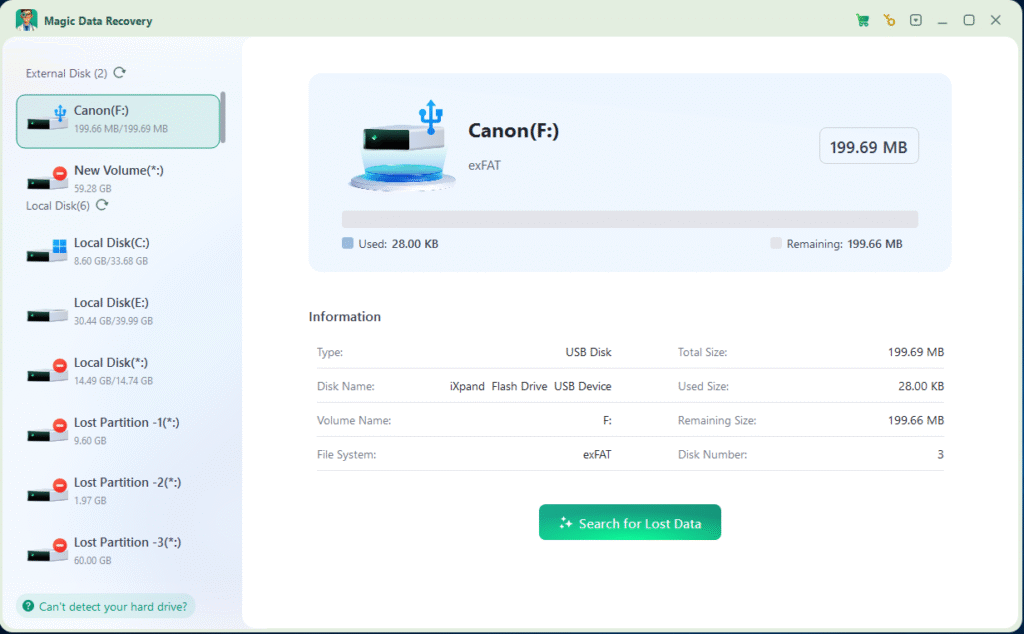
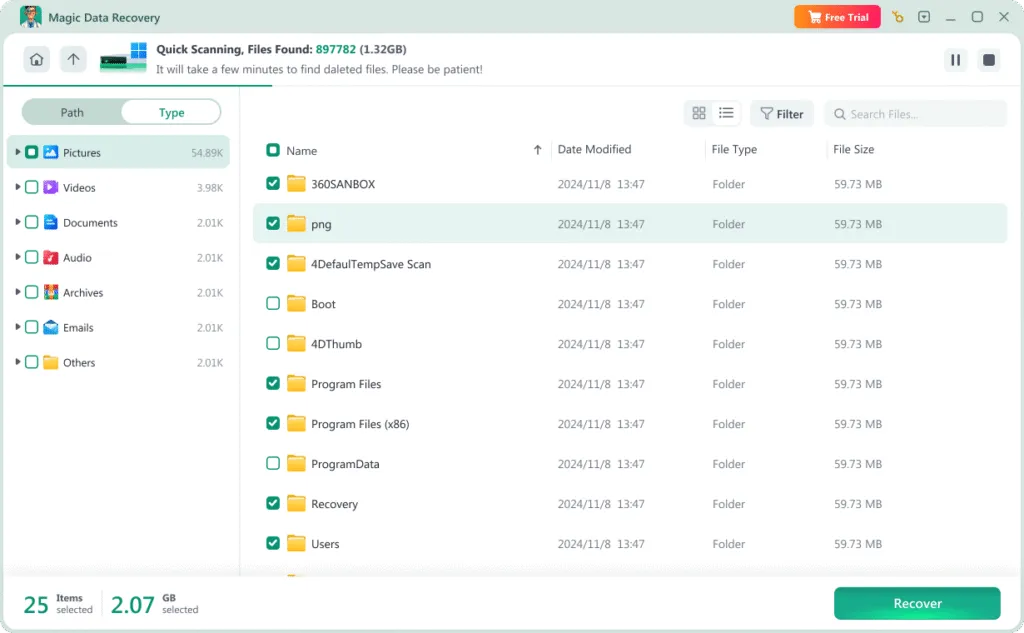
Método 2. Recuperar los datos de una partición perdida con Magic Data Recovery
Recuperar una partición borrada o perdida con Magic Data Recovery Es rápido y sencillo. A continuación se indican los pasos básicos para empezar.
1. Descargar e instalar: Visite Magic Data Recovery desde el sitio web oficial e instálalo en tu ordenador.
Compatible con Windows 7/8/10/11 y Windows Server


Método 3. Restaurar la tabla de particiones con una herramienta avanzada
Las herramientas de recuperación de tablas de particiones, como TestDisk, pueden buscar los límites de las particiones eliminadas y volver a escribir las entradas de las particiones seleccionadas en el MBR o el GPT.
Este método puede resultar adecuado cuando:
- Es necesario restaurar la estructura de particiones original.
- Los límites de las particiones detectadas son claros
- El disco está en buen estado físico
- Ya se ha realizado una copia de seguridad o se han recuperado los archivos importantes
- El usuario comprende los cambios en la tabla de particiones
La restauración de la tabla de particiones modifica las estructuras del disco. Si se selecciona un límite de partición incorrecto o se escribe una tabla errónea, las particiones existentes podrían quedar inaccesibles.
En el caso de los discos que contengan archivos importantes, recupera primero los archivos antes de intentar restaurar la entrada de la partición original.
¿Qué método de recuperación de particiones perdidas deberías utilizar?
| Situación | Método recomendado |
|---|---|
| La partición está en buen estado, pero no tiene letra de unidad. | Asignar una letra de unidad |
| La partición aparece como «Sin asignar» | Recupera primero los archivos del disco físico |
| La partición aparece como RAW | Recuperar archivos antes de formatear o reparar |
| La partición se borró por error | Recupera primero los archivos; plantéate restaurar la tabla de particiones después |
| Es necesario restaurar la entrada de partición original | Utiliza una herramienta avanzada de recuperación de particiones después de haber protegido los datos |
| El disco duro hace clic o se desconecta repetidamente | Deja de utilizar programas informáticos y ponte en contacto con un servicio profesional de recuperación de datos |
Recuperar particiones perdidas de distintos dispositivos de almacenamiento
Recuperación de particiones perdidas en el disco duro
La recuperación de una partición del disco duro puede ser posible si el disco sigue siendo detectable y no presenta daños mecánicos graves. Deja de utilizar el disco y realiza un análisis completo de la unidad física, en lugar de crear una nueva partición.
Si el disco duro hace ruidos como chasquidos o chirridos, gira repetidamente o deja de funcionar durante el escaneo, deja de utilizarlo y busca ayuda profesional.
Recuperación de particiones de discos duros externos
Comprueba el cable USB, la carcasa, el adaptador de corriente y otro puerto USB antes de iniciar la recuperación. Si el disco aparece en «Administración de discos» como «RAW» o «Sin asignar», recupera los archivos antes de formatearlo.
No guardes los archivos recuperados en la misma unidad externa.
Recuperación de particiones perdidas en SSD
Deja de utilizar el SSD inmediatamente. Si sigues utilizándolo, podrías reducir las posibilidades de recuperación, ya que los SSD procesan los bloques eliminados de forma diferente a los discos duros tradicionales.
Siempre que sea posible, retira el SSD del sistema en funcionamiento y escanéalo desde otro ordenador con Windows que funcione correctamente.
Recuperación de particiones de memorias USB y tarjetas de memoria
Las memorias USB y las tarjetas de memoria pueden mostrar una capacidad reducida, sistemas de archivos RAW o espacio no asignado tras errores de formateo o daños en las particiones.
Evita formatear de nuevo el dispositivo. Realiza un análisis completo del dispositivo físico y guarda los archivos recuperados en una unidad del ordenador o en otro disco externo.
Cuando el software no puede recuperar una partición perdida
La recuperación mediante software puede no ser adecuada en los siguientes casos:
- El disco duro emite chasquidos, chirridos o ruidos repetidos al ponerse en marcha
- El dispositivo de almacenamiento no es reconocido por la BIOS, la UEFI ni la herramienta «Administración de discos»
- El dispositivo se desconecta repetidamente durante el escaneo
- La unidad ha sufrido daños por agua, fuego, golpes o problemas eléctricos
- Los sectores defectuosos graves impiden una lectura estable
- El controlador o los componentes internos han fallado
En estas situaciones, los análisis repetidos del software pueden suponer una carga adicional para el dispositivo de almacenamiento. Deja de utilizarlo y ponte en contacto con un servicio profesional de recuperación de datos.
Cómo evitar la pérdida de particiones
Las siguientes medidas pueden reducir el riesgo de perder particiones:
- Haz una copia de seguridad de los archivos importantes en un disco físico independiente o en un servicio en la nube
- Comprueba que el disco seleccionado es el correcto antes de utilizar DiskPart o las herramientas de gestión de particiones.
- Evita interrumpir el cambio de tamaño, la clonación o la instalación del sistema operativo
- Utiliza una fuente de alimentación fiable durante las operaciones con discos y particiones
- Expulsa de forma segura las unidades externas antes de desconectarlas
- Supervisa el estado de los discos duros (HDD) y SSD para detectar errores de lectura y alertas SMART
- Realiza una copia de seguridad completa antes de convertir de MBR a GPT o viceversa.
- Evita utilizar programas de partición, clonación u optimización del sistema que no sean de confianza.
Reflexiones finales
Recuperación de particiones perdidas A menudo es posible, pero el método adecuado depende de cómo aparezca la partición en Windows.
Es posible que un volumen «salvo» que no tenga letra de unidad solo necesite una nueva letra de unidad. Una partición «sin asignar», «RAW», eliminada o que falte suele requerir una recuperación de datos antes de proceder a la reparación estructural.
No formatees, inicialices, reparticiones ni escribas nuevos archivos en el disco afectado. Utiliza Magic Data Recovery para escanear todo el disco físico, obtener una vista previa de los archivos recuperables y guardarlos en otra unidad.
Una vez que hayas comprobado que los archivos necesarios están a salvo, puedes volver a crear la partición o utilizar un método avanzado de recuperación de la tabla de particiones si es necesario.
Actúe ya. Descargue Magic Data Recovery y dé a sus datos perdidos la mejor oportunidad de una recuperación completa.
Compatible con Windows 7/8/10/11 y Windows Server
Preguntas frecuentes
¿Se puede recuperar una partición perdida?
¿Cómo puedo recuperar una partición borrada en Windows?
¿Puedo recuperar una partición perdida sin formatear?
¿Se puede recuperar una partición perdida con la herramienta «Administración de discos»?
¿Magic Data Recovery restaura la partición original?
¿Cuál es la diferencia entre la recuperación de una partición perdida y la recuperación de datos de una partición?
¿Puedo recuperar archivos de una partición dañada o en formato RAW?
¿Cuándo debería recurrir a un servicio profesional de recuperación de datos?

Erin Smith es reconocida como una de las redactoras más profesionales de Amagicsoft. Ha perfeccionado continuamente sus habilidades de escritura durante los últimos 10 años y ha ayudado a millones de lectores a resolver sus problemas tecnológicos.