
Recuperação de dados de cartão SD: como recuperar arquivos excluídos, formatados ou corrompidos

Losing photos, videos, or documents from an SD card does not always mean permanent data loss. Users can often recover SD card data after accidental deletion, a quick format, file system corruption, or a RAW file system. Recovery remains possible when new content has not overwritten the missing files.
Stop using the card immediately. Do not take new photos, copy files to it, format it again, or run CHKDSK before recovering important data.
For logical data loss, Magic Data Recovery can scan SD, SDHC, SDXC, microSD, CF, and other memory cards connected to a Windows computer. It supports more than 5,000 file types and handles data loss caused by deletion, formatting, partition errors, and file system damage.
For additional recovery methods and troubleshooting resources, visit our complete Soluções de recuperação de cartão SD.
Compatível com Windows 7/8/10/11 e Windows Server
Índice
Quick Answer: How to Recover Data from an SD Card
To perform SD card data recovery safely, stop using the card immediately and remove it from the camera, phone, drone, or other device. Connect it to a Windows computer through a reliable card reader and check whether it appears in File Explorer or Gerenciamento de disco.
When Windows detects the card, use data recovery software to scan for deleted files, formatted data, or content that file system errors have made inaccessible. Preview the found files and save them to another drive. Repair or format the SD card only after all important data has been recovered.
Recovery software can usually help with logical data loss. Contact a professional data recovery service when physical damage has cracked, burnt, or exposed the card to water. You should also seek professional help when every computer and card reader fails to recognize it.
Can SD Card Data Be Recovered?
Exclusão acidental de arquivos
Stop using the SD card and run a recovery scan. Deleted files may remain on the storage space until new content overwrites them.
Quick-formatted SD card
Avoid formatting the card again or taking new photos. Instead, run a deep scan to locate files after the format removed their original directory information.
RAW SD card or formatting prompt
Cancel the formatting prompt and recover your important files first. Running CHKDSK, formatting the card, or changing its file system could reduce the recovery chance.
Disappeared files with occupied storage space
Enable the display of hidden files and scan the card for malware. If the files remain missing, use recovery software to search for deleted or damaged file records.
Card visible in Disk Management but missing from File Explorer
Check whether Disk Management displays the correct capacity. A RAW or unallocated status usually indicates a partition or file system problem. Recover your files before changing the partition structure.
Incorrect capacity or 0-byte status
Try another card reader, USB port, and computer. If every device reports an incorrect capacity, a faulty controller or memory chip may have caused the problem.
Visible physical damage
Disconnect a bent, cracked, burnt, or water-damaged card immediately. Do not format, solder, heat, open, or repeatedly reconnect it. Contact a professional recovery service instead.
No detection on any computer
Software cannot scan a device that Windows cannot recognize. Stop repeated connection attempts and ask a professional recovery laboratory to inspect the card.
Choose the Right SD Card Data Recovery Method
Os arquivos foram excluídos acidentalmente
Stop using the card and run a recovery scan. Deleted files may remain recoverable until their storage sectors are overwritten.
The SD card was quick-formatted
Do not format it again or take new photos. Use a deep scan to search for files whose original directory information has been removed.
The card shows as RAW or asks to be formatted
Cancel the formatting prompt. Recover important files before running CHKDSK, formatting, or changing the file system.
Files disappeared, but the used storage space remains unchanged
Enable the display of hidden files and scan the card for malware. If the files are still missing, use recovery software.
The card appears in Disk Management but not File Explorer
Check whether it has the correct capacity and whether its partition is shown as RAW or unallocated. Recover the data before making structural changes.
The card shows 0 bytes or an incorrect capacity
Test another card reader, USB port, and computer. If the incorrect capacity remains, the controller or memory chip may have failed.
The card is bent, cracked, burnt, or water-damaged
Disconnect it immediately. Do not format, solder, heat, open, or repeatedly reconnect it. Contact a professional recovery service.
The card is not detected by any reader or computer
Software cannot scan a storage device that the operating system cannot detect. Repeated connection attempts may worsen an unstable hardware problem.
Why Use Magic Data Recovery for SD Card Recovery?
Magic Data Recovery handles logical data-loss situations when Windows or Disk Management can still detect the SD card. Its guided interface helps users scan, preview, and recover files without complicated command-line tools.
Its main SD card recovery features include:
• Support for SD, SDHC, SDXC, microSD, CF, and other memory cards.
• Recovery after accidental deletion, quick formatting, RAW file systems, partition errors, and other logical failures.
• Support for more than 5,000 file types, including photos, videos, documents, audio files, archives, and camera RAW images.
• Support for formats such as JPG, PNG, MP4, MOV, CR2, CR3, NEF, ARW, RAF, RW2, ORF, DNG, DOCX, XLSX, PDF, and ZIP.
• Advanced scanning for files whose original names or folder structures have been lost.
• Filters for locating files by name, type, size, or date.
• File preview before recovery.
• Up to 500 MB of free file recovery for testing.
• Local recovery without uploading personal files to cloud servers.
Magic Data Recovery runs on Windows 11, Windows 10, Windows 8, Windows 7, and supported Windows Server editions. You can also scan cards from a Mac, camera, Android phone, drone, dash cam, or other device. Remove the card from the original device, insert it into a card reader, and connect the reader to a Windows computer.
How to Perform SD Card Data Recovery with Magic Data Recovery
Step 1: Stop Using and Connect the SD Card
Remove the SD card from the camera, phone, drone, dash cam, or other device. Insert it into a reliable card reader and connect the reader directly to a Windows computer.
If Windows displays “You need to format the disk before you can use it,” click Cancel. Do not format the card before recovering your files.
Etapa 2: Instalar e iniciar o Magic Data Recovery
Baixar Magic Data Recovery and install it on the Windows computer’s internal drive. Do not install the program on the affected SD card, because installation files could overwrite recoverable data.
Compatível com Windows 7/8/10/11 e Windows Server
Step 3: Select the SD Card
Launch Magic Data Recovery and locate the SD card in the device list. Identify it by its capacity, device type, and other available information. Double-check your selection before starting the scan.
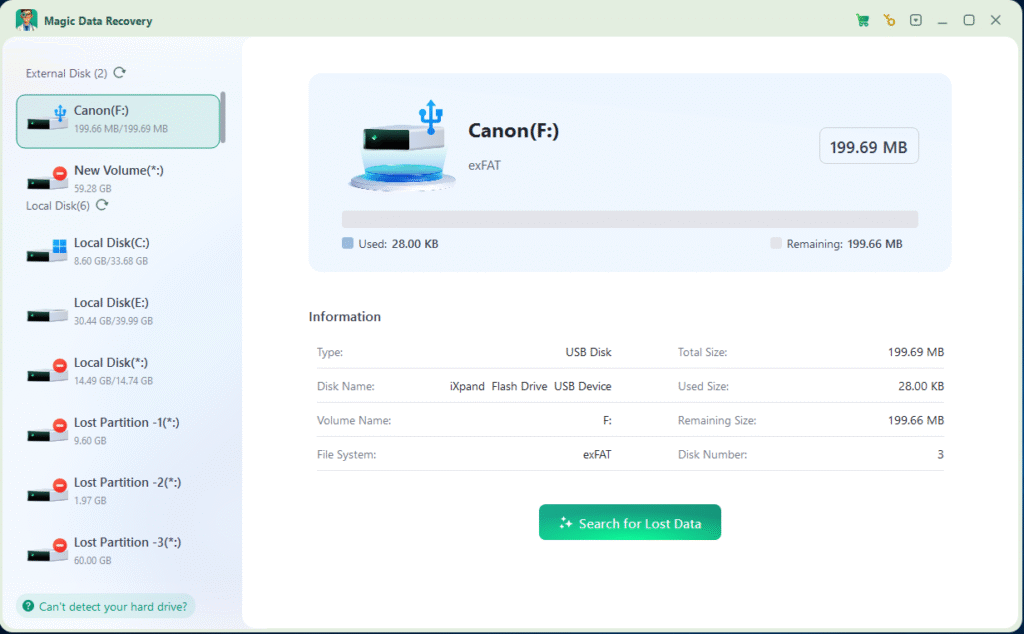
Step 4: Search for Lost Data
Click Search for Lost Data to begin scanning. The software searches for deleted file records and recognizable file signatures. A deeper scan is particularly useful when the card has been formatted, become RAW, or lost its original file system information.
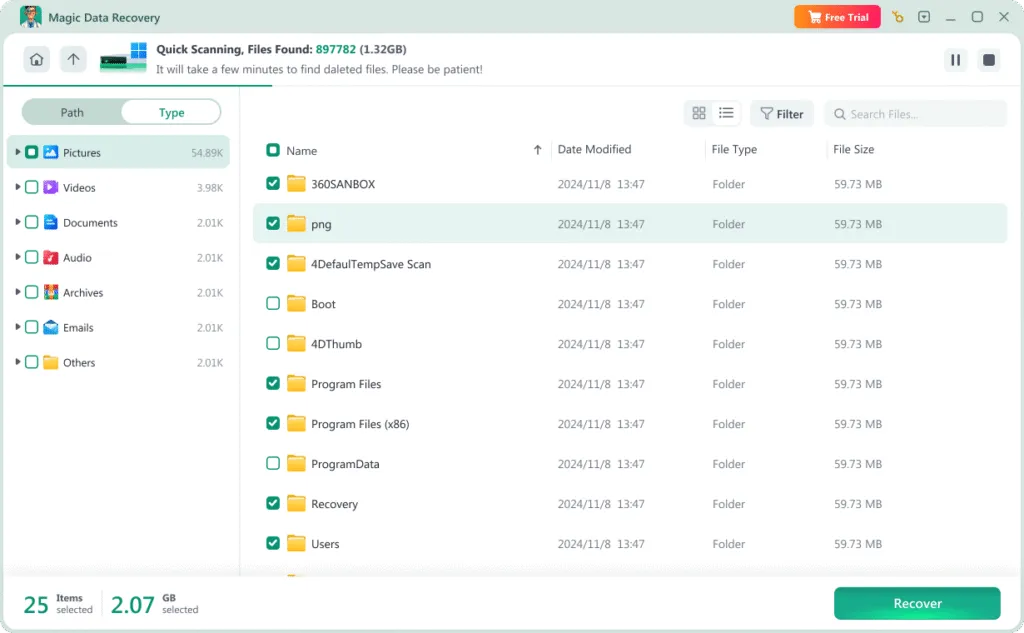
Step 5: Filter and Preview Recoverable Files
Use the file type, name, size, and date filters to narrow the results. Preview important photos, documents, and supported videos to confirm that they are readable before recovery.
For camera SD cards, check common image and video formats as well as RAW formats such as CR2, CR3, NEF, ARW, RAF, and DNG.

Etapa 6: Recuperar arquivos em outra unidade
Select the files you need and click Recover. Save them to the computer’s internal drive, another external drive, or a different healthy storage device.
Never save recovered files back to the affected SD card. Writing new files to the source card may overwrite other lost data that has not yet been recovered.

♦ Você também pode assistir ao vídeo no YouTube para conhecer as etapas
SD Card Data Recovery for Different Data-Loss Scenarios
Recover Deleted Files from an SD Card
Files deleted directly from an SD card usually do not enter the Windows Recycle Bin. The file system removes the reference to the file and marks its storage space as available, but the underlying content may remain until it is overwritten.
Stop using the card as soon as you notice the deletion. Do not take new photos, record videos, or copy files to the card before scanning it.
Recover Data from a Formatted SD Card
Recovery is often possible after a quick format because the operation normally rebuilds the file system without immediately overwriting every storage sector. A full format, secure erase, or continued use of the card significantly reduces the recovery chance.
Do not repeatedly format the card. Connect it to Windows, run a deep scan, preview the results, and save recoverable files to another drive.
Recover Data from a RAW or Corrupted SD Card
A RAW status means that Windows cannot recognize the SD card’s file system. The card may appear in Disk Management while remaining inaccessible in File Explorer.
Recover important files before using CHKDSK, formatting, or other repair tools. These utilities modify file system structures and may remove damaged entries that recovery software could otherwise analyze.
Recover Data When the SD Card Is Not Showing Up
Try another USB port, card reader, and Windows computer. Then open Disk Management and check whether the card appears with the correct capacity.
If the card appears in Disk Management, recovery software may still be able to scan it. If it is absent from every device, shows 0 bytes, becomes unusually hot, or repeatedly disconnects, stop using it and consult a professional recovery service.
Recover Hidden Files from an SD Card
If files disappeared but the card still shows the same amount of used storage space, the files may be hidden rather than deleted. Enable Hidden items in Windows File Explorer and run a trusted antivirus scan.
If the files remain unavailable after hidden items are displayed, use recovery software to search for deleted or damaged file records.
Conclusão
Successful SD card data recovery depends less on repeatedly trying different repair commands and more on protecting the card from further writes. Stop using it, determine whether the problem is logical or physical, and recover important files before formatting or repairing the file system.
For deleted, quick-formatted, RAW, or logically corrupted cards that are still detected by Windows, Magic Data Recovery can scan the card, preview found files, and restore more than 5,000 supported file types to another safe location.
You can also visit our Soluções de recuperação de cartão SD hub for formatted-card recovery, RAW SD card repair, photo recovery, brand-specific instructions, and additional troubleshooting guides.
Compatível com Windows 7/8/10/11 e Windows Server
Perguntas frequentes
Can SD card data recovery recover permanently deleted files?
Posso recuperar dados de um cartão SD formatado?
Should I run CHKDSK before SD card data recovery?
Can I recover data if my SD card is not detected?
É possível recuperar fotos e vídeos do cartão SD de uma câmera?
Does Magic Data Recovery work with microSD, SDHC, and SDXC cards?
Onde devo salvar os arquivos recuperados do cartão SD?
Quando devo recorrer a um serviço profissional de recuperação de cartões SD?

Erin Smith é reconhecida como uma das redatoras mais profissionais do Amagicsoft. Ela aprimorou continuamente suas habilidades de redação nos últimos 10 anos e ajudou milhões de leitores a resolver seus problemas de tecnologia.