AI 資料復原:運作原理與可復原的資料類型

AI is increasingly appearing in data recovery software, but the term “AI data recovery” is often used loosely. Some tools apply machine learning to file recognition, media repair, or fragmented-file analysis, while many recovery programs still rely primarily on file-system records, file signatures, and sector-level scanning.
This guide explains how AI may assist data recovery, what it can realistically recover, and where its limitations begin. It also introduces a practical Windows recovery solution for retrieving files lost through deletion, formatting, partition problems, and file-system errors. For a broader overview of recovery scenarios and methods, visit our data recovery guide.
目錄
什麼是 AI 資料復原?
AI 資料復原 refers to the use of machine learning or related intelligent systems within part of the recovery workflow. Depending on the software, AI may assist with:
- Recognizing the likely data-loss scenario.
- Prioritizing storage areas during a scan.
- Classifying recovered files.
- Identifying fragments that resemble known file structures.
- Repairing certain corrupted photos, videos, or documents.
- Recommending the most appropriate scan mode.
Traditional data recovery software is not necessarily “blind” or unsophisticated. Established recovery engines analyze file system metadata, directory records, partition structures, file signatures, and raw storage sectors. These techniques can recover deleted files effectively without using machine learning.
The presence of AI therefore does not automatically make one tool more effective. Recovery still depends primarily on whether the original file data remains intact.
How AI May Assist Data Recovery
Depending on how a recovery program is designed, AI may assist with file classification, damaged-media analysis, pattern recognition, or the reconstruction of certain fragmented files. However, these functions vary considerably between products.
AI does not replace the basic recovery process. Most data recovery software still searches file-system records, scans storage sectors, and identifies files through recognizable signatures. AI may improve certain stages of analysis, but it cannot guarantee that lost files will be recoverable.
AI 工具可解決的常見資料遺失情境
大多數使用者都會因日常錯誤或意外的系統問題而導致資料遺失。. AI 驅動的資料復原工具 就是為了處理這些情況而設計的。.
意外刪除檔案
意外刪除重要文件或相片是最常見的問題之一。.
即使檔案從回收站消失,底層資料仍可能存在於磁碟上。. AI 驅動的資料復原 演算法可以在這些片段被覆寫之前將其識別出來。.
格式化的硬碟機
A quick format usually recreates file system structures without immediately overwriting every data block, so some files may remain recoverable. A full format, secure erase, extensive reuse, or SSD TRIM can substantially reduce or eliminate recovery possibilities. Stop using the formatted device before scanning it.
進階 AI 資料復原工具 分析磁區層級資訊,並重建檔案,即使目錄結構已被移除。.
檔案系統錯誤
電源故障、不安全的裝置移除或磁碟損毀都可能損壞檔案系統,例如
在這些情況下、, AI 驅動的資料復原 可分析剩餘的資料區塊,並重建遺失的檔案。.
病毒或惡意軟體攻擊
Malware may hide, delete, corrupt, or encrypt files. Recovery software may locate deleted originals or surviving file copies, but it cannot normally decrypt ransomware-protected data without the correct key. Remove the malware first and scan a disk image or safely isolated drive whenever possible.
AI 驅動的復原工具可偵測異常檔案結構,並找出可復原的資料片段。.
AI 資料復原工具如何運作
瞭解如何 AI 資料復原工具 操作可以幫助使用者選擇正確的解決方案。.
大多數 AI 驅動的工具都遵循多階段流程。.
智慧型磁碟分析
該工具會掃描儲存裝置,並收集結構資訊,例如
- 檔案系統元資料
- 區域佈局
- 資料分佈模式
AI 模型會分析這些結構。.
模式識別
而不是僅依賴固定的檔案簽章、, AI 驅動的資料復原 系統偵測與已知檔案結構相似的模式。.
這可讓軟體復原標準工具可能遺漏的檔案。.
碎片重建
許多刪除的檔案會變得支離破碎。.
Some recovery tools attempt to identify and reassemble file fragments using file system records, known format structures, or specialized reconstruction algorithms. Machine learning may assist with selected formats, but it cannot reconstruct unique file content that has already been overwritten.
檔案完整性驗證
最後,系統會驗證已復原的檔案,以確保檔案可用且未損毀。.
How to Choose an AI Data Recovery Tool
Do not choose recovery software based only on the word “AI.” Compare the features that directly affect your recovery case:
- Data-loss scenario: Accidental deletion, formatting, partition loss, file corruption, and physical damage require different solutions.
- 支援的檔案系統: Check for NTFS, FAT32, exFAT, ReFS, APFS, HFS+, or Linux EXT support as required.
- Supported devices: Confirm compatibility with HDDs, SSDs, SD cards, USB drives, external disks, RAID, or NAS.
- Preview capability: A usable preview is stronger evidence of recoverability than a file name alone.
- 唯讀掃描: The tool should not intentionally write recovered data to the source drive.
- Free-version limits: “Free download” may mean free scanning rather than free recovery.
- 身體狀況: Do not run DIY software on a clicking, water-damaged, or repeatedly disconnecting drive.
Magic Data Recovery: An Advanced Windows Recovery Alternative
當討論 AI 驅動的資料復原工具, 因此,重要的是要專注於使用 AI 演算法設計的解決方案,而不是簡單地增加基本掃描功能。.
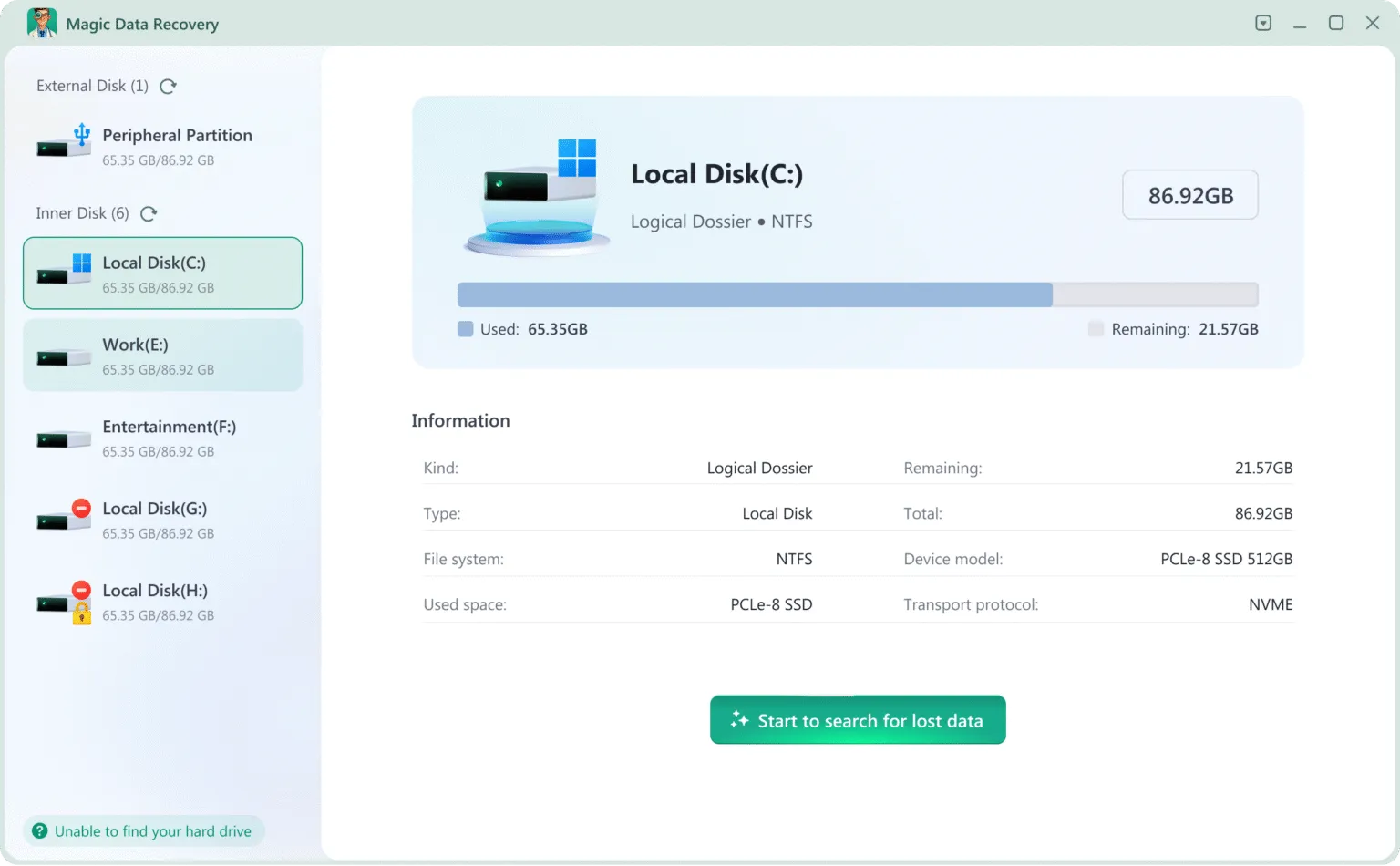
Magic Data Recovery is a Windows data recovery tool designed for logical data-loss scenarios such as accidental deletion, quick formatting, RAW file systems, damaged partitions, and lost partitions. It combines file system analysis, quick scanning, deep sector scanning, and file-signature detection to locate recoverable data.
The software supports more than 5,000 file types and works with internal drives, external hard drives, USB devices, memory cards, and other storage media recognized by Windows. It can also scan EXT2, EXT3, and EXT4 storage devices when they are connected to a Windows computer.
Magic Data Recovery should only be described as AI-powered if the product team can document the specific machine-learning component, the tasks it performs, and how it differs from conventional scanning.

Magic Data Recovery 可解決的核心問題
使用者經常在以下情況中掙扎:
- 無法找到的已刪除檔案
- 格式化硬碟機
- 損毀的磁碟分割
- 與病毒相關的資料遺失
Magic Data Recovery targets these scenarios through file system analysis, raw sector scanning, and file-signature recognition. Actual results depend on the condition of the storage device and whether the original data has been overwritten.
支援 Windows 7/8/10/11 和 Windows Server
Magic Data Recovery 的主要優勢
有幾個因素讓這款工具在眾多工具中脫穎而出 AI 驅動的資料復原工具.
Multiple Scan Methods
Magic Data Recovery analyzes available file system records and performs deeper sector-level searches when directory information is missing or damaged. This makes it suitable for both recently deleted files and more complex logical data-loss scenarios.
支援多種資料遺失情況
Magic Data Recovery 支持從以下情況中恢復:
- 意外刪除
- 格式化的硬碟機
- 檔案系統損毀
- 病毒損害
- 分區損失
友善的使用者介面
雖然背後的技術 AI 驅動的資料復原 複雜,該工具將過程簡化成幾個步驟:
- 選擇磁碟機
- 掃描磁碟
- 預覽可復原的檔案
- 還原選取的檔案
此工作流程讓非技術使用者也能使用此工具。.
Broad Device and File-Type Support
Magic Data Recovery supports internal HDDs and SSDs, external hard drives, USB drives, memory cards, and other devices detected by Windows. It can search for more than 5,000 file types, including documents, photos, videos, audio files, archives, emails, and camera RAW formats.
How to Recover Data Without Making the Loss Worse
Regardless of whether a recovery tool uses AI, the following safety rules have a greater impact on recovery success:
- 立即停止使用受影響的裝置。.
- Do not install recovery software on the source drive.
- Do not format, initialize, defragment, or run CHKDSK.
- Scan the correct physical disk or partition.
- Preview important files before recovery when possible.
- 將已復原的檔案儲存至不同的健康磁碟機。.
- Contact a professional service if the device shows signs of physical failure.
AI-Assisted vs. Traditional Data Recovery: Which Is Better?
AI-assisted recovery is not automatically better than traditional recovery. File system metadata analysis is often the most effective method for recently deleted files because it may preserve original file names, paths, dates, and folder structures. Signature-based deep scanning is useful when metadata has been lost, while AI may assist with scan prioritization, classification, or selected reconstruction tasks.
The best recovery tools combine several techniques rather than relying on AI alone. Users should evaluate actual preview results, supported file systems, scan safety, device compatibility, and recovery limits instead of choosing software based only on an AI label.
何時應該使用 AI 資料復原工具?
最好使用 AI 資料復原工具 發生資料遺失後,請立即.
避免將新資料寫入受影響的硬碟機,因為覆寫可能會降低復原成功率。.
AI 復原工具有幫助的常見情況包括
- 復原已刪除的相片或文件
- 還原格式化的外接式硬碟機
- 從損毀的磁碟分割擷取資料
- 修復與病毒相關的資料遺失
如果您面臨這些問題,人工智能驅動的解決方案,例如 Magic Data Recovery 可提供更有效率的復原程序。.
總結
AI may assist with file recognition, media analysis, and certain reconstruction tasks, but it does not remove the fundamental limitations of data recovery. Overwritten data, completed secure erasure, missing encryption keys, and physically damaged devices cannot be reliably restored simply by using AI.
For common Windows data-loss situations such as accidental deletion, quick formatting, inaccessible partitions, and file-system errors, a recovery program with quick scanning, deep sector scanning, and file preview is often the more practical choice. Magic Data Recovery provides these capabilities across internal drives, external drives, USB devices, and memory cards.
You can also explore our complete data recovery guide for additional recovery methods and storage-device-specific instructions.
支援 Windows 7/8/10/11 和 Windows Server
FAQs About AI Data Recovery Tools
Is AI data recovery better than traditional data recovery?
Can AI recover overwritten files?
Can AI recover data from a formatted drive?
Can AI data recovery recover ransomware-encrypted files?
Is AI data recovery safe?
Does Magic Data Recovery use AI?
Can AI recover data from an SSD after TRIM?
What should I look for in an AI data recovery tool?
Jason 在電腦資料安全產業擁有超過 15 年的實務經驗。他專精於資料復原、備份與還原,以及檔案修復技術,已協助全球數百萬使用者解決複雜的資料遺失與安全問題。.