
Datenwiederherstellung mit KI: So funktioniert es und welche Daten lassen sich wiederherstellen

AI is increasingly appearing in data recovery software, but the term “AI data recovery” is often used loosely. Some tools apply machine learning to file recognition, media repair, or fragmented-file analysis, while many recovery programs still rely primarily on file-system records, file signatures, and sector-level scanning.
This guide explains how AI may assist data recovery, what it can realistically recover, and where its limitations begin. It also introduces a practical Windows recovery solution for retrieving files lost through deletion, formatting, partition problems, and file-system errors. For a broader overview of recovery scenarios and methods, visit our data recovery guide.
Inhaltsübersicht
Was ist AI Datenrettung?
AI-Datenwiederherstellung refers to the use of machine learning or related intelligent systems within part of the recovery workflow. Depending on the software, AI may assist with:
- Recognizing the likely data-loss scenario.
- Prioritizing storage areas during a scan.
- Classifying recovered files.
- Identifying fragments that resemble known file structures.
- Repairing certain corrupted photos, videos, or documents.
- Recommending the most appropriate scan mode.
Traditional data recovery software is not necessarily “blind” or unsophisticated. Established recovery engines analyze file system metadata, directory records, partition structures, file signatures, and raw storage sectors. These techniques can recover deleted files effectively without using machine learning.
The presence of AI therefore does not automatically make one tool more effective. Recovery still depends primarily on whether the original file data remains intact.
How AI May Assist Data Recovery
Depending on how a recovery program is designed, AI may assist with file classification, damaged-media analysis, pattern recognition, or the reconstruction of certain fragmented files. However, these functions vary considerably between products.
AI does not replace the basic recovery process. Most data recovery software still searches file-system records, scans storage sectors, and identifies files through recognizable signatures. AI may improve certain stages of analysis, but it cannot guarantee that lost files will be recoverable.
Häufige Szenarien für Datenverluste, die KI-Tools lösen können
Die meisten Benutzer erleiden Datenverluste aufgrund von alltäglichen Fehlern oder unerwarteten Systemproblemen. KI-gestützte Datenwiederherstellungstools sind darauf ausgerichtet, diese Situationen zu bewältigen.
Versehentliches Löschen von Dateien
Das versehentliche Löschen von wichtigen Dokumenten oder Fotos ist eines der häufigsten Probleme.
Auch wenn Dateien aus dem Papierkorb verschwinden, können die zugrunde liegenden Daten noch auf der Festplatte vorhanden sein. KI-unterstützte Datenwiederherstellung Algorithmen können diese Fragmente identifizieren, bevor sie überschrieben werden.
Formatierte Laufwerke
A quick format usually recreates file system structures without immediately overwriting every data block, so some files may remain recoverable. A full format, secure erase, extensive reuse, or SSD TRIM can substantially reduce or eliminate recovery possibilities. Stop using the formatted device before scanning it.
Fortgeschrittene AI-Datenwiederherstellungstools Informationen auf Sektorebene zu analysieren und Dateien zu rekonstruieren, selbst wenn die Verzeichnisstruktur entfernt wurde.
Dateisystem-Fehler
Stromausfälle, unsicheres Entfernen von Geräten oder Festplattenbeschädigungen können Dateisysteme wie z. B. die folgenden beschädigen:
In diesen Fällen, KI-unterstützte Datenwiederherstellung kann die verbleibenden Datenblöcke analysieren und die verlorenen Dateien wiederherstellen.
Viren- oder Malware-Angriffe
Malware may hide, delete, corrupt, or encrypt files. Recovery software may locate deleted originals or surviving file copies, but it cannot normally decrypt ransomware-protected data without the correct key. Remove the malware first and scan a disk image or safely isolated drive whenever possible.
KI-gesteuerte Wiederherstellungstools können abnormale Dateistrukturen erkennen und wiederherstellbare Datenfragmente lokalisieren.
Wie AI-Datenrettungstools funktionieren
Verstehen, wie AI-Datenwiederherstellungstools operate kann den Nutzern bei der Auswahl der richtigen Lösung helfen.
Die meisten KI-gestützten Tools durchlaufen einen mehrstufigen Prozess.
Intelligente Festplattenanalyse
Das Tool scannt das Speichergerät und sammelt strukturelle Informationen wie z. B.:
- Dateisystem-Metadaten
- Sektorlayout
- Datenverteilungsmuster
KI-Modelle analysieren dann diese Strukturen.
Erkennung von Mustern
Anstatt sich nur auf feste Dateisignaturen zu verlassen, KI-unterstützte Datenwiederherstellung Systeme erkennen Muster, die bekannten Dateistrukturen ähneln.
Auf diese Weise kann die Software Dateien wiederherstellen, die von Standardprogrammen möglicherweise übersehen werden.
Fragment-Rekonstruktion
Viele gelöschte Dateien werden fragmentiert.
Some recovery tools attempt to identify and reassemble file fragments using file system records, known format structures, or specialized reconstruction algorithms. Machine learning may assist with selected formats, but it cannot reconstruct unique file content that has already been overwritten.
Validierung der Dateiintegrität
Schließlich überprüft das System die wiederhergestellten Dateien, um sicherzustellen, dass sie brauchbar und nicht beschädigt sind.
How to Choose an AI Data Recovery Tool
Do not choose recovery software based only on the word “AI.” Compare the features that directly affect your recovery case:
- Data-loss scenario: Accidental deletion, formatting, partition loss, file corruption, and physical damage require different solutions.
- Unterstützte Dateisysteme: Check for NTFS, FAT32, exFAT, ReFS, APFS, HFS+, or Linux EXT support as required.
- Supported devices: Confirm compatibility with HDDs, SSDs, SD cards, USB drives, external disks, RAID, or NAS.
- Preview capability: A usable preview is stronger evidence of recoverability than a file name alone.
- Nur-Lese-Scannen: The tool should not intentionally write recovered data to the source drive.
- Free-version limits: “Free download” may mean free scanning rather than free recovery.
- Körperliche Verfassung: Do not run DIY software on a clicking, water-damaged, or repeatedly disconnecting drive.
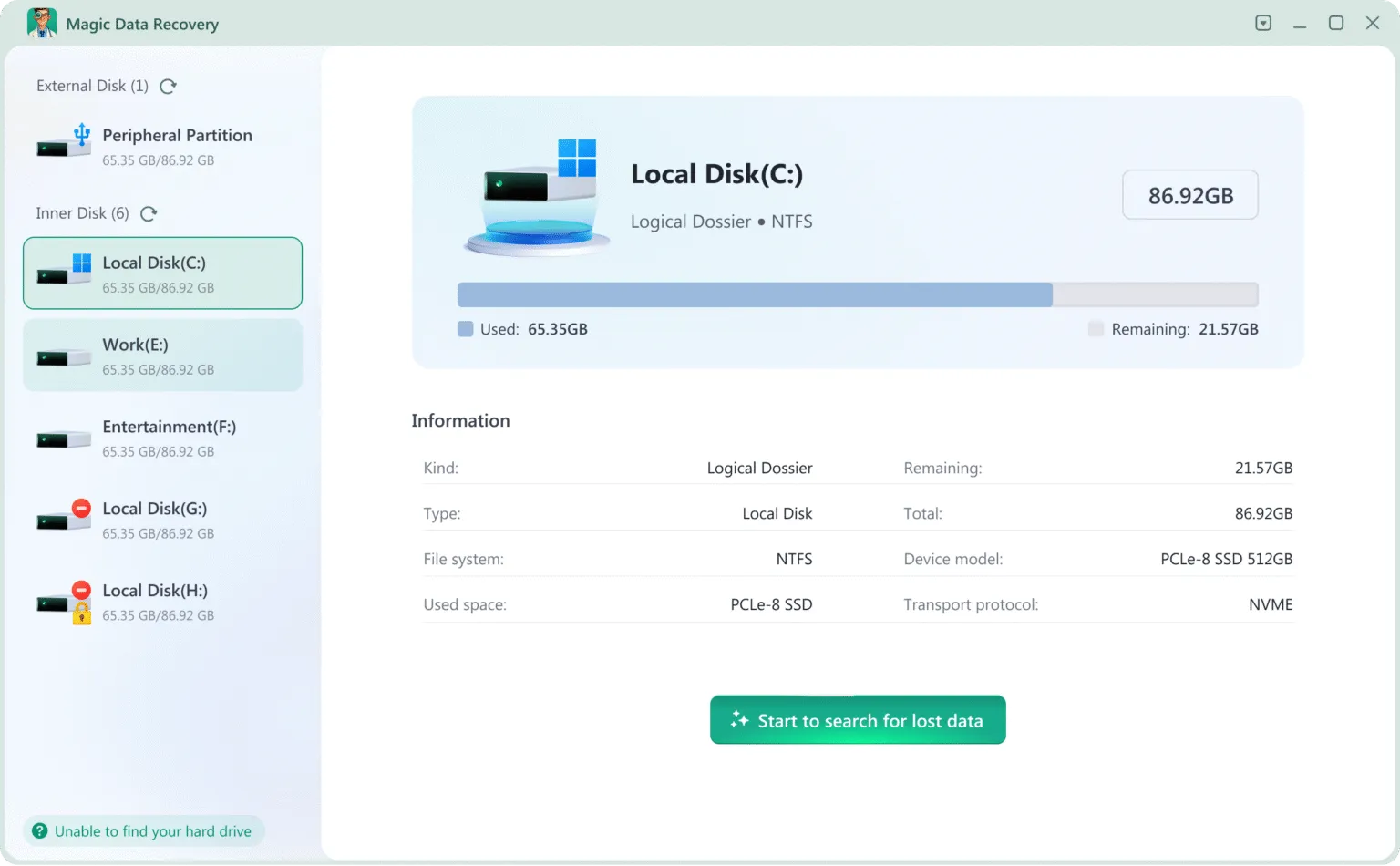
Magic Data Recovery: An Advanced Windows Recovery Alternative
Bei der Diskussion über KI-gestützte Datenwiederherstellungstools, ist es wichtig, sich auf Lösungen zu konzentrieren, die speziell mit KI-Algorithmen entwickelt wurden, anstatt einfach nur grundlegende Scanfunktionen hinzuzufügen.
Magic Data Recovery is a Windows data recovery tool designed for logical data-loss scenarios such as accidental deletion, quick formatting, RAW file systems, damaged partitions, and lost partitions. It combines file system analysis, quick scanning, deep sector scanning, and file-signature detection to locate recoverable data.
The software supports more than 5,000 file types and works with internal drives, external hard drives, USB devices, memory cards, and other storage media recognized by Windows. It can also scan EXT2, EXT3, and EXT4 storage devices when they are connected to a Windows computer.
Magic Data Recovery should only be described as AI-powered if the product team can document the specific machine-learning component, the tasks it performs, and how it differs from conventional scanning.
Kernprobleme, die Magic Data Recovery löst
Die Nutzer haben oft mit Situationen wie der folgenden zu kämpfen:
- gelöschte Dateien, die nicht gefunden werden können
- formatierte Festplatten
- beschädigte Partitionen
- virusbedingter Datenverlust
Magic Data Recovery targets these scenarios through file system analysis, raw sector scanning, and file-signature recognition. Actual results depend on the condition of the storage device and whether the original data has been overwritten.
Unterstützt Windows 7/8/10/11 und Windows Server
Die wichtigsten Vorteile von Magic Data Recovery
Mehrere Faktoren heben dieses Tool von anderen ab KI-gestützte Datenwiederherstellungstools.
Multiple Scan Methods
Magic Data Recovery analyzes available file system records and performs deeper sector-level searches when directory information is missing or damaged. This makes it suitable for both recently deleted files and more complex logical data-loss scenarios.
Unterstützt mehrere Datenverlust-Szenarien
Magic Data Recovery unterstützt die Erholung von:
- versehentliches Löschen
- formatierte Laufwerke
- Beschädigung des Dateisystems
- Virenschaden
- Trennungsverlust
Benutzerfreundliche Oberfläche
Obwohl die Technologie hinter KI-unterstützte Datenwiederherstellung komplex ist, vereinfacht das Tool den Prozess in wenigen Schritten:
- Wählen Sie das Laufwerk
- Scannen der Festplatte
- Vorschau wiederherstellbarer Dateien
- Ausgewählte Dateien wiederherstellen
Dieser Arbeitsablauf macht das Tool auch für technisch nicht versierte Benutzer zugänglich.
Broad Device and File-Type Support
Magic Data Recovery supports internal HDDs and SSDs, external hard drives, USB drives, memory cards, and other devices detected by Windows. It can search for more than 5,000 file types, including documents, photos, videos, audio files, archives, emails, and camera RAW formats.
How to Recover Data Without Making the Loss Worse
Regardless of whether a recovery tool uses AI, the following safety rules have a greater impact on recovery success:
- Stellen Sie die Verwendung des betroffenen Geräts sofort ein.
- Do not install recovery software on the source drive.
- Do not format, initialize, defragment, or run CHKDSK.
- Scan the correct physical disk or partition.
- Preview important files before recovery when possible.
- Speichern Sie wiederhergestellte Dateien auf einem anderen gesunden Laufwerk.
- Contact a professional service if the device shows signs of physical failure.
AI-Assisted vs. Traditional Data Recovery: Which Is Better?
AI-assisted recovery is not automatically better than traditional recovery. File system metadata analysis is often the most effective method for recently deleted files because it may preserve original file names, paths, dates, and folder structures. Signature-based deep scanning is useful when metadata has been lost, while AI may assist with scan prioritization, classification, or selected reconstruction tasks.
The best recovery tools combine several techniques rather than relying on AI alone. Users should evaluate actual preview results, supported file systems, scan safety, device compatibility, and recovery limits instead of choosing software based only on an AI label.
Wann sollten Sie AI-Datenrettungstools verwenden?
Am besten ist es, Folgendes zu verwenden AI-Datenwiederherstellungstools unmittelbar nach dem Auftreten eines Datenverlustes.
Vermeiden Sie es, neue Daten auf das betroffene Laufwerk zu schreiben, da das Überschreiben den Erfolg der Wiederherstellung verringern kann.
Häufige Situationen, in denen AI-Wiederherstellungstools hilfreich sind, sind folgende:
- Wiederherstellung gelöschter Fotos oder Dokumente
- Wiederherstellung formatierter externer Laufwerke
- Wiederherstellung von Daten aus beschädigten Partitionen
- Behebung von virusbedingtem Datenverlust
Wenn Sie mit diesen Problemen konfrontiert sind, ist eine KI-gestützte Lösung wie Magic Data Recovery kann einen effizienteren Wiederherstellungsprozess ermöglichen.
Schlussfolgerung
AI may assist with file recognition, media analysis, and certain reconstruction tasks, but it does not remove the fundamental limitations of data recovery. Overwritten data, completed secure erasure, missing encryption keys, and physically damaged devices cannot be reliably restored simply by using AI.
For common Windows data-loss situations such as accidental deletion, quick formatting, inaccessible partitions, and file-system errors, a recovery program with quick scanning, deep sector scanning, and file preview is often the more practical choice. Magic Data Recovery provides these capabilities across internal drives, external drives, USB devices, and memory cards.
You can also explore our complete data recovery guide for additional recovery methods and storage-device-specific instructions.
Unterstützt Windows 7/8/10/11 und Windows Server
FAQs About AI Data Recovery Tools
Is AI data recovery better than traditional data recovery?
Can AI recover overwritten files?
Can AI recover data from a formatted drive?
Can AI data recovery recover ransomware-encrypted files?
Is AI data recovery safe?
Does Magic Data Recovery use AI?
Can AI recover data from an SSD after TRIM?
What should I look for in an AI data recovery tool?

Jason ist ein Spezialist für Datenwiederherstellung und technischen Support mit über 15 Jahren praktischer Erfahrung. Er hat intensiv mit Endnutzern zusammengearbeitet, schwierige Fälle von Datenverlust behoben und praktische Lösungen für versehentlich gelöschte Daten, formatierte Laufwerke, beschädigte Dateisysteme, verlorene Partitionen, Systemausfälle und andere Notfälle im Bereich der Datenwiederherstellung bereitgestellt. Zu seinen Fachgebieten gehören außerdem Datensicherung und -wiederherstellung, Dateireparatur sowie Notfallwiederherstellung, wobei er besonderen Wert auf eine sichere, zuverlässige und technisch korrekte Beratung legt.