
AI Data Recovery: How It Works and What It Can Recover

AI is increasingly appearing in data recovery software, but the term “AI data recovery” is often used loosely. Some tools apply machine learning to file recognition, media repair, or fragmented-file analysis, while many recovery programs still rely primarily on file-system records, file signatures, and sector-level scanning.
This guide explains how AI may assist data recovery, what it can realistically recover, and where its limitations begin. It also introduces a practical Windows recovery solution for retrieving files lost through deletion, formatting, partition problems, and file-system errors. For a broader overview of recovery scenarios and methods, visit our data recovery guide.
Table of Contents
What Is AI Data Recovery?
AI data recovery refers to the use of machine learning or related intelligent systems within part of the recovery workflow. Depending on the software, AI may assist with:
- Recognizing the likely data-loss scenario.
- Prioritizing storage areas during a scan.
- Classifying recovered files.
- Identifying fragments that resemble known file structures.
- Repairing certain corrupted photos, videos, or documents.
- Recommending the most appropriate scan mode.
Traditional data recovery software is not necessarily “blind” or unsophisticated. Established recovery engines analyze file system metadata, directory records, partition structures, file signatures, and raw storage sectors. These techniques can recover deleted files effectively without using machine learning.
The presence of AI therefore does not automatically make one tool more effective. Recovery still depends primarily on whether the original file data remains intact.
How AI May Assist Data Recovery
Depending on how a recovery program is designed, AI may assist with file classification, damaged-media analysis, pattern recognition, or the reconstruction of certain fragmented files. However, these functions vary considerably between products.
AI does not replace the basic recovery process. Most data recovery software still searches file-system records, scans storage sectors, and identifies files through recognizable signatures. AI may improve certain stages of analysis, but it cannot guarantee that lost files will be recoverable.
Common Data Loss Scenarios AI Tools Can Solve
Most users experience data loss due to everyday mistakes or unexpected system issues. AI-powered data recovery tools are designed to address these situations.
Accidental File Deletion
Accidentally deleting important documents or photos is one of the most common problems.
Even after files disappear from the recycle bin, the underlying data may still exist on the disk. AI-powered data recovery algorithms can identify those fragments before they are overwritten.
Formatted Drives
A quick format usually recreates file system structures without immediately overwriting every data block, so some files may remain recoverable. A full format, secure erase, extensive reuse, or SSD TRIM can substantially reduce or eliminate recovery possibilities. Stop using the formatted device before scanning it.
Advanced AI data recovery tools analyze sector-level information and reconstruct files even when the directory structure has been removed.
File System Errors
Power failures, unsafe device removal, or disk corruption can damage file systems such as:
In these cases, AI-powered data recovery can analyze remaining data blocks and rebuild lost files.
Virus or Malware Attacks
Malware may hide, delete, corrupt, or encrypt files. Recovery software may locate deleted originals or surviving file copies, but it cannot normally decrypt ransomware-protected data without the correct key. Remove the malware first and scan a disk image or safely isolated drive whenever possible.
AI-driven recovery tools can detect abnormal file structures and locate recoverable data fragments.
How AI Data Recovery Tools Work
Understanding how AI data recovery tools operate can help users choose the right solution.
Most AI-powered tools follow a multi-stage process.
Intelligent Disk Analysis
The tool scans the storage device and collects structural information such as:
- file system metadata
- sector layout
- data distribution patterns
AI models then analyze these structures.
Pattern Recognition
Instead of relying only on fixed file signatures, AI-powered data recovery systems detect patterns that resemble known file structures.
This allows the software to recover files that standard tools might miss.
Fragment Reconstruction
Many deleted files become fragmented.
Some recovery tools attempt to identify and reassemble file fragments using file system records, known format structures, or specialized reconstruction algorithms. Machine learning may assist with selected formats, but it cannot reconstruct unique file content that has already been overwritten.
File Integrity Validation
Finally, the system validates recovered files to ensure they are usable and not corrupted.
How to Choose an AI Data Recovery Tool
Do not choose recovery software based only on the word “AI.” Compare the features that directly affect your recovery case:
- Data-loss scenario: Accidental deletion, formatting, partition loss, file corruption, and physical damage require different solutions.
- Supported file systems: Check for NTFS, FAT32, exFAT, ReFS, APFS, HFS+, or Linux EXT support as required.
- Supported devices: Confirm compatibility with HDDs, SSDs, SD cards, USB drives, external disks, RAID, or NAS.
- Preview capability: A usable preview is stronger evidence of recoverability than a file name alone.
- Read-only scanning: The tool should not intentionally write recovered data to the source drive.
- Free-version limits: “Free download” may mean free scanning rather than free recovery.
- Physical condition: Do not run DIY software on a clicking, water-damaged, or repeatedly disconnecting drive.
Magic Data Recovery: An Advanced Windows Recovery Alternative
When discussing AI-powered data recovery tools, it is important to focus on solutions designed specifically with AI algorithms rather than simply adding basic scanning features.
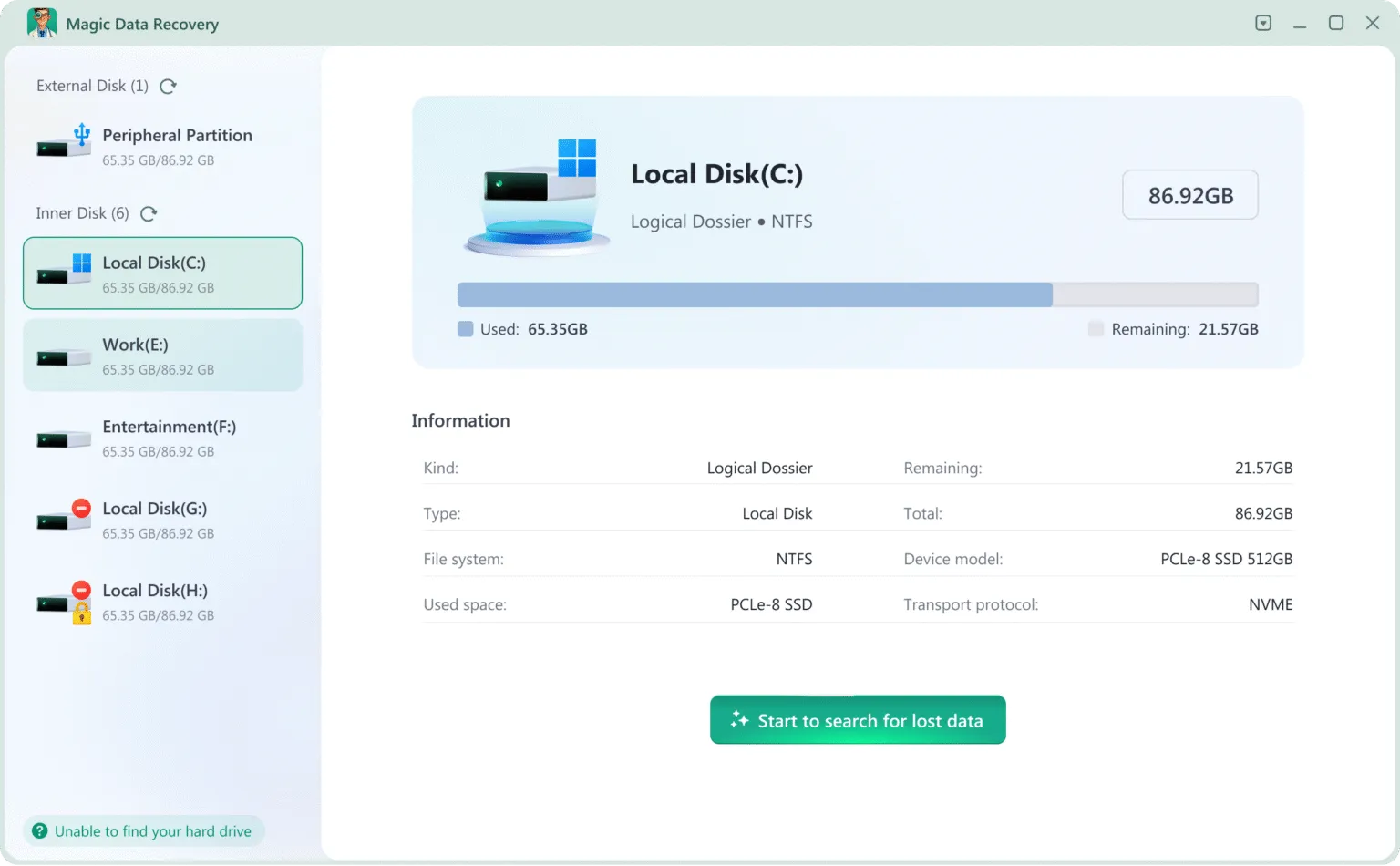
Magic Data Recovery is a Windows data recovery tool designed for logical data-loss scenarios such as accidental deletion, quick formatting, RAW file systems, damaged partitions, and lost partitions. It combines file system analysis, quick scanning, deep sector scanning, and file-signature detection to locate recoverable data.
The software supports more than 5,000 file types and works with internal drives, external hard drives, USB devices, memory cards, and other storage media recognized by Windows. It can also scan EXT2, EXT3, and EXT4 storage devices when they are connected to a Windows computer.
Magic Data Recovery should only be described as AI-powered if the product team can document the specific machine-learning component, the tasks it performs, and how it differs from conventional scanning.
Core Problems Magic Data Recovery Solves
Users often struggle with situations such as:
- deleted files that cannot be found
- formatted hard drives
- corrupted partitions
- virus-related data loss
Magic Data Recovery targets these scenarios through file system analysis, raw sector scanning, and file-signature recognition. Actual results depend on the condition of the storage device and whether the original data has been overwritten.
Supports Windows 7/8/10/11 and Windows Server
Key Advantages of Magic Data Recovery
Several factors make this tool stand out among AI-powered data recovery tools.
Multiple Scan Methods
Magic Data Recovery analyzes available file system records and performs deeper sector-level searches when directory information is missing or damaged. This makes it suitable for both recently deleted files and more complex logical data-loss scenarios.
Supports Multiple Data Loss Scenarios
Magic Data Recovery supports recovery from:
- accidental deletion
- formatted drives
- file system corruption
- virus damage
- partition loss
User-Friendly Interface
Although the technology behind AI-powered data recovery is complex, the tool simplifies the process into a few steps:
- Select the drive
- Scan the disk
- Preview recoverable files
- Restore selected files
This workflow makes the tool accessible even for non-technical users.
Broad Device and File-Type Support
Magic Data Recovery supports internal HDDs and SSDs, external hard drives, USB drives, memory cards, and other devices detected by Windows. It can search for more than 5,000 file types, including documents, photos, videos, audio files, archives, emails, and camera RAW formats.
How to Recover Data Without Making the Loss Worse
Regardless of whether a recovery tool uses AI, the following safety rules have a greater impact on recovery success:
- Stop using the affected device immediately.
- Do not install recovery software on the source drive.
- Do not format, initialize, defragment, or run CHKDSK.
- Scan the correct physical disk or partition.
- Preview important files before recovery when possible.
- Save recovered files to a different healthy drive.
- Contact a professional service if the device shows signs of physical failure.
AI-Assisted vs. Traditional Data Recovery: Which Is Better?
AI-assisted recovery is not automatically better than traditional recovery. File system metadata analysis is often the most effective method for recently deleted files because it may preserve original file names, paths, dates, and folder structures. Signature-based deep scanning is useful when metadata has been lost, while AI may assist with scan prioritization, classification, or selected reconstruction tasks.
The best recovery tools combine several techniques rather than relying on AI alone. Users should evaluate actual preview results, supported file systems, scan safety, device compatibility, and recovery limits instead of choosing software based only on an AI label.
When Should You Use AI Data Recovery Tools?
It is best to use AI data recovery tools immediately after data loss occurs.
Avoid writing new data to the affected drive, as overwriting may reduce recovery success.
Common situations where AI recovery tools are helpful include:
- recovering deleted photos or documents
- restoring formatted external drives
- retrieving data from corrupted partitions
- fixing virus-related data loss
If you are facing these problems, an AI-powered solution like Magic Data Recovery can provide a more efficient recovery process.
Conclusion
AI may assist with file recognition, media analysis, and certain reconstruction tasks, but it does not remove the fundamental limitations of data recovery. Overwritten data, completed secure erasure, missing encryption keys, and physically damaged devices cannot be reliably restored simply by using AI.
For common Windows data-loss situations such as accidental deletion, quick formatting, inaccessible partitions, and file-system errors, a recovery program with quick scanning, deep sector scanning, and file preview is often the more practical choice. Magic Data Recovery provides these capabilities across internal drives, external drives, USB devices, and memory cards.
You can also explore our complete data recovery guide for additional recovery methods and storage-device-specific instructions.
Supports Windows 7/8/10/11 and Windows Server
FAQs About AI Data Recovery Tools
Is AI data recovery better than traditional data recovery?
Can AI recover overwritten files?
Can AI recover data from a formatted drive?
Can AI data recovery recover ransomware-encrypted files?
Is AI data recovery safe?
Does Magic Data Recovery use AI?
Can AI recover data from an SSD after TRIM?
What should I look for in an AI data recovery tool?

Jason is a data recovery and technical support specialist with over 15 years of hands-on experience. He has worked extensively with frontline users, troubleshooting difficult data loss cases and providing practical recovery solutions for accidental deletion, formatted drives, damaged file systems, lost partitions, system failures, and other recovery emergencies. His expertise also includes backup and restoration, file repair, and disaster recovery, with a strong emphasis on safe, reliable, and technically accurate guidance.