
Application « Recover Files » : récupérer des fichiers supprimés
Lorsque des fichiers importants disparaissent, la première chose que recherchent de nombreux utilisateurs, c'est un application de récupération de fichiers. Peut-être avez-vous supprimé un document professionnel, vidé la corbeille, formaté une clé USB ou constaté qu’un disque externe était soudainement devenu inaccessible. Dans ces cas-là, la solution la plus sûre est de ne pas tenter de réparations au hasard. Commencez plutôt par définir clairement la marche à suivre pour la récupération et déterminez quelle méthode correspond le mieux à votre situation.
Ce guide explique comment un application de récupération de fichiers comment cela fonctionne, dans quels cas les options intégrées à Windows suffisent, dans quels cas un logiciel de récupération professionnel devient nécessaire, et pourquoi Ce guide de récupération de fichiers supprimés peut vous aider à choisir la bonne étape suivante. Vous apprendrez également comment Magic Data Recovery permet de récupérer des fichiers supprimés, formatés, manquants ou affectés par des erreurs du système de fichiers, sans nécessiter de compétences techniques avancées.
Prise en charge de Windows 7/8/10/11 et Windows Server
Table des matières
Qu'est-ce qu'une application de récupération de fichiers ?
A application de récupération de fichiers Il s'agit d'un logiciel qui analyse un périphérique de stockage à la recherche de fichiers supprimés, perdus, formatés ou inaccessibles. Lorsque vous supprimez un fichier, Windows supprime généralement d'abord l'entrée visible du fichier. Dans de nombreux cas, le contenu réel du fichier peut rester sur le disque jusqu'à ce que de nouvelles données viennent l'écraser.
C’est pourquoi le timing est crucial. Plus tôt vous cesserez d’utiliser le disque concerné, plus vous aurez de chances de retrouver des fichiers exploitables. Une bonne application de récupération de fichiers ne se contente pas simplement d“” annuler » la suppression. Elle analyse les enregistrements de fichiers, les signatures de fichiers, les structures de répertoires et les blocs de stockage afin de localiser les données qui pourraient encore exister.
A application de récupération de fichiers peut être utile dans des situations telles que :
Suppression accidentelle depuis un PC ou un ordinateur portable
Vider la corbeille trop tôt
Shift + Delete suppression permanente
Formatage rapide d'une clé USB ou d'un disque externe
Fichiers manquants suite à des erreurs du système de fichiers
Partitions au format RAW, inaccessibles ou corrompues
Perte de fichiers suite à des pannes du système ou à des dommages causés par des virus
Cependant, la récupération logicielle a ses limites. Si le disque présente des dommages physiques, émet des cliquetis, souffre d'une surchauffe importante ou a été déconnecté à plusieurs reprises, cessez de l'utiliser et envisagez de faire appel à un laboratoire professionnel de récupération de données.
Pourquoi certains fichiers peuvent encore être récupérés après leur suppression
Les fichiers supprimés restent souvent récupérables, car la plupart des systèmes de fichiers n'effacent pas immédiatement leur contenu. Ils marquent plutôt l'espace de stockage comme disponible pour de nouvelles données. Tant que de nouveaux fichiers n'ont pas écrasé cet espace, un application de récupération de fichiers pourrait encore retrouver les données d'origine.
Par exemple, si vous avez supprimé un dossier d'un disque dur externe et que vous n'avez rien copié de nouveau sur ce disque, un logiciel de récupération pourrait retrouver les fichiers manquants. En revanche, si vous avez téléchargé des fichiers volumineux, installé des logiciels ou continué à modifier des documents sur ce même disque, vous risquez de réduire vos chances de récupération.
Cette règle revêt une importance encore plus grande pour SSD. Des fonctionnalités telles que TRIM peuvent effacer les données supprimées de manière plus radicale ; ainsi, les fichiers supprimés sur les SSD peuvent devenir irrécupérables plus rapidement que ceux stockés sur des disques durs traditionnels. Il convient donc d’agir rapidement et d’éviter d’écrire de nouvelles données sur le périphérique de stockage concerné.
Que faire avant d'utiliser une application de récupération de fichiers ?
Avant d'installer ou d'exécuter un quelconque application de récupération de fichiers, procédez avec prudence. Ces mesures permettent de protéger les données d'origine et de réduire le risque d'écraser des fichiers récupérables.
Cesser d'utiliser le lecteur affecté
N'enregistrez pas de nouveaux documents, n'installez pas de programmes, ne téléchargez pas de fichiers et n'utilisez pas d'outils de nettoyage sur le disque sur lequel des données ont été perdues. Chaque nouvelle opération d'écriture risque d'écraser le contenu supprimé.
Ne reformatez pas le disque
Si Windows vous demande de formater une clé USB, une carte SD ou un disque dur externe, annulez cette opération. Le formatage peut modifier la structure du système de fichiers et compliquer la récupération des données.
Évitez d'abord les commandes de réparation
Des commandes telles que CHKDSK Ces outils peuvent corriger les erreurs du système de fichiers, mais ils peuvent également modifier la structure du disque. Si ces fichiers sont importants, commencez par les analyser et les récupérer. Réparerez ensuite le disque.
Préparer un autre périphérique de stockage
Enregistrez toujours les fichiers récupérés sur un autre disque en bon état. Ne restaurez jamais les fichiers à leur emplacement d'origine lors de la récupération.
Les meilleures solutions gratuites à essayer avant de recourir à un logiciel de récupération
Tous les cas de perte de données ne nécessitent pas forcément un logiciel de récupération dédié. Commencez par essayer les options intégrées, qui sont sûres, surtout si la suppression est récente.
Vérifier la corbeille
Si vous avez supprimé des fichiers d'un disque interne sous Windows, ouvrez d'abord la Corbeille. Sélectionnez les fichiers, cliquez dessus avec le bouton droit de la souris, puis choisissez « Restaurer ». Les fichiers seront ainsi replacés à leur emplacement d'origine.
Toutefois, cette méthode ne sera d'aucune utilité si vous avez utilisé la combinaison Maj + Suppr, vidé la corbeille, supprimé des fichiers depuis plusieurs clés USB ou perdu des fichiers à la suite d'un formatage.
Utilisez immédiatement Ctrl + Z
Si vous venez de supprimer ou de déplacer des fichiers il y a quelques secondes à peine, appuyez sur Ctrl + Z dans le même dossier. Windows pourrait alors annuler la dernière action. Cette méthode est particulièrement efficace immédiatement après une erreur, avant d'effectuer d'autres opérations sur les fichiers.
Consultez l'historique des fichiers ou la sauvegarde
Si vous avez activé l'historique des fichiers, ouvrez le dossier dans lequel se trouvait le fichier perdu. Cliquez ensuite avec le bouton droit de la souris et consultez les versions précédentes. Vous pouvez également effectuer une recherche sur votre disque de sauvegarde externe, dans votre sauvegarde sur le cloud ou dans votre sauvegarde système.
Les sauvegardes constituent la solution de récupération la plus sûre, car elles n'analysent pas les espaces de stockage endommagés ou écrasés. Pourtant, de nombreux utilisateurs ne se rendent compte qu'après la suppression qu'ils n'ont jamais activé la sauvegarde.
Rechercher dans OneDrive ou dans la corbeille du cloud
Si les fichiers manquants ont été synchronisés avec OneDrive, Google Drive, Dropbox ou un autre service de stockage en ligne, vérifiez la corbeille du service concerné ou l'historique des versions. La récupération dans le cloud fonctionne bien pour les fichiers synchronisés, mais les durées de conservation varient.
Si ces méthodes gratuites échouent, un application de récupération de fichiers devient alors la solution la plus pratique.
Récupération de fichiers Windows vs application Visual Recover Files
Microsoft propose « Windows File Recovery » sous la forme d'un outil en ligne de commande. Il permet de récupérer des fichiers sur des disques locaux, des périphériques USB et des disques externes lorsque la Corbeille ne suffit pas. Cependant, son utilisation nécessite de connaître la syntaxe des commandes, les chemins d'accès source et de destination, les modes et les options.
Pour les utilisateurs avertis, cette approche peut s'avérer efficace. Pour les utilisateurs lambda, elle peut sembler déroutante. Une seule lettre de lecteur ou un seul paramètre de commande erroné peut entraîner une perte de temps ou donner des résultats incomplets.
Une illustration application de récupération de fichiers offre aux utilisateurs un flux de travail plus clair :
Sélectionnez l'emplacement des données perdues
Scanner le lecteur
Filtrer les résultats
Prévisualisation des fichiers récupérables
Choisissez les éléments à restaurer
Enregistrer les fichiers sur un autre disque
Cette approche réduit les incertitudes. Elle permet également aux utilisateurs de vérifier si les fichiers détectés sont exploitables avant leur récupération.
Comment choisir la meilleure application de récupération de fichiers
Les meilleurs application de récupération de fichiers doit correspondre à votre situation concrète de perte de données. Ne choisissez pas un logiciel uniquement parce qu’il figure dans un classement ou qu’il revendique un taux de récupération élevé. Vérifiez plutôt s’il prend en charge votre type de fichier, votre périphérique et votre scénario de perte.
Prise en charge des scénarios de reprise
Un outil de récupération de fichiers basique peut s'avérer utile pour les fichiers supprimés récemment. Cependant, dans la pratique, la perte de données implique souvent des cas plus complexes. Optez pour un outil capable de gérer les suppressions, les formatages, les erreurs du système de fichiers, les disques inaccessibles, les partitions RAW et les fichiers perdus à la suite de problèmes système.
Aperçu du fichier
L'aperçu est important, car les analyses de récupération peuvent renvoyer des milliers de résultats. Une fonctionnalité d'aperçu vous permet de vérifier si les photos, documents, vidéos et fichiers d'archive semblent utilisables avant de les enregistrer.
Couverture par type de fichier
Un bon logiciel de récupération de données doit prendre en charge les documents courants, les photos, les vidéos, les fichiers audio, les archives, les e-mails et d'autres formats de fichiers. Une prise en charge plus large des types de fichiers s'avère utile lorsque vous ne savez pas exactement quels fichiers ont disparu.
Compatibilité des périphériques de stockage
De nombreux utilisateurs perdent des fichiers stockés sur des disques durs externes, des clés USB, des cartes SD, des cartes mémoire, des SSD et des disques internes. Une solution pratique application de récupération de fichiers devrait analyser les périphériques de stockage courants connectés à un ordinateur Windows.
Flux de travail convivial pour les débutants
Les outils en ligne de commande peuvent être utiles aux utilisateurs avancés, mais la plupart des gens ont besoin d'une interface intuitive. Un bon logiciel doit guider les utilisateurs tout au long des étapes d'analyse, de recherche, de filtrage, de prévisualisation et de récupération, sans les obliger à comprendre les structures du système de fichiers.
Application recommandée pour la récupération de fichiers : Magic Data Recovery
Lorsque les options intégrées ne fonctionnent pas, Magic Data Recovery est un outil pratique application de récupération de fichiers destiné aux utilisateurs de Windows qui ont besoin d'un processus de récupération plus sûr et plus clair. Il se concentre sur les scénarios courants de perte de données, notamment les fichiers supprimés, les disques formatés, les erreurs du système de fichiers, les partitions inaccessibles et les fichiers perdus sur des périphériques de stockage externes.
Contrairement aux simples outils de récupération de fichiers, Magic Data Recovery permet aux utilisateurs d'analyser l'emplacement concerné et de prévisualiser les fichiers récupérables avant de les enregistrer. C'est important, car la récupération ne consiste pas seulement à retrouver des fichiers. Il s'agit également de trouver les bons fichiers et d'éviter les opérations risquées susceptibles d'écraser les données restantes.
Problèmes fondamentaux résolus par Magic Data Recovery
Magic Data Recovery est utile lorsque :
Les fichiers ont été supprimés de façon permanente
La corbeille a été vidée
Un disque a été formaté par erreur
Une clé USB ou un disque dur externe est devenu inaccessible
Une erreur du système de fichiers a entraîné la disparition de fichiers
Des photos, des documents, des vidéos ou des archives ont disparu
Des fichiers ont disparu à la suite d'un plantage, d'une infection virale ou d'un problème système
Pour les utilisateurs qui souhaitent obtenir plus de détails sur les cas de suppression, ceci Guide de récupération des fichiers supprimés par erreur propose un processus de travail utile en la matière.
Pourquoi la méthode Magic Data Recovery est plus fiable que les solutions aléatoires
Les interventions hasardeuses entraînent souvent de nouveaux risques. Le formatage d'un disque, l'exécution prématurée de commandes de réparation, l'installation d'applications sur le mauvais disque ou l'enregistrement des fichiers récupérés au même emplacement peuvent réduire les chances de récupération.
Magic Data Recovery offre aux utilisateurs un processus plus maîtrisé. Vous sélectionnez le disque concerné, lancez une analyse, prévisualisez les fichiers, puis récupérez les éléments sélectionnés vers un autre emplacement sûr. Ce processus permet aux utilisateurs lambda de gérer les situations stressantes de perte de données en commettant moins d'erreurs.
Il prend également en charge différents cas d'utilisation. Les utilisateurs de bureautique peuvent avoir besoin de documents Word, Excel ou PDF. Les photographes peuvent avoir besoin de fichiers JPG, RAW ou vidéo. Les étudiants peuvent avoir besoin de fichiers de projet stockés sur une clé USB. Les petites entreprises peuvent avoir besoin d'archives, de factures ou de dossiers de travail stockés sur un disque externe.
Comment récupérer des fichiers avec Magic Data Recovery
Suivez ces étapes pour l'utiliser application de récupération de fichiers en toute sécurité.
Étape 1 : Installer Magic Data Recovery sur un disque sécurisé
Téléchargez et installez Magic Data Recovery sur un disque différent de celui sur lequel les fichiers ont été perdus. Par exemple, si des fichiers ont disparu d'une clé USB, installez le logiciel sur le disque dur interne de votre ordinateur.
Prise en charge de Windows 7/8/10/11 et Windows Server
Étape 2 : Sélection de l'emplacement des données perdues
Lancez le logiciel et sélectionnez le disque, la partition, la clé USB, la carte SD ou le périphérique externe sur lequel les fichiers ont disparu.
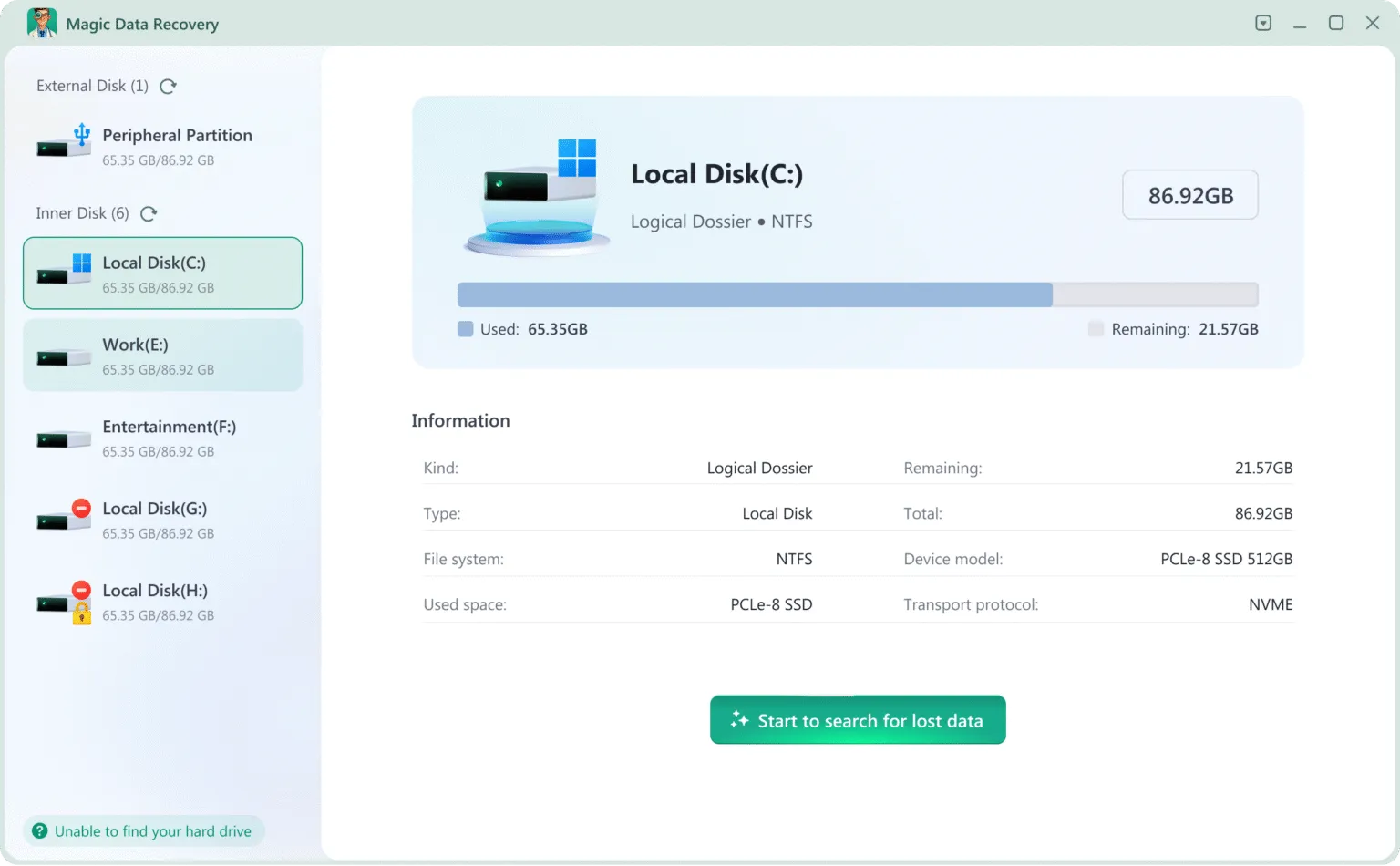
Étape 3 : Lancer une analyse
Lancez l'analyse et attendez les résultats. Si l'analyse rapide ne permet pas de trouver les fichiers dont vous avez besoin, lancez une analyse plus approfondie pour effectuer une recherche plus minutieuse.
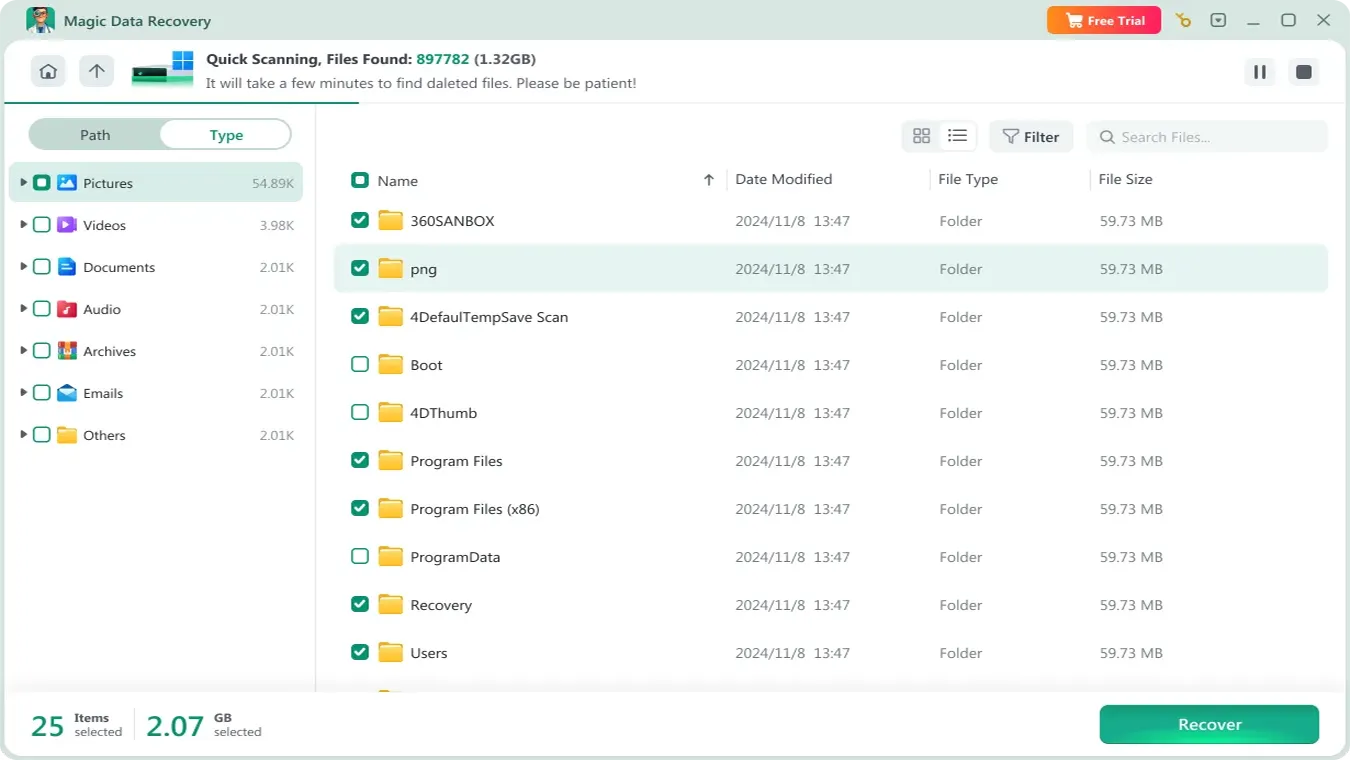
Étape 4 : Filtrer et prévisualiser les fichiers
Utilisez les filtres par type de fichier, la fonction de recherche et l'aperçu pour retrouver les fichiers importants. L'aperçu vous permet d'éviter de restaurer des fichiers inutiles ou endommagés.

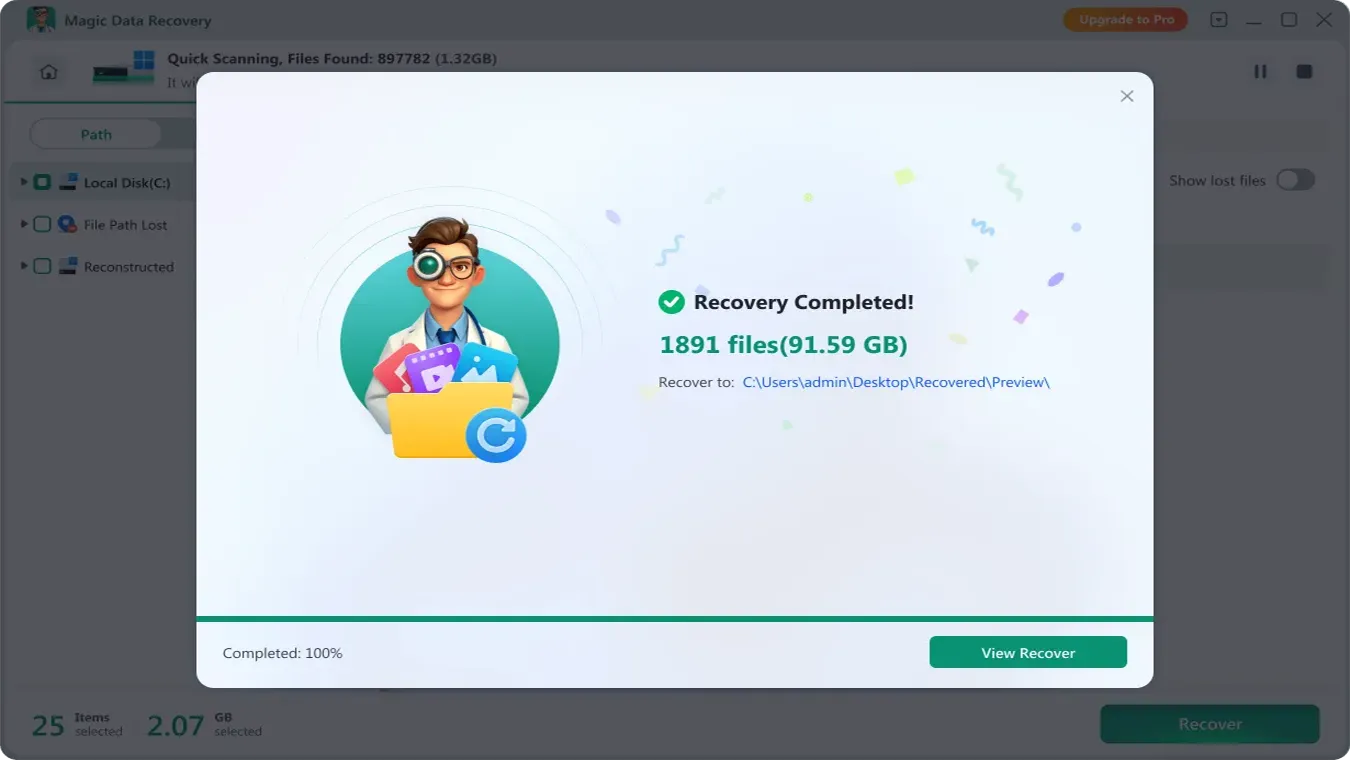
Étape 5 : Récupération des fichiers sur un autre disque
Sélectionnez les fichiers dont vous avez besoin et enregistrez-les sur un autre périphérique de stockage en bon état. Ne les restaurez pas sur le disque d'origine.
Pour les cas Windows récemment supprimés, vous pouvez également consulter ceci Guide pour récupérer des fichiers récemment supprimés sous Windows 11 avant de choisir la méthode de récupération définitive.
Comparatif des applications de récupération de fichiers : quelle méthode convient le mieux à votre cas ?
Méthode de récupération | Meilleur pour | Principal avantage | Limitation |
Corbeille | Fichiers récemment supprimés sous Windows | Rapide et gratuit | Impossible d'aider après une vidange ou une suppression permanente |
Historique des fichiers ou sauvegarde | Fichiers sauvegardés avant la suppression | Itinéraire de récupération le plus sûr | Nécessite la mise en place d'une sauvegarde avant la perte de données |
Poubelle du cloud | Fichiers synchronisés à partir de dossiers dans le cloud | Pratique pour les fichiers en ligne | La durée de conservation pourrait arriver à expiration |
Récupération de fichiers sous Windows | Utilisateurs expérimentés maîtrisant les commandes | Outil Microsoft gratuit | Le fonctionnement en ligne de commande peut dérouter les débutants |
Logiciel gratuit de base pour la récupération de fichiers supprimés | Cas simples de fichiers supprimés | Léger et rapide | Peut rencontrer des problèmes de mise en forme ou des erreurs liées au système de fichiers |
Magic Data Recovery | Cas de fichiers supprimés, formatés, manquants ou inaccessibles | Analyse visuelle, aperçu, filtres et scénarios de récupération plus variés | Impossible de réparer le matériel physiquement endommagé |
Cette comparaison montre pourquoi un application de récupération de fichiers doit correspondre au problème réel. Si le fichier se trouve toujours dans la Corbeille, restaurez-le à partir de là. Si le disque a été formaté, est endommagé ou inaccessible, un outil dédié tel que Magic Data Recovery vous offre une procédure plus adaptée.
Pour les utilisateurs qui comparent des outils gratuits, ceci Guide des logiciels gratuits de récupération de données peut vous aider à comprendre la différence entre les utilitaires de restauration de fichiers de base et les logiciels de récupération plus complets.
Les erreurs courantes qui réduisent le succès de la récupération
Même un bon application de récupération de fichiers On ne peut pas réparer toutes les erreurs. Évitez ces actions après une perte de données.
Installation de logiciels sur le disque contenant les données perdues
Si vous installez un logiciel de récupération sur le même disque que celui où se trouvent les fichiers perdus, le programme d'installation risque d'écraser les données récupérables. Utilisez toujours un autre disque lorsque cela est possible.
Enregistrement des fichiers récupérés au même emplacement
Cette erreur peut écraser d'autres fichiers que le logiciel n'a pas encore récupérés. Choisissez toujours un emplacement de destination distinct.
Exécution de la réparation du disque avant la restauration
Les outils de réparation peuvent modifier la structure du système de fichiers. Si vous avez besoin des fichiers manquants, commencez par récupérer les données, puis réparez le disque dur.
Poursuivre l'utilisation de l'appareil
La copie de fichiers, le téléchargement d'applications, la modification de documents ou la prise de nouvelles photos peuvent écraser les données perdues. Cessez immédiatement d'utiliser l'appareil concerné.
Se fier uniquement aux noms de fichiers
Les noms des fichiers récupérés peuvent changer, notamment après un formatage ou une corruption du système de fichiers. Utilisez l'aperçu, les filtres par type de fichier, la taille et la date de modification pour vérifier que vous avez bien ce dont vous avez besoin.
Si votre problème concerne un disque en mode RAW ou endommagé, ceci Guide sur les erreurs du système de fichiers explique pourquoi la récupération des données devrait souvent précéder la réparation.
Quand une application de récupération de fichiers peut ne pas suffire
A application de récupération de fichiers est particulièrement efficace en cas de perte de données d'ordre logique. Cela inclut les suppressions, les formatages, les erreurs du système de fichiers, les partitions perdues et les cas où le périphérique est encore fonctionnel mais le stockage inaccessible.
Cependant, un logiciel ne peut pas réparer les dommages physiques. Contactez un laboratoire spécialisé si vous constatez :
Des cliquetis ou des grincements
Odeur de brûlé
Surchauffe grave
Un disque dur qui ne tourne pas
Déconnexions répétées
Capacité de disque incorrecte dans Gestion des disques
Dommages causés par l'eau, le feu ou un choc
Dans ces cas-là, des balayages répétés risquent d'aggraver le problème. Cessez d'utiliser l'appareil et consultez un professionnel.
Conseils pour améliorer vos chances de guérison
Pour obtenir de meilleurs résultats avec n'importe quel application de récupération de fichiers, Pour ce faire, il convient de suivre les meilleures pratiques suivantes :
Agissez dès que vous constatez la perte de données.
Cessez d'utiliser le périphérique de stockage concerné.
Ne formatez pas le disque, même si Windows vous le demande.
Installez le logiciel de récupération sur un autre lecteur.
Utilisez l'aperçu avant d'enregistrer les fichiers récupérés.
Récupérez les fichiers sur un autre appareil en bon état de fonctionnement.
Conservez vos sauvegardes après la restauration afin d'éviter toute perte future.
Ces étapes peuvent sembler simples, mais elles font souvent la différence entre une récupération réussie et une perte définitive.
Conclusion : quelle application de récupération de fichiers choisir ?
La droite application de récupération de fichiers Cela dépend de la situation dans laquelle vous vous trouvez. Commencez par vérifier la Corbeille, vos sauvegardes, l'Historique des fichiers et la corbeille du cloud, si ces options sont disponibles. Si ces méthodes échouent, évitez les réparations risquées et utilisez un outil de récupération dédié avant que de nouvelles données ne viennent écraser les fichiers manquants.
Magic Data Recovery Ce logiciel mérite d'être recommandé car il ne se limite pas à la simple suppression de fichiers. Il aide les utilisateurs à récupérer des fichiers suite à une suppression, un formatage, des erreurs du système de fichiers, des disques inaccessibles et d'autres cas courants de perte logique de données. Son processus de scan, de filtrage, de prévisualisation et de récupération offre aux utilisateurs lambda un bon compromis entre simplicité et contrôle.
Si vous cherchez une méthode plus simple pour récupérer des fichiers perdus, commencez par cette solution de récupération de fichiers supprimés et essayez la commande « Magic Data Recovery » avant d'apporter des modifications au disque concerné.
Prise en charge de Windows 7/8/10/11 et Windows Server
Foire aux questions sur l'application « Recover Files »
Une application de récupération de fichiers peut-elle récupérer des fichiers supprimés définitivement ?
Oui, un application de récupération de fichiers Il est possible de récupérer des fichiers supprimés définitivement si le contenu original du fichier n'a pas été écrasé par de nouvelles données. Cessez immédiatement d'utiliser le disque concerné, installez un logiciel de récupération sur un autre disque, analysez l'emplacement où se trouvaient les données perdues, prévisualisez les résultats, puis enregistrez les fichiers récupérés sur un périphérique de stockage distinct.
Une application de récupération de fichiers est-elle sûre à utiliser ?
Une fiabilité application de récupération de fichiers Il est généralement sans danger lorsqu'on l'utilise correctement. La règle d'or est d'éviter de l'installer sur le disque dur où les fichiers ont été perdus et de ne jamais enregistrer les fichiers récupérés au même emplacement. Choisissez un logiciel qui permette de prévisualiser les fichiers, d'effectuer une analyse approfondie et de récupérer les fichiers sur un autre disque dur.
Quelle est la meilleure application de récupération de fichiers pour les utilisateurs de Windows ?
Les meilleurs application de récupération de fichiers Pour Windows, il doit prendre en charge les fichiers supprimés, les disques formatés, les erreurs de système de fichiers, les périphériques externes et l'aperçu avant la récupération. Magic Data Recovery constitue un choix pratique, car il offre un flux de travail visuel permettant d'analyser, de filtrer, de prévisualiser et de restaurer des fichiers sans avoir à passer par des étapes complexes en ligne de commande.
Puis-je récupérer des fichiers sans utiliser de logiciel de récupération ?
Oui, vous pouvez récupérer des fichiers sans logiciel s'ils se trouvent encore dans la Corbeille, dans l'Historique des fichiers, sur un disque de sauvegarde ou dans la corbeille du cloud. Il est préférable d'essayer d'abord ces méthodes, car elles sont sûres et gratuites. Si ces options échouent, un logiciel spécialisé application de récupération de fichiers constitue la prochaine étape concrète.
Une application de récupération de fichiers peut-elle restaurer des fichiers à partir d'un disque formaté ?
A application de récupération de fichiers peut permettre de récupérer des fichiers à partir d'un disque formaté, en particulier après un formatage rapide. Les chances de récupération dépendent du fait que de nouvelles données aient ou non écrasé le contenu d'origine. Ne formatez pas à nouveau le disque, évitez d'y enregistrer de nouveaux fichiers et analysez le périphérique dès que possible.
Pourquoi ne dois-je pas enregistrer les fichiers récupérés sur le même disque ?
Enregistrer les fichiers récupérés sur le même disque peut écraser d'autres données perdues qui sont encore récupérables. Cette erreur peut réduire les chances de restaurer d'autres fichiers. Veillez à toujours récupérer les données sur un autre disque en bon état, un disque externe ou une clé USB, afin que la source d'origine reste inchangée pendant la récupération.
Une application de récupération de fichiers fonctionne-t-elle sur les clés USB et les cartes SD ?
Oui, beaucoup application de récupération de fichiers Ces outils permettent d'analyser les clés USB, les cartes SD, les disques durs externes et autres périphériques de stockage amovibles. Connectez le périphérique à un ordinateur Windows, évitez d'y enregistrer de nouvelles données, lancez une analyse, prévisualisez les fichiers récupérables, puis enregistrez les résultats sur un autre disque.
Dans quels cas dois-je éviter d'utiliser une application de récupération de fichiers ?
Évitez d'utiliser un application de récupération de fichiers Si le disque dur présente des signes de dommages physiques, tels que des cliquetis, une odeur de brûlé, une surchauffe importante ou des déconnexions répétées, la récupération logicielle est plus efficace en cas de perte de données logique. En cas de défaillance matérielle, cessez d'utiliser le périphérique et contactez un laboratoire de récupération spécialisé.

Jason est un spécialiste de la récupération de données et de l'assistance technique, fort de plus de 15 ans d'expérience sur le terrain. Il a beaucoup travaillé auprès des utilisateurs finaux, résolvant des cas complexes de perte de données et proposant des solutions de récupération concrètes en cas de suppression accidentelle, de disques formatés, de systèmes de fichiers endommagés, de partitions perdues, de pannes système et d’autres situations d’urgence nécessitant une récupération. Son expertise couvre également la sauvegarde et la restauration, la réparation de fichiers et la reprise après sinistre, en mettant particulièrement l’accent sur des conseils sûrs, fiables et techniquement rigoureux.