
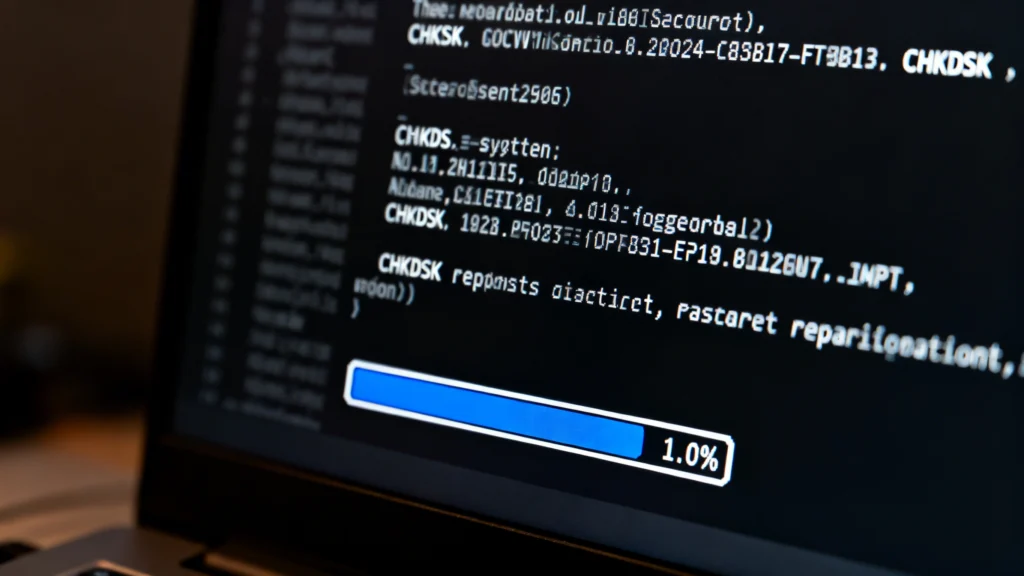
CHKDSK-Befehle: Ein vollständiger Leitfaden
Inhaltsübersicht
Wie CHKDSK funktioniert
So führen Sie Check Disk aus
Um CHKDSK auszuführen, gehen Sie folgendermaßen vor:
- Öffnen Sie die Eingabeaufforderung als Administrator: Presse
Fenster + Xund wählen Sie Eingabeaufforderung (Admin). - Führen Sie den CHKDSK-Befehl aus: Geben Sie im Eingabeaufforderungsfenster den gewünschten CHKDSK-Befehl mit den entsprechenden Parametern ein, z. B:
chkdsk C: /f (ersetzen Sie “C:” durch den Buchstaben Ihres Ziellaufwerks).
- Neustart des Computers: Wenn Sie das Systemlaufwerk (C:) scannen, plant CHKDSK den Scan für den nächsten Neustart. Drücken Sie
Yzu bestätigen.
Vollständige Liste der CHKDSK-Befehle und -Parameter
Hier finden Sie eine detaillierte Liste aller CHKDSK-Befehle, die Sie verwenden können:
Parameter | Beschreibung |
| Gibt den Laufwerksbuchstaben (gefolgt von einem Doppelpunkt), den Einhängepunkt oder den Volume-Namen an. |
| Nur mit der Dateizuordnungstabelle (FAT) und FAT32 verwenden. Gibt den Speicherort und den Namen einer Datei oder einer Gruppe von Dateien an, die Sie chkdsk um auf Fragmentierung zu prüfen. Sie können die Platzhalterzeichen verwenden ? und * um mehrere Dateien anzugeben. |
/f | Behebt Fehler auf dem Datenträger. Der Datenträger muss gesperrt sein. Wenn chkdsk das Laufwerk nicht sperren kann, wird eine Meldung angezeigt, in der Sie gefragt werden, ob Sie das Laufwerk beim nächsten Neustart des Computers überprüfen möchten. |
/v | Zeigt den Namen jeder Datei in jedem Verzeichnis an, wenn der Datenträger überprüft wird. |
/r | Findet fehlerhafte Sektoren und stellt lesbare Informationen wieder her. Der Datenträger muss gesperrt sein. /r umfasst die Funktionalität von /f, mit der zusätzlichen Analyse der physischen Plattenfehler. |
/x | Erzwingt, dass der Datenträger, falls erforderlich, zuerst abgebaut wird. Alle offenen Handles für das Laufwerk werden ungültig gemacht. /x umfasst auch die Funktionalität von /f. |
/i | Nur mit NTFS verwenden. Führt eine weniger strenge Prüfung der Indexeinträge durch, was die für die Ausführung erforderliche Zeit verkürzt. chkdsk. |
/c | Nur mit NTFS verwenden. Prüft keine Zyklen innerhalb der Ordnerstruktur, was die für die Ausführung erforderliche Zeit reduziert chkdsk. |
/l[: | Nur mit NTFS verwenden. Ändert die Größe der Protokolldatei auf die von Ihnen angegebene Größe. Wenn Sie den Parameter size weglassen, /l zeigt die aktuelle Größe an. |
/b | Nur mit NTFS verwenden. Löscht die Liste der fehlerhaften Cluster auf dem Volume und durchsucht alle zugewiesenen und freien Cluster erneut auf Fehler. /b umfasst die Funktionalität von /r. Verwenden Sie diesen Parameter, nachdem Sie ein Volume auf ein neues Festplattenlaufwerk gesichert haben. |
/scan | Nur mit NTFS verwenden. Führt einen Online-Scan auf dem Volume durch. |
/forceofflinefix | Nur mit NTFS verwenden (muss mit /scan). Umgehung aller Online-Reparaturen; alle gefundenen Defekte werden zur Offline-Reparatur in eine Warteschlange gestellt (z.B., |
/perf | Nur mit NTFS verwenden (muss mit /scan). Verbraucht mehr Systemressourcen, um einen Scan so schnell wie möglich abzuschließen. Dies kann sich negativ auf die Leistung anderer auf dem System laufender Aufgaben auswirken. |
/spotfix | Nur mit NTFS verwenden. Führt eine Spotfixierung auf dem Volume durch. |
/sdcleanup | Nur mit NTFS verwenden. Unnötige Sicherheitsdeskriptordaten sammeln (impliziert /f). |
/offlinescanandfix | Führt eine Offline-Überprüfung und -Korrektur des Volumes durch. |
/freeorphanedchains | Nur mit FAT/FAT32/exFAT verwenden. Gibt alle verwaisten Clusterketten frei, anstatt ihren Inhalt wiederherzustellen. |
/Markenreinheit | Nur mit FAT/FAT32/exFAT verwenden. Markiert den Datenträger als sauber, wenn keine Beschädigung erkannt wurde, auch wenn /f wurde nicht spezifiziert. |
/? | Zeigt die Hilfe an der Eingabeaufforderung an. |
Wie man den richtigen Befehl wählt
Je nach dem Problem, das Sie mit Ihrer Festplatte haben, können Sie verschiedene Kombinationen dieser Parameter wählen, um den Reparaturprozess zu optimieren.
- Für grundlegende Festplattenreparaturen: Verwenden Sie
/fum Fehler auf dem Datenträger zu beheben. - Für die Wiederherstellung schlechter Sektoren: Verwenden Sie
/rum lesbare Daten aus defekten Sektoren wiederherzustellen und Dateisystemfehler zu beheben. - Um eine gründlichere Prüfung durchzuführen: Verwenden Sie
/rzusammen mit/xum das Laufwerk vor dem Scannen zu trennen. - So beschleunigen Sie den Scanvorgang: Verwenden Sie
/imit NTFS, um die Prüfzeit zu verkürzen oder/perfum mehr Systemressourcen für eine schnellere Überprüfung zuzuweisen. - Für Offline-Reparaturen: Verwenden Sie
/offlinescanandfixum das Volume zu scannen und zu reparieren, wenn es nicht aktiv verwendet wird.
Vorteile der Verwendung von CHKDSK-Befehlen
- Dateisystemfehler reparieren: Check Disk kann Beschädigungen in Dateisystemen beheben.
- Wiederherstellung von Daten aus fehlerhaften Sektoren: Die
/rOption stellt lesbare Informationen aus fehlerhaften Sektoren wieder her. - Verbesserte Leistung: Die regelmäßige Anwendung von Check Disk kann Ihre Festplatte in optimalem Zustand halten.
Beschränkungen von CHKDSK
- Datenverlust: In einigen Fällen kann Check Disk Dateien löschen wenn sie sich in fehlerhaften Sektoren oder beschädigten Bereichen der Festplatte befinden.
- Zeitaufwendig: Je nach Größe Ihres Laufwerks und den von Ihnen verwendeten Parametern kann der Scanvorgang sehr zeitaufwändig sein.
Schlussfolgerung
CHKDSK-Befehle sind wertvolle Werkzeuge für die Wartung und Reparatur Ihrer Festplatte. Sie können Dateisystemfehler überprüfen und beheben, Daten aus defekten Sektoren wiederherstellen und die Gesamtleistung Ihres Systems optimieren. Wenn Ihre Daten jedoch bereits verloren sind oder Check Disk nicht auf eine beschädigte Partition zugreifen kann, benötigen Sie ein spezielles Datenrettungsprogramm.
Wenn CHKDSK Ihr Laufwerk nicht reparieren kann oder Daten verloren gegangen sind, Magic Data Recovery ist Ihre zuverlässige Lösung. Es kann Dateien wiederherstellen, auch wenn Ihre Partition beschädigt ist und Check Disk die Probleme nicht beheben konnte. Laden Sie Magic Data Recovery jetzt herunter, um sicher Ihre Daten wiederherstellen und erhalten Sie wieder Zugriff auf Ihre Dateien.
Unterstützt Windows 7/8/10/11 und Windows Server
FAQs über CHKDSK-Befehle
Was ist besser, CHKDSK r oder f?
Wie führt man eine CHKDSK-Reparatur durch?
Wie kann ich beschädigte Dateien mit CHKDSK reparieren?
Wie kann man mit CHKDSK gelöschte Dateien wiederherstellen?
Soll ich SFC oder DISM ausführen?
Wie repariert man eine langsame Festplatte?

Erin Smith gilt als eine der professionellsten Autorinnen bei Amagicsoft. In den letzten 10 Jahren hat sie ihre schriftstellerischen Fähigkeiten kontinuierlich verfeinert und Millionen von Lesern bei der Lösung ihrer technischen Probleme geholfen.