
Cómo formatear un SSD en Windows 11/10 de forma segura
Cómo formatear un SSD Es una pregunta habitual cuando se quiere configurar una nueva unidad, reparar un sistema de archivos dañado, reinstalar Windows o reutilizar un SSD externo. Sin embargo, formatear un SSD no siempre está exento de riesgos. Si la unidad aún contiene archivos importantes, el formateo puede dificultar el acceso a ellos o su recuperación, especialmente cuando el SSD está en formato RAW, es inaccesible o se ha formateado accidentalmente.
Antes de continuar, asegúrate de haber hecho una copia de seguridad de todos los archivos importantes. Si ya has formateado el SSD por error o necesitas recuperar datos de una unidad formateada, lee nuestro recuperación de unidades formateadas Lee primero la guía.
En esta guía, aprenderás a formatear un SSD de forma segura en Windows, a elegir entre NTFS y exFAT, a inicializar un SSD nuevo, a formatear un SSD externo, qué hacer antes de formatear un SSD ilegible o en formato RAW, y cómo recuperar archivos perdidos utilizando Magic Data Recovery Una vez cometiste un error al dar formato.
Compatible con Windows 7/8/10/11 y Windows Server
Índice
Respuesta rápida: Cómo formatear un SSD de forma segura
Para formatear un SSD de forma segura, haz primero una copia de seguridad o recupera los archivos importantes, comprueba que has seleccionado la unidad correcta, elige el sistema de archivos adecuado y utiliza Formato rápido para un uso habitual. Para la mayoría de los usuarios de Windows, NTFS es el mejor sistema de archivos para un SSD interno, mientras que exFAT es más adecuado para un SSD externo que se utilice tanto en Windows como en macOS.
Si el SSD es nuevo, inicialízalo como GPT en Gestión de discos antes de crear y formatear un nuevo volumen. Si el SSD está en formato RAW, no se puede leer o te pide que lo formatees antes de usarlo, no lo formatees inmediatamente. Recupera primero los archivos y, a continuación, formatea el SSD una vez que tus datos estén a salvo.
Por qué puede ser necesario formatear un SSD
Una unidad SSD puede necesitar ser formateada por varias razones. Además, entender el propósito ayuda a determinar el flujo de trabajo más seguro.
Las situaciones más comunes son:
Preparación de una nueva SSD para su primer uso
Eliminar todos los datos antes de vender o reutilizar el disco
Corrección de la corrupción del sistema de archivos (RAW / SSD ilegible)
Cambios de partición o reorganización de unidades
Realizar una instalación limpia de Windows
Conversión de un sistema de archivos antiguo (exFAT/FAT32) a NTFS
El formateo también es necesario cuando se aprende cómo formatear SSD Windows 10 o cómo formatear SSD Windows 11 para la instalación del sistema operativo.
Dado que las unidades SSD utilizan diferentes controladores y técnicas de nivelación del desgaste, el formateo borra las estructuras lógicas, lo que dificulta o imposibilita la recuperación de los datos anteriores. Por tanto, recuperación de archivos se recomienda encarecidamente.
Antes de formatear un SSD: comprobaciones de seguridad importantes
Antes de formatear un SSD, dedica unos minutos a comprobar que el proceso es seguro. Formatear la unidad equivocada o hacerlo antes de realizar una recuperación puede provocar una pérdida de datos que se podría haber evitado.
Comprueba primero estos puntos:
Asegúrate de haber seleccionado el SSD correcto.
Haz una copia de seguridad de los archivos importantes en otra unidad.
No formatees el SSD si está en formato RAW o es ilegible y aún contiene archivos necesarios.
No guardes archivos nuevos en el SSD antes de la recuperación.
Elige NTFS si vas a utilizarlo únicamente con Windows.
Elige exFAT si necesitas utilizar el SSD tanto en Windows como en macOS.
Utiliza GPT en la mayoría de los ordenadores modernos con Windows 11 y Windows 10.
Utiliza el borrado seguro en lugar del formateo normal si tienes pensado vender o donar el SSD.
Si el SSD contiene archivos que no puedes permitirte perder, recupéralos antes de formatearlo.
Formateo frente a borrado seguro: ¿cuál es la diferencia?
Formatear un SSD y borrarlo de forma segura no es lo mismo. Un formateo normal prepara el SSD para su reutilización, mientras que el borrado seguro está diseñado para eliminar los datos de forma más exhaustiva.
| Acción | Lo mejor para | Qué hace |
|---|---|---|
| Formato rápido | Reutilizar tu propio SSD | Reconstruye el sistema de archivos y hace que la unidad parezca vacía |
| Formato completo | Formateo más profundo, pero no es lo más adecuado para un uso frecuente de SSD | Tarda más tiempo y escribe más datos en la unidad |
| Borrado seguro | Vender, donar o deshacerse de un SSD | Utiliza comandos de borrado a nivel de SSD para eliminar los datos de forma más exhaustiva |
| Diskpart clean | Eliminar particiones y volver a formatear el SSD | Elimina la información de la partición |
| Diskpart clean all | Borrado completo mediante sobrescritura | Escribe ceros en el disco y tarda mucho más tiempo |
Para un uso normal, suele bastar con el «formateo rápido». Si tu principal preocupación es la privacidad, utiliza el borrado seguro en lugar del formateo estándar.
¿Qué sistema de archivos deberías elegir para un SSD?
A la hora de formatear un SSD, es importante elegir el sistema de archivos adecuado. La mejor opción depende del uso que le vayas a dar a la unidad.
| Sistema de archivos | Lo mejor para | Recomendación |
|---|---|---|
| NTFS | Unidades SSD internas que solo se utilizan en Windows | La mejor opción predeterminada para Windows 11/10 |
| exFAT | Unidades SSD externas utilizadas en Windows y macOS | La mejor opción para el almacenamiento multiplataforma |
| FAT32 | Dispositivos antiguos y unidades de pequeño tamaño | No se recomienda para los SSD modernos debido a las restricciones de tamaño de los archivos |
| APFS | Unidades SSD que solo se utilizan en macOS | Ideal para uso exclusivo en Mac |
Para la mayoría de los usuarios que buscan cómo formatear SSD En Windows, NTFS es la opción predeterminada más segura. Si vas a formatear un SSD externo para utilizarlo tanto en Windows como en Mac, elige exFAT.
Precauciones importantes antes de formatear un SSD
Antes de proceder, tenga en cuenta estos puntos esenciales de seguridad:
① Nunca formatees un SSD inmediatamente si se vuelve ilegible.
Cuando Windows solicita, “Es necesario formatear el disco antes de poder utilizarlo,No formatee hasta que intente recuperar los datos.
② Recuperar o hacer una copia de seguridad de los datos antes de formatear.
Los controladores de SSD utilizan TRIM, lo que puede borrar los bloques inmediatamente después del formateo. Esto hace que los datos sean irrecuperables una vez sobrescritos.
③ Confirmar la unidad de destino.
Compruebe siempre la letra de la unidad SSD o el nombre del modelo para evitar formatear el disco equivocado.
④ Utiliza una herramienta de recuperación profesional si el SSD está dañado.
Magic Data Recovery proporciona una exploración de sólo lectura que evita daños mayores.
Cómo formatear SSD en Windows (métodos estándar)
Cómo formatear un SSD con el Explorador de archivos
Utiliza este método cuando el SSD ya aparezca en el Explorador de archivos y tenga asignada una letra de unidad.
- Abra el Explorador de archivos.
- Haz clic en «Este PC».
- Haz clic con el botón derecho del ratón en la partición del SSD que quieras formatear.
- Selecciona «Formato».
- Elige NTFS si vas a utilizarlo solo con Windows, o exFAT si vas a utilizarlo tanto con Windows como con Mac.
- Mantén seleccionada la opción «Formato rápido» para poder reutilizarlo normalmente.
- Haz clic en «Inicio» y confirma la advertencia.
Esta es la forma más sencilla de formatear un SSD que Windows ya reconoce.
Cómo formatear un SSD nuevo mediante «Administración de discos»
Utilice Gestión de discos cuando el SSD es nuevo, no está asignado o no aparece en el Explorador de archivos.
- Haz clic con el botón derecho en «Inicio» y selecciona «Administración de discos».
- Busca el nuevo SSD en la lista de discos.
- Si Windows te pide que inicialices el disco, selecciona GPT.
- Haz clic con el botón derecho del ratón en el espacio sin asignar.
- Selecciona «Nuevo volumen simple».
- Asigna una letra de unidad.
- Elige entre NTFS o exFAT.
- Selecciona «Realizar un formateo rápido».
- Haz clic en «Finalizar».
Una vez formateado, el nuevo SSD debería aparecer en el Explorador de archivos.
Cómo formatear un SSD con el comando Diskpart
Diskpart resulta útil cuando el Explorador de archivos o la Administración de discos no pueden formatear correctamente el SSD. Sin embargo, también entraña un riesgo, ya que si se selecciona el disco equivocado se puede borrar otra unidad.
Utiliza estos comandos con precaución:
					parte de disco
listar disco
seleccionar disco X
limpiar
crear partición primaria
formatear fs=ntfs rápido
asignar
salir
Sustituye X por el número correcto del SSD.
Si quieres formatear el SSD en exFAT, utiliza este comando en su lugar:
formato fs=exfat quick
Importante: No ejecutes el comando «Diskpart clean» en un SSD que contenga archivos que aún necesites.
Recuperar datos antes de formatear un SSD con Magic Data Recovery
Si el SSD contiene archivos importantes, recupera los datos antes de formatearlo. Esto es especialmente importante cuando el SSD está en formato RAW, es inaccesible, está dañado, se ha formateado accidentalmente o te pide que lo formatees antes de utilizarlo.
Magic Data Recovery Puede ayudar a recuperar archivos perdidos de SSD formateados, archivos eliminados, sistemas de archivos dañados, particiones inaccesibles y otras situaciones habituales de pérdida de datos. Analiza el SSD y te permite previsualizar los archivos recuperables antes de guardarlos en otra unidad en buen estado.
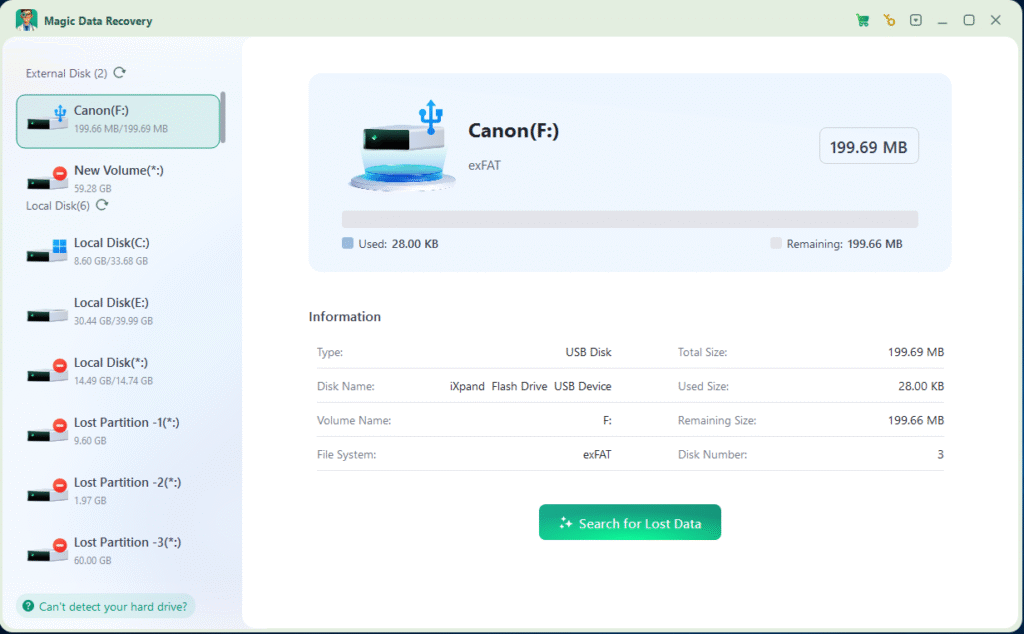
Cómo recuperar datos de un SSD antes de formatearlo:
- Instala Magic Data Recovery en otra unidad.
- Inicia el programa y selecciona el SSD afectado.
- Haz clic en «Buscar datos perdidos».
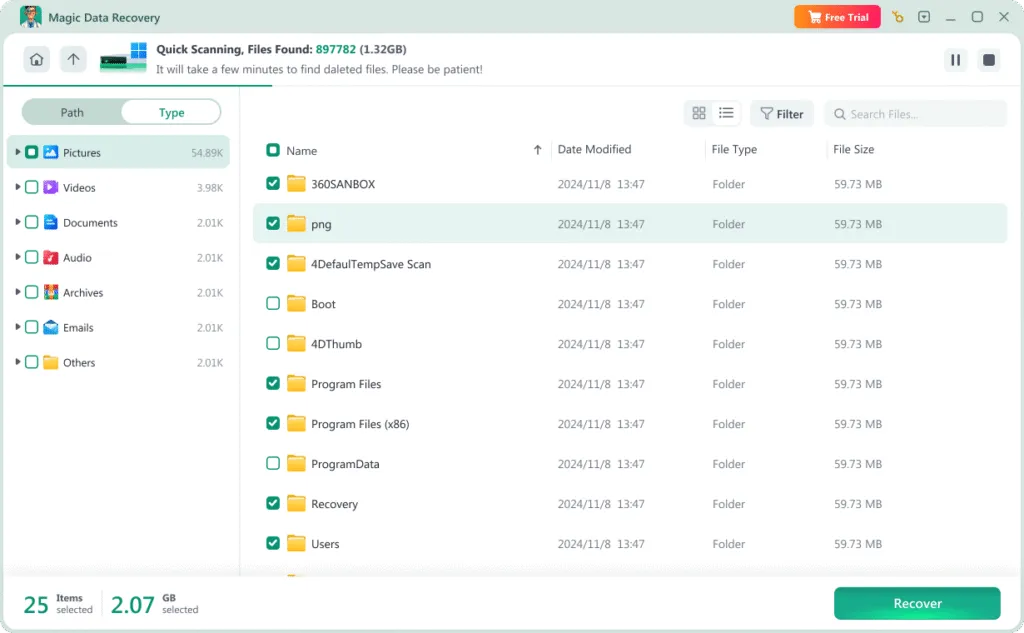
- Espera a que finalice el escaneo.
- Previsualiza los archivos encontrados.
- Selecciona los archivos que quieras recuperar.
- Guárdalos en otra unidad que funcione correctamente.
- Una vez que tus archivos estén a salvo, formatea el SSD utilizando uno de los métodos indicados anteriormente.
No guardes los archivos recuperados en el mismo SSD hasta que se haya completado el formateo.
Cómo recuperar datos de SSD usando Magic Data Recovery
Magic Data Recovery realiza un escaneo no destructivo, permitiéndole extraer datos de forma segura antes de formatear su SSD.
Proceso de recuperación paso a paso
1. Descargar e instalar: Consigue Magic Data Recovery de la web oficial e instálalo en tu ordenador.
Compatible con Windows 7/8/10/11 y Windows Server


Conclusión
Ahora ya lo sabes cómo formatear SSD de forma segura en diferentes situaciones. Si el SSD funciona con normalidad, puedes formatearlo mediante el Explorador de archivos, la Administración de discos, la Configuración de Windows o Diskpart. Para la mayoría de los usuarios de Windows, las opciones recomendadas son NTFS, GPT y el formateo rápido.
Sin embargo, el formateo no es el primer paso si el SSD está en formato RAW, es ilegible, se ha formateado por error o aún contiene archivos importantes. En ese caso, recupera primero tus archivos con Magic Data Recovery y guárdalas en otra unidad que funcione correctamente antes de formatear.
Si necesitas una guía completa para recuperar archivos tras formatear, lee nuestro recuperación de unidades formateadas guía.
Compatible con Windows 7/8/10/11 y Windows Server
Preguntas frecuentes sobre cómo formatear un SSD
¿Es seguro formatear un SSD?
¿Cuál es la mejor forma de formatear un SSD?
¿Debería utilizar NTFS o exFAT al formatear un SSD?
¿Debo formatear mi SSD MBR o GPT?
¿Debería formatear un SSD de forma rápida o completa?
¿Cómo formateo un SSD nuevo?
¿Puedo formatear un SSD sin perder datos?
¿Por qué me pide Windows que formatee mi SSD?
¿Puedo recuperar archivos después de formatear un SSD?

Erin Smith es reconocida como una de las redactoras más profesionales de Amagicsoft. Ha perfeccionado continuamente sus habilidades de escritura durante los últimos 10 años y ha ayudado a millones de lectores a resolver sus problemas tecnológicos.