
Descargar «Recuperar archivos»: 7 métodos seguros
When important installers, work documents, photos, or email attachments disappear from your Downloads folder, you may search download recover files because you need either to restore deleted downloads or find a safe recovery program. This guide covers both goals. Start with the least invasive options, protect the original drive from overwriting, and move to dedicated recovery software only when Windows backups and cloud copies cannot help. For a broader recovery workflow, review Amagicsoft’s guía de recuperación de archivos eliminados.
Índice
Quick Answer: How Do You Download Recover Files Safely?
A download recover files safely on Windows, follow this order:
- Stop using the drive that stored the missing files.
- Press Ctrl + Z if the deletion just happened.
- Comprueba la papelera de reciclaje.
- Re-download the file from its original website, email, or cloud account.
- Check File History, Previous Versions, or OneDrive.
- Utiliza la herramienta de recuperación de archivos de Windows si te sientes cómodo con los comandos.
- Use Magic Data Recovery when files were permanently deleted, the drive was formatted, or file system errors made data inaccessible.
The safest method depends on what happened. A recently deleted file may return in seconds, while a formatted or corrupted drive usually requires a full scan. Therefore, a successful download recover files plan should begin with diagnosis rather than software.
What Does “Download Recover Files” Mean?
The search phrase download recover files usually has two meanings:
- You deleted files that had been downloaded to the Windows Downloads folder.
- You want to download software that can recover deleted or lost files.
These situations overlap, but they require careful handling. Downloading a recovery program onto the same drive that contains the deleted data may overwrite the exact sectors you need to scan. Therefore, the download location and installation location matter as much as the software itself.
A typical Downloads folder sits at:
C:\Usuarios\TuNombre\Descargas
However, browsers can save files elsewhere. Chrome, Edge, Firefox, download managers, email clients, and cloud-sync apps may use custom folders. Before you start recovery, confirm the original location.
Why Deleted Downloaded Files May Still Be Recoverable
Windows usually removes a file’s directory reference before it erases every data block. The operating system then marks that storage space as available for reuse. Until new data overwrites it, a recovery tool may still locate the file record, reconstruct the file from metadata, or identify it by its file signature. Microsoft similarly explains that deleted file space becomes available for reuse and may remain recoverable until new activity overwrites it.
This explains why timing matters when you download recover files. Web browsing, installing software, downloading videos, running Windows Update, and copying large folders can all write new data to the drive.
Recovery chances generally depend on:
- Whether the file went to the Recycle Bin
- Whether File History or another backup was active
- Whether the data was stored on an HDD or SSD
- Whether Windows issued a TRIM command to an SSD
- Cuántos datos nuevos se han escrito tras la eliminación
- Whether the drive has logical errors or physical damage
No download recover files method can promise that every deleted file will return intact. A previewable file is a positive sign, but final results still depend on the condition of the underlying data.
Before You Download Recover Files Software
Antes de probar cualquier download recover files solution, protect the source drive.
Stop Writing Data to the Affected Drive
Do not download new files, install applications, extract archives, or save recovered data to the same partition. If the missing downloads were on drive C:, use another computer to obtain the installer when possible. Then place it on a USB drive or another internal disk.
Use a Different Destination Drive
Recovery tools should read from the source and write restored files elsewhere. For example:
- Scan C: and save to E:
- Scan an external HDD and save to the computer’s internal drive
- Scan an SD card and save to an external SSD
Using separate source and destination drives prevents recovered files from overwriting other recoverable data. Microsoft requires different source and destination drives for Windows File Recovery, while independent recovery guidance also recommends installing software away from the affected drive.
Avoid Formatting, CHKDSK, and Cleanup Tools
Do not format a drive simply because Windows says it needs formatting. Avoid running CHKDSK before recovering important data because file-system repairs can modify metadata.
Disk Cleanup, Storage Sense, defragmentation, and third-party “optimizer” tools can also create additional writes.
Stop If the Drive Has Physical Failure Symptoms
Clicking, repeated disconnections, severe slowness, burning smells, or a drive that does not appear in Disk Management can indicate hardware failure.
Software scanning may worsen the problem. In that case, disconnect the device and consult a professional recovery laboratory.
Method 1: Undo the Deletion Immediately
If you deleted a file moments ago, Ctrl + Z offers the fastest download recover files method. For users who search download recover files immediately after an accidental deletion, this should always be the first attempt.
- Keep the File Explorer window open.
- Press Ctrl + Z.
- Check the Downloads folder.
Windows reverses the most recent file operation when no later action has replaced it in the undo history.
This method works best after a normal Delete command. It will not help after a restart, a long series of later actions, formatting, or most permanent-deletion scenarios.
Método 2: Recuperar archivos de la Papelera de reciclaje
For normal deletions from an internal drive, Windows usually moves the files to the Recycle Bin.
- Abra la Papelera de reciclaje desde el escritorio.
- Search by filename, file type, or deletion date.
- Select the required files.
- Haga clic con el botón derecho y seleccione Restaurar.
Windows returns each item to its original folder. This is the simplest way to download recover files without installing anything. In many everyday download recover files cases, the Recycle Bin resolves the problem with no scan.
However, files may bypass the Recycle Bin when you:
- Use Shift + Delete
- Delete very large items
- Remove files from some removable devices
- Vaciar la papelera de reciclaje
- Run a cleanup utility
In those cases, continue to the next method.
Method 3: Re-Download the Original File
A downloaded file may be easier to replace than to recover. Before scanning the drive, check whether the original source still exists. This replacement-first approach can complete a download recover files task without touching deleted sectors.
Check Browser Download History
Open your browser’s downloads page:
- Chrome or Edge: press Ctrl + J
- Firefox: press Ctrl + J
The history entry may show the original filename, source URL, and destination. The history does not store the deleted file itself, but it can help you download the same item again.
Check Email and Messaging Apps
Search the email thread, support ticket, Slack conversation, Teams chat, or messaging app where you received the attachment.
Re-download the attachment only when you trust the sender and source.
Check Software Accounts and Purchase Portals
Installers, invoices, templates, and digital products often remain available in the account used for purchase.
Sign in to the vendor’s official website instead of downloading replacement files from unverified mirror sites.
This approach works well when the file remains publicly available and unchanged. It is less useful for:
- Unique exports
- Edited documents
- Expired download links
- Private attachments
- Files from websites that no longer exist
Method 4: Restore from OneDrive or Another Cloud Copy
Many Windows users sync Desktop, Documents, Pictures, or custom folders with OneDrive. Other users rely on Google Drive, Dropbox, or business sync services.
Compruébalo:
- The cloud service’s recycle bin or trash
- Historial de versiones
- Carpetas compartidas
- Another synced computer
- Offline copies on external drives
Cloud recovery follows the provider’s retention rules. For a cloud-related download recover files request, start with the provider’s own restore controls.
For example, Microsoft allows users to restore eligible OneDrive files from its online Recycle Bin. It also notes that online-only files may not appear in the Windows Recycle Bin.
Moreover, local recovery software cannot directly scan a cloud server. It can only scan a local disk that previously stored or synchronized the file.
Amagicsoft explains this distinction in its guide to recovering deleted Google Drive files from local synced folders.
Para un download recover files search involving a synced Downloads folder, pause syncing before running a local scan. This reduces new disk writes and prevents repeated deletions or downloads from changing the source drive.
Method 5: Use File History or Previous Versions
Windows backup features can restore earlier copies without a sector-level scan. They offer a low-risk download recover files option when a valid backup already exists.
Restaurar con el historial de archivos
- Abra el Panel de control.
- Seleccione Sistema y seguridad.
- Elija Historial de archivos.
- Haga clic en Restaurar archivos personales.
- Browse available dates and folders.
- Select the item and restore it.
File History works only when it was enabled before the loss and when the relevant folder was included in the backup.
If the Downloads folder was not protected, search the backup for another location where you may have copied the file.
Comprobar versiones anteriores
- Abra el Explorador de archivos.
- Navigate to C:\Users\YourName.
- Right-click the Downloads folder or its parent folder.
- Seleccione Propiedades.
- Abra el Versiones anteriores ficha.
- Open or copy a suitable version before restoring it.
Previous Versions may use File History or restore-point data. If no earlier version appears, Windows has no usable snapshot for that location.
Built-in backups make download recover files easier because they restore a known copy rather than reconstructing deleted sectors. Always check them before running a deep scan.
Método 6: Utilizar la función de recuperación de archivos de Windows
Microsoft provides Windows File Recovery as a command-line utility for local drives. It gives advanced users a free download recover files route when no backup is available.
The utility can scan:
- Unidades internas
- Discos duros externos
- Dispositivos USB
- Other supported local storage
It does not recover directly from cloud storage or network file shares.
La sintaxis básica es la siguiente:
winfr source-drive: destination-drive: [/modo] [/interruptores]
For example, to recover PDF and DOCX files from the Downloads folder on C: to E:, use:
winfr C: E: /regular /n \Users\YourName\Downloads\*.pdf /n \Users\YourName\Downloads\*.docx
If Regular mode does not find the files, try Extensive mode:
winfr C: E: /extensive /n \Users\YourName\Downloads\
Normas importantes:
- The source and destination drives must differ.
- Run the terminal as an administrator.
- Use filters to reduce unnecessary scanning.
- Save recovered files to a healthy drive.
- Do not keep using the source drive while scanning.
Windows File Recovery is free and useful for technical users. However, its command syntax, recovery modes, and output folders can confuse beginners.
It also lacks the visual preview and filtering workflow found in graphical recovery tools.
Method 7: Download Recover Files with Magic Data Recovery
When the Recycle Bin is empty, backups are unavailable, Windows File Recovery feels too complex, or the storage device has been formatted or become inaccessible, Magic Data Recovery offers a visual download recover files flujo de trabajo.
It also consolidates several download recover files scenarios into one guided interface.
The software addresses several common pain points:
- Borrado accidental y Shift + Suprimir
- Vaciar la papelera de reciclaje
- Deleted Downloads folder
- Formateo rápido
- Particiones RAW o inaccesibles
- Errores del sistema de archivos
- Lost files after a system reinstall
- Recovery from Windows-detected storage devices
Supported storage devices include:
- Discos duros internos
- Unidades SSD
- Discos duros externos
- Memorias USB
- Tarjetas SD
- Tarjetas de memoria
- Other drives detected by Windows
According to its official product page, Magic Data Recovery supports more than 5,000 file types. It lets users scan, filter, preview, and select files before recovery. Its trial also supports up to 500 MB of recovery, allowing users to test the workflow and inspect results before choosing a full version.
Compatible con Windows 7/8/10/11 y Windows Server
Why Magic Data Recovery Is More Practical Than Basic Methods
Built-in Windows methods depend on a surviving file, Recycle Bin entry, or prior backup.
Magic Data Recovery instead scans the storage device for deleted file records and recognizable file data. This makes it useful when the operating system can no longer display the missing files.
Sus principales ventajas son:
- A graphical workflow for nontechnical users
- Scan results organized by path and file type
- Search and filter tools for large result sets
- Vista previa del archivo antes de recuperarlo
- Support for deletion, formatting, and file-system error scenarios
- Recovery to a different drive
- One tool for several Windows storage devices
Magic Data Recovery does not overcome physical drive failure, overwritten sectors, or deleted cloud-only data.
Those limitations apply to software-based recovery in general. Recognizing them helps users choose a realistic solution instead of repeatedly scanning a device that requires professional assistance.
Cómo utilizar Magic Data Recovery
Step 1: Download and Install It Safely
Use the official Magic Data Recovery download.
If the missing files were stored on C:, download the installer with another computer when possible. Place it on a USB drive and install the program on another drive.
Compatible con Windows 7/8/10/11 y Windows Server
The key rule for download recover files software is simple: never install it onto the same drive you need to recover.
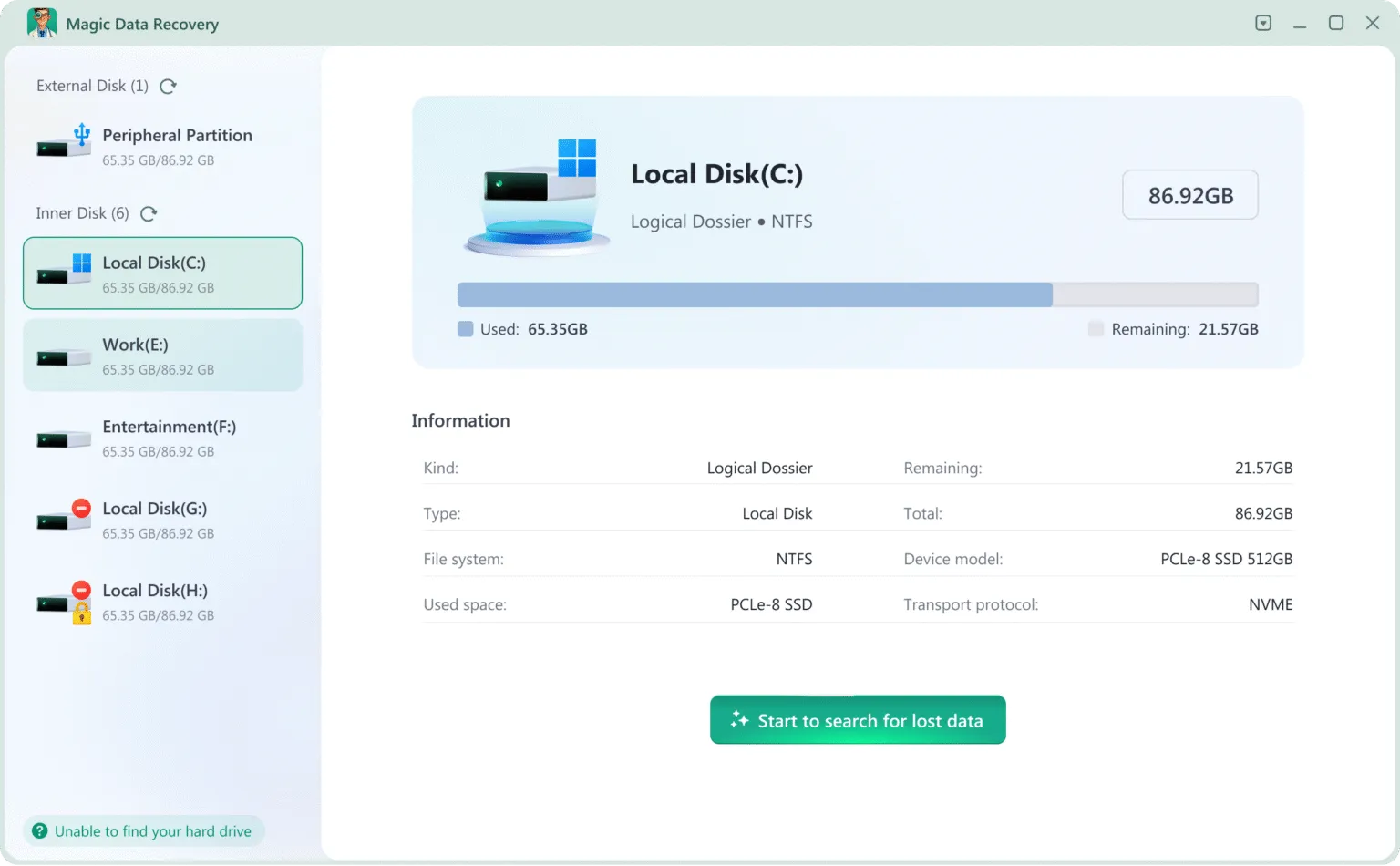
Paso 2: Seleccionar la ubicación de almacenamiento original
Launch the program and choose the disk or partition that contained the deleted Downloads folder.
For browser downloads on a standard Windows setup, this is often the C: partition.
If the files came from a USB drive, SD card, or external hard drive, connect the device and select it from the drive list.
Paso 3: Buscar datos perdidos
Inicia el escaneo.
Allow it to complete for the most comprehensive result set, especially after formatting or file system errors.
You can review files while the scan proceeds, but an incomplete scan may not show every recoverable item.
Step 4: Search, Filter, and Preview
Use the original filename when known. Otherwise, filter by extension, size, date, or file type.
Por ejemplo:
- Documents: DOCX, XLSX, PPTX, PDF
- Images: JPG, PNG, HEIC, PSD
- Video: MP4, MOV, AVI
- Archives: ZIP, RAR, 7Z
- Installers: EXE, MSI
Preview important files where supported. A correct preview provides stronger evidence that the file content remains readable.
Paso 5: Recuperar en otra unidad
Select the required files and choose a different destination.
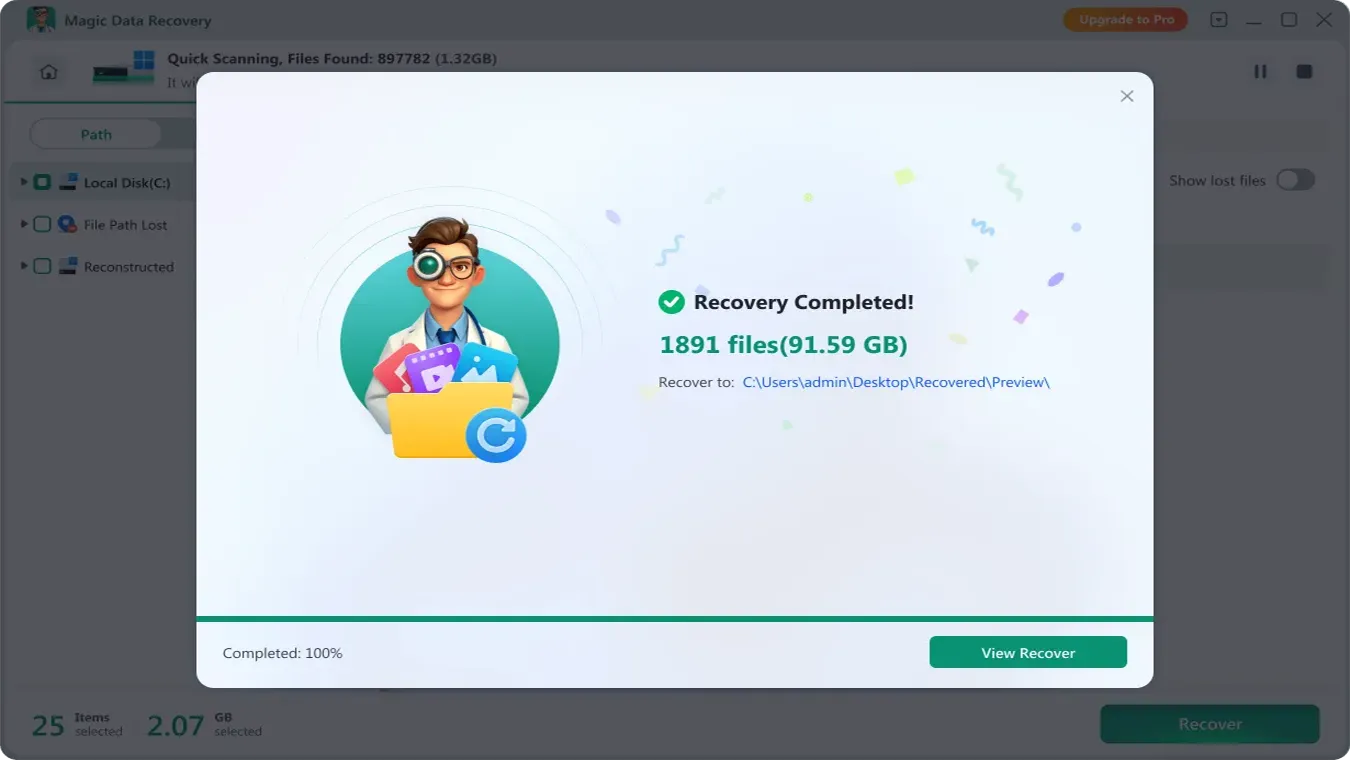
Do not restore them to the original Downloads folder until you have finished all recovery attempts.
For more deletion-specific troubleshooting, see:
Download Recover Files Method Comparison
Método | Lo mejor para | Requires prior backup | Limitación principal |
Ctrl + Z | An immediate accidental deletion | No | Works only before later actions replace the undo history |
Papelera de reciclaje | Normal deletion from an internal drive | No | Fails after emptying, Shift + Delete, or bypassed deletions |
Re-download | Public installers, attachments, and unchanged online files | No | The original source may be unavailable or unsafe |
Restauración desde la nube | Synced or uploaded files | Cloud copy required | Retention periods and account access apply |
Historial de archivos | Files included in a configured Windows backup | Sí | Must have been enabled before deletion |
Recuperación de archivos de Windows | Command-line recovery from local storage | No | Technical syntax and no visual preview |
Magic Data Recovery | Permanent deletion, formatting, file system errors, and broad device recovery | No | Cannot repair physical damage or recover overwritten data |
Este download recover files comparison shows why no single download recover files method fits every case.
Start with reversible actions. Then use a storage scan only when simpler options fail.
¿Qué método de recuperación deberías utilizar?
The File Was Deleted Seconds Ago
Press Ctrl + Z. If that fails, open the Recycle Bin immediately.
The Downloads Folder Was Emptied
Compruébalo:
- Papelera de reciclaje
- Historial de archivos
- Versiones anteriores
- OneDrive u otro servicio en la nube
- Browser download history
Next, use Windows File Recovery or Magic Data Recovery.
The File Came from a Website or Email
Check browser history, email attachments, account dashboards, and trusted cloud sources before scanning the disk.
The Drive Was Formatted
Stop using it. Do not create a new partition or copy files to it.
Use a recovery scanner that handles formatted storage. Magic Data Recovery is suitable when Windows still detects the physical device.
The Drive Shows RAW or Asks to Be Formatted
Cancel the formatting prompt and scan the device first.
File-system repair should come after important data has been copied elsewhere.
The Drive Clicks or Disconnects Repeatedly
Do not run a prolonged software scan. Disconnect the device and seek professional assistance.
Matching the method to the data-loss event makes download recover files recovery safer and more efficient.
HDD vs. SSD: Why Storage Type Matters
Deleted-file recovery behaves differently across storage technologies.
Unidades de disco duro
On an HDD, deleted data may remain in its original sectors until Windows overwrites them.
Therefore, stopping drive use quickly can preserve a useful recovery window.
Unidades de estado sólido
SSDs use TRIM and internal garbage collection to manage unused blocks. Windows delete notifications can inform supported storage devices that specific clusters are no longer in use.
As a result, direct recovery from an SSD can become difficult sooner than recovery from an HDD.
This does not mean every SSD deletion is hopeless. The following options may still work:
- Papelera de reciclaje
- Historial de archivos
- Cloud copies
- Versiones anteriores
- Instantáneas
- Immediate recovery scans
However, act quickly and avoid repeated scanning or unnecessary writes.
Common Download Recover Files Mistakes
Evita estos errores cuando download recover files:
- Installing the recovery tool on the affected drive
- Saving restored files back to the source drive
- Continuing to download large games, videos, or updates
- Formatting a RAW drive before recovery
- Running CHKDSK before copying important files
- Downloading cracked recovery tools from unknown sites
- Assuming a filename alone proves the file is healthy
- Scanning a physically failing drive repeatedly
- Expecting software to recover overwritten data
- Treating cloud-only files as locally recoverable
A careful workflow protects more data than repeatedly trying random recovery programs.
How to Prevent Future Loss of Downloaded Files
The Downloads folder often becomes temporary storage, which makes important files easy to delete during cleanup.
Adopta estos hábitos:
- Move important documents from Downloads into organized folders.
- Enable File History or another versioned backup.
- Keep an offline copy of critical work.
- Sync selected folders to a trusted cloud service.
- Review Storage Sense settings before automatic cleanup.
- Confirm the Downloads checkbox before deleting temporary files.
- Keep software installers in a dedicated archive when licenses or versions matter.
- Test backups by restoring a sample file.
Prevention turns the next download recover files emergency into a straightforward restore. It also reduces the need to download recover files software under pressure.
Conclusión
Una caja fuerte download recover files process begins with protecting the original drive.
Try Ctrl + Z, Recycle Bin, re-downloading, cloud copies, File History, and Previous Versions first. Windows File Recovery offers a free command-line option, while dedicated software becomes more useful when files were permanently deleted, the disk was formatted, or file system errors hide the data.
Magic Data Recovery is recommended because it combines a visual scan, filtering, preview, broad file-type support, and recovery for several logical data-loss scenarios without requiring command-line knowledge. It also lets users test recoverability before committing to a full recovery.
For a complete strategy, return to the Centro de recuperación de archivos borrados and choose the method that matches your loss scenario.
Compatible con Windows 7/8/10/11 y Windows Server
Preguntas frecuentes
¿Puedo recuperar archivos después de vaciar la Papelera de reciclaje?
Sí, aún es posible recuperarlos, ya que al vaciar la Papelera de reciclaje normalmente se eliminan las referencias a los archivos y se marca su espacio de almacenamiento como reutilizable. Deja de utilizar la unidad afectada inmediatamente. A continuación, escanéala con Windows File Recovery o Magic Data Recovery y guarda los archivos recuperados en otro disco. La recuperación se vuelve menos probable una vez que los nuevos datos sobrescriben los sectores eliminados.
¿Es seguro descargar un programa de recuperación de archivos en la unidad C?
Es arriesgado si los archivos perdidos estaban almacenados en la unidad C. Al descargar e instalar software se crean nuevos datos que podrían sobrescribir el contenido eliminado. Utiliza otro ordenador para descargar el instalador, cópialo en una memoria USB e instálalo en otra partición siempre que sea posible. Guarda siempre los archivos recuperados en una ubicación diferente.
¿Cómo puedo recuperar la carpeta «Descargas» que se ha borrado en Windows 11?
Empieza por pulsar Ctrl + Z y revisar la Papelera de reciclaje. A continuación, comprueba el Historial de archivos, las Versiones anteriores, OneDrive y el historial de descargas del navegador. Si no hay ninguna copia de seguridad ni copia de repuesto, ejecuta la herramienta de recuperación de archivos de Windows o una herramienta gráfica como Magic Data Recovery. Escanea la partición original, pero restaura la carpeta encontrada en otra unidad.
¿Puedo volver a descargar los archivos en lugar de recuperarlos?
Sí, volver a descargar suele ser la solución más sencilla en el caso de los instaladores, los documentos públicos, los archivos adjuntos de correo electrónico y los archivos almacenados en una cuenta en línea. Comprueba el historial del navegador, el correo electrónico original, los portales de compra y los servicios en la nube de confianza. No utilices sitios espejo desconocidos, especialmente en el caso de archivos ejecutables, ya que la versión de sustitución podría estar desactualizada, modificada o infectada.
¿Puede Magic Data Recovery recuperar archivos tras formatear?
Magic Data Recovery puede escanear una unidad detectada por Windows tras un formateo rápido y buscar registros de archivos recuperables o firmas de archivos. Deja de utilizar el dispositivo formateado y no grabes en él un nuevo sistema operativo ni archivos de gran tamaño. Los resultados dependen de si se ha sobrescrito posteriormente, del tipo de formateo, del sistema de archivos y del estado físico del dispositivo de almacenamiento.
¿Es Windows File Recovery mejor que Magic Data Recovery?
Windows File Recovery es gratuito y resulta útil para los usuarios que conocen la sintaxis de los comandos, las unidades de origen y destino, los filtros y los modos de recuperación. Magic Data Recovery ofrece una interfaz gráfica, vista previa de archivos, búsqueda y filtrado, lo que puede resultar más adecuado para los usuarios habituales. La mejor opción depende de tu nivel de conocimientos técnicos, del tipo de pérdida y de si necesitas una verificación visual.
¿Los métodos de recuperación de archivos permiten recuperar datos de un SSD?
A veces. La Papelera de reciclaje, las copias de seguridad, las copias en la nube y las instantáneas pueden permitir recuperar los archivos del SSD con normalidad. El análisis directo de archivos eliminados es menos predecible, ya que las funciones TRIM y de limpieza de memoria pueden borrar los bloques no utilizados. Deja de utilizar el SSD inmediatamente y evita instalar software en él. Ningún programa puede recuperar datos una vez que los bloques en cuestión han sido borrados o sobrescritos.
8. ¿Por qué los archivos recuperados están dañados o no se pueden abrir?
Una herramienta de recuperación puede detectar un nombre de archivo o una firma de archivo incluso cuando parte del contenido ya se haya sobrescrito. La fragmentación, los daños en el sistema de archivos, las descargas interrumpidas y los fallos de hardware también pueden dar lugar a archivos incompletos. Previsualiza los resultados antes de la recuperación, prueba con una copia de seguridad anterior o una versión en la nube, y evita escribir más datos en la unidad de origen durante los intentos posteriores.

Jason cuenta con más de 15 años de experiencia práctica en el sector de la seguridad de datos informáticos. Está especializado en tecnologías de recuperación de datos, copia de seguridad y restauración, y reparación de archivos, y ha ayudado a millones de usuarios de todo el mundo a resolver complejos problemas de pérdida de datos y seguridad.