
Download Recover Files: 7 Safe Methods
When important installers, work documents, photos, or email attachments disappear from your Downloads folder, you may search download recover files because you need either to restore deleted downloads or find a safe recovery program. This guide covers both goals. Start with the least invasive options, protect the original drive from overwriting, and move to dedicated recovery software only when Windows backups and cloud copies cannot help. For a broader recovery workflow, review Amagicsoft’s deleted file recovery guide.
Table of Contents
Quick Answer: How Do You Download Recover Files Safely?
To download recover files safely on Windows, follow this order:
- Stop using the drive that stored the missing files.
- Press Ctrl + Z if the deletion just happened.
- Check the Recycle Bin.
- Re-download the file from its original website, email, or cloud account.
- Check File History, Previous Versions, or OneDrive.
- Use Windows File Recovery if you are comfortable with commands.
- Use Magic Data Recovery when files were permanently deleted, the drive was formatted, or file system errors made data inaccessible.
The safest method depends on what happened. A recently deleted file may return in seconds, while a formatted or corrupted drive usually requires a full scan. Therefore, a successful download recover files plan should begin with diagnosis rather than software.
What Does “Download Recover Files” Mean?
The search phrase download recover files usually has two meanings:
- You deleted files that had been downloaded to the Windows Downloads folder.
- You want to download software that can recover deleted or lost files.
These situations overlap, but they require careful handling. Downloading a recovery program onto the same drive that contains the deleted data may overwrite the exact sectors you need to scan. Therefore, the download location and installation location matter as much as the software itself.
A typical Downloads folder sits at:
C:\Users\YourName\Downloads
However, browsers can save files elsewhere. Chrome, Edge, Firefox, download managers, email clients, and cloud-sync apps may use custom folders. Before you start recovery, confirm the original location.
Why Deleted Downloaded Files May Still Be Recoverable
Windows usually removes a file’s directory reference before it erases every data block. The operating system then marks that storage space as available for reuse. Until new data overwrites it, a recovery tool may still locate the file record, reconstruct the file from metadata, or identify it by its file signature. Microsoft similarly explains that deleted file space becomes available for reuse and may remain recoverable until new activity overwrites it.
This explains why timing matters when you download recover files. Web browsing, installing software, downloading videos, running Windows Update, and copying large folders can all write new data to the drive.
Recovery chances generally depend on:
- Whether the file went to the Recycle Bin
- Whether File History or another backup was active
- Whether the data was stored on an HDD or SSD
- Whether Windows issued a TRIM command to an SSD
- How much new data was written after deletion
- Whether the drive has logical errors or physical damage
No download recover files method can promise that every deleted file will return intact. A previewable file is a positive sign, but final results still depend on the condition of the underlying data.
Before You Download Recover Files Software
Before trying any download recover files solution, protect the source drive.
Stop Writing Data to the Affected Drive
Do not download new files, install applications, extract archives, or save recovered data to the same partition. If the missing downloads were on drive C:, use another computer to obtain the installer when possible. Then place it on a USB drive or another internal disk.
Use a Different Destination Drive
Recovery tools should read from the source and write restored files elsewhere. For example:
- Scan C: and save to E:
- Scan an external HDD and save to the computer’s internal drive
- Scan an SD card and save to an external SSD
Using separate source and destination drives prevents recovered files from overwriting other recoverable data. Microsoft requires different source and destination drives for Windows File Recovery, while independent recovery guidance also recommends installing software away from the affected drive.
Avoid Formatting, CHKDSK, and Cleanup Tools
Do not format a drive simply because Windows says it needs formatting. Avoid running CHKDSK before recovering important data because file-system repairs can modify metadata.
Disk Cleanup, Storage Sense, defragmentation, and third-party “optimizer” tools can also create additional writes.
Stop If the Drive Has Physical Failure Symptoms
Clicking, repeated disconnections, severe slowness, burning smells, or a drive that does not appear in Disk Management can indicate hardware failure.
Software scanning may worsen the problem. In that case, disconnect the device and consult a professional recovery laboratory.
Method 1: Undo the Deletion Immediately
If you deleted a file moments ago, Ctrl + Z offers the fastest download recover files method. For users who search download recover files immediately after an accidental deletion, this should always be the first attempt.
- Keep the File Explorer window open.
- Press Ctrl + Z.
- Check the Downloads folder.
Windows reverses the most recent file operation when no later action has replaced it in the undo history.
This method works best after a normal Delete command. It will not help after a restart, a long series of later actions, formatting, or most permanent-deletion scenarios.
Method 2: Restore Files from the Recycle Bin
For normal deletions from an internal drive, Windows usually moves the files to the Recycle Bin.
- Open Recycle Bin from the desktop.
- Search by filename, file type, or deletion date.
- Select the required files.
- Right-click and choose Restore.
Windows returns each item to its original folder. This is the simplest way to download recover files without installing anything. In many everyday download recover files cases, the Recycle Bin resolves the problem with no scan.
However, files may bypass the Recycle Bin when you:
- Use Shift + Delete
- Delete very large items
- Remove files from some removable devices
- Empty the Recycle Bin
- Run a cleanup utility
In those cases, continue to the next method.
Method 3: Re-Download the Original File
A downloaded file may be easier to replace than to recover. Before scanning the drive, check whether the original source still exists. This replacement-first approach can complete a download recover files task without touching deleted sectors.
Check Browser Download History
Open your browser’s downloads page:
- Chrome or Edge: press Ctrl + J
- Firefox: press Ctrl + J
The history entry may show the original filename, source URL, and destination. The history does not store the deleted file itself, but it can help you download the same item again.
Check Email and Messaging Apps
Search the email thread, support ticket, Slack conversation, Teams chat, or messaging app where you received the attachment.
Re-download the attachment only when you trust the sender and source.
Check Software Accounts and Purchase Portals
Installers, invoices, templates, and digital products often remain available in the account used for purchase.
Sign in to the vendor’s official website instead of downloading replacement files from unverified mirror sites.
This approach works well when the file remains publicly available and unchanged. It is less useful for:
- Unique exports
- Edited documents
- Expired download links
- Private attachments
- Files from websites that no longer exist
Method 4: Restore from OneDrive or Another Cloud Copy
Many Windows users sync Desktop, Documents, Pictures, or custom folders with OneDrive. Other users rely on Google Drive, Dropbox, or business sync services.
Check:
- The cloud service’s recycle bin or trash
- Version history
- Shared folders
- Another synced computer
- Offline copies on external drives
Cloud recovery follows the provider’s retention rules. For a cloud-related download recover files request, start with the provider’s own restore controls.
For example, Microsoft allows users to restore eligible OneDrive files from its online Recycle Bin. It also notes that online-only files may not appear in the Windows Recycle Bin.
Moreover, local recovery software cannot directly scan a cloud server. It can only scan a local disk that previously stored or synchronized the file.
Amagicsoft explains this distinction in its guide to recovering deleted Google Drive files from local synced folders.
For a download recover files search involving a synced Downloads folder, pause syncing before running a local scan. This reduces new disk writes and prevents repeated deletions or downloads from changing the source drive.
Method 5: Use File History or Previous Versions
Windows backup features can restore earlier copies without a sector-level scan. They offer a low-risk download recover files option when a valid backup already exists.
Restore with File History
- Open Control Panel.
- Select System and Security.
- Choose File History.
- Click Restore personal files.
- Browse available dates and folders.
- Select the item and restore it.
File History works only when it was enabled before the loss and when the relevant folder was included in the backup.
If the Downloads folder was not protected, search the backup for another location where you may have copied the file.
Check Previous Versions
- Open File Explorer.
- Navigate to C:\Users\YourName.
- Right-click the Downloads folder or its parent folder.
- Select Properties.
- Open the Previous Versions tab.
- Open or copy a suitable version before restoring it.
Previous Versions may use File History or restore-point data. If no earlier version appears, Windows has no usable snapshot for that location.
Built-in backups make download recover files easier because they restore a known copy rather than reconstructing deleted sectors. Always check them before running a deep scan.
Method 6: Use Windows File Recovery
Microsoft provides Windows File Recovery as a command-line utility for local drives. It gives advanced users a free download recover files route when no backup is available.
The utility can scan:
- Internal drives
- External hard drives
- USB devices
- Other supported local storage
It does not recover directly from cloud storage or network file shares.
The basic syntax is:
winfr source-drive: destination-drive: [/mode] [/switches]
For example, to recover PDF and DOCX files from the Downloads folder on C: to E:, use:
winfr C: E: /regular /n \Users\YourName\Downloads\*.pdf /n \Users\YourName\Downloads\*.docx
If Regular mode does not find the files, try Extensive mode:
winfr C: E: /extensive /n \Users\YourName\Downloads\
Important rules:
- The source and destination drives must differ.
- Run the terminal as an administrator.
- Use filters to reduce unnecessary scanning.
- Save recovered files to a healthy drive.
- Do not keep using the source drive while scanning.
Windows File Recovery is free and useful for technical users. However, its command syntax, recovery modes, and output folders can confuse beginners.
It also lacks the visual preview and filtering workflow found in graphical recovery tools.
Method 7: Download Recover Files with Magic Data Recovery
When the Recycle Bin is empty, backups are unavailable, Windows File Recovery feels too complex, or the storage device has been formatted or become inaccessible, Magic Data Recovery offers a visual download recover files workflow.
It also consolidates several download recover files scenarios into one guided interface.
The software addresses several common pain points:
- Accidental deletion and Shift + Delete
- Empty Recycle Bin
- Deleted Downloads folder
- Quick formatting
- RAW or inaccessible partitions
- File system errors
- Lost files after a system reinstall
- Recovery from Windows-detected storage devices
Supported storage devices include:
- Internal hard drives
- SSDs
- External hard drives
- USB flash drives
- SD cards
- Memory cards
- Other drives detected by Windows
According to its official product page, Magic Data Recovery supports more than 5,000 file types. It lets users scan, filter, preview, and select files before recovery. Its trial also supports up to 500 MB of recovery, allowing users to test the workflow and inspect results before choosing a full version.
Supports Windows 7/8/10/11 and Windows Server
Why Magic Data Recovery Is More Practical Than Basic Methods
Built-in Windows methods depend on a surviving file, Recycle Bin entry, or prior backup.
Magic Data Recovery instead scans the storage device for deleted file records and recognizable file data. This makes it useful when the operating system can no longer display the missing files.
Its main advantages include:
- A graphical workflow for nontechnical users
- Scan results organized by path and file type
- Search and filter tools for large result sets
- File preview before recovery
- Support for deletion, formatting, and file-system error scenarios
- Recovery to a different drive
- One tool for several Windows storage devices
Magic Data Recovery does not overcome physical drive failure, overwritten sectors, or deleted cloud-only data.
Those limitations apply to software-based recovery in general. Recognizing them helps users choose a realistic solution instead of repeatedly scanning a device that requires professional assistance.
How to Use Magic Data Recovery
Step 1: Download and Install It Safely
Use the official Magic Data Recovery download.
If the missing files were stored on C:, download the installer with another computer when possible. Place it on a USB drive and install the program on another drive.
Supports Windows 7/8/10/11 and Windows Server
The key rule for download recover files software is simple: never install it onto the same drive you need to recover.
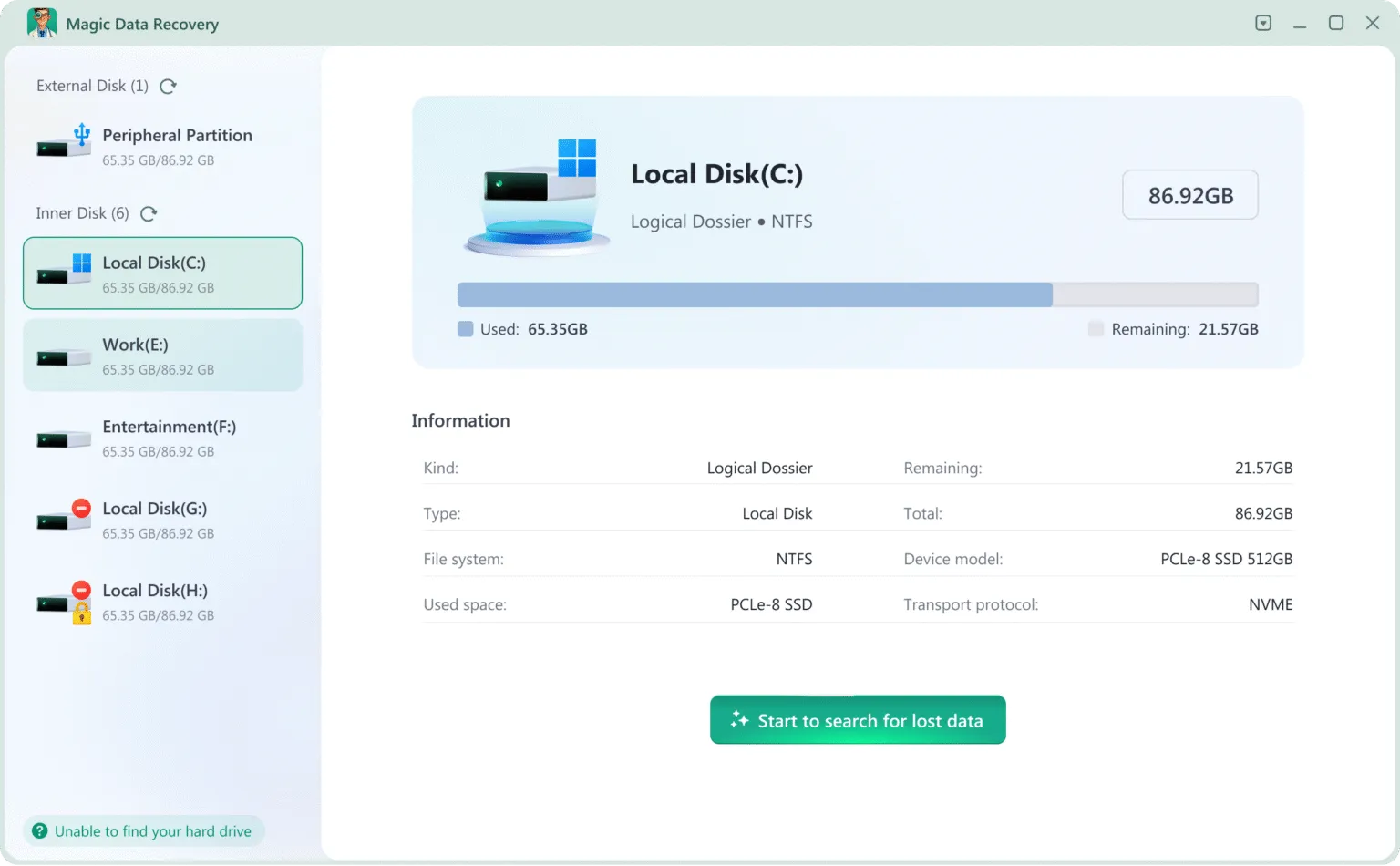
Step 2: Select the Original Storage Location
Launch the program and choose the disk or partition that contained the deleted Downloads folder.
For browser downloads on a standard Windows setup, this is often the C: partition.
If the files came from a USB drive, SD card, or external hard drive, connect the device and select it from the drive list.
Step 3: Scan for Lost Data
Start the scan.
Allow it to complete for the most comprehensive result set, especially after formatting or file system errors.
You can review files while the scan proceeds, but an incomplete scan may not show every recoverable item.
Step 4: Search, Filter, and Preview
Use the original filename when known. Otherwise, filter by extension, size, date, or file type.
For example:
- Documents: DOCX, XLSX, PPTX, PDF
- Images: JPG, PNG, HEIC, PSD
- Video: MP4, MOV, AVI
- Archives: ZIP, RAR, 7Z
- Installers: EXE, MSI
Preview important files where supported. A correct preview provides stronger evidence that the file content remains readable.
Step 5: Recover to Another Drive
Select the required files and choose a different destination.
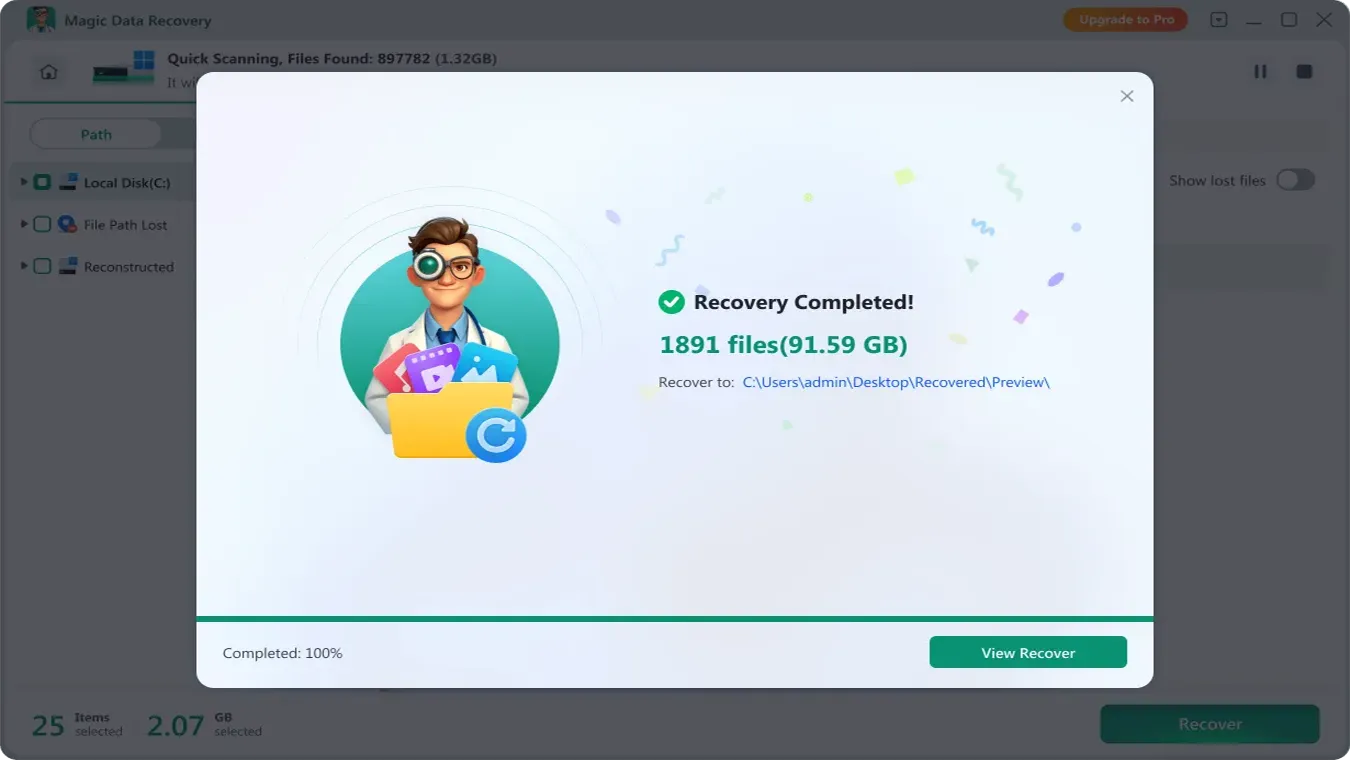
Do not restore them to the original Downloads folder until you have finished all recovery attempts.
For more deletion-specific troubleshooting, see:
Download Recover Files Method Comparison
Method | Best for | Requires prior backup | Main limitation |
Ctrl + Z | An immediate accidental deletion | No | Works only before later actions replace the undo history |
Recycle Bin | Normal deletion from an internal drive | No | Fails after emptying, Shift + Delete, or bypassed deletions |
Re-download | Public installers, attachments, and unchanged online files | No | The original source may be unavailable or unsafe |
Cloud restore | Synced or uploaded files | Cloud copy required | Retention periods and account access apply |
File History | Files included in a configured Windows backup | Yes | Must have been enabled before deletion |
Windows File Recovery | Command-line recovery from local storage | No | Technical syntax and no visual preview |
Magic Data Recovery | Permanent deletion, formatting, file system errors, and broad device recovery | No | Cannot repair physical damage or recover overwritten data |
This download recover files comparison shows why no single download recover files method fits every case.
Start with reversible actions. Then use a storage scan only when simpler options fail.
Which Recovery Method Should You Use?
The File Was Deleted Seconds Ago
Press Ctrl + Z. If that fails, open the Recycle Bin immediately.
The Downloads Folder Was Emptied
Check:
- Recycle Bin
- File History
- Previous Versions
- OneDrive or another cloud service
- Browser download history
Next, use Windows File Recovery or Magic Data Recovery.
The File Came from a Website or Email
Check browser history, email attachments, account dashboards, and trusted cloud sources before scanning the disk.
The Drive Was Formatted
Stop using it. Do not create a new partition or copy files to it.
Use a recovery scanner that handles formatted storage. Magic Data Recovery is suitable when Windows still detects the physical device.
The Drive Shows RAW or Asks to Be Formatted
Cancel the formatting prompt and scan the device first.
File-system repair should come after important data has been copied elsewhere.
The Drive Clicks or Disconnects Repeatedly
Do not run a prolonged software scan. Disconnect the device and seek professional assistance.
Matching the method to the data-loss event makes download recover files recovery safer and more efficient.
HDD vs. SSD: Why Storage Type Matters
Deleted-file recovery behaves differently across storage technologies.
Hard Disk Drives
On an HDD, deleted data may remain in its original sectors until Windows overwrites them.
Therefore, stopping drive use quickly can preserve a useful recovery window.
Solid-State Drives
SSDs use TRIM and internal garbage collection to manage unused blocks. Windows delete notifications can inform supported storage devices that specific clusters are no longer in use.
As a result, direct recovery from an SSD can become difficult sooner than recovery from an HDD.
This does not mean every SSD deletion is hopeless. The following options may still work:
- Recycle Bin
- File History
- Cloud copies
- Previous Versions
- Snapshots
- Immediate recovery scans
However, act quickly and avoid repeated scanning or unnecessary writes.
Common Download Recover Files Mistakes
Avoid these errors when you download recover files:
- Installing the recovery tool on the affected drive
- Saving restored files back to the source drive
- Continuing to download large games, videos, or updates
- Formatting a RAW drive before recovery
- Running CHKDSK before copying important files
- Downloading cracked recovery tools from unknown sites
- Assuming a filename alone proves the file is healthy
- Scanning a physically failing drive repeatedly
- Expecting software to recover overwritten data
- Treating cloud-only files as locally recoverable
A careful workflow protects more data than repeatedly trying random recovery programs.
How to Prevent Future Loss of Downloaded Files
The Downloads folder often becomes temporary storage, which makes important files easy to delete during cleanup.
Use these habits:
- Move important documents from Downloads into organized folders.
- Enable File History or another versioned backup.
- Keep an offline copy of critical work.
- Sync selected folders to a trusted cloud service.
- Review Storage Sense settings before automatic cleanup.
- Confirm the Downloads checkbox before deleting temporary files.
- Keep software installers in a dedicated archive when licenses or versions matter.
- Test backups by restoring a sample file.
Prevention turns the next download recover files emergency into a straightforward restore. It also reduces the need to download recover files software under pressure.
Conclusion
A safe download recover files process begins with protecting the original drive.
Try Ctrl + Z, Recycle Bin, re-downloading, cloud copies, File History, and Previous Versions first. Windows File Recovery offers a free command-line option, while dedicated software becomes more useful when files were permanently deleted, the disk was formatted, or file system errors hide the data.
Magic Data Recovery is recommended because it combines a visual scan, filtering, preview, broad file-type support, and recovery for several logical data-loss scenarios without requiring command-line knowledge. It also lets users test recoverability before committing to a full recovery.
For a complete strategy, return to the deleted file recovery hub and choose the method that matches your loss scenario.
Supports Windows 7/8/10/11 and Windows Server
FAQs
Can I Download Recover Files After Emptying the Recycle Bin?
Yes, recovery may still be possible because emptying the Recycle Bin usually removes file references and marks their storage space as reusable. Stop using the affected drive immediately. Then scan it with Windows File Recovery or Magic Data Recovery and save restored files to another disk. Recovery becomes less likely after new data overwrites the deleted sectors.
Is It Safe to Download Recover Files Software to Drive C?
It is risky when the missing files were stored on drive C. Downloading and installing software creates new data that could overwrite deleted content. Use another computer to download the installer, place it on a USB drive, and install it to a different partition when possible. Always save recovered files to a separate destination as well.
How Can I Recover a Deleted Downloads Folder in Windows 11?
Start with Ctrl + Z and the Recycle Bin. Next, check File History, Previous Versions, OneDrive, and browser download history. If no backup or replacement copy exists, run Windows File Recovery or a graphical tool such as Magic Data Recovery. Scan the original partition but restore the found folder to another drive.
Can I Re-Download Files Instead of Recovering Them?
Yes, re-downloading is often the easiest solution for installers, public documents, email attachments, and files stored in an online account. Check browser history, the original email, purchase portals, and trusted cloud services. Do not use unknown mirror sites, especially for executable files, because the replacement may be outdated, modified, or infected.
Can Magic Data Recovery Recover Files After Formatting?
Magic Data Recovery can scan a Windows-detected drive after quick formatting and look for recoverable file records or file signatures. Stop using the formatted device and do not write a new operating system or large files to it. Results depend on later overwriting, the type of format, the file system, and the physical condition of the storage device.
Is Windows File Recovery Better Than Magic Data Recovery?
Windows File Recovery is free and useful for users who understand command syntax, source and destination drives, filters, and recovery modes. Magic Data Recovery provides a graphical interface, file preview, search, and filtering, which may suit ordinary users better. The better choice depends on technical comfort, the loss scenario, and whether you need visual verification.
Can Download Recover Files Methods Restore Data from an SSD?
Sometimes. Recycle Bin, backups, cloud copies, and snapshots may restore SSD files normally. Direct deleted-file scanning is less predictable because TRIM and garbage collection can clear unused blocks. Stop using the SSD immediately and avoid installing software on it. No program can recover data after the relevant blocks have been erased or overwritten.
8. Why Are Recovered Files Corrupted or Unable to Open?
A recovery tool may find a filename or file signature even when part of the content has already been overwritten. Fragmentation, file-system damage, interrupted downloads, and failing hardware can also produce incomplete files. Preview results before recovery, try an earlier backup or cloud version, and avoid writing more data to the source drive during additional attempts.

Jason has over 15 years of hands-on experience in the computer data security industry. He specializes in data recovery, backup and restoration, and file repair technologies, and has helped millions of users worldwide resolve complex data loss and security issues.