
How to Find Bitlocker Recovery Key with Recovery Key ID
Users may encounter BitLocker issues and pose questions on the Microsoft Community. For example:
“My Dell Inspiron laptop suddenly crashed. After restarting it, it indicates that the hard drive is not installed. It prompts me to enter the BitLocker Recovery key and shows an 8-digit Key ID below it. I’ve never heard of BitLocker before. I attempted to retrieve the key through my Microsoft account, but it says the key isn’t associated with it. Is there any way I can recover the BitLocker Recovery key using this 8-digit Key ID? Please assist!”
To locate your BitLocker recovery key, you first need to have a good understanding of BitLocker and the BitLocker recovery key ID. Magic Recovery Key makes it easy to find your BitLocker recovery key quickly and efficiently. You can download it using the button below.
Supports Windows 7/8/10/11 and Windows Server
Table of Contents
What is the Bitlocker?
BitLocker is a Windows security feature that protects your data by encrypting your drives. This encryption ensures that if someone tries to access a disk offline, they won’t be able to read any of its content.
BitLocker is particularly valuable if your device is lost or stolen, as it keeps your sensitive information secure. It’s designed to be user-friendly and integrates seamlessly with the Windows operating system, making it easy to set up and manage.
Can You Recover BitLocker with Key ID Only?
No. A BitLocker Recovery Key ID cannot unlock your encrypted drive by itself.
The Key ID is used to identify which recovery key belongs to the locked drive. The actual key you need is a 48-digit numerical BitLocker recovery key. When BitLocker asks for recovery, Windows may show a Key ID on the blue recovery screen. You need to use that ID to search your saved recovery key records and find the matching 48-digit key.
Item | Recovery Key ID | BitLocker Recovery Key |
Purpose | Identifies the correct recovery key | Unlocks the BitLocker-encrypted drive |
Format | A shorter identifier string | 48-digit numerical password |
Can unlock BitLocker? | No | Yes |
Where it appears | BitLocker recovery screen, saved key file, admin portal | Microsoft account, USB, printout, TXT file, AD, Entra ID, backup |
So, if you only have the Key ID, your next step is not to enter it as the recovery key. Instead, you should use it to locate the matching 48-digit recovery key.
How to Find the Bitlocker Recovery Key ID
Finding the BitLocker recovery key ID is an important step in further locating your BitLocker recovery key, because the BitLocker ID corresponds to the recovery key. Here are two methods for obtaining your BitLocker recovery ID.
Method 1: From within Windows
To locate the key identifier for a drive, partition, or removable drive follow the steps below.
1. From the start menu, search for CMD then right-click Command Prompt and click run as administrator.

manage-bde -protectors -get <drive letter>: where <drive letter> is the drive letter for the BitLocker protected drive that you want to recover.

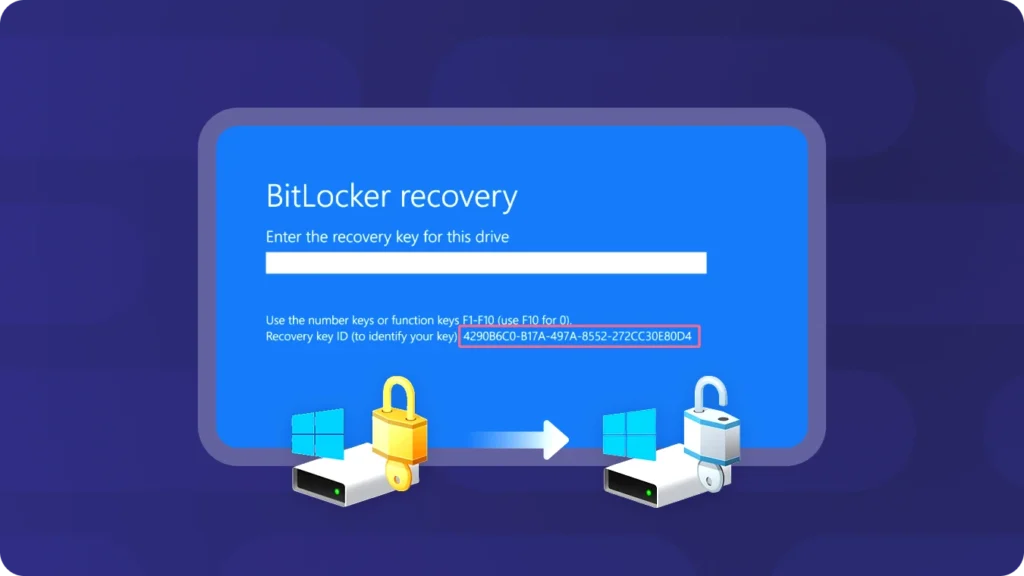
Method 2: From the BitLocker recovery screen
If your computer is booting to the BitLocker recovery screen, the key identifier is in the highlighted area of the following image.

Method 3: Check Your Work or School Account
If the computer belongs to a company, school, or organization, the recovery key may be saved to a work or school account instead of a personal Microsoft account.
This usually applies when:
- The device is managed by a company or school
- You signed in with a work or school account
- The PC was joined to Azure AD or Microsoft Entra ID
- The computer was issued by an IT department
Sign in to your work or school account and check whether your organization allows you to view BitLocker recovery keys. If you cannot access the key yourself, contact your IT administrator and provide the Recovery Key ID shown on your screen.
Method 4: Ask Your IT Admin to Search Active Directory or Microsoft Entra ID
For business devices, the BitLocker recovery key may be stored in:
- Active Directory Domain Services
- Microsoft Entra ID
- Endpoint Manager / Intune
- Other enterprise device management systems
In this case, the Recovery Key ID is very useful. Your IT administrator can search for the matching key by using the Key ID. Once the correct record is found, the admin can provide the 48-digit recovery key needed to unlock the device.
When contacting IT support, provide:
- The full Recovery Key ID
- Device name
- User account
- Serial number, if available
- Screenshot or photo of the BitLocker recovery screen
Method 5. Check USB Drives
When BitLocker was first enabled, Windows may have offered an option to save the recovery key to a USB flash drive.
Insert any USB drives you may have used before and search for files related to BitLocker. The file name may look similar to:
BitLocker Recovery Key XXXXXXXX-XXXX-XXXX-XXXX-XXXXXXXXXXXX.txt
Open the file and compare the Recovery Key ID with the one shown on your locked PC. If they match, enter the 48-digit recovery key.
Method 6. Check Printed Copies or Paper Records
Some users choose to print the BitLocker recovery key when enabling BitLocker.
Check places where you may store important documents, such as:
- Desk drawers
- Filing folders
- Computer purchase documents
- Office IT records
- School or company device paperwork
- Personal password storage notebooks
If you find a printed BitLocker recovery key, compare the Key ID before entering the 48-digit key.
Method 7. Search Old Backups or Saved TXT Files
The BitLocker recovery key may have been saved as a TXT file on another drive, old computer, backup disk, or cloud folder.
Search for file names and keywords such as:
BitLocker Recovery Key
Recovery Key
BitLocker
48-digit
Key ID
Check locations such as:
- External hard drives
- Old Windows installations
- OneDrive
- Google Drive
- Dropbox
- Desktop folders
- Documents folders
- USB backups
- Email attachments
Once you find a BitLocker recovery key file, compare the Key ID carefully. Do not enter a recovery key unless the Key ID matches the locked drive.
How to Do Bitlocker Recovery with Key ID
Once you have the Key ID, you can then attempt to find the BitLocker recovery key for that drive. Magic Recovery Key is a recommended tool as it can list both your BitLocker recovery key and the corresponding key ID. After that, you can use the BitLocker recovery key to unlock your BitLocker – encrypted drive.
Please download and install Magic Recovery Key from a reputable source to proceed.
Supports Windows 7/8/10/11 and Windows Server


How to Avoid Losing Your BitLocker Recovery Key Again
After you regain access to your drive, take a few minutes to back up your recovery key properly.
Recommended backup methods include:
- Save it to your Microsoft account
- Save it to a USB drive
- Print a physical copy
- Store a TXT copy in a secure backup location
- Save it in a trusted password manager
- For business devices, confirm that the key is backed up to your organization’s management system
You can also check your BitLocker status in Windows by opening Control Panel and going to:
Control Panel > System and Security > BitLocker Drive Encryption
From there, you can back up your recovery key again.
Conclusion
When a BitLocker-protected drive is locked, Windows may display a Recovery Key ID instead of the actual recovery key. It is important to understand that the Recovery Key ID is not the key itself, but a reference used to help identify which 48-digit BitLocker recovery key is required.
By using the Recovery Key ID, you can match it with the correct recovery key stored in various locations, such as your Microsoft account, Active Directory / Azure AD (for work or school devices), USB drives, printed records, or backup files. In some cases, specialized recovery tools may also help locate previously saved keys on the system.
Knowing how to retrieve the Recovery Key ID and where to search for the corresponding recovery key can save significant time and prevent unnecessary data loss. To avoid future issues, it is always recommended to securely back up your BitLocker recovery key as soon as encryption is enabled.
You can download Magic Recovery Key using the button below if you need to find your bitlocker recovery key.
Supports Windows 7/8/10/11 and Windows Server
FAQs
What is a BitLocker Recovery Key ID?
Is the Recovery Key ID the same as the BitLocker recovery key?
How can I find my BitLocker recovery key using the Key ID?
Can I view the Recovery Key ID from Windows Command Prompt?
Where is the recovery key stored if my device is managed by an organization?
What if I never backed up my BitLocker recovery key?
Can third-party tools help find my BitLocker recovery key?
What happens if I cannot find the matching recovery key?

Erin Smith is recognized as one of the most professional writers at Amagicsoft. She has continually honed her writing skills over the past 10 years and helped millions of readers solve their tech problems.