
Repairing Disk Errors: Causes, Fixes & Data Recovery Guide
Why Repairing Disk Errors Should Not Be Ignored
Seeing the message “repairing disk errors” during Windows startup can be alarming, especially when your system appears stuck for hours. For many users, this happens suddenly—after a forced shutdown, a system crash, or an unexpected power outage.
While Windows attempts to protect your system by scanning and repairing disk issues automatically, disk errors often signal deeper file system problems or early signs of drive failure. If handled incorrectly, these errors may lead to permanent data loss.
This guide explains what repairing disk errors really means, why it happens, and how to fix it safely. More importantly, it shows how to protect and recover your data when standard repairs are not enough—using a reliable solution like Magic Data Recovery.
Supports Windows 7/8/10/11 and Windows Server
Table of Contents
What Does “Repairing Disk Errors” Mean in Windows?
When Windows displays repairing disk errors, it indicates that the operating system has detected inconsistencies in the file system or disk structure.
In most cases, Windows automatically launches a disk check utility—commonly CHKDSK—to scan the drive for logical errors, corrupted file entries, or bad sectors.
This process aims to:
- Fix file system inconsistencies
- Mark unusable sectors
- Restore disk stability
However, successful repair depends on the severity of the disk issue. Logical errors are usually fixable, while physical damage may continue to worsen over time.
Common Causes of Repairing Disk Errors
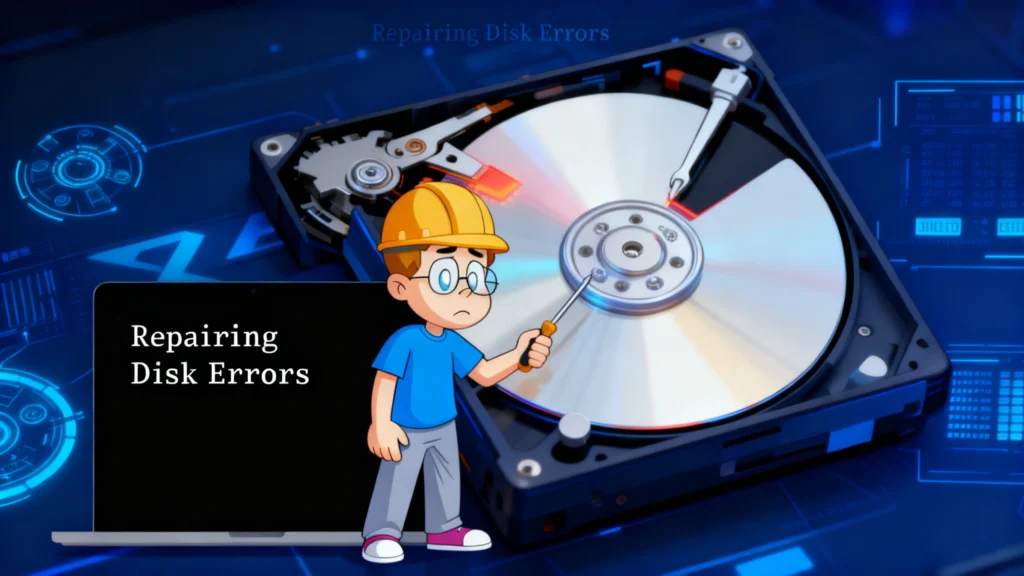
Understanding the root cause helps you choose the safest fix and avoid unnecessary data loss.
1. Improper Shutdowns and Power Failures
Sudden power loss interrupts disk write operations. As a result, file tables may become inconsistent, triggering repairing disk errors at the next boot.
2. File System Corruption
Corrupted NTFS or FAT file systems often occur after system crashes, forced restarts, or failed Windows updates.
3. Bad Sectors on the Hard Drive
Bad sectors are unreadable areas of a disk.
- Soft bad sectors result from logical errors.
- Hard bad sectors indicate physical damage and often worsen over time.
4. Aging or Failing Hardware
Mechanical wear, overheating, or manufacturing defects can gradually degrade a drive’s reliability.
5. Malware or Software Conflicts
Certain malware or low-level system utilities may damage disk structures, leading to recurring errors.
Symptoms That Indicate a Serious Disk Problem
Some warning signs suggest that repairing disk errors may not resolve the underlying issue:
- Repeated disk repair loops during startup
- Extremely slow boot times
- Frequent system freezes or blue screens
- Clicking or grinding noises from HDDs
When these symptoms appear, protecting your data becomes more important than forcing repairs.
How to Fix Repairing Disk Errors Safely
Method 1: Let Windows Complete the Repair
If the process starts automatically, patience is often the safest choice. Interrupting disk repair can worsen file system corruption.
Tip:
If the process lasts longer than 2–3 hours without progress, the issue may be more serious.
Method 2: Run CHKDSK Manually (Recommended)
Running CHKDSK manually gives you more control over the repair process.
Steps:
- Boot into Windows Recovery or Safe Mode
- Open Command Prompt as Administrator
- Enter:
chkdsk C: /f
- Restart your PC when prompted
/f fixes logical file system errors without scanning every sector.
Method 3: Use CHKDSK /r for Deeper Repairs
chkdsk C: /r
The /r parameter locates bad sectors and attempts data recovery.
Important:
This process can take several hours and increases disk stress. It is not ideal for failing drives.
Method 4: Run SFC and DISM
If disk errors affect system files:
sfc /scannow
Followed by:
DISM /Online /Cleanup-Image /RestoreHealth
These tools repair Windows system components without altering user files.
When Repairing Disk Errors Causes Data Loss
Disk repair tools modify file structures. During this process:
- Corrupted files may become inaccessible
- Entire partitions may disappear
- Files may be marked as lost
This is where traditional disk repair methods fall short.
Recovering Lost Data with Magic Data Recovery
When repairing disk errors results in missing or inaccessible files, Magic Data Recovery provides a safer recovery-focused approach.
How Magic Data Recovery Helps
- Recovers files lost after CHKDSK repairs
- Extracts data from corrupted or inaccessible partitions
- Works even when Windows fails to boot properly
Key Advantages
- Read-only scanning prevents further damage
- Supports HDDs, SSDs, USB drives, and memory cards
- Deep scan technology for complex disk corruption
Typical Use Case
A system enters a disk repair loop after a power failure. CHKDSK completes, but documents and photos are missing. Magic Data Recovery scans the affected drive and restores recoverable files before further deterioration.
Why It’s More Reliable
Unlike disk repair tools that prioritize structure over data, Magic Data Recovery focuses on preserving and recovering files safely.
If you are looking for a more reliable solution to recover data after repairing disk errors, Magic Data Recovery is worth considering.
How to Prevent Disk Errors in the Future
- Shut down Windows properly
- Use a UPS to prevent power loss
- Run periodic disk checks
- Keep regular backups
- Replace aging drives proactively
Preventive maintenance reduces the risk of recurring disk corruption.
Conclusion: Fix Disk Errors Without Risking Your Data
While repairing disk errors is a built-in Windows safeguard, it does not guarantee data safety. Basic repairs work for minor issues, but serious disk problems require a careful balance between repair and recovery.
When data loss occurs, Magic Data Recovery provides a practical and safer solution—allowing you to retrieve files before irreversible damage happens. Choosing the right approach protects both your system and your data.
Supports Windows 7/8/10/11 and Windows Server
FAQs
How do I fix a repairing disk error?
How long should I wait for repairing disk errors?
Is it safe to repair disk errors myself?
How to run a CHKDSK repair?
Can I interrupt repairing disk errors?
Which is better, CHKDSK /f or /r?
Can I turn off my PC during automatic repair?

Erin Smith is recognized as one of the most professional writers at Amagicsoft. She has continually honed her writing skills over the past 10 years and helped millions of readers solve their tech problems.