
How to Recover Unsaved Excel File

Supports Windows 7/8/10/11 and Windows Server
Table of Contents
Why Excel Files Become Unsaved
How to Recover Unsaved Excel File: All Working Methods
1. Use Excel’s Built-In AutoRecover (Most Effective Option)
Microsoft Excel automatically saves temporary versions of your workbook every few minutes.
Here Are the Steps:
① Open Excel
② Go to File > Info
③ Select Manage Workbook
④ Click Recover Unsaved Workbooks
⑤ Choose the version you want, then save it immediately
Tip: If AutoRecover was disabled, consider enabling it under File > Options > Save to prevent future data loss.
2. Find the Unsaved Excel File Location Manually
Excel stores backup copies inside a specific folder. If the built-in interface does not show your file, you can manually navigate to its path.
Common Unsaved Excel File Location (Windows)
C:\Users\[YourName]\AppData\Local\Microsoft\Office\UnsavedFiles\
How to Use It
① Open File Explorer
② Paste the path
③ Look for files with the .tmp or .xlsb extension
④ Open each file to confirm the version
This method often uncovers temporary backups that Excel does not display in the program.
3. Check the Temporary Excel Files Location
Windows frequently stores Excel autosaves inside the system temp directory. Locating this folder gives you another opportunity to recover your work.
Typical Temporary Excel Files Location
C:\Users\[YourName]\AppData\Local\Temp\
The Steps for Checking the Temporary
① Press Win + R
② Type %temp%
③ Sort by “Date Modified”
④ Look for recently created Excel-related temporary files
This directory is especially useful after a sudden crash or forced reboot.
4. Restore from Previous Versions (Windows File History)
If File History is enabled, Windows may keep earlier versions of your Excel file.
How to Restore
① Right-click the folder containing your Excel file
② Choose Restore previous versions
③ Select the correct backup
④ Click Restore
However, this method only works if File History or OneDrive Version History was active beforehand.
5. Recover Unsaved Excel Files Using Magic Data Recovery (Professional Solution)
If Excel’s built-in recovery options cannot find the workbook, first determine whether the file was previously saved. Magic Data Recovery can help when an existing Excel file—or an AutoRecover or temporary copy—was deleted, lost after formatting, or became inaccessible because of a file system problem. If the workbook was never saved and no temporary copy was created, data recovery software may not be able to reconstruct it. Magic Data Recovery provides a read-only scanning engine capable of restoring Excel data even after formatting or corruption.
Why Magic Data Recovery Helps
Recovers deleted Excel files and recoverable temporary copies
Supports NTFS, FAT32, exFAT, and SSD/TRIM environments
Read-only scanning to protect original data
Useful when temporary files have been removed by cleanup software
Recovery Steps
① Download and install Magic Data Recovery
Supports Windows 7/8/10/11 and Windows Server

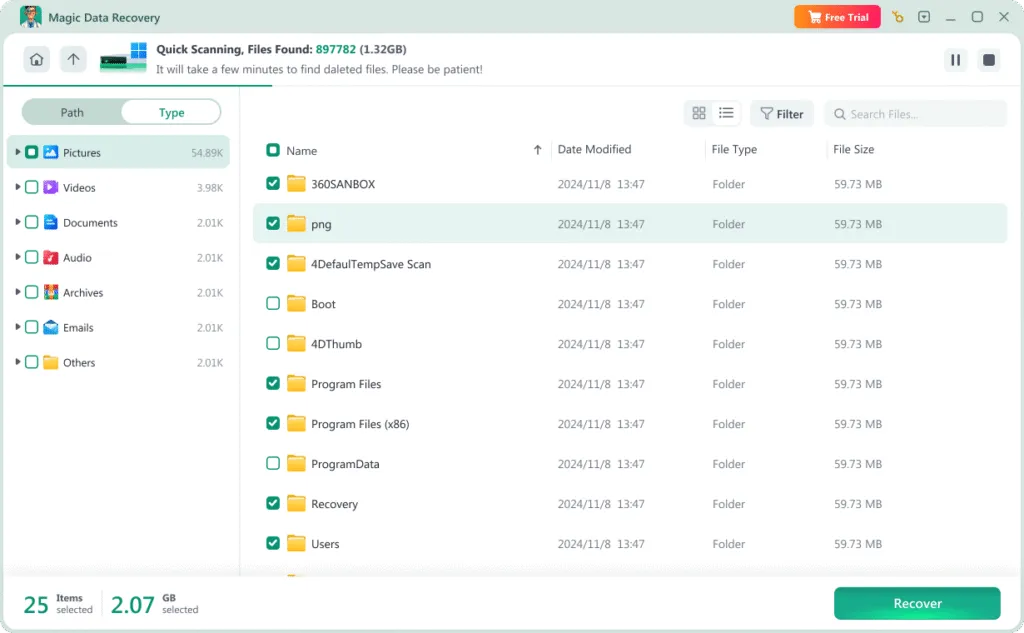
④ Filter results by Excel file types (*.xlsx, *.xls, .xlsb)
⑤ Preview the recovered workbook and save it to a secure location

Common Methods vs. Magic Data Recovery
Before choosing a recovery method, it’s important to understand what each approach can realistically achieve. Excel’s built-in tools are convenient for simple scenarios—such as unsaved work caused by a crash—but they rely entirely on temporary files that may no longer exist after a system cleanup or unexpected shutdown. A professional tool like Magic Data Recovery, however, scans the disk directly and provides a deeper, more comprehensive way to recover missing Excel files when standard methods fall short. The comparison below outlines the key differences so you can select the most suitable option.
Comparison Item | Common Excel/Windows Methods | Magic Data Recovery |
Recovery Scope | Retrieves unsaved files through AutoRecover or temp folders | Recovers deleted Excel files and recoverable AutoRecover or temporary copies through disk scanning |
Dependency on File Locations | Entirely depends on the unsaved Excel file location and temporary Excel files location | Works even if temporary files were removed or paths are unavailable |
Success Rate | Effective only when temp files still exist and AutoRecover was enabled | Higher success rate in complex cases such as accidental deletion, system crashes, partition errors |
Version Availability | Provides only the most recent autosaved version | Identifies multiple recoverable file versions detected during disk scanning |
Technical Requirements | Requires Excel and Windows paths to be functioning normally | Operates independently of Excel and supports corrupted or unstable systems |
Ease of Use | Free but often requires manual navigation and checking multiple folders | Offers guided steps, file preview, and simplified recovery for all users |
Advanced Scenario Support | Not suitable for deleted files or missing system paths | Useful when a previously saved Excel file is lost because of deletion, formatting, a RAW partition, or file system errors |
Best Use Case | Basic unsaved scenarios after minor crashes | Serious data loss, deletion, or system-level issues that standard tools cannot solve |
Summary
Supports Windows 7/8/10/11 and Windows Server
How to Recover Unsaved Excel File FAQs
Where can I find the unsaved Excel file location?
How do I recover an Excel file after a crash?
Can I restore temporary Excel files manually?
What if the AutoRecover option was disabled?
Can Excel recover overwritten files?
Are temporary Excel files automatically deleted?
Will Magic Data Recovery recover corrupted Excel files?
Is it possible to recover a permanently deleted Excel file?

Erin Smith is recognized as one of the most professional writers at Amagicsoft. She has continually honed her writing skills over the past 10 years and helped millions of readers solve their tech problems.