
SSD Drive Not Recognized: Causes, Fixes, and Data Recovery Guide
Table of Contents
Why Is Your SSD Drive Not Recognized?
An SSD drive not recognized error is one of the most frustrating storage problems users face today. You connect the SSD to your PC, but it does not appear in File Explorer, Disk Management, or even the BIOS. In many real-world cases, this issue happens suddenly—after a system update, power outage, improper shutdown, or disk formatting failure.
When an SSD drive not recognized issue occurs, users often worry about two things:
- whether the SSD hardware is damaged, and
- whether their important data is permanently lost.
The good news is that many SSD detection problems are software-related, not physical failures. Issues such as partition loss or a file system turning RAW can prevent the drive from being recognized properly. In these scenarios, professional recovery tools like Magic Data Recovery can help retrieve lost data safely using SSD solution before further repair attempts.
Supports Windows 7/8/10/11 and Windows Server
Causes of “SSD Drive Not Recognized”
An SSD drive not recognized problem can appear in several ways:
- SSD not showing up in File Explorer
- SSD visible in Disk Management but marked as Unallocated
- SSD file system appears as RAW
- SSD not detected in BIOS or UEFI
- Windows shows “Unknown Device” or no response at all
Each symptom points to a different root cause, which is why accurate diagnosis is critical before taking action.
Common Causes of SSD Drive Not Recognized
Understanding why an SSD drive not recognized issue occurs helps you choose the correct solution and avoid data loss.
1. Connection or Power Issues
Loose SATA cables, faulty USB adapters, or insufficient power supply often cause SSD detection failures. External SSDs are especially vulnerable to unstable USB ports.
Typical scenario:
A portable SSD works on one computer but not another due to a damaged USB cable.
2. Missing or Lost SSD Partition
If the SSD partition table is damaged, the drive may appear as Unallocated. This commonly happens after:
- Accidental disk initialization
- Partition deletion
- Interrupted formatting
In this case, the SSD drive not recognized issue is logical, not physical.
3. RAW File System Error
When Windows cannot read the SSD’s file system, it may show the drive as RAW. This can be caused by:
- Sudden power failure
- Unsafe ejection
- File system corruption
A RAW SSD cannot be accessed without formatting, which puts data at risk.
4. Outdated or Corrupted Drivers
Incorrect storage controller drivers may prevent the system from recognizing the SSD correctly.
5. BIOS or Firmware Issues
If the SSD is not detected in BIOS, possible reasons include:
- Disabled SATA ports
- Outdated SSD firmware
- Incorrect boot mode (AHCI vs. RAID)
6. Physical SSD Failure
Although less common, NAND wear, controller failure, or firmware corruption can lead to a truly dead SSD.
How to Fix SSD Drive Not Recognized (Step-by-Step)
Below are proven solutions to fix an SSD drive not recognized problem, starting with the safest methods.
Solution 1: Check Physical Connections
- Reconnect SATA or USB cables
- Try a different port or adapter
- Test the SSD on another computer
This simple step resolves many detection issues.
Solution 2: Check Disk Management
- Press Win + X → Disk Management
- Locate the SSD
Possible outcomes:
- Unallocated: Partition lost
- RAW: File system corrupted
⚠️ Do not format the drive if data is important.
Solution 3: Recover Data from Lost or RAW SSD (Recommended)
When partition loss or RAW file systems cause an SSD drive not recognized issue, data recovery should be the first priority.
Why Use Magic Data Recovery?
Magic Data Recovery is designed to handle complex SSD data loss scenarios safely.
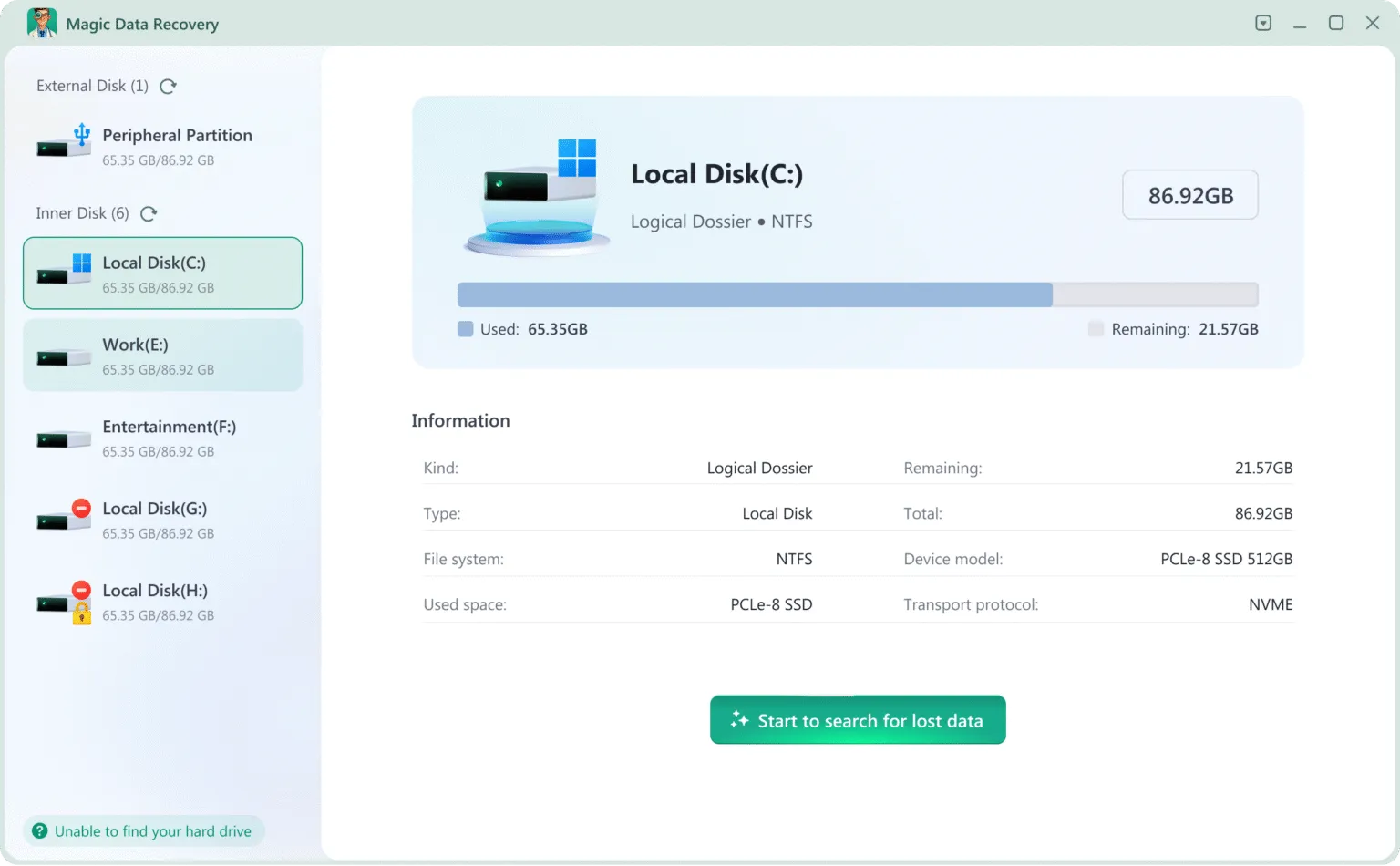
Core Problems It Solves
- Lost or deleted SSD partitions
- RAW file system recovery
- SSD not recognized after formatting
- File system errors preventing access
Key Advantages
- Deep scan technology for SSDs
- Supports NTFS, FAT32, exFAT, RAW
- Read-only recovery to avoid data overwrite
- Simple interface suitable for non-technical users
Real-World Use Case
A user’s SSD becomes RAW after a sudden shutdown. Windows prompts for formatting, but Magic Data Recovery scans the disk directly and recovers documents, photos, and videos without modifying the drive.
Compared with manual repair commands, Magic Data Recovery is more reliable because it avoids further corruption during the recovery process.
If you are looking for a safer and more efficient SSD recovery solution, Magic Data Recovery is worth trying before any repair attempts.
Supports Windows 7/8/10/11 and Windows Server
Solution 4: Assign or Change Drive Letter
Sometimes the SSD is recognized but lacks a drive letter.
- Open Disk Management
- Right-click the SSD
- Choose Change Drive Letter and Paths
Solution 5: Update Storage Drivers
- Open Device Manager
- Update SATA/USB controllers
- Restart the system
This fix helps when drivers block SSD recognition.
Solution 6: Check BIOS Settings
- Enter BIOS/UEFI
- Confirm SSD is enabled
- Set SATA mode to AHCI
- Update BIOS if necessary
If the SSD does not appear in BIOS, hardware issues become more likely.
How to Tell If an SSD Is Physically Dead
An SSD drive not recognized issue does not always mean failure. However, signs of a dead SSD include:
- Not detected in BIOS on multiple computers
- No power or activity indicator
- Unusual heating or burning smell
In such cases, professional repair may be required.
Preventing Future SSD Recognition Problems
- Always eject external SSDs safely
- Avoid sudden power loss
- Keep firmware and drivers updated
- Maintain regular backups
These best practices reduce the risk of recurring SSD drive not recognized errors.
Conclusion
An SSD drive not recognized issue can stem from simple connection problems or complex logical failures like partition loss and RAW file systems. While hardware checks and system fixes can restore access, data recovery should always come first when valuable files are involved.
Magic Data Recovery stands out because it focuses on safe, read-only recovery, supports SSD-specific failure scenarios, and delivers consistent results without requiring advanced technical skills. For users facing SSD recognition issues caused by logical errors, it provides a more reliable solution than risky manual commands.
Supports Windows 7/8/10/11 and Windows Server
FAQs
How to fix SSD not recognized?
How to fix SSD not showing up on PC?
Is SSD dead if not detected?
How to fix unreadable SSD?
How to tell if SSD is corrupted?
Why SSD is not recognized by BIOS?
How do I diagnose a dead SSD?

Erin Smith is recognized as one of the most professional writers at Amagicsoft. She has continually honed her writing skills over the past 10 years and helped millions of readers solve their tech problems.