
Thumb Drive Not Recognized? Full Guide to Fix & Recover Data
That sinking feeling is all too familiar. You plug in your USB thumb drive, but instead of seeing your files, you’re met with a frustrating error: “USB device not recognized” or the drive simply doesn’t appear in Windows File Explorer. A thumb drive not recognized is a common but stressful problem that threatens your precious photos, documents, and work files. Before you assume the worst, know that many causes are fixable.
This guide is your definitive resource. We will systematically explore every reason why your USB thumb drive is not recognized, from quick physical fixes to complex software solutions. More importantly, we provide actionable, step-by-step fixes for each scenario. A critical section addresses file system errors—a frequent culprit that makes data seem lost. For this specific problem, we recommend Magic Data Recovery as a reliable tool to rescue your files safely. Let’s diagnose and solve this issue together.
Table of Contents
Understanding the “USB Device Not Recognized” Error
When Windows fails to communicate with your thumb drive, it triggers a generic alert. This error can stem from various points of failure along the connection path. Think of it as a conversation between your computer and the drive. If the drive doesn’t “speak up” correctly, or if Windows “mishears” it, the connection fails.
The main actors here are the USB port, the drive’s hardware (controller and memory chips), the Windows USB drivers, and the file system that organizes the data. A fault in any of these areas can lead to your USB thumb drive not being recognized. Diagnosing the issue requires checking each component methodically, starting with the simplest possibilities.
Common Scenarios and Step-by-Step Fixes
Let’s break down the problem into specific scenarios. Follow these troubleshooting steps in order, as they escalate from simple to more advanced.
Scenario 1: Basic Hardware and Connection Checks
Often, the simplest solutions are the most effective. Never skip these foundational steps.
- Try a Different USB Port: Plug the drive into another port on your computer. The original port may be damaged or provide insufficient power.
- Test on Another Computer: This is a crucial diagnostic step. If the drive works on a second PC, the problem is isolated to your first computer’s software or ports.
- Inspect the Drive Physically: Look for any obvious damage, bent connectors, or debris inside the USB port. Gently clean the metal contacts with a dry cotton swab.
- Avoid USB Hubs: Plug the drive directly into a port on your computer. Hubs can sometimes cause power delivery issues, leading to a thumb drive not recognized error.
Scenario 2: Driver Issues in Windows
Corrupted or outdated USB drivers are a common software culprit. Here’s how to address them.
- Update or Reinstall Drivers:
- Right-click the Start button and select Device Manager.
- Expand the Universal Serial Bus controllers section.
- Look for any device with a yellow exclamation mark (!).
- Right-click on the problematic device (or on the USB Mass Storage Device if listed) and choose Update driver > “Search automatically for drivers.”
- If that doesn’t work, select Uninstall device. Then, unplug the drive, restart your computer, and plug it back in. Windows will attempt to reinstall fresh drivers.
- Change the Power Management Setting: Sometimes, Windows turns off devices to save power.
- In Device Manager, right-click on your USB Root Hub and select Properties.
- Go to the Power Management tab.
- Uncheck the box that says “Allow the computer to turn off this device to save power.” Click OK.
Scenario 3: Drive Letter Conflicts and Allocation Issues
Your USB thumb drive not recognized in File Explorer might simply be missing its drive letter.
- Open Disk Management (press Win + X and select it).
- Look for your thumb drive. It should appear here even if not in File Explorer.
- If the drive has a healthy partition but no letter (e.g., “Data (D:)”), right-click on the partition and select Change Drive Letter and Paths… > Add. Assign an available letter.
- If the drive shows as “Unallocated,” this indicates a more serious file system error or corruption. Do not initialize it, as this will make data recovery much harder. Proceed to the next section.
When File System Errors Cause Recognition Failure
This is a critical and complex scenario. The file system (like NTFS, FAT32, exFAT) is the roadmap Windows uses to read data on the drive. If this roadmap gets corrupted, Windows sees the drive as “Raw” or “Unallocated” in Disk Management and cannot access the files through normal means. Common causes include:
- Unsafe removal of the drive during a write operation.
- Malware or virus infection.
- Bad sectors on the flash memory.
- Sudden power loss while the drive is in use.
Signs of a File System Error:
- Drive appears in Disk Management but not in File Explorer.
- You are prompted to “format the disk” when you plug it in. Do not format.
- The drive’s properties show 0 bytes used and 0 bytes free.
- The file system is listed as “RAW.”
In these cases, your primary goal should be data recovery first, repair second. Attempting to fix the file system with Windows tools like chkdsk on a failing drive can sometimes overwrite the very data you’re trying to save.
How to Recover Data from a Thumb Drive with File System Errors
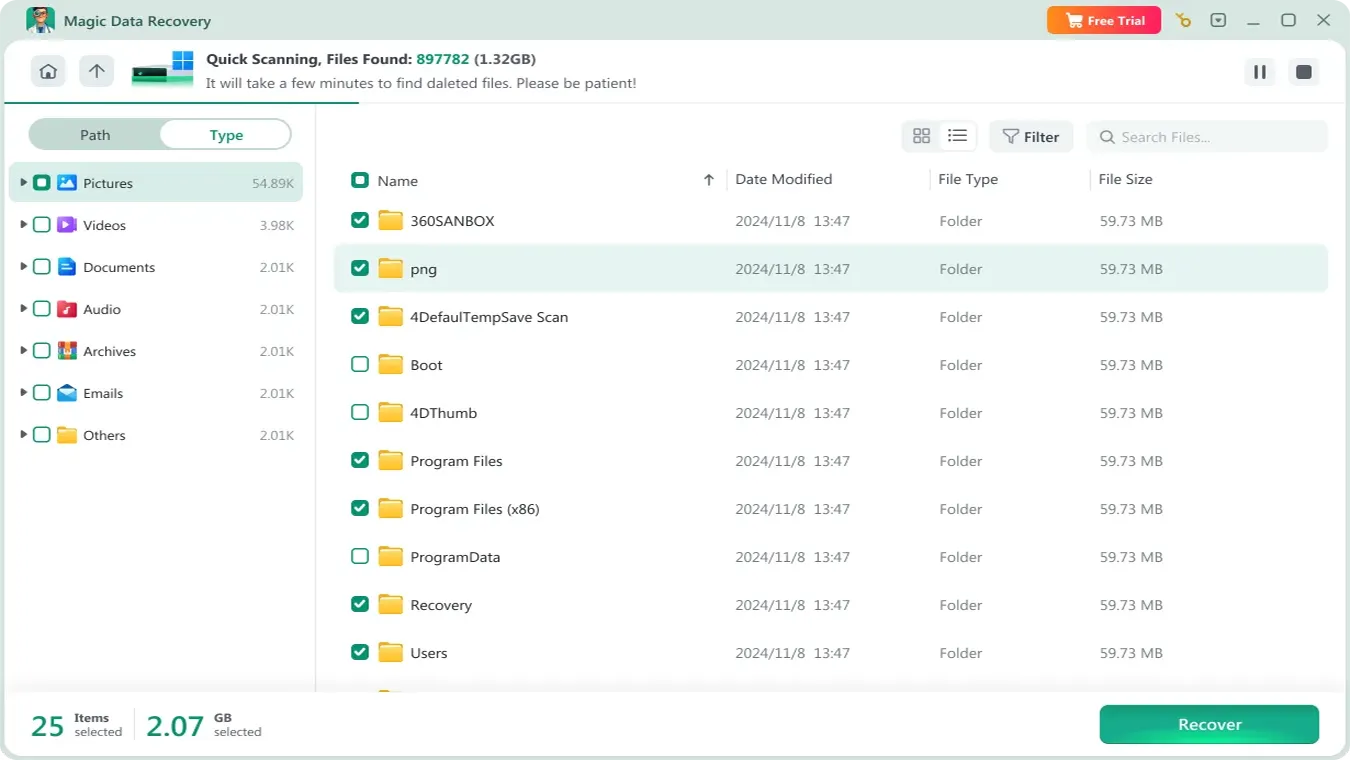
Magic Data Recovery is engineered to handle precisely this class of problems. Unlike generic fixes that risk further damage, it operates in a read-only mode, scanning the raw storage of your USB thumb drive to reconstruct files based on their signatures, bypassing the corrupted file system entirely.
Why Choose Magic Data Recovery for This Scenario?
- Solves the Core Pain Point: It directly addresses the inability to access data due to file system errors, partition loss, or drive formatting prompts.
- Key Advantages:
- Deep Scan Technology: It meticulously searches for recoverable file remnants, supporting hundreds of file types (documents, photos, videos, archives).
- Preview Before Recovery: You can see the found files and judge their quality before purchasing a license, ensuring the recovery is possible.
- User-Centric Design: The interface guides you through a simple three-step process: Select Drive > Scan > Recover, making it accessible for non-technical users.
- A Practical Use Case: Imagine your thumb drive with important project files suddenly becomes RAW. Instead of panicking, you run Magic Data Recovery. The software scans the drive, lets you preview the recovered project folders, and allows you to save them to a different, healthy drive—all without writing to the damaged thumb drive.
- Reliability Compared to Other Options: While free tools exist, they often lack the sophisticated algorithms for deep scanning and may not handle severe corruption well. Magic Data Recovery offers a more robust and dedicated solution, balancing power with ease of use, which gives you a higher chance of successful recovery from a thumb drive not recognized error.
If your data is valuable and the drive shows signs of file system damage, using a dedicated tool like Magic Data Recovery is the most reliable next step. You can download and scan with the free version to assess what can be recovered before making any commitment.
Supports Windows 7/8/10/11 and Windows Server
Advanced Troubleshooting Steps
If the drive is still not recognized after the above steps, consider these advanced measures.
- Check for Errors in Windows: Open Command Prompt as Administrator and type
chkdsk X: /f(replace X with your drive letter). Only do this if you have already recovered your data or if the data is not important, aschkdskcan be aggressive on failing hardware. - Use Windows Hardware Troubleshooter: Go to Settings > Update & Security > Troubleshoot > Additional troubleshooters. Run the Hardware and Devices troubleshooter.
- Update Your Motherboard Chipset Drivers: Visit your computer or motherboard manufacturer’s website to download the latest chipset/USB drivers.
Conclusion
A USB thumb drive not recognized error is a formidable obstacle, but it’s rarely a dead end. We’ve walked through a logical progression—from checking connections and drivers to resolving drive letter conflicts. The most delicate situation arises from file system errors, where standard Windows tools can fall short and even pose a risk to your data.
In such cases, employing a specialized data recovery tool is the prudent, professional approach. Magic Data Recovery is recommended because it provides a targeted, safe, and effective method to retrieve files from drives that Windows can no longer read normally. Its ability to perform a deep scan and preview results addresses the core user need: verifying that recovery is possible before any further action is taken.
To avoid future headaches, always eject your thumb drive safely using the “Safely Remove Hardware” notification. Keep backups of critical data on multiple locations, such as cloud storage or an external hard drive. Remember, your thumb drive is a convenient transport tool, not a primary backup solution. With these practices and the solutions outlined here, you can face the “USB device not recognized” message with confidence, not dread.
FAQs
Why can't my thumb drive be detected?
How do I fix my USB flash drive not recognized?
Why is my OTG pendrive not detecting?
How to tell if a thumb drive is corrupted?
How do I force my computer to recognize a USB?
Do USB flash drives go bad?
Why is my USB stick suddenly unreadable?
How to repair a dead USB flash drive?

Erin Smith is recognized as one of the most professional writers at Amagicsoft. She has continually honed her writing skills over the past 10 years and helped millions of readers solve their tech problems.