
Data Backup Strategy: The Complete Guide

Data loss can happen at any moment, and without a reliable data backup strategy, the consequences are often irreversible.
The 3 2 1 data backup strategy is widely recognized as one of the most effective ways to protect important files from hardware failure, accidental deletion, cyberattacks, and natural disasters. By following this proven data backup strategy, users can significantly reduce the risk of permanent data loss while ensuring fast and reliable recovery when unexpected incidents occur.
Table of Contents
What Is a Data Backup Strategy?
A data backup strategy is a structured plan that defines:
- What data should be backed up
- How often backups are created
- Where backups are stored
- How data can be restored when needed
Without a clear strategy, backups often become incomplete, outdated, or unreliable.
Common Problems Without a Backup Strategy
Many users face the same issues:
- Backups stored on the same device as original data
- Manual backups forgotten or delayed
- Cloud storage synced but not truly backed up
- No tested recovery process
These mistakes often lead to irreversible data loss. This is where the 3 2 1 data backup strategy proves its value.
What Is the 3 2 1 Data Backup Strategy?
The 3 2 1 data backup strategy is a simple yet powerful rule:
- 3 copies of your data
- 2 different storage media
- 1 copy stored offsite
This approach minimizes risk by eliminating single points of failure.
Why the 3 2 1 Rule Is Considered Best Practice
Industry experts widely recommend this method because it protects data from:
- Hardware failure
- Natural disasters
- Malware and ransomware
- Human error
Unlike basic backup methods, the 3 2 1 data backup strategy focuses on redundancy and separation.
Breaking Down the 3 2 1 Data Backup Strategy
1. Keep 3 Copies of Your Data
The first rule ensures redundancy:
- 1 original (working data)
- 2 backup copies
If one copy fails, another remains available.
Example:
Your laptop stores original files, an external hard drive holds the first backup, and cloud storage keeps the second backup.
2. Use 2 Different Types of Storage Media
Using different media reduces the risk of simultaneous failure.
Recommended combinations include:
- Internal drive + external hard drive
- External drive + NAS
- Local storage + cloud backup
Relying on a single storage type is a common mistake in many failed data backup strategy setups.
3. Store 1 Backup Offsite
An offsite backup protects against physical damage and local disasters.
Offsite options include:
- Cloud backup services
- A hard drive stored in another location
- Secure remote servers
Even if your office or home is affected, your data remains safe.
Why the 3 2 1 Data Backup Strategy Works So Well
This method balances simplicity and reliability.
Key advantages include:
- Clear structure that is easy to follow
- Strong protection against multiple failure scenarios
- Scalability for individuals and businesses
Compared to single-location backups, the 3 2 1 data backup strategy dramatically improves data survival rates.
How to Implement the 3 2 1 Data Backup Strategy Step by Step
Step 1: Identify Critical Data
Not all files need the same level of protection.
Focus on:
- Work documents
- Photos and videos
- Databases
- System configurations
Prioritization is a key part of a professional data backup strategy.
Step 2: Choose Backup Storage Solutions
A balanced setup might include:
- Local external hard drive for fast access
- Cloud backup for offsite protection
Avoid relying on file syncing alone. Syncing mirrors mistakes, while backups preserve versions.
Step 3: Automate Backups
Manual backups often fail due to human error.
Automation ensures:
- Consistent backup schedules
- Reduced risk of forgotten backups
- Reliable version history
Automation significantly strengthens any data backup strategy.
Step 4: Test Backup Restoration Regularly
A backup is useless if it cannot be restored.
Best practices include:
- Periodic recovery tests
- Checking file integrity
- Verifying access permissions
Testing builds confidence and trust in your backup system.
Common Mistakes to Avoid When Using the 3 2 1 Strategy
Even a solid plan can fail if implemented incorrectly.
Avoid these common errors:
- Storing all backups in the same physical location
- Using outdated or failing storage devices
- Ignoring encryption and security
- Never testing recovery
A successful 3 2 1 data backup strategy requires maintenance, not just setup.
3 2 1 Data Backup Strategy vs Other Backup Methods
Aspect | Local Backup | 3 2 1 Strategy |
Redundancy | Low | High |
Disaster Protection | Weak | Strong |
Reliability | Limited | Excellent |
Simple backups may work short-term, but they fail under real-world threats.
What If You Lose Data Before Backup?
Despite best intentions, many users search for a data backup strategy only after data loss occurs.
Common scenarios include:
- Accidentally deleted files
- Formatted drives
- System crashes before backup
- Virus or ransomware damage
In such cases, data recovery becomes the last option.
Recovering Lost Data with Magic Data Recovery
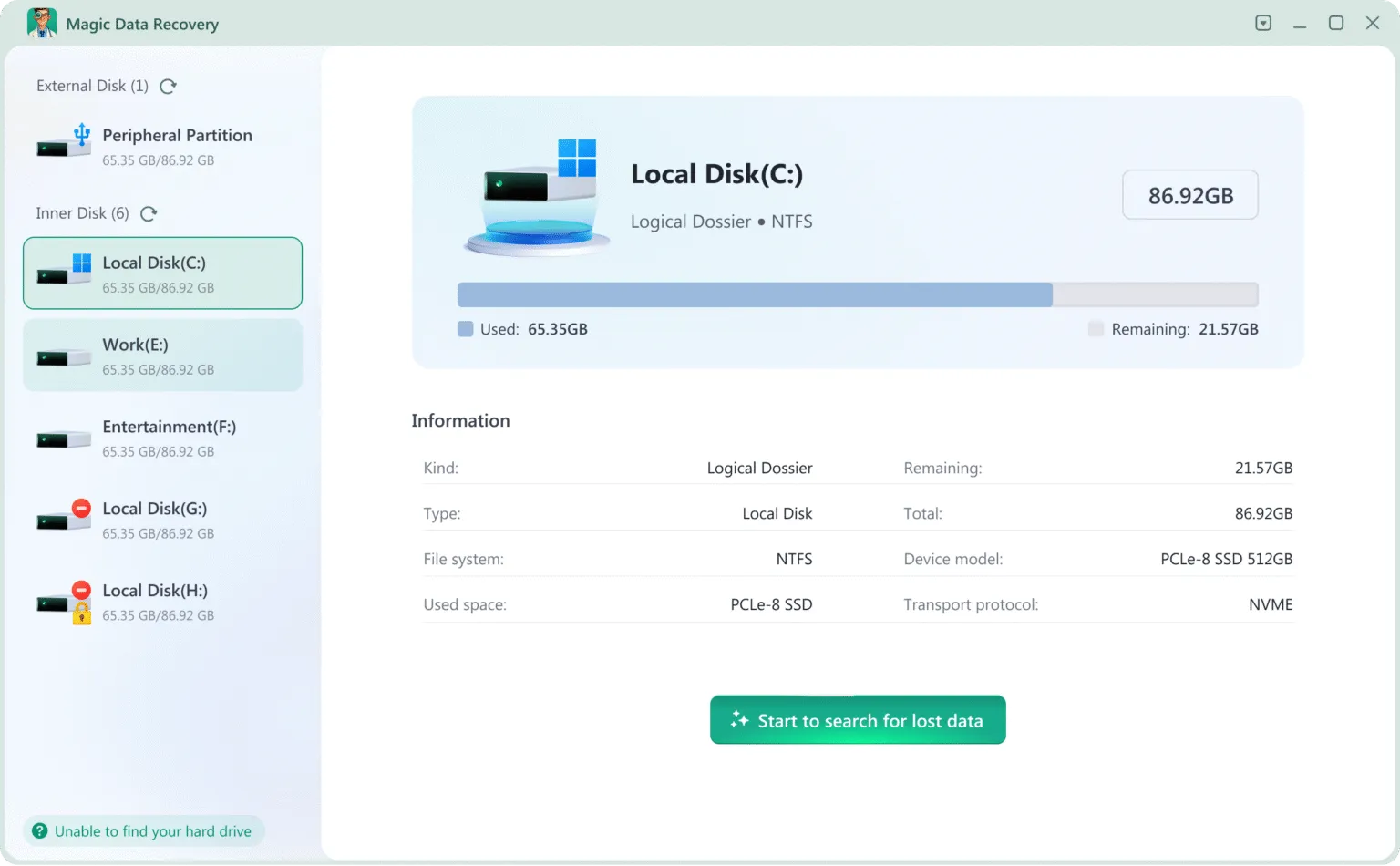
Core Problems It Solves
- Recover deleted files from hard drives, SSDs, USB drives
- Restore data after formatting or system crashes
- Retrieve files lost due to accidental deletion
Key Advantages of Magic Data Recovery
- User-friendly interface suitable for non-technical users
- Advanced scanning algorithms for deeper recovery
- Wide file format support, including documents, photos, and videos
- Read-only recovery process, reducing risk of further data damage
Unlike many tools, it focuses on recovery accuracy rather than aggressive marketing. You can download it below.
Supports Windows 7/8/10/11 and Windows Server
Real-World Usage Scenarios
Magic Data Recovery is useful when:
- A backup was planned but not executed
- An external drive fails unexpectedly
- Files are deleted during cleanup
- A system upgrade causes data loss
It complements a 3 2 1 data backup strategy by providing a fallback option when prevention fails.
Why It Is More Reliable Than Other Recovery Options
Compared with generic recovery tools:
- It offers clearer scan results
- It avoids overwriting lost data
- It provides preview options before recovery
This makes it a trustworthy choice for users facing urgent data loss.
If you are looking for an efficient recovery solution, Magic Data Recovery is worth trying.
Conclusion
A reliable data backup strategy is no longer optional.
The 3 2 1 data backup strategy remains one of the most effective ways to protect personal and professional data.
By maintaining multiple copies, using different storage media, and keeping one backup offsite, you significantly reduce the risk of permanent loss.
However, no system is perfect. When backups fail or are missing, tools like Magic Data Recovery provide a practical second chance.
Start building your backup plan today—and ensure your data is protected before the next unexpected event.
Supports Windows 7/8/10/11 and Windows Server
FAQs
What is the 3 2 1 data backup strategy?
Why is the 3 2 1 data backup strategy considered best practice?
Is cloud storage enough as a data backup strategy?
How often should backups be created?
What are common mistakes in data backup strategies?
Can the 3 2 1 strategy work for personal users?
What should I do if I lose data before backing it up?
Is data recovery a replacement for a data backup strategy?

Jason is a data recovery and technical support specialist with over 15 years of hands-on experience. He has worked extensively with frontline users, troubleshooting difficult data loss cases and providing practical recovery solutions for accidental deletion, formatted drives, damaged file systems, lost partitions, system failures, and other recovery emergencies. His expertise also includes backup and restoration, file repair, and disaster recovery, with a strong emphasis on safe, reliable, and technically accurate guidance.