
How to Recover Hidden Files from USB Drive: 6 Safe Methods
When a USB drive still shows used space but its folders look empty, the data may be hidden rather than erased. The right way to recover hidden files from USB storage depends on what caused them to disappear: a changed file attribute, malware, antivirus quarantine, deletion, formatting, or file system damage. This guide starts with safe, built-in checks and then explains when Magic Data Recovery can help. For broader advice about portable storage problems, see Amagicsoft’s external hard drive recovery solutions.
First rule: Stop copying, editing, or downloading files to the affected USB drive. If the data was deleted rather than hidden, new writes may overwrite recoverable content. Do not format the drive merely because Windows asks you to.
Supports Windows 7/8/10/11 and Windows Server
Table of Contents
Are the USB Files Hidden, Deleted, or Inaccessible?
People often say they need to recover hidden files, although several different problems can produce the same “empty USB” symptom. Identifying the likely cause prevents an easy visibility issue from turning into real data loss.
In File Explorer, right-click the drive, choose Properties, and compare Used space with the files you can see. Used space on an apparently empty drive often points to hidden items or file-system metadata, but it does not prove that the files remain healthy.
What you notice | Likely situation | Best first method |
Files appear after enabling Hidden items | Normal hidden attribute | File Explorer |
Folders remain invisible, but the drive has used space | Hidden and/or system attributes | ATTRIB command |
Shortcuts replaced the original folders | Possible shortcut malware | Antivirus scan, then ATTRIB |
Defender recently reported a threat | Files may be quarantined | Protection History |
Files were Shift+Deleted or the USB was formatted | Actual data loss | Magic Data Recovery |
Windows says the USB is RAW or must be formatted | File system damage | Recover data before repair |
Drive disconnects, clicks, heats up, or is absent from Disk Management | Possible hardware failure | Stop using it; contact a recovery lab |
The distinction matters. File Explorer and ATTRIB reveal files that still exist; they do not undelete content. Recovery software, by contrast, scans for file records and recognizable data left behind after logical loss.
Before You Recover Hidden Files from USB
Take these precautions before trying the six methods:
- Reconnect the drive once. Try another USB port without a hub. If another computer can read it, copy important files to that computer.
- Confirm the drive letter. Open This PC and note the assigned letter, such as E:.
- Avoid repair-first actions. CHKDSK repairs file-system structures; it does not recover files. Scan or image a RAW or corrupted USB before repair.
- Save recovered data elsewhere. Choose the internal drive or another healthy disk.
Overwriting, severe corruption, encryption, and physical damage can all limit recovery.
Method 1: Show Hidden USB Files in File Explorer
Start here when the USB opens normally and you simply cannot see some folders. Microsoft documents the Windows 11 path as View > Show > Hidden items.
- Connect the USB drive and open File Explorer.
- Select This PC, then open the USB drive.
- In Windows 11, choose View > Show > Hidden items. In Windows 10, open the View tab and select Hidden items.
- Look for faded file or folder icons. A faded icon usually indicates that the item has the Hidden attribute.
- Select the required items, right-click them, and choose Properties.
- Clear Hidden, select Apply, and apply the change to subfolders and files when prompted.
This method lets you recover hidden files from USB in the everyday sense: it restores their visibility. It does not restore deleted data. Microsoft provides the same menu path in its File Explorer guidance.
What if “Hidden items” reveals nothing?
Malware sometimes applies both Hidden and System attributes. File Explorer normally protects system-designated items from casual changes, so Method 2 offers a more targeted approach. Do not permanently expose protected operating-system files across the whole computer just to inspect one USB drive.
Method 2: Recover Hidden Files from USB with the ATTRIB Command
The attrib command displays, adds, or removes file attributes. Here, -h removes Hidden, -s removes System, and -r removes Read-only. The /s switch includes matching files in subfolders, while /d includes directories. These meanings come from Microsoft’s official attrib reference.
- Press Windows + E, open the USB drive, and verify its drive letter.
- Search for Command Prompt, right-click it, and choose Run as administrator.
- Enter the command below, replacing E: with the actual USB letter:
- attrib -h -s -r “E:\*.*” /s /d
- Wait for the prompt to return, then reopen the USB drive.
- Copy any important files that reappear to a healthy disk.
For example, if a shortcut virus hid a “Client Photos” folder, ATTRIB may make the existing folder visible again. It is a quick way to recover hidden files when directory entries remain intact.
Important: ATTRIB does not reconstruct deleted files, repair a RAW volume, or reverse formatting. If it finishes without an error but the missing data does not return, move to Method 5 or 6 rather than repeating random commands.
Fix common ATTRIB errors
- Path not found: Recheck the USB drive letter in This PC.
- Access denied: Reopen Command Prompt as administrator and scan for active malware.
- The command runs but files remain missing: They may have been deleted, quarantined, or disconnected from the damaged file system.
- Strange shortcut files return after reconnecting: The computer or USB may still contain malware. Continue with Method 3.
Method 3: Scan the USB and Computer for Malware
If folders changed into shortcuts, unfamiliar .exe files appeared, or the hidden state returns after every reconnect, treat the case as a possible infection. Revealing files without removing the cause only provides a temporary fix.
- Update Windows Security or your trusted antivirus definitions.
- In File Explorer, right-click the USB drive. On Windows 11, select Show more options if necessary.
- Choose Scan with Microsoft Defender.
- Quarantine confirmed threats, restart the computer if requested, and scan the computer as well.
- Run Method 1 or Method 2 again after the drive is clean.
Microsoft confirms that users can right-click a specific file or folder and scan it with Microsoft Defender. Avoid opening suspicious shortcuts or executables. Also avoid downloading an unknown “USB unhider”; such tools require broad access to the same files you are trying to protect.
Method 4: Check Windows Security Protection History
Sometimes the file is neither hidden nor deleted by you. Security software may quarantine an infected file or flag a legitimate file incorrectly. Check the record before assuming the USB lost the data.
- Open Windows Security.
- Select Virus & threat protection > Protection history.
- Review events that match the time when the USB files disappeared.
- Expand an item and verify its original path.
- Restore or allow it only when you are certain it is safe and the detection is a false positive.
Microsoft Defender records its actions in Protection History for only a limited period. A missing entry does not prove that no quarantine occurred. Leave questionable files quarantined and replace them from a clean backup.
Method 5: Restore a Clean Copy from Backup or Previous Versions
A backup is usually safer than sector-level recovery because it does not depend on the current condition of the USB. Check every location that may hold another copy:
- OneDrive, Google Drive, Dropbox, or a company sync service
- Email attachments and messaging-app downloads
- The source computer used to create or copy the files
- File History, Windows Backup, or third-party backup software
- Another external disk or NAS
To check Previous Versions, right-click the folder that once held the USB files, choose Properties > Previous Versions, and review any available snapshot. This option works only if a backup system or restore mechanism created a usable version beforehand. Windows does not automatically maintain a convenient recovery history for every removable USB drive.
Restore the copy to a healthy disk first. Once you verify that it opens correctly, scan it for malware and create a second backup. This method can recover hidden files from USB problems indirectly when the current copies have also become damaged or unsafe.
Method 6: Recover Files That Are No Longer Merely Hidden
If File Explorer and ATTRIB reveal nothing, the files may have been deleted, the USB may have been quick-formatted, or file-system errors may have broken the links to them. At this point, a tool that only changes visibility settings cannot help.
Magic Data Recovery provides a scan–preview–recover workflow for Windows. It supports USB drives and other storage devices, more than 5,000 file types, and logical-loss cases that include deletion, formatting, and file-system errors. Its useful advantage here is diagnostic as well as practical: you can preview supported files before recovery instead of assuming every found entry remains usable.
How to Use Magic Data Recovery Safely
1. Download and install the program on the computer’s internal drive, not on the affected USB.
Supports Windows 7/8/10/11 and Windows Server
2. Connect the USB and launch Magic Data Recovery.
3. Select the correct removable drive and start the scan.
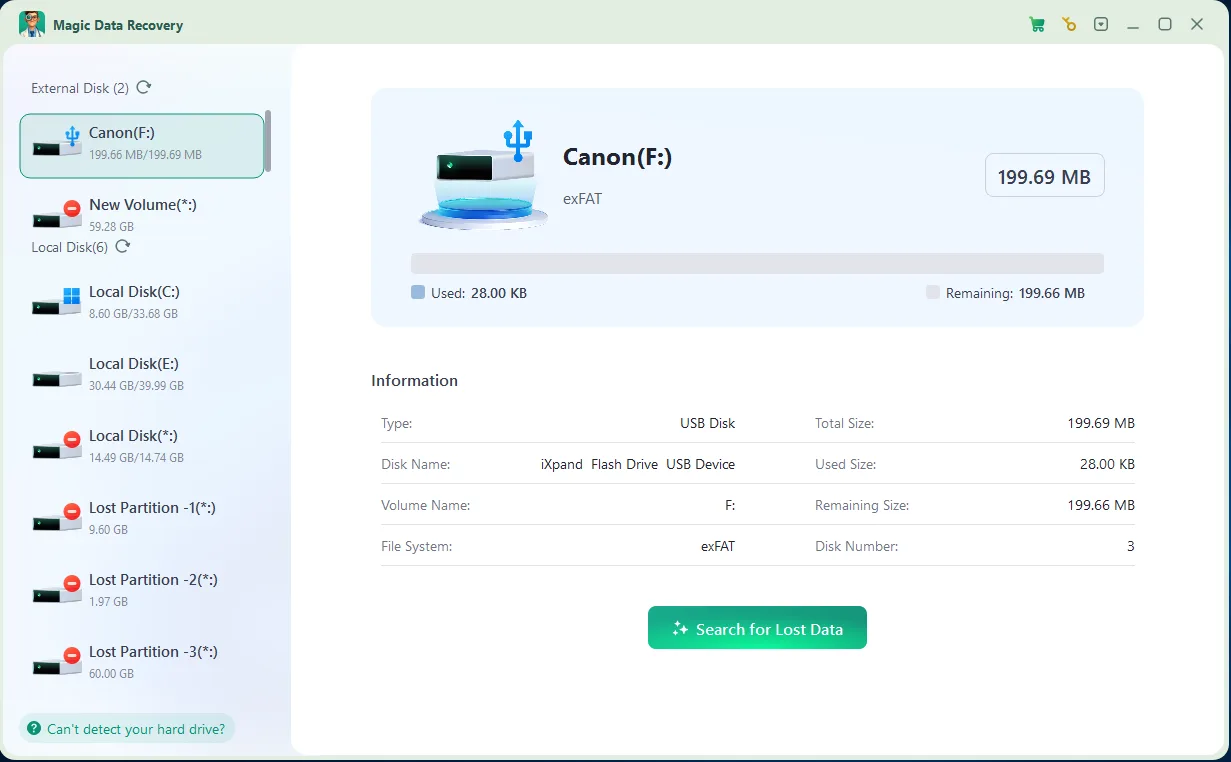
4. Let the scan finish for the most complete result. Use file type, path, or search filters to narrow the list.
5. Preview important photos, documents, or other supported items when possible.

6. Select the files and recover them to a different healthy drive.
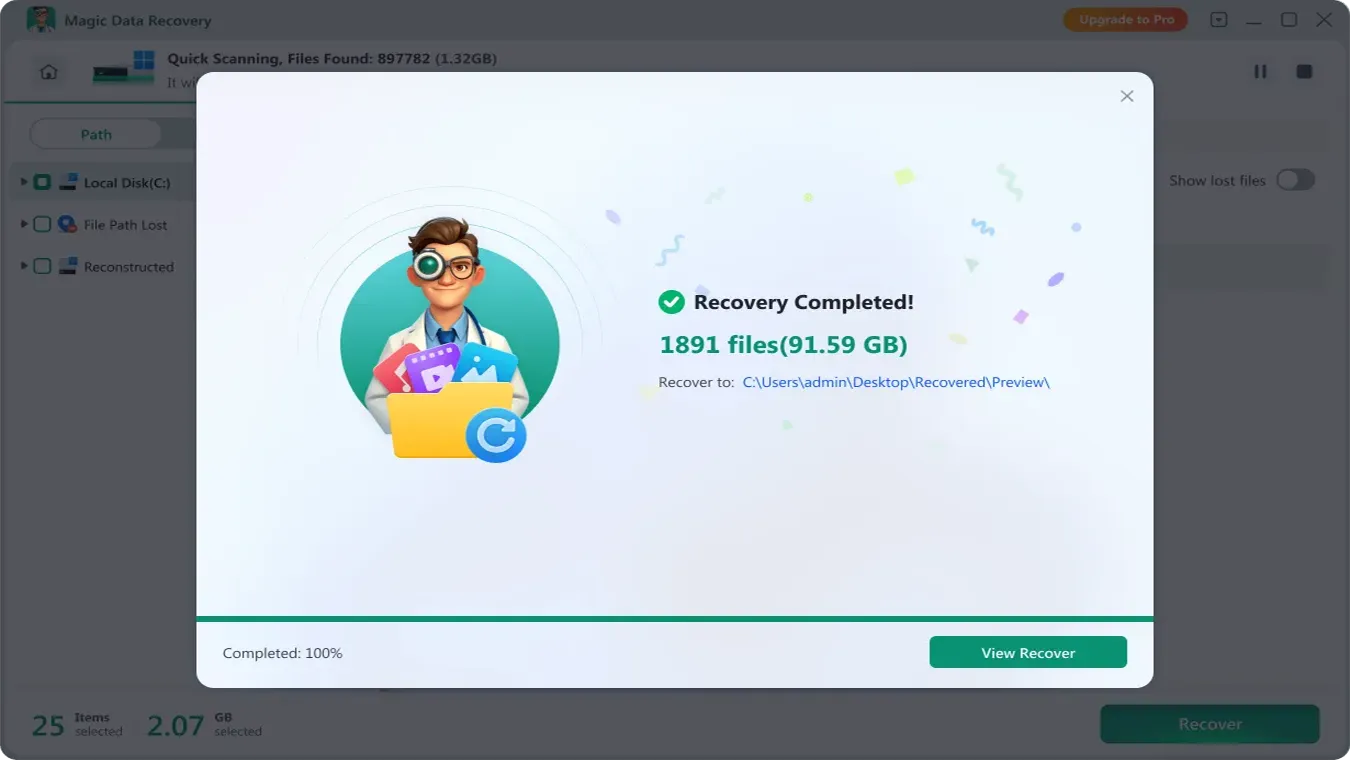
For example, a photographer may see an empty USB even though Properties reports used space. If Explorer and ATTRIB find nothing, a scan can search beyond visible directory entries for recoverable photos. Magic Data Recovery is therefore more suitable once the task shifts from “unhide” to actual recovery.
No recovery application can restore overwritten sectors or fix physical flash-memory failure. Stop immediately and seek a professional lab if the USB repeatedly disconnects, becomes unusually hot, shows the wrong capacity, or fails to appear in Disk Management.
Which Method Should You Choose?
For most users, the safest sequence is File Explorer, a malware scan if infection seems likely, ATTRIB, backup checks, and then recovery software. If Windows reports RAW, asks to format the drive, or the files were knowingly deleted, start with data recovery and postpone repairs.
Mistakes That Can Make USB Recovery Harder
Avoid these reactions while trying to recover hidden files:
- Formatting when Windows says “You need to format the disk.” Cancel the prompt until the data is safe.
- Copying recovered files back to the same USB. Those writes may overwrite other missing data.
- Running CHKDSK before recovery. Repair operations can alter damaged metadata.
- Using ATTRIB on the wrong drive letter. Always verify the target in This PC.
- Restoring every quarantined file blindly. A shortcut or executable may be genuinely malicious.
- Continuing to reconnect a physically failing drive. Repeated power cycles can worsen hardware damage.
Conclusion
To recover hidden files from USB storage safely, first determine whether the files still exist. File Explorer and ATTRIB solve attribute-based visibility problems; Microsoft Defender handles malware and quarantine clues; backups replace compromised copies. When files were deleted, formatted, or lost through file-system errors, Magic Data Recovery is the more appropriate option because it scans the USB, supports preview, and saves selected results to a separate disk through a clear workflow.
After recovery, keep at least one additional copy of important data and eject portable storage properly. You can also bookmark Amagicsoft’s external hard drive recovery solutions for related USB-connected storage guidance.
Supports Windows 7/8/10/11 and Windows Server
FAQs
How do I recover hidden files from a USB drive for free?
Start with File Explorer's View > Show > Hidden items option. If nothing appears, use the ATTRIB command after checking the correct drive letter. Both options are built into Windows and work when files still exist but carry Hidden or System attributes.
What command recovers hidden files from a USB?
Open Command Prompt as administrator and run attrib -h -s -r "E:\*.*" /s /d, replacing E: with the USB drive letter. The command removes Hidden, System, and Read-only attributes from matching files and folders; it does not undelete erased data.
Why does my USB show used space but no files?
The files may have hidden or system attributes, malware may have replaced folders with shortcuts, or file-system damage may prevent Windows from listing directory entries. Used space is a useful clue, but it cannot confirm that every file remains intact or recoverable.
Can ATTRIB recover deleted files from a USB?
No. ATTRIB only changes attributes on files and folders that still exist in the accessible file system. It cannot restore Shift+Deleted data, reverse formatting, or rebuild files after file-system loss. Use a backup or recovery scan for those situations.
How can I recover hidden files from a virus-infected USB?
First scan the USB and computer with updated security software. Quarantine confirmed threats, then use File Explorer or ATTRIB to reveal surviving folders. Do not open suspicious shortcuts or executables, and restore questionable files only when you can verify they are safe.
Should I run CHKDSK when USB files disappear?
Not as the first step when the files matter. CHKDSK repairs file-system structures rather than recovering data, and it may change damaged metadata. Recover or image the USB first. After securing the files, you can diagnose and repair the device more safely.
Can Magic Data Recovery find files that are merely hidden?
It can scan a USB and show existing or lost data, but simple hidden-attribute cases usually need only File Explorer or ATTRIB. Magic Data Recovery becomes more valuable when those methods fail because files were deleted, formatted, or disconnected by file-system errors.
Where should I save recovered USB files?
Save them to the computer's internal drive or another healthy external disk. Never recover them onto the affected USB, because new writes could overwrite other recoverable content. Open and verify the recovered files before repairing or reformatting the original drive.

Jason is a data recovery and technical support specialist with over 15 years of hands-on experience. He has worked extensively with frontline users, troubleshooting difficult data loss cases and providing practical recovery solutions for accidental deletion, formatted drives, damaged file systems, lost partitions, system failures, and other recovery emergencies. His expertise also includes backup and restoration, file repair, and disaster recovery, with a strong emphasis on safe, reliable, and technically accurate guidance.