
OneDrive Files Disappeared? 7 Fixes Methods

When OneDrive files disappeared, the first reaction is often that syncing deleted everything. Sometimes that is exactly what happened. More often, however, the files still exist under a different Microsoft account, inside the OneDrive web Recycle Bin, or in another Desktop path on the computer. The wrong first move—resetting OneDrive, moving folders, or continuing to save data—can make the situation harder to untangle.
This guide follows a safer order. You will first check whether the files are hidden, moved, unsynced, or deleted. Then you will use OneDrive’s built-in recovery options before considering local disk recovery. If the cloud no longer has a usable copy but the files once existed on your Windows drive, Magic Data Recovery may provide another route. For a broader explanation of recovery after accidental deletion, see Amagicsoft’s deleted file recovery guide.
Do this first: Pause OneDrive syncing and avoid downloading, installing, or saving large files to the affected drive. Do not empty either Recycle Bin. If local data was actually deleted, new writes can overwrite recoverable content.
Supports Windows 7/8/10/11 and Windows Server
Table of Contents
Why Have My OneDrive Files Disappeared?
A missing icon does not prove that a file was erased. OneDrive coordinates cloud storage, local folders, folder backup, Files On-Demand, and sometimes several accounts. A change in any layer can make data appear to vanish.
Common causes include:
- You signed in to a different personal, work, or school account.
- Desktop folder backup moved files from the local Desktop to C:\Users\<Name>\OneDrive\Desktop.
- A folder was deselected under OneDrive’s Choose folders setting, removing its local view while leaving it online.
- OneDrive stopped running, lost its connection, reached a storage limit, or developed a sync error.
- Files were deleted on another synced device, through OneDrive.com, or by someone with access to a shared folder.
- Files On-Demand left only cloud placeholders, and those placeholders are no longer visible locally.
- Malware, file-system damage, accidental formatting, or a genuine deletion removed the local copies.
When OneDrive files disappeared from desktop, path redirection is especially common. Windows may display an empty local Desktop even though the original files remain in the OneDrive Desktop folder or online. If OneDrive files disappeared after a backup or account change, determine the active path before moving anything.
Quick Diagnosis: Missing, Unsynced, or Deleted?
Before trying a fix, compare the web and local views. Sign in to OneDrive on the web and search for a distinctive filename. Microsoft recommends starting there because the website shows the cloud library to which devices sync. This is the fastest way to determine why OneDrive files disappeared locally.
Use this table to choose your next step:
| What you find | Likely explanation | Best next action |
| Files exist online but not on the PC | Sync selection, account, or client problem | Check account, folder selection, and sync status |
| Files exist in another local Desktop path | Folder backup or profile redirection | Copy or move them only after confirming the active path |
| Files appear in OneDrive Recycle Bin | Synced or cloud deletion | Restore them on the web |
| Files exist but contain old or wrong content | Overwrite or sync conflict | Use Version History |
| Many files changed or vanished together | Batch deletion, corruption, or ransomware | Use Restore your OneDrive if available |
| Files are absent online and locally | Possible permanent deletion | Check backups, then scan the original local drive |
This check prevents a common mistake: using recovery software for a sync-visibility issue. A disk scanner cannot repair a cloud account or retrieve content that was always online-only.
Fix 1: Search OneDrive.com and Confirm the Correct Account
If OneDrive files disappeared, search the web library before changing settings on the computer.
- Open OneDrive.com and sign in.
- Use Search everything with part of the filename, file type, date, project name, or a word that may appear in the file.
- Check My files, Shared, Photos, and Personal Vault. Personal Vault items may not appear in ordinary search results while the vault is locked.
- Select your profile picture and confirm the email address.
- Repeat the search in any other personal, work, or school account you use.
This often solves cases that begin after changing employers, reinstalling Windows, or adding a second Microsoft 365 account. A shared file can also vanish from your view if its owner removes it or revokes your permission.
Fix 2: Check Both Desktop Locations and Folder Backup
The clue OneDrive files disappeared from desktop usually points to one of two folders:
- C:\Users\<YourName>\Desktop
- C:\Users\<YourName>\OneDrive\Desktop
Open both paths in File Explorer. Also inspect C:\Users for another profile folder if Windows signed you into a temporary or different account.
Next, right-click Desktop in File Explorer, choose Properties, and open Location. Note the path before changing anything. If it points to OneDrive, the empty local Desktop may simply be inactive.
Finally, select the cloud icon, open Settings > Sync and backup > Manage backup, and review Desktop backup. Do not toggle it repeatedly while diagnosing why OneDrive files disappeared from desktop. First copy irreplaceable files to a separate drive. For a deeper checklist, see Files Automatically Deleted from Desktop?.
Fix 3: Restore Missing Items from the Right Recycle Bin
When OneDrive files disappeared after a deletion, remember that OneDrive and Windows maintain separate recovery locations. Check both, but start online when the deletion may have originated in the cloud or another device.
Restore from the OneDrive Recycle Bin
- Sign in to OneDrive.com.
- Select Recycle bin in the left navigation.
- Sort or search for the missing items.
- Select the files or folders and click Restore.
- Allow time for the restored content to sync back to the PC.
If Personal Vault files are missing, unlock it and choose Show Personal Vault items. A work or school administrator may have additional recovery options.
Restore from Windows Recycle Bin
Open the Windows Recycle Bin, sort by deletion date, and restore matching files. Do not assume an item must appear in both bins; its location can depend on where the deletion started.
For a more detailed cloud-deletion workflow, read How to Recover Files Deleted from OneDrive.
Fix 4: Use Version History or Restore Your OneDrive
Sometimes OneDrive files disappeared is not the whole story. A file may still exist under the same name but contain an older, blank, corrupted, or unwanted version.
Restore One File with Version History
On OneDrive.com, right-click the file, select Version history, review earlier copies, and restore the correct one. The same command is available for synced files in File Explorer. OneDrive Version History works with many file types, not only Office documents.
Roll Back Many Changes
Microsoft 365 subscribers can use Restore your OneDrive to undo a group of recent actions:
- Open OneDrive on the web.
- Go to Settings > Options > Restore your OneDrive.
- Choose a suggested date or a custom restore point.
- Review the activity chart and selected actions.
- Confirm the rollback.
Use this when OneDrive files disappeared in bulk, ransomware changed many items, or a folder tree synchronized incorrectly. Review the timeline carefully: newer items can move to the Recycle Bin during rollback.
Fix 5: Repair a Sync or Folder-Selection Problem
When OneDrive files disappeared from the computer but remain online, recovery is unnecessary; the local OneDrive view needs attention.
Select the cloud icon and look for Paused, Sign in, a red X, storage-full warnings, or Processing changes. Resolve the displayed error. Then open Settings > Account > Choose folders and select the missing folder. A deselected folder can disappear from the PC while remaining online.
If OneDrive is not running, launch it from Start. Unlink and relink only after verifying that OneDrive files disappeared from the PC but remain online, and after protecting local-only content. Relinking rebuilds the local view; it cannot restore data deleted from both cloud and disk.
Fix 6: Check Local Backups and Windows File Recovery
If OneDrive files disappeared from desktop and neither Recycle Bin contains them, check backups created before the loss:
- Right-click the former parent folder and open Properties > Previous Versions.
- Review File History if it was enabled.
- Check an external backup drive, NAS, or another cloud service.
- Inspect another computer that may hold an offline copy; keep it offline to avoid syncing the deletion.
Windows File Recovery is Microsoft’s command-line option when OneDrive files disappeared from local storage. It requires different source and destination drives and cannot recover from cloud storage or network shares.
Fix 7: Recover Locally Synced Copies with Magic Data Recovery
Consider Magic Data Recovery only after cloud search, both Recycle Bins, Version History, OneDrive Restore, and backups fail. If OneDrive files disappeared after permanent local deletion, it addresses a specific problem: complete copies once existed on a Windows drive but were later deleted, lost after formatting, or made inaccessible by file-system damage.
Magic Data Recovery scans the original storage device, not the OneDrive account. Its visual results, filters, and preview are easier for many users than a command line. It also handles deletion, formatting, and file-system-error scenarios in one interface—useful when OneDrive files disappeared locally and both Recycle Bins are empty.
The limitation matters: Magic Data Recovery cannot retrieve online-only content that was never downloaded. No tool can guarantee recovery after overwriting or SSD cleanup. Therefore, try official cloud restoration first.
How to Use Magic Data Recovery Safely
1. Stop using the affected drive as much as possible.
2. Download and install Magic Data Recovery on another drive when practical.
Supports Windows 7/8/10/11 and Windows Server
3. Select the drive that previously stored the OneDrive folder and start the scan.
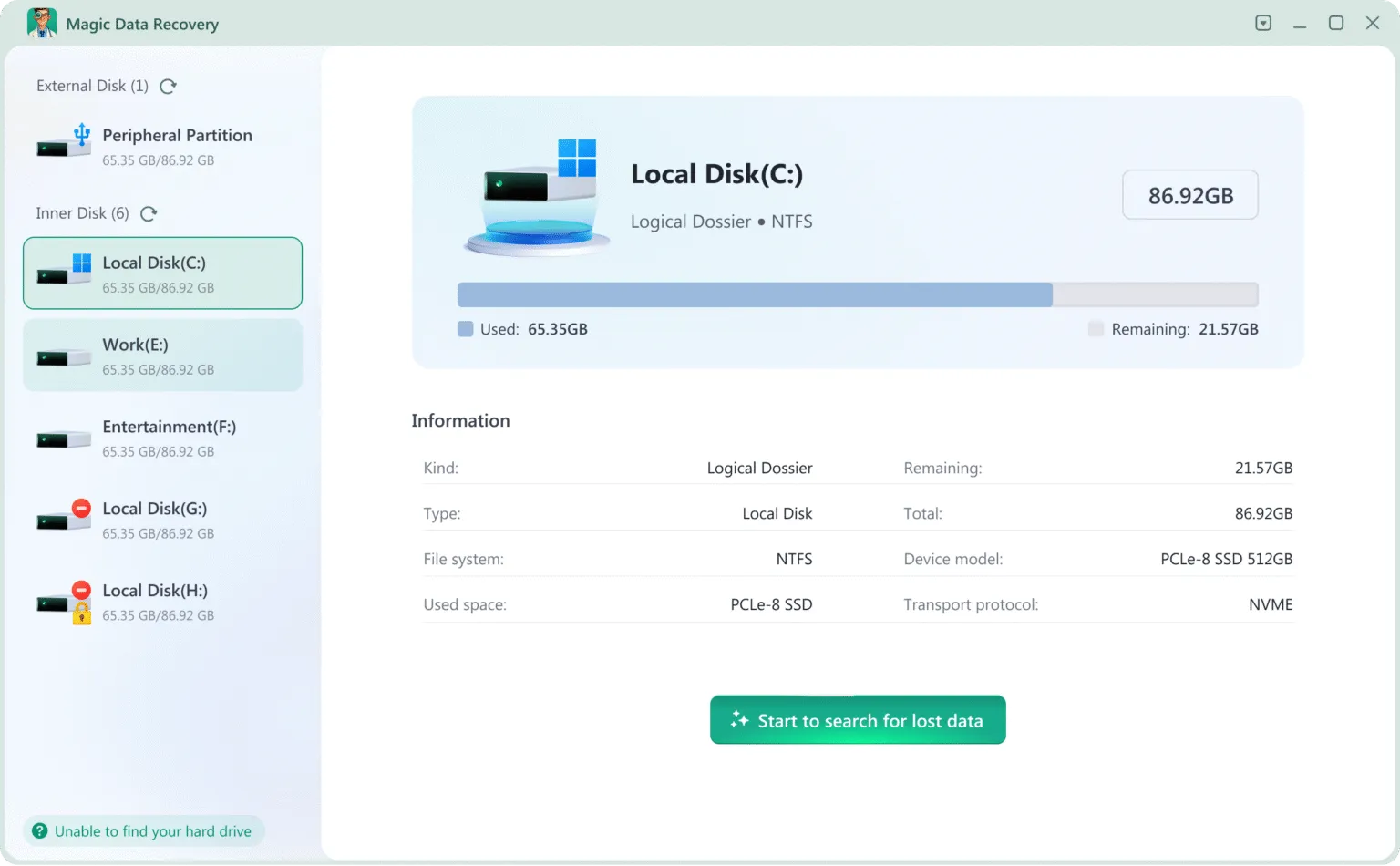
4. Filter by filename, path, date, or file type, then preview the results.

5. Recover selected files to a different drive or external storage—not the source drive.
This scan is more relevant than repeatedly resetting OneDrive after true local deletion. If a backup exists, use it instead; it will usually preserve filenames and folders more reliably.
How to Prevent OneDrive Files from Disappearing Again
After OneDrive files disappeared, prevention deserves attention. Sync is useful, but it is not an independent backup; a deletion or unwanted change can propagate across devices. Reduce that risk with a few habits:
- Keep a second copy of irreplaceable data on storage that is not continuously synced.
- Confirm whether Desktop, Documents, and Pictures backup is on before changing OneDrive settings.
- Review the signed-in account and sync status after a Windows reinstall or Microsoft 365 account change.
- Mark essential working files Always keep on this device if you need a complete local copy.
- Investigate mass deletions, unknown account activity, or ransomware warnings immediately.
- Before unlinking an account, verify important folders on OneDrive.com and copy local-only files elsewhere.
Conclusion: What to Do When OneDrive Files Disappeared
When OneDrive files disappeared, begin by deciding whether they are missing from the PC, missing from the cloud, or truly deleted. Search OneDrive.com, confirm the account, inspect both Desktop paths, check both Recycle Bins, and use Version History or Restore your OneDrive before altering the sync setup. If the files remain online, repair the sync view rather than scanning the disk.
Magic Data Recovery is recommended only for the gap that OneDrive’s cloud tools cannot cover: a complete local copy once existed on a Windows drive, but it is now deleted or inaccessible and no backup can restore it. Its scanning, filters, and preview make that local recovery process easier to evaluate, while honest limits remain—online-only data and overwritten sectors cannot be recovered from the PC. For additional recovery planning, return to the deleted file recovery guide.
Supports Windows 7/8/10/11 and Windows Server
FAQs About OneDrive Files Disappeared
Why did my OneDrive files suddenly disappear?
They may be under another account, moved into a OneDrive-backed Desktop path, excluded from local sync, deleted on another device, or affected by a sync error. Search OneDrive.com first because it separates a local visibility problem from an actual cloud deletion.
Where are my files if OneDrive files disappeared from Desktop?
Check both C:\Users\<Name>\Desktop and C:\Users\<Name>\OneDrive\Desktop. Also inspect Desktop's Location tab and OneDrive.com. Folder backup can redirect Desktop to OneDrive, leaving the old local Desktop empty even though the files still exist elsewhere.
Can I recover missing OneDrive files from the Recycle Bin?
Yes, if the items remain in the OneDrive web Recycle Bin or Windows Recycle Bin. Check both locations and restore the files. If Personal Vault content is involved, unlock the vault before viewing its deleted items.
Why are my OneDrive files online but missing from my PC?
The folder may be deselected in Choose folders, OneDrive may be paused or signed out, or Files On-Demand may show only selected content locally. Confirm sync status and folder selection. Do not use recovery software when the cloud copy remains intact.
Can OneDrive restore an overwritten file?
Often, yes. Right-click the file on OneDrive.com or in File Explorer and select Version History. Review earlier versions and restore the correct one. This method fits altered files better than deleted-file recovery because the cloud still retains the file's revision history.
Can Magic Data Recovery recover missing OneDrive files?
It may recover files that were fully synced or downloaded to a Windows drive before deletion, provided their data has not been overwritten. It cannot scan OneDrive's cloud servers or reconstruct online-only files that never had complete local content.
Should I unlink OneDrive when files are missing?
Not immediately. First confirm that the files exist online and copy any local-only data to separate storage. Unlinking and relinking can repair persistent sync issues, but it will not restore files already deleted from both the cloud and local drive.
How can I stop OneDrive Desktop files from disappearing again?
Keep an independent backup, verify Desktop backup settings before changing accounts, monitor sync errors, and preserve offline copies of essential files. Before disabling folder backup or unlinking OneDrive, confirm the cloud contents and copy local-only files to another drive.

Jason is a data recovery and technical support specialist with over 15 years of hands-on experience. He has worked extensively with frontline users, troubleshooting difficult data loss cases and providing practical recovery solutions for accidental deletion, formatted drives, damaged file systems, lost partitions, system failures, and other recovery emergencies. His expertise also includes backup and restoration, file repair, and disaster recovery, with a strong emphasis on safe, reliable, and technically accurate guidance.