SD Card Data Disappeared? How to Recover Missing Files


Path A: Recover Deleted or Formatted SD Card Data
Symptoms: Files/folders vanished but card is readable
Immediate steps (must do before recovery):
1.Stop using the SD card immediately. Any write may overwrite recoverable data.
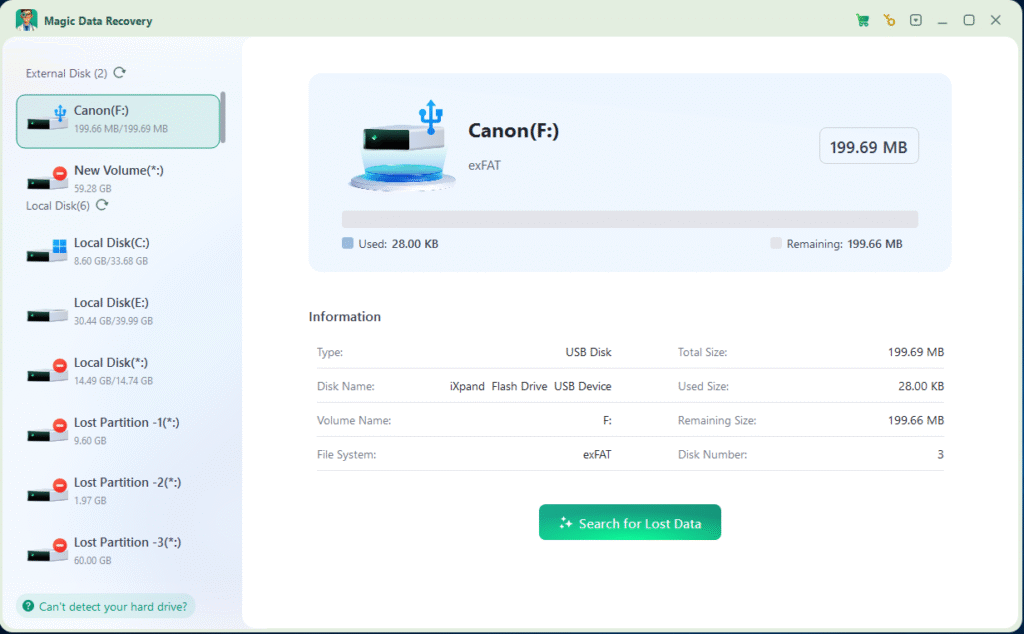
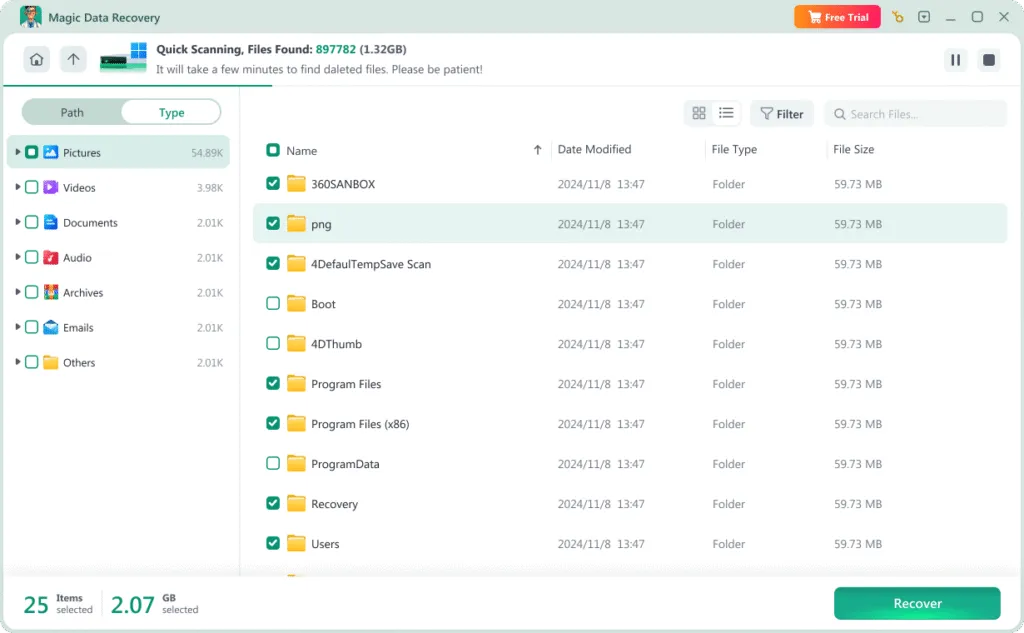
2.Use trustworthy SD card data recovery software like Magic Data Recovery that supports quick and advanced scans. These tools scan the file allocation table and perform file carving (signature-based recovery) to list recoverable files.
Why this works: Deletion and most quick formats generally only mark clusters as free or remove directory references. The file content usually remains until overwritten.
Path B: Fix Missing Files or Garbled Names Caused by Directory Corruption
Symptoms: Files or folders disappear intermittently, folder names turn into strange characters, or the SD card shows garbled file names even though the storage space is still used.
What is happening: Directory entries store file names, sizes, timestamps, and starting locations on the SD card. If these entries are damaged, the card may stop showing files correctly even when the actual file content still exists. This often happens after unsafe removal, interrupted recording, file system errors, or device compatibility problems.
Why standard recovery software sometimes fails: Recovery tools focus on deleted/formatted scenarios and file carving. When directory structures are partially corrupted (and filenames/attributes preserved in unusual locations), a low-level hex/disk editor can inspect and repair directory entries or extract files precisely.
Advanced Option: Inspect Directory Errors with WinHex
Warning: WinHex and other sector-level editors can change raw disk structures. Do not edit the original SD card directly. Create a full sector-by-sector image first, work only on the image, and consider professional help if you are not familiar with FAT32/exFAT directory structures.
For most users, it is safer to scan the SD card with recovery software first. WinHex is mainly useful when directory entries are corrupted and a professional needs to inspect FAT32 or exFAT structures manually.
Step-by-step (high-level):
1. Open the SD card volume in WinHex (or a similar low-level disk editor).
2. Locate the partition start and the file system structures — for FAT32/exFAT that means examining the Boot Sector, FAT table area and directory entry. In this case, we can see the subfolder in “DCIM” contains strange characters, and the starting sector is garbled. However, the next sector contains the correct information for a directory entry. We can assume the issue is that the correct sector location is offset by one sector.