
Ransomware Data Recovery Guide
A ransomware attack can lock your documents, photos, videos, work files, and business records within minutes. When that happens, many users search for ransomware data recovery because they want one clear answer: can the files still be recovered?
The honest answer is: sometimes. The right recovery method depends on how the ransomware attacked your files. Some cases require clean backups or official decryptors. Other cases involve deleted originals, damaged file systems, formatted drives, or lost files that may still be recoverable with reliable deleted file recovery software.
This guide explains how ransomware data recovery works, what to do first, which recovery methods are worth trying, and when Magic Data Recovery can help recover deleted, lost, formatted, or file-system-error-related data after a ransomware incident.
Supports Windows 7/8/10/11 and Windows Server
Table of Contents
Quick Answer: What Is the Best Ransomware Data Recovery Method?
The best ransomware data recovery method is to restore files from a clean backup created before the attack. If no usable backup exists, check whether a trusted decryptor is available for your ransomware strain. If the ransomware deleted original files, damaged the file system, or removed data while creating encrypted copies, a data recovery tool such as Magic Data Recovery may help scan the affected drive and recover remaining file traces.
However, recovery software is not a ransomware decryptor. It cannot unlock strongly encrypted files without the correct decryption key. Its value comes from finding recoverable original files, deleted files, lost files, formatted-drive data, and files affected by logical storage errors.
First Steps Before Ransomware Data Recovery
Your first actions can directly affect the recovery result. Before you try any ransomware data recovery method, focus on containment and preservation.
1. Disconnect the Infected Device
Unplug the network cable, turn off Wi-Fi, and disconnect shared drives. Ransomware can spread through mapped drives, network shares, cloud sync folders, and external storage devices.
Do not reconnect the computer until you understand the infection scope. If you manage multiple computers, isolate affected devices one by one.
2. Do Not Pay the Ransom Immediately
Paying the ransom does not guarantee that criminals will send a working decryptor. It may also encourage further attacks. Review backups, decryptors, and recovery options first.
For businesses, involve IT security staff, legal advisors, cyber insurance contacts, or incident response professionals before making any decision.
3. Preserve Evidence
Keep the ransom note, encrypted file extensions, suspicious email attachments, malware file names, and attack timeline. These details help identify the ransomware family.
For example, a file extension such as .lockbit, .stop, .djvu, .phobos, or another unusual suffix may point to a known ransomware strain. Once you identify the strain, you can check whether a trusted decryptor exists.
4. Stop Writing New Data to the Affected Drive
If ransomware deleted original files or damaged the file system, new data can overwrite recoverable content. Avoid installing software, downloading files, running cleanup tools, or saving restored data to the same drive.
For safer ransomware file recovery, connect the affected drive to a clean Windows computer and recover files to another storage device.
Can You Recover Ransomware Encrypted Files?
You may recover ransomware encrypted files in some situations, but not always. The key is to understand what actually happened to your data.
Case 1: You Have a Clean Backup
This is the safest ransomware data recovery path. A clean backup lets you restore files from a point before encryption.
Before restoring, scan the backup and the destination system. If ransomware still exists on the computer, it may encrypt restored files again.
Case 2: A Trusted Decryptor Exists
Some ransomware families contain implementation flaws or have released keys. In those cases, security researchers may provide free decryptors.
Only download decryptors from trusted security organizations or official ransomware recovery projects. Random “decryptor” downloads can contain more malware.
Case 3: The Ransomware Deleted Original Files
Many ransomware attacks encrypt copies, delete originals, or overwrite file records during the attack. If the original file content still exists on the disk, ransomware data recovery software may help recover those deleted originals.
This is where Magic Data Recovery can be useful. It scans the storage device for deleted files, lost file records, and file signatures instead of trying to break encryption.
Case 4: The Files Are Fully Encrypted and No Key Exists
If the only remaining files are strongly encrypted and no backup or decryptor exists, normal recovery software cannot decrypt them. In this case, you can still preserve encrypted files in case a future decryptor becomes available.
Do not rename, edit, or “repair” encrypted files randomly. That may damage metadata needed for future decryption.
Best Ransomware Data Recovery Methods Compared
Different ransomware recovery methods solve different problems. Use the table below to choose the right path.
Method | Best For | Limitations | Difficulty |
Clean backup restore | Files backed up before the attack | Requires a safe backup point | Medium |
Cloud version history | OneDrive, Dropbox, Google Drive, or similar synced files | May fail if encrypted files synced over clean versions | Easy |
Official decryptor | Known ransomware variants with available keys | Only works for specific ransomware families | Medium |
Windows Previous Versions | Systems with restore points or shadow copies | Many ransomware strains delete shadow copies | Easy |
Magic Data Recovery | Deleted originals, lost files, formatted drives, file system errors, virus-related deletion | Cannot decrypt files without a key | Easy |
Professional recovery service | Business-critical cases, damaged drives, complex storage, RAID, servers | Higher cost and longer turnaround | Hard |
A smart ransomware data recovery plan starts with the least risky method. Check backups and version history first. Then look for decryptors. If those options fail and files may have been deleted or lost locally, scan the original drive with a recovery tool.
How to Recover Deleted or Lost Files After Ransomware with Magic Data Recovery
Magic Data Recovery is not designed to “crack” ransomware encryption. Instead, it helps when ransomware or malware causes data loss at the storage level.
That distinction matters. If ransomware deleted original files, removed local copies, damaged the file system, formatted a partition, or made a drive inaccessible, Magic Data Recovery can scan the affected storage device and look for recoverable data.
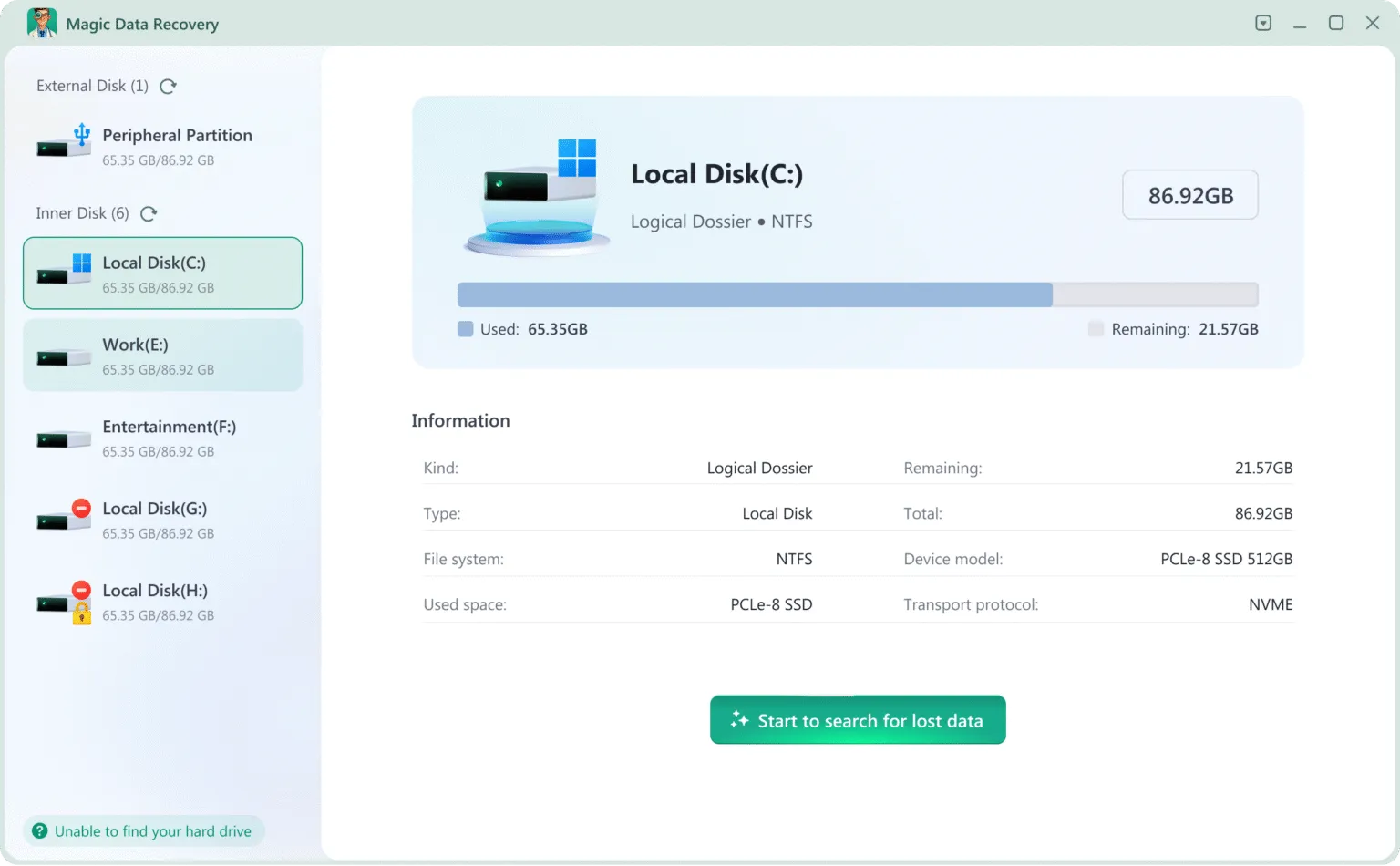
What Pain Points Does Magic Data Recovery Solve?
After a ransomware attack, users often face several problems:
- Original files disappeared after encryption.
- The Recycle Bin was emptied.
- Local cloud-sync folders lost files.
- External drives or USB devices became unreadable.
- A partition turned RAW or inaccessible.
- Files disappeared after malware cleanup.
- The system was reinstalled or reset during recovery.
Magic Data Recovery helps in these logical data loss scenarios. It supports recovery from deleted files, formatted drives, file system errors, lost partitions, and many storage devices, including HDDs, SSDs, USB drives, SD cards, and external drives.
Why It Can Be More Reliable Than Random Fixes
Many users try risky actions after ransomware. They rename encrypted files, run repair commands, format the drive, reinstall Windows, or download unknown decryptors. These actions can reduce the chance of successful ransomware file recovery.
Magic Data Recovery follows a safer workflow:
1. Select the affected drive.
2. Scan for lost and deleted files.
3. Filter results by file type, name, size, or date.
4. Preview recoverable files when possible.
5. Recover selected files to another safe drive.
This scan-preview-recover process helps you avoid guesswork. It also lets you check whether found documents, photos, videos, archives, and other files are usable before you save them.
When Should You Use Magic Data Recovery?
Use Magic Data Recovery after ransomware when:
- Backups are missing or incomplete.
- Cloud recovery options fail.
- The files were once stored locally.
- Ransomware deleted originals after creating encrypted copies.
- A drive shows file system errors after malware removal.
- You need to recover files from an external device affected during the attack.
For a detailed workflow, you can also follow the Magic Data Recovery user guide before scanning important storage devices.
Steps to Recover Files After Ransomware
Follow these steps carefully:
1. Disconnect the infected computer from the network.
2. Remove the affected drive if possible.
3. Connect the drive to a clean Windows PC using a USB adapter or enclosure.
4. Install Magic Data Recovery on the clean computer, not on the affected drive.
Supports Windows 7/8/10/11 and Windows Server
5. Launch the software and select the affected drive or partition.
6. Start a scan and wait for recoverable files to appear.
7. Use filters to find documents, photos, videos, archives, or project files.
8. Preview files when available.
9. Recover selected files to another healthy drive.
10. Scan recovered files with security software before opening them.
This method gives you a practical ransomware data recovery option when the issue involves deleted, lost, or logically damaged data rather than only encrypted files.
Magic Data Recovery vs Other Ransomware Recovery Options
No single tool solves every ransomware case. The best choice depends on the attack pattern.
Recovery Option | Best Use Case | Main Advantage | Main Limitation |
Backup restore | Clean pre-attack copies exist | Safest and most complete option | Requires reliable backups |
Decryption tool | Known ransomware with available decryptor | Can unlock encrypted files | Variant-specific |
Cloud rollback | Synced folders and cloud files | Easy for supported accounts | May not cover local-only files |
Magic Data Recovery | Deleted originals and local data loss | Scans disk-level recoverable data | Cannot decrypt strong encryption |
Professional service | Enterprise storage or severe damage | Handles complex cases | Higher cost |
Therefore, Magic Data Recovery works best as part of a layered ransomware data recovery plan. It is especially useful after built-in restore options fail and the lost files once existed on a local drive.
Common Mistakes That Reduce Ransomware Data Recovery Success
Avoid these mistakes before and during recovery.
Mistake 1: Restoring Files Before Removing Malware
If ransomware still runs on the system, restored files may become encrypted again. Clean the environment first, then restore files.
Mistake 2: Saving Recovered Files to the Same Drive
Saving recovered files to the original drive may overwrite other recoverable data. Always choose another healthy disk, external drive, or USB device.
Mistake 3: Formatting the Drive Too Early
Formatting may make the system look clean, but it can also remove file system records that help recovery software locate lost files. Recover important data first, then repair or reformat the drive.
Mistake 4: Trusting Unknown Decryptors
Fake decryptors are common. Download recovery tools only from trusted vendors, official security projects, or well-known cybersecurity companies.
Mistake 5: Assuming Sync Is a Backup
Cloud sync copies changes across devices. If ransomware encrypts local files, encrypted versions may sync to the cloud. Use version history or rollback features quickly, and keep independent backups.
How to Improve Future Ransomware Recovery
Good preparation makes future ransomware data recovery faster and safer.
Use these best practices:
- Keep at least one offline or disconnected backup.
- Test backups regularly.
- Enable version history for important cloud folders.
- Use reputable security software.
- Keep Windows, browsers, and business apps updated.
- Restrict write access to shared folders.
- Avoid using administrator accounts for daily work.
- Train users to identify phishing emails and suspicious downloads.
- Store important files in more than one location.
- Keep a written recovery checklist for emergencies.
Backups remain the strongest defense. However, a recovery tool still has value when data loss happens outside the backup window, when local files disappear, or when the file system becomes damaged.
Summary: Best Ransomware Data Recovery Plan
The best ransomware data recovery strategy is not a single button. It is a careful process.
First, isolate infected devices. Next, identify the ransomware strain. Then check clean backups, cloud version history, and trusted decryptors. If those methods cannot restore the files and the lost data once existed on a local drive, use Magic Data Recovery to scan for deleted, lost, formatted, or file-system-error-related files.
Magic Data Recovery is worth recommending because it solves a real recovery gap. It does not promise to decrypt every ransomware encrypted file. Instead, it gives users a clear and practical way to recover recoverable originals, deleted files, missing documents, lost photos, damaged storage data, and files affected by logical data loss.
If you are looking for a safer and more efficient deleted file recovery solution after a ransomware incident, Magic Data Recovery is a practical tool to try before making further changes to the affected drive.
Supports Windows 7/8/10/11 and Windows Server
FAQs About Ransomware Data Recovery
What is ransomware data recovery?
Ransomware data recovery is the process of restoring files after ransomware encrypts, deletes, damages, or blocks access to data. It may involve clean backups, cloud version history, official decryptors, file recovery software, or professional recovery services. The correct method depends on whether files were encrypted, deleted, overwritten, or lost because of file system damage.
Can ransomware encrypted files be recovered without paying?
Sometimes, but not always. You may recover ransomware encrypted files if you have a clean backup, cloud version history, or a trusted decryptor for that specific ransomware variant. If no key or backup exists, normal recovery software cannot break strong encryption. However, it may still recover deleted original files left on the drive.
Can Magic Data Recovery decrypt ransomware files?
No. Magic Data Recovery is not a ransomware decryptor and should not be presented as one. It cannot unlock strongly encrypted files without the correct key. Its role is different: it scans storage devices for deleted, lost, formatted, or file-system-error-related data that may still exist after the ransomware attack.
When should I use data recovery software after ransomware?
Use ransomware data recovery software when backups, cloud restore, and decryptors fail, and the files were once stored locally. It is especially useful when ransomware deleted original files, damaged the file system, removed local copies, or caused a drive to become inaccessible. Stop using the affected drive before scanning it.
Should I remove ransomware before recovering files?
You should isolate the infected device immediately, but avoid actions that overwrite recoverable data. For safer recovery, connect the affected drive to a clean computer and scan it there. After you recover needed files, remove malware, rebuild the system if necessary, and scan recovered files before opening them.
Can cloud backups help with ransomware recovery?
Yes, cloud backups and version history can help with ransomware recovery, especially when encrypted versions have not replaced all clean copies. Check OneDrive, Google Drive, Dropbox, or other cloud services for recycle bins, file history, and account rollback options. Pause sync first if the attack is still active.
Why should I not save recovered files to the same drive?
Saving recovered files to the same drive can overwrite other lost data that recovery software has not restored yet. Always recover files to another healthy drive, external disk, or USB device. This rule matters in ransomware file recovery because deleted originals may still exist only in unused disk space.
What is the safest ransomware data recovery order?
The safest ransomware data recovery order is: isolate the device, identify the ransomware, check clean backups, review cloud version history, search for official decryptors, scan for deleted or lost local files, and contact professionals for complex storage. This order reduces risk and avoids unnecessary changes to the affected drive.

Jason is a data recovery and technical support specialist with over 15 years of hands-on experience. He has worked extensively with frontline users, troubleshooting difficult data loss cases and providing practical recovery solutions for accidental deletion, formatted drives, damaged file systems, lost partitions, system failures, and other recovery emergencies. His expertise also includes backup and restoration, file repair, and disaster recovery, with a strong emphasis on safe, reliable, and technically accurate guidance.