
Files Disappeared from Desktop Windows 10
When your files disappeared from desktop Windows 10, do not assume they have been erased. Windows may be showing the wrong Desktop folder, OneDrive may have redirected it, or the PC may have signed you into a temporary profile. Actual deletion is only one possibility. This guide helps you identify what happened, try the safest fixes first, and use Magic Data Recovery when the files are genuinely missing from the disk.
Before doing anything else, stop downloading files, installing updates, or cleaning the C: drive. If deletion caused the problem, new data can overwrite the space that still holds your documents, photos, or project folders.
Supports Windows 7/8/10/11 and Windows Server
Table of Contents
Quick Answer: Why Did My Windows 10 Desktop Files Disappear?
In most cases, desktop files disappeared Windows 10 users report for one of these reasons:
- Desktop icons are hidden. The files remain in the Desktop folder, but Windows does not display them.
- You opened a different Desktop folder. OneDrive backup, another account, or a changed folder location can redirect the desktop.
- Windows loaded a temporary profile. A plain wallpaper and reset preferences are common clues.
- An update moved old user data. Files may remain under another user folder or Windows.old.
- The items were moved, hidden, synced, or deleted. Accidental drag-and-drop, OneDrive activity, malware, and cleanup tools can all play a role.
- The drive has a logical or physical problem. File-system errors can hide files, while an unstable drive may disappear or become unreadable.
A useful rule is simple: if File Explorer finds the files, you have a location or display problem. If search, account folders, cloud storage, and backups all fail, treat the case as possible data loss.
First, Protect Your Chance of Recovery
When files suddenly disappeared Windows 10, the next few actions matter more than most users realize.
- Stop creating or downloading data on the affected drive.
- Do not run Disk Cleanup, defragmentation, Reset this PC, or a Windows reinstall.
- Do not use CHKDSK before recovering important files from a drive that reports errors. It repairs file-system structures rather than recovering user data, and its changes may complicate later recovery.
- If a hard drive clicks, repeatedly disconnects, or is not detected reliably, shut down the PC and consult a professional recovery service.
- Prepare another physical drive for recovered files.
These precautions matter most when Desktop is stored on C:, because everyday PC use writes data to that partition.
Diagnose the Problem Before You Recover Anything
Use the clues below to choose the right starting point.
What you see | Most likely explanation | Start with |
Wallpaper and shortcuts are all gone | Hidden icons or a temporary profile | Methods 1 and 4 |
Files appear in File Explorer but not on screen | Desktop display setting | Method 1 |
OneDrive status changed or syncing stopped | Desktop folder redirection | Methods 3 and 5 |
The issue began after an update | Another profile or Windows.old | Methods 4 and 7 |
Only a few files are missing | Moved, hidden, or deleted items | Methods 2, 6, and 8 |
Search and backups find nothing | True deletion or file-system damage | Method 9 |
9 Ways to Restore Files Disappeared from Desktop in Windows 10
Work through these methods in order. The early checks do not write much data to the disk and often solve the issue without recovery software.
1. Turn On “Show Desktop Icons”
If every icon vanished at once, first rule out a display setting:
- Right-click an empty area of the desktop.
- Select View.
- Make sure Show desktop icons is checked.
This setting controls what appears on screen; it does not delete files. Press Win + R, enter %USERPROFILE%\Desktop, and select OK. If your files appear in that folder, they are safe even if the desktop view remains blank.
2. Search the Whole PC, Not Just the Desktop
Files are often dragged into another folder by accident. Open File Explorer, select This PC, and search for a distinctive file name. If you do not remember the full name, try an extension such as *.docx, *.xlsx, or *.jpg, then sort the results by Date modified.
Microsoft recommends searching the entire device when files go missing after an upgrade. A result proves the item was moved or redirected, not deleted. Right-click it and choose Open file location before moving it back.
3. Check Every Possible Desktop Folder
One Windows installation can contain more than one valid Desktop location. Paste these paths into File Explorer one at a time:
- %USERPROFILE%\Desktop
- %USERPROFILE%\OneDrive\Desktop
- C:\Users\Public\Desktop
- C:\Users\<your-old-account-name>\Desktop
The Public Desktop mainly contains shared shortcuts. Personal files normally sit under your profile or OneDrive. If files disappeared from desktop Windows 10 after a OneDrive backup change, focus on the second path. Confirm the Desktop location Windows currently uses before moving anything, or you may create duplicates.
4. Check Whether Windows Loaded a Temporary Profile
A temporary profile often looks like a new PC: the wallpaper changes, taskbar pins disappear, and personal settings reset. Open C:\Users and check whether your usual user folder still contains the original Desktop files.
If Windows displays “We can’t sign in to your account,” save anything created during this session to an external drive before signing out. Microsoft warns that work changed inside a temporary profile may be lost at sign-out. Then restart and try the normal account again.
For a damaged profile, create a new administrator account and copy personal data from the old profile. Avoid deleting the old account until every needed file has been verified.
5. Inspect OneDrive Online and Its Recycle Bin
Windows 10 may back up the Desktop through OneDrive. A sync change on another device can therefore remove local desktop items as well.
Sign in to OneDrive on the web with the account used on the PC. Search My files, inspect Desktop, and open the OneDrive Recycle bin. Also check whether syncing is paused, signed out, over quota, or using a different account. Do not unlink OneDrive while investigating. Microsoft states that personal items normally remain in the online Recycle Bin for up to 30 days.
6. Reveal Hidden Files and Check the Recycle Bin
Malware, scripts, or an accidental property change may mark files as hidden. In Windows 10 File Explorer, select View and enable Hidden items. Hidden items appear faded. If you recognize one, right-click it, select Properties, clear Hidden, and apply the change.
Next, open the Windows Recycle Bin, sort by Deleted Date, select the items, and choose Restore. If it has been emptied, follow this guide to recovering files after emptying the Recycle Bin and minimize use of the source drive.
7. Look in Windows.old After an Upgrade
If files suddenly disappeared Windows 10 immediately after a major upgrade, open C:\Windows.old\Users\<old-user-name>\Desktop. Copy any required data to a safe location.
Time matters. Microsoft says Windows.old is generally available for only 10 days after an upgrade. Never treat this temporary rollback folder as a backup.
If the folder does not exist, check every directory under C:\Users before moving to recovery software.
8. Restore a Backup or Previous Version
Backups are safer than scanning deleted sectors. If File History was enabled before the loss:
- Open the folder that originally contained the missing files.
- Select Home > History, or right-click the Desktop folder and choose Restore previous versions.
- Open an available version and inspect its contents.
- Restore selected files, preferably to a separate location first.
Also check other cloud services, NAS snapshots, and external backups. Previous Versions may be empty if protection was not configured earlier; enabling it now cannot create an older copy.
9. Recover Truly Lost Desktop Files with Magic Data Recovery
If every location and backup check fails, the desktop files disappeared Windows 10 issue may involve actual deletion, formatting, file-system damage, a Windows reinstall, or virus-related loss. At this point, Magic Data Recovery provides a practical visual alternative to command-line recovery.
Magic Data Recovery scans Windows-compatible storage for recoverable file records and content. It combines quick and deep scans with filters and file preview. Beyond deletion, it supports logical loss after formatting, inaccessible or corrupted file systems, system reinstallation, and malware damage.
This coverage matters when the cause is uncertain. Recycle Bin and backup methods need an existing record or copy; Magic Data Recovery examines the source storage. However, no responsible tool can restore data already overwritten or cleared by SSD TRIM.
How to Use Magic Data Recovery Safely
1. Install it away from the source. If the missing Desktop was on C:, use another physical drive or connect the affected disk to a healthy Windows PC when practical.
Supports Windows 7/8/10/11 and Windows Server
2. Scan the original disk. Select the partition that held the Desktop and allow the scan to complete.
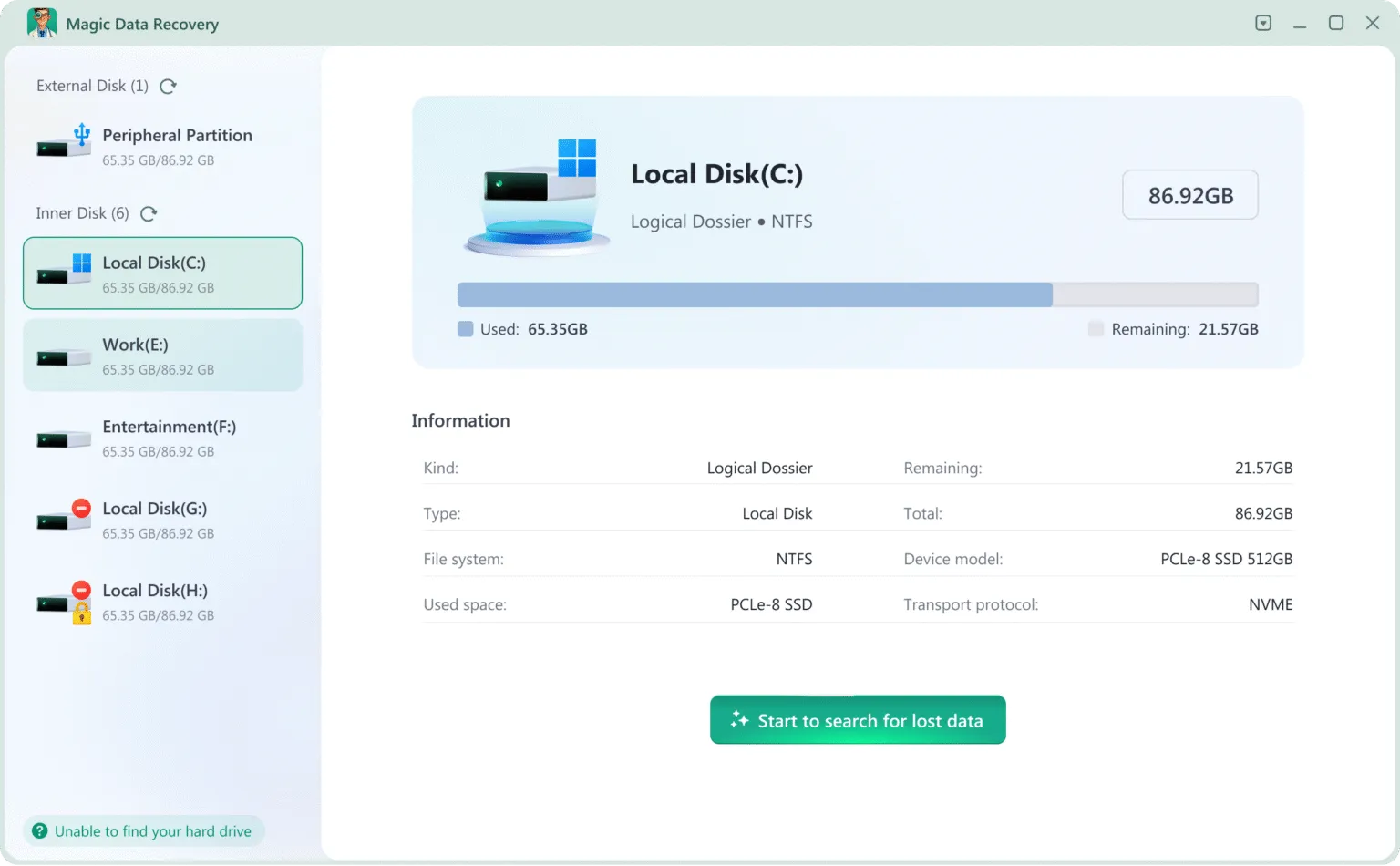
3. Filter and preview. Search by file name, type, path, size, or date, then preview important documents and photos.

4. Recover elsewhere. Save selected files to a different physical drive, open several samples, and confirm they are usable.
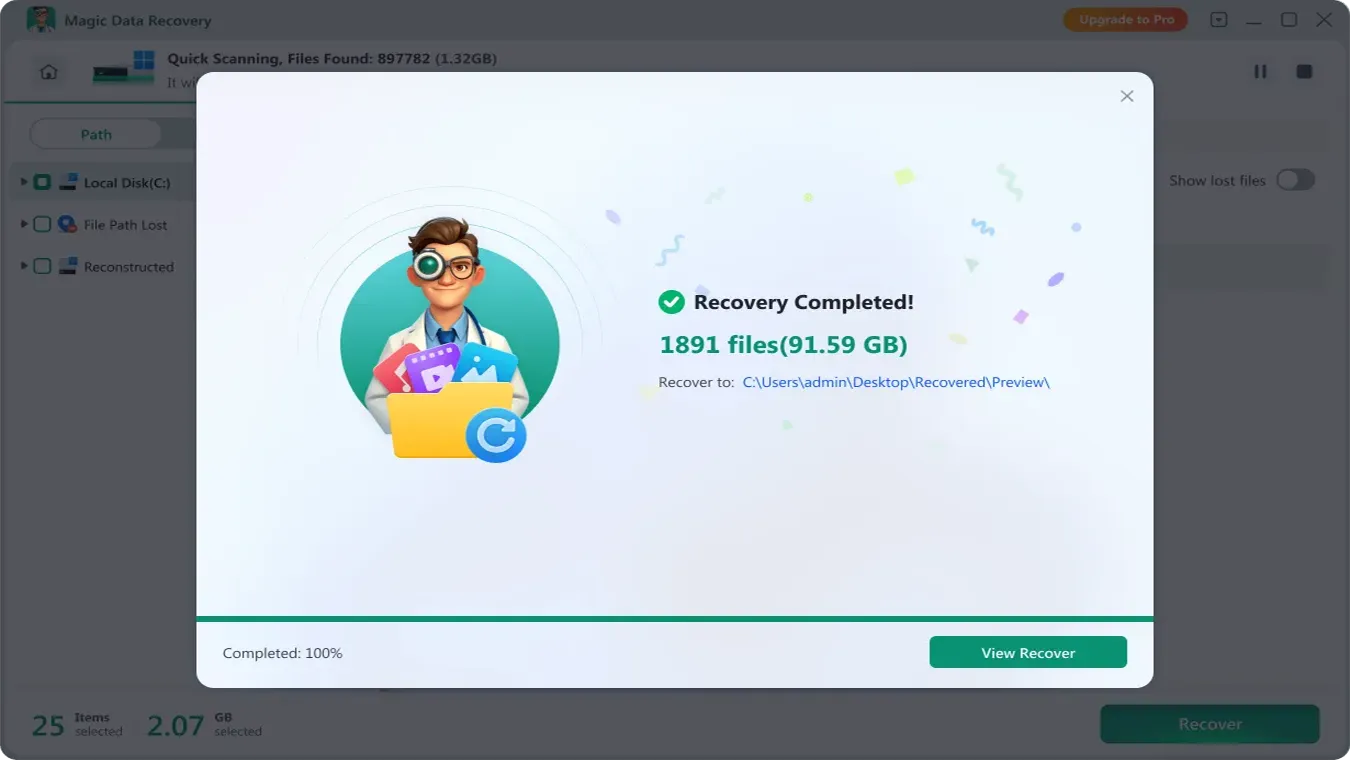
The Magic Data Recovery user guide provides interface details. After built-in checks fail, scan first and evaluate the previews before deciding what to recover.
Magic Data Recovery vs. Windows File Recovery
Microsoft offers Windows File Recovery for local internal drives, external drives, and USB devices. It is a valid option when no backup exists, but it uses commands, requires separate source and destination drives, and does not support cloud or network-share recovery.
| Option | Best for | Main limitation |
| File History or cloud backup | Files captured before the incident | Cannot restore an item that was never backed up |
| Windows File Recovery | Users comfortable with command syntax | No graphical preview; local storage only |
| Magic Data Recovery | Deleted, formatted, corrupted, or uncertain logical-loss cases | Results depend on overwrite, SSD TRIM, and drive condition |
| Recovery laboratory | Clicking, unstable, or physically damaged drives | Usually costs more and requires sending the device away |
Magic Data Recovery is unnecessary for a hidden icon or paused OneDrive account. Its advantage begins when normal folders, synced storage, the Recycle Bin, and backups no longer contain the data.
Common Mistakes to Avoid
When files disappeared from desktop Windows 10, avoid these recovery mistakes:
- Do not save recovered files to the source partition.
- Do not reinstall Windows or reset the PC before recovery.
- Do not delete an old user profile after an update until its Desktop, Documents, and Downloads folders have been checked.
- Do not keep scanning a drive that clicks, disconnects, or reports rapidly increasing hardware errors.
- Preview recovered content rather than trusting a file name alone.
Once the data is safe, run Microsoft Defender, check drive health, and create a regular backup. Windows 10 support ended on October 14, 2025, so plan a move to a supported operating system.
Conclusion
When files disappeared from desktop Windows 10, start by proving whether they are hidden, moved, synced, or stored under another profile. Check the desktop display, search the whole PC, inspect local and OneDrive Desktop folders, protect files in a temporary profile, and review the Recycle Bin, Windows.old, and backups.
If those checks return nothing, stop using the affected drive. Magic Data Recovery is recommended at that stage because it addresses the real remaining problem: the normal file reference may be gone even though recoverable data still exists on the storage device. Its quick-and-deep scan, filtering, preview, and separate-destination workflow make it suitable for ordinary Windows users without pretending that overwritten data or a physically damaged disk can always be repaired.
Supports Windows 7/8/10/11 and Windows Server
FAQs About Files Disappeared from Desktop Windows 10
Why did all my desktop files disappear in Windows 10?
Windows may have hidden desktop icons, loaded a temporary profile, redirected Desktop to OneDrive, or signed you into another account. An update can also move user data. Check %USERPROFILE%\Desktop, %USERPROFILE%\OneDrive\Desktop, and C:\Users before assuming the files were deleted.
How do I get my desktop files back after a Windows 10 update?
Search This PC, inspect other folders under C:\Users, and check C:\Windows.old\Users\<name>\Desktop. Also confirm that Windows did not load a temporary profile. Microsoft generally keeps Windows.old for only 10 days after an upgrade, so copy important files promptly.
Can OneDrive make Windows 10 desktop files disappear?
Yes. When OneDrive backs up Desktop, moving or deleting a synced item on one device can affect other devices. Check the OneDrive website, its Desktop folder, and its Recycle Bin. Confirm that the PC uses the expected Microsoft account before changing sync settings.
Are missing desktop files actually deleted?
Not always. If File Explorer search locates them, they were hidden, moved, or redirected rather than erased. True deletion becomes more likely only after you have checked every Desktop path, user profile, cloud account, Recycle Bin, Windows.old, and available backup.
How can I recover desktop files without software?
Restore them from the Windows or OneDrive Recycle Bin, File History, Previous Versions, another cloud backup, or Windows.old. These methods work only when an intact copy or record already exists. If none does, storage-scanning software or a recovery service may be necessary.
Can Magic Data Recovery recover permanently deleted desktop files?
It may recover deleted files when their original data has not been overwritten. Scan the partition that held the Desktop, preview the results, and restore files to another physical drive. Recovery is less likely after heavy disk use, secure erasure, or SSD TRIM.
Should I run CHKDSK when files suddenly disappear?
Not before protecting important data. CHKDSK repairs file-system structures; it is not a file-recovery tool. On a damaged logical volume, its changes may remove or alter records useful for recovery. Recover or image critical data first, then repair the file system.
What if the missing desktop files were on an SSD?
Stop using the SSD immediately. Windows may issue TRIM after deletion, allowing the drive to clear unused blocks and sharply reducing recovery chances. Check backups and cloud storage first, then scan promptly. No legitimate recovery application can guarantee results after TRIM has erased the underlying data.

Jason is a data recovery and technical support specialist with over 15 years of hands-on experience. He has worked extensively with frontline users, troubleshooting difficult data loss cases and providing practical recovery solutions for accidental deletion, formatted drives, damaged file systems, lost partitions, system failures, and other recovery emergencies. His expertise also includes backup and restoration, file repair, and disaster recovery, with a strong emphasis on safe, reliable, and technically accurate guidance.