
How to Use Recuva Data Recovery Software (and What to Do If It Doesn’t Work)
Recuva data recovery is a popular file recovery tool for Windows users who want to restore deleted photos, documents, videos, emails, and other lost files from a computer, Recycle Bin, USB drive, memory card, or external storage device.
In this guide, you’ll learn how to use Recuva data recovery step by step, when Recuva works best, why it may fail to find certain files, and what to do if your data was lost after formatting, corruption, RAW drive errors, or file system damage. For more deleted file recovery methods, you can also read our deleted file recovery guide.
If Recuva cannot recover the files you need, Magic Data Recovery can help you scan deeper and recover files from more complex data loss situations.
Supports Windows 7/8/10/11 and Windows Server
Table of Contents
What Is Recuva Data Recovery?
Recuva data recovery is a Windows file recovery tool developed by Piriform, the maker of CCleaner. It is mainly used to recover deleted files from Windows computers, the Recycle Bin, USB flash drives, memory cards, external hard drives, digital camera cards, and other rewritable storage devices.
Recuva can recover many common file types, including photos, documents, videos, music, emails, and archives. It also includes a Deep Scan mode for harder-to-find deleted files and a secure overwrite feature for users who want to permanently erase files.
Main Recuva data recovery features include:
Quick scan for recently deleted files
Deep Scan for harder recovery cases
File preview before recovery
Support for common Windows file systems
Recovery from PCs, USB drives, memory cards, and external drives
Secure file deletion feature
Free version for basic recovery needs
Recuva is a good starting point if your files were deleted recently and the storage device is still working normally. However, if the drive has been formatted, turned RAW, corrupted, or has partition errors, recovery results may be less predictable. In those cases, a more advanced data recovery tool may be a better option.
How to Use Recuva to Recover Deleted Files
Here’s a simple step-by-step guide to using Recuva recovery software:
1. Download and install Recuva from the official Piriform website.

2. Launch the Recuva Wizard, which guides you through recovery options.
3. Select the file type you want to recover (e.g., photos, documents, videos).
4. Choose the drive or location where the files were stored.
5. Click “Start” to begin the scan.
6. Review the scan results — Recuva will show recoverable files.

7. Select the files you want to restore and save them to a different drive.
✅ Tip: Never save recovered files back to the same drive you’re recovering from — it may overwrite the lost data.
When Does Recuva Data Recovery Work Best?
Recuva data recovery usually works best in simple data loss situations, especially when the deleted files have not been overwritten. You may get better results when:
The files were deleted recently.
The drive is still working normally.
The files were deleted from an HDD, USB drive, or memory card.
You stopped using the device immediately after deletion.
The original folder structure is still readable.
You are recovering common file types such as photos, documents, videos, or emails.
Recuva is especially useful for recovering files deleted from the Recycle Bin, USB flash drives, SD cards, and external drives. However, recovery success is never guaranteed. If new data has overwritten the deleted files, no software can fully restore the original data.
Common Recuva Data Recovery Problems and Why They Happen
Recuva Shows Files as Unrecoverable
This usually means the deleted file data may have been overwritten. When Windows deletes a file, the file entry may remain for a while, but the actual storage space can be reused by new data. Once overwritten, the file may become partially or fully unrecoverable.
Recuva Finds Zero-Byte Files
Zero-byte files may appear when the file record is damaged or when Recuva can only detect the file name but not the original file content. This is common after file system errors, interrupted transfers, or severe corruption.
Recuva Cannot Find Files After Formatting
Recuva may recover some files after quick formatting, especially if the original data has not been overwritten. However, after full formatting, partition changes, or heavy disk usage, recovery becomes more difficult.
Recuva Does Not Detect a RAW or Corrupted Drive
If a drive becomes RAW, unrecognized, or severely corrupted, Recuva may not be able to read the file system correctly. In this case, you may need software that can scan lost partitions, damaged file systems, and raw file signatures more deeply.
Recuva Scan Takes Too Long or Stops
This can happen when the drive has bad sectors, unstable connections, file system errors, or physical damage. If the drive makes unusual noises or disconnects frequently, stop scanning and consider professional recovery help.
What to Do If Recuva Data Recovery Doesn’t Work
If you’ve tried all of the above and still can’t find your data, it doesn’t mean your files are gone forever.
Professional tools like Magic Data Recovery are designed for deeper scans and complex recovery cases — where free tools like Recuva often fail.
Magic Data Recovery can:
Recover files from formatted or corrupted drives
Work with RAW or unrecognized partitions
Support NTFS, FAT, exFAT, and BitLocker drives
Restore photos, documents, archives, and videos with full structure
Preview data before restoring
In tests, Magic Data Recovery often detects files that Recuva misses — especially after formatting, partition loss, or serious file system errors.
👉 Try Magic Data Recovery’s free scan to see what files can still be restored.
Recuva vs Magic Data Recovery: Quick Comparison
| Feature | Recuva Data Recovery | Magic Data Recovery |
|---|---|---|
| Best for | Recently deleted files and basic recovery | Deleted, formatted, RAW, corrupted, and more complex recovery cases |
| Ease of use | Beginner-friendly wizard | Beginner-friendly recovery workflow |
| Free option | Free version available | Free scan available |
| Deep scan | Available | Available |
| Formatted drive recovery | Possible in some cases, results vary | Designed for formatted drive recovery |
| RAW drive recovery | Limited | Supported |
| Lost partition recovery | Limited | Supported |
| File preview | Available | Available |
| File system support | Common Windows file systems | NTFS, FAT, exFAT, BitLocker, and more |
| Support | Free version has limited support; Pro includes priority support | Product support available |
| Best use case | Simple deleted file recovery | More advanced recovery after formatting, corruption, or file system errors |
Recuva data recovery is a good first option when you need a free and simple tool for recently deleted files. Magic Data Recovery is more suitable when Recuva cannot find your files, the drive has been formatted, the partition is lost, or the file system has become RAW or corrupted.
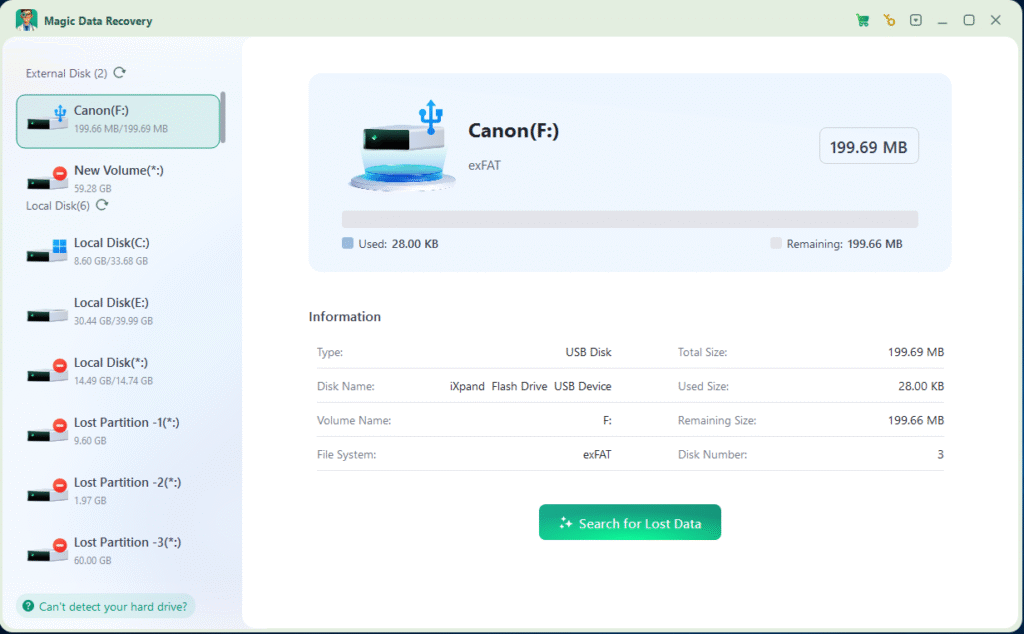
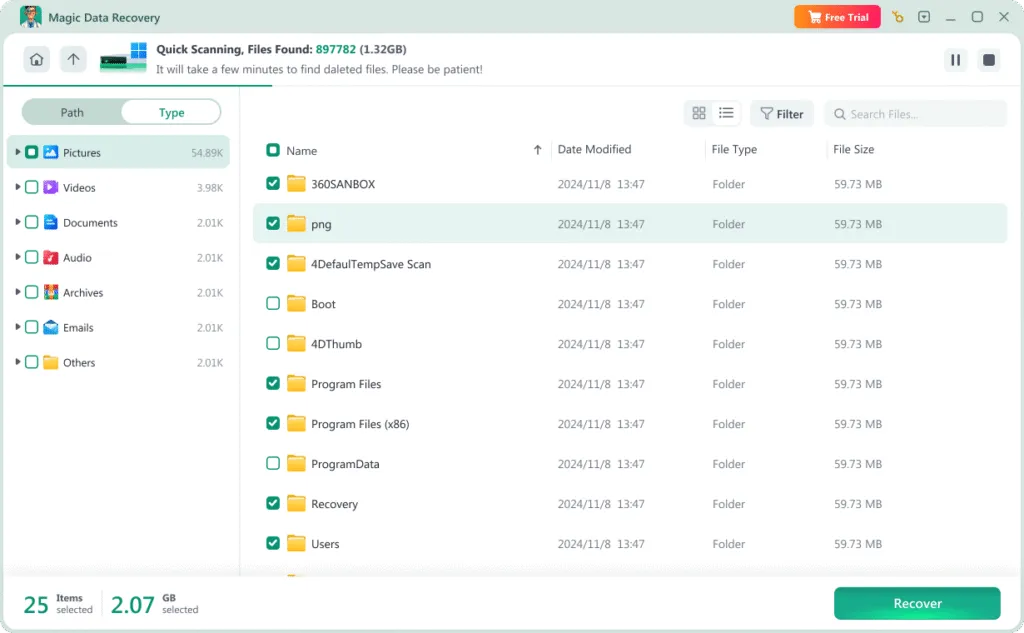
Step-by-Step Guide: Recover Data with Magic Data Recovery
Supports Windows 7/8/10/11 and Windows Server


Conclusion
Recuva data recovery is a useful starting point if you need a simple and free tool to recover recently deleted files from a Windows computer, USB drive, memory card, or external drive. It is easy to use and includes helpful features such as the Recuva Wizard, Deep Scan, file preview, and secure file deletion.
However, if Recuva cannot find your files, shows them as unrecoverable, or fails to scan a formatted, RAW, corrupted, or damaged drive, you may need a more advanced recovery solution. Magic Data Recovery can help you perform a deeper scan, preview recoverable files, and restore lost data from more complex recovery situations.
Before using any recovery tool, stop writing new data to the affected drive and save recovered files to a different storage device.
Supports Windows 7/8/10/11 and Windows Server
FAQs
Is Recuva data recovery free?
Is Recuva data recovery safe to use?
Can Recuva recover permanently deleted files?
Can Recuva recover files after formatting?
Why does Recuva show files as unrecoverable?
Does Recuva work on Windows 11?
Should I use Recuva or Magic Data Recovery?
What should I do before using Recuva data recovery?

Erin Smith is recognized as one of the most professional writers at Amagicsoft. She has continually honed her writing skills over the past 10 years and helped millions of readers solve their tech problems.