
Your Essential Guide to Flash Stick Memory

Table of Contents
What Exactly is Flash Stick Memory?
Often called a USB flash drive, thumb drive, or memory stick, a flash stick memory device is a compact, portable data storage solution. It utilizes a specific type of non-volatile memory technology called NAND flash memory. Unlike your computer’s RAM, which loses data when powered off, NAND flash memory retains information without a constant power supply. This makes it ideal for portable storage.
The core components inside your flash stick memory drive are the NAND flash memory chips (where your data is physically stored) and a microcontroller. This controller acts as the brain, managing data communication between the flash chips and the USB connector, handling error correction, and wear leveling. Understanding this basic architecture is the first step in appreciating both the versatility and the vulnerabilities of these ubiquitous devices.
Common Uses and Advantages of Flash Drives
The popularity of flash stick memory is no accident. Its benefits address modern needs perfectly.
- Extreme Portability and Convenience: Their small, durable form factor allows you to carry gigabytes—even terabytes—of data in your pocket. Transferring files between computers, sharing large presentations, or carrying personal work environments becomes trivial.
- Broad Compatibility: The universal USB standard, especially USB-A and the newer USB-C, means flash drives work with nearly every modern computer, laptop, smart TV, and car stereo without needing special drivers.
- Rewritability and Speed: You can erase and rewrite data on a flash drive thousands of times. With advancements like USB 3.2 Gen 1 and Gen 2, data transfer speeds have increased dramatically, making large file transfers a matter of seconds, not minutes.
- Practical Use Cases: From creating a bootable installer for an operating system and securely transporting sensitive documents to serving as a quick backup for your most important files, the applications are endless.
Understanding the Risks: How Data Gets Lost on Flash Stick Memory
Despite their robustness, flash drives are not infallible. Recognizing these risks is your best defense. Common scenarios include:
- Accidental Human Error: The most frequent cause. This involves mistakenly deleting files, formatting the wrong drive, or improperly ejecting the drive (which can lead to file system corruption).
- Physical Damage and Corruption: Flash drives can be damaged by water, extreme heat, or physical shock. Furthermore, a sudden power surge during a write operation or frequent unplugging without “Eject” can corrupt the file system, making data inaccessible.
- Virus and Malware Attacks: As portable media, they can easily transfer viruses. Some malware may hide or delete files, while others can corrupt the drive’s logical structure.
- Natural Wear and Tear: NAND flash memory cells have a finite number of Program/Erase (P/E) cycles. Over a very long period of heavy use, cells can wear out, leading to read/write failures. However, for most users, this happens long after the drive’s useful lifespan.
Best Practices to Protect Your Flash Drive Data
Prevention is always better than cure. Follow these best practices to maximize your flash stick memory safety and lifespan.
- Safe Ejection Routine: Always use the “Safely Remove Hardware and Eject Media” option (Windows) or drag the drive to the Trash/Eject (macOS) before unplugging. This ensures all pending write operations are complete.
- Regular and Redundant Backups: The golden rule of data. Never store the only copy of an important file on a single flash drive. Use the 3-2-1 backup rule: 3 total copies, on 2 different media, with 1 copy offsite (e.g., cloud storage).
- Smart Handling and Storage: Keep your drive in a clean, dry, and cool place. Use a protective cap to prevent dust and short circuits. Avoid exposing it to magnetic fields, though typical magnets are not a significant threat to flash memory.
- Use Reliable Security: For sensitive data, consider flash drives with hardware encryption. Always use reputable antivirus software to scan drives from unknown sources.
What To Do When Data Loss Occurs: Immediate Steps
If you realize you’ve lost data from your flash stick memory, stay calm and act immediately. These steps are crucial to prevent overwriting and increase recovery success.
- Stop Using the Drive Immediately: Do not save, copy, or add any new files to the drive. This prevents the system from overwriting the “deleted” data, which is often still physically present but marked as free space.
- Check the Recycle Bin/Trash: For simple deletions on your main computer, check here first. However, files deleted directly from the flash drive typically bypass this.
- Verify Connections and Try Another Port: Sometimes, the issue is a loose connection or a faulty USB port. Gently reinsert the drive or try a different port on your computer.
- Do Not Attempt Risky DIY Fixes: Avoid running built-in disk repair tools like
chkdsk /fon the drive at this stage, as they might repair the file system by permanently deleting “corrupt” data you wish to recover.
The Solution: Recovering Lost Files from Flash Stick Memory
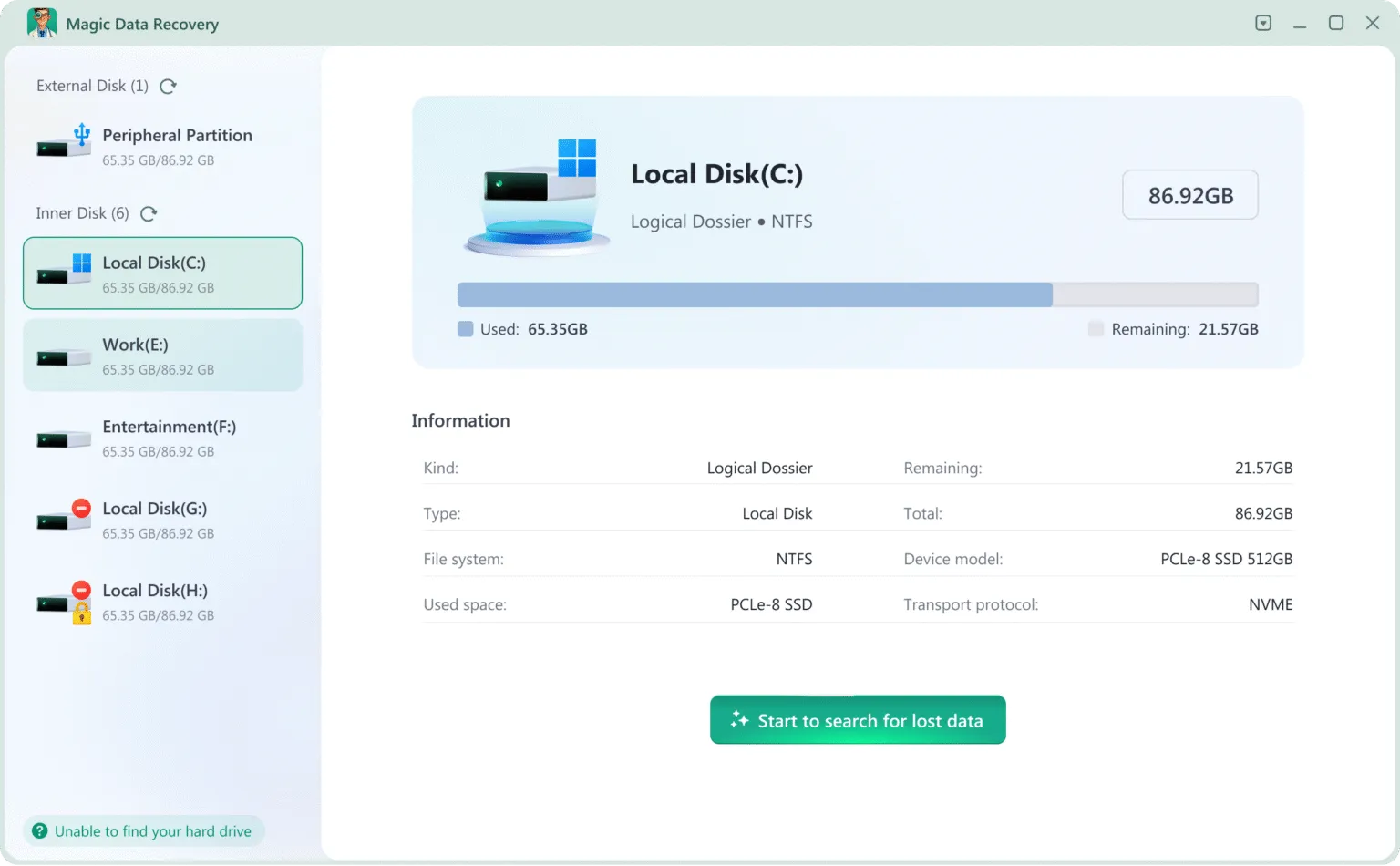
Why a dedicated recovery tool is often the most reliable solution:
- Deep Scan Technology: They perform a sector-by-sector scan, looking for file headers and footers to identify recoverable data, even without a working directory.
- Broad File System Support: They can handle common systems like FAT32, exFAT, and NTFS, which are used on flash drives.
- Pre-Recovery Preview: Quality tools allow you to preview found files (like photos, documents) before purchasing, confirming the recovery is possible.
- Non-Destructive Operation: A good recovery program operates in read-only mode, ensuring your original data on the flash stick memory is not altered during the scan.
Why Magic Data Recovery is the Recommended Choice
When facing the stress of data loss, you need a solution that is effective, trustworthy, and straightforward. Magic Data Recovery is specifically engineered to address the unique challenges of flash stick memory recovery.
Core Pain Point Solved
It directly tackles the primary causes of data loss on flash drives—accidental deletion, formatting, corruption, and virus attacks—by performing a deep, comprehensive scan of the storage media.
Key Product Advantages
- High Recovery Success Rate: Its advanced algorithms are optimized for NAND flash memorystructures, yielding a high likelihood of retrieving lost photos, documents, archives, and more.
- User-Friendly Interface: The process is guided and intuitive. You don’t need to be a tech expert. Just select your flash drive, choose a scan mode, preview results, and recover.
- Versatility and Preview Function: It supports recovery from all major file systems and hundreds of file types. The preview feature before recovery is crucial for verifying file integrity.
- Safety and Speed: The software is read-only and does not write to your damaged drive, keeping your original data safe. Its quick scan and deep scan options balance speed with thoroughness.
Typical Use Case
Imagine you accidentally formatted your flash stick memory containing a year’s worth of digital photos. After the initial panic, you install Magic Data Recovery. You select the drive, run a “Search for lost data” and after a short wait, you can see thumbnails of your lost images. You select the needed files, choose a safe recovery location (a different drive!), and restore them successfully.
Why It’s a More Reliable Option: Compared to freeware tools that often have depth limits or lack previews, Magic Data Recovery offers a more powerful and transparent solution. Unlike attempting risky manual commands, it provides a safe, guided process. For physical damage, software is the necessary first step before considering expensive and invasive lab recovery services.
If you’re facing the challenge of lost files on your flash drive, a reliable tool like Magic Data Recovery offers a professional and accessible solution to get your data back.
Supports Windows 7/8/10/11 and Windows Server
Conclusion
Flash stick memory has revolutionized how we carry and share data, offering unparalleled convenience. However, with this convenience comes the responsibility of understanding the risks of data loss. By grasping how these devices work, adhering to best practices like safe ejection and regular backups, and knowing the immediate steps to take after data loss, you can use your flash drives with greater confidence.
When preventive measures fall short, and you find yourself needing to recover precious files, turning to a specialized, trustworthy data recovery software is the most sensible and effective course of action. Tools like Magic Data Recovery are built for this exact purpose, providing a powerful yet user-friendly bridge between loss and restoration. They embody the practical application of data recovery expertise, turning a potentially disastrous situation into a manageable one. Remember, in the digital world, your data’s safety ultimately relies on your habits and your choice of USB recovery tools when needed.
FAQs
How much memory is on a USB stick?
Can I recover deleted files from a flash drive?
Is USB a RAM or ROM?
What does a flash memory stick do?
Is 256GB enough for a flash drive?
Which is better, a 32GB or 64GB flash drive?

Jason is a data recovery and technical support specialist with over 15 years of hands-on experience. He has worked extensively with frontline users, troubleshooting difficult data loss cases and providing practical recovery solutions for accidental deletion, formatted drives, damaged file systems, lost partitions, system failures, and other recovery emergencies. His expertise also includes backup and restoration, file repair, and disaster recovery, with a strong emphasis on safe, reliable, and technically accurate guidance.