
SSD NAND Flash Memory: How It Works & Data Recovery

Have you ever experienced the panic of a sudden computer blue screen with an unrecognizable SSD, or discovered that critical files stored on your solid-state drive have mysteriously vanished? The core of these issues often points to one key component: SSD NAND flash memory. As the heart of every solid-state drive, this storage technology determines your device’s speed, reliability, and data security.
This article provides an in-depth analysis of how SSD NAND flash memory works, its different types, common failure causes, and offers a complete data protection and recovery strategy. We will specifically address the growing issue of SSD data loss, explaining why traditional recovery methods often fail and how specialized SSD data recovery tools can provide an effective solution.
Table of Contents
What is SSD NAND Flash Memory?
How SSD NAND Flash Memory Works: Architecture & Operations
To truly appreciate the advantages and limitations of your solid-state drive, it’s essential to understand the fundamental architecture and operations of the NAND flash memory inside it.
The Core Cell: Trapping Electrons
At the physical level, SSD NAND flash memory is composed of billions of memory cells, each built from a floating-gate transistor. Data is stored by trapping electrical charges (electrons) on this floating gate. The amount of charge determines the cell’s state:
- A charged state typically represents a binary ‘0’.
- A discharged state represents a binary ‘1’.
The Hierarchy: Cells, Pages, and Blocks
Cells are not managed individually. They are organized into a specific hierarchy crucial for SSD performance and lifespan:
- Cell: The basic unit storing 1 to 4 bits (depending on type).
- Page (e.g., 16KB): The smallest unit for a read or write operation. When you save a small file, the controller writes it to one or more pages.
- Block (e.g., 256 Pages = 4MB): The smallest unit for an erase operation. This is the most critical aspect of NAND flash memory management.
The Write/Erase Cycle Challenge
This asymmetry between writing to pages and erasing entire blocks creates the main challenge for SSD NAND flash memory. To update data in a single page, the controller must:
- Read the entire block containing that page into a cache.
- Erase the entire block.
- Write the updated block (with the new page data) back to the memory.
This process, known as write amplification, increases wear on the cells. The SSD’s controller uses sophisticated techniques like wear leveling and over-provisioning (reserved spare area) to mitigate this effect and prolong the drive’s life.
Types of SSD NAND Flash Memory: SLC, MLC, TLC, QLC, and 3D NAND
Not all SSD NAND flash memory is created equal. The type used in your drive significantly impacts its cost, performance, endurance, and suitability for your needs.
Planar NAND Types: Bits per Cell
The primary classification is based on how many bits of data are stored in each memory cell.
Type | Full Name | Bits per Cell | Endurance | Speed (Relative) | Cost (Relative) | Common Use Case in SSDs |
SLC | Single-Level Cell | 1 | Very High (100k P/E cycles) | Fastest | Very High | Enterprise, Industrial |
MLC | Multi-Level Cell | 2 | High (10k-30k P/E cycles) | High | High | High-performance Consumer |
TLC | Triple-Level Cell | 3 | Moderate (3k-5k P/E cycles) | Good | Moderate | Mainstream Consumer SSDs |
QLC | Quad-Level Cell | 4 | Lower (1k-2k P/E cycles) | Lower (esp. sustained writes) | Low | High-capacity, Budget Drives |
What does this mean for you? For most users, a TLC-based SSD offers the best balance of performance, endurance, and price. QLC SSDs are excellent for storing large media libraries where extreme write endurance is not required, but they may slow down during large, sustained file transfers.
3D NAND: The Vertical Revolution
To overcome the physical scaling limits and performance degradation of packing more bits into planar (2D) cells, manufacturers developed 3D NAND. Instead of spreading cells out horizontally, this technology stacks memory cells vertically in layers (like a skyscraper).
- Advantages: Higher storage densities, improved performance, lower power consumption, and often better endurance per cell compared to planar counterparts at similar node sizes.
- Current Standard: Nearly all modern consumer SSDs now use some form of 3D NAND technology (e.g., 3D TLC NAND).
Why Data Gets Lost on SSD NAND Flash Memory
Understanding the failure modes of SSD NAND flash memory is the first step toward preventing data loss and knowing how to recover it.
1. Wear-Out and Cell Degradation
Every block of NAND flash memory has a finite number of Program/Erase (P/E) cycles. As the drive approaches and exceeds its rated endurance (measured in Terabytes Written – TBW), cells can become unstable, leading to uncorrectable errors and data corruption.
2. Logical Failures and Corruption
- Firmware Corruption: The SSD’s controller runs complex firmware. A failed update, power loss, or bug can corrupt this firmware, rendering the entire drive inaccessible.
- Bad Blocks: Over time, blocks can fail. While the controller maps these out, a sudden accumulation can overwhelm the system.
- File System Corruption: Issues with the NTFS, FAT32, or exFAT file system can make data appear lost.
- Accidental Deletion or Formatting: User error remains a common cause.
3. Controller Failure
The memory controller is a single point of failure. If it malfunctions due to an electrical surge or physical defect, the SSD will not respond, even if the NAND chips themselves are physically intact.
4. The TRIM Command: A Double-Edged Sword
TRIM is a crucial SSD maintenance command. It allows the operating system to inform the SSD which blocks of data are no longer in use and can be wiped internally. While this improves write performance and longevity, it makes data recovery much more difficult. Once TRIM is executed (which happens automatically after deletion on modern systems), the SSD’s controller may physically erase those pages, making traditional file recovery software ineffective. This is why acting quickly after data loss on an SSD is critical.
Best Practices for Maintaining Your SSD and Protecting Data
Proactive care can maximize the lifespan and reliability of your SSD NAND flash memory.
- Enable AHCI/NVMe Mode: Ensure your motherboard’s SATA controller is set to AHCI mode (or NVMe for M.2 drives) for optimal performance and feature support (like TRIM).
- Keep Some Free Space: Never fill your SSD to absolute capacity. Maintain at least 10-20% free space to allow the controller to perform wear leveling and garbage collection efficiently.
- Ensure TRIM is Enabled: On Windows, open Command Prompt as Administrator and type
fsutil behavior query DisableDeleteNotify. A result of0means TRIM is enabled. - Avoid Defragmentation: SSDs do not need defragging. It causes unnecessary writes and wear. Disable automatic defragmentation for your SSD in Windows.
- Regular Backups: This is non-negotiable. Use the 3-2-1 backup rule: 3 copies of your data, on 2 different media, with 1 copy offsite.
Recovering Lost Data from SSD NAND Flash Memory
When prevention fails, specialized data recovery approaches are necessary. The method depends heavily on the failure type.
Scenario 1: Logical Failures (Accidental Deletion, Formatting, Corruption)
For these cases, dedicated SSD data recovery software is your first and most effective line of defense. However, due to TRIM and the complex nature of SSD NAND flash memory, the software must be specifically engineered for the task.
Introducing Magic Data Recovery for SSD NAND Flash
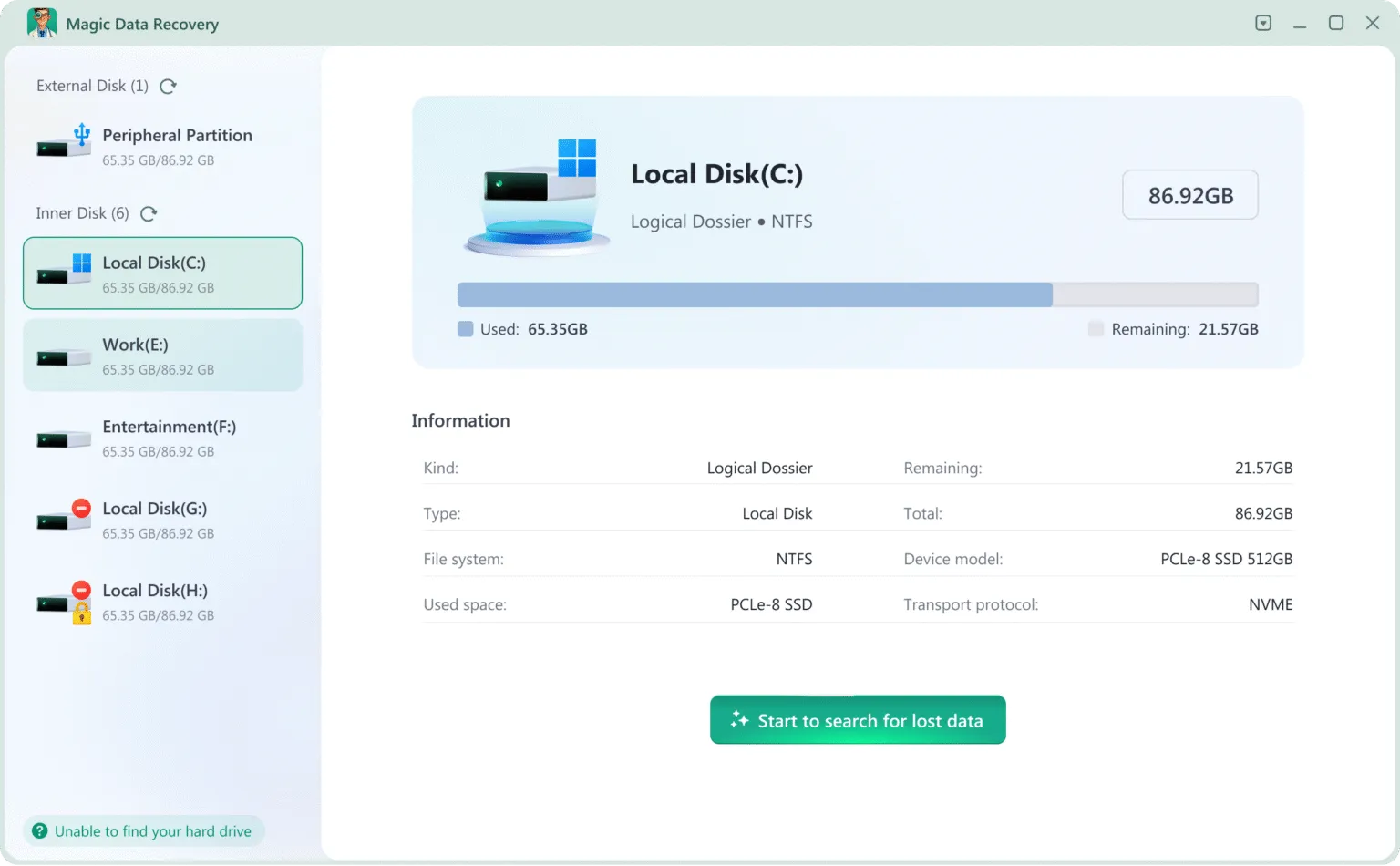
If you are facing data loss due to accidental actions or logical corruption on your solid-state drive, Magic Data Recovery offers a targeted solution designed for modern storage.
Supports Windows 7/8/10/11 and Windows Server
Core Pain Point Solved
It tackles the primary challenge of SSD data recovery — dealing with the TRIM command and the unique block-based architecture of NAND flash memory. Its advanced scanning algorithms go beyond simple file table lookups to perform a deep scan for residual data patterns.
Key Advantages
- SSD-Optimized Scanning: Uses specialized methods to locate files that may have been marked for TRIM but not yet fully erased.
- Wide File System Support: Compatible with NTFS, FAT32, exFAT, EXT2/3, and others common on SSDs.
- Preview Before Recovery: Allows you to see recoverable files (photos, documents, videos) before purchasing, confirming the data is intact.
- User-Friendly Workflow: A clear, step-by-step process guides you from drive selection to final recovery.
Typical Use Case
You accidentally quick-formatted your game drive SSD. Immediately, you stop using the drive, connect it to another computer as a secondary disk, and run Magic Data Recovery. You select the drive, click “Search for lost data,” and the software meticulously analyzes the NAND flash memory to reconstruct the directory structure and files, allowing you to recover them to a safe location.
Why It’s a Reliable Choice
Compared to generic recovery tools, Magic Data Recovery employs logic specifically tuned for SSD NAND flashchallenges. Compared to sending your drive to a lab (which can cost hundreds of dollars), it provides a fast, affordable, and private first attempt for logical failures.
Scenario 2: Physical & Electronic Failures (Dead SSD, Water Damage, Controller Failure)
If the SSD is not detected by the BIOS, makes unusual sounds (though rare), or has physical damage, professional data recovery services are required. These labs have specialized tools, cleanrooms, and expertise to:
- Desolder and directly read NAND flash memory chips.
- Repair or replace faulty controllers.
- Reconstruct data by combining raw reads from multiple memory chips.
Conclusion
SSD NAND flash memory is the engine behind the speed and responsiveness of modern computing, but it comes with unique data loss risks rooted in its electrical nature and management commands like TRIM. By understanding its types, failure modes, and maintenance needs, you can better protect your valuable data.
When logical data loss occurs—be it deletion, formatting, or corruption—time is of the essence. For these scenarios, we recommend Magic Data Recovery. Its focused approach on the intricacies of SSD NAND flash memory, combined with a high success rate for logical recoveries and a user-centric design, makes it an excellent tool for both home users and IT professionals.
Facing SSD data loss? If you need an effective and specialized solution for recovering files from solid-state drives, consider trying Magic Data Recovery for a direct and powerful recovery experience.
Supports Windows 7/8/10/11 and Windows Server
FAQs
What is a SSD NAND flash memory?
Is all SSD storage based on NAND flash?
How do I know what type of NAND flash is in my SSD?
Is TLC or QLC better for my SSD?
Does the TRIM command delete my data permanently?
Can I recover data from a failed SSD myself?

Jason is a data recovery and technical support specialist with over 15 years of hands-on experience. He has worked extensively with frontline users, troubleshooting difficult data loss cases and providing practical recovery solutions for accidental deletion, formatted drives, damaged file systems, lost partitions, system failures, and other recovery emergencies. His expertise also includes backup and restoration, file repair, and disaster recovery, with a strong emphasis on safe, reliable, and technically accurate guidance.