
Unrecognized HDD Recovery: How to Recover Data from a Hard Drive Not Detected

An unrecognized HDD is not always physically dead. If the hard drive still appears in Disk Management with the correct capacity—even as RAW, Unallocated, Unknown, Not Initialized, or without a drive letter—unrecognized HDD recovery is often possible.
The safest approach is to stop using the drive, check where Windows can detect it, perform only non-destructive connection checks, recover the important files to another disk, and repair or format the HDD afterward. Do not initialize the disk, create a new volume, format it, or run CHKDSK with repair parameters before securing the data you need.
This guide explains how to recover data from an undetected hard disk, an unreadable drive, or a hard drive that Windows does not recognize. It also helps you determine whether you can use hard drive recovery solutions at home or need a professional data recovery service.
Table of Contents
Supports Windows 7/8/10/11 and Windows Server
Can You Recover Data from a Hard Drive That Is Not Recognized?
Yes, data can often be recovered from a hard drive that is not recognized in File Explorer, provided that the physical disk still appears in Disk Management, Device Manager, or BIOS with the correct capacity. In this situation, the drive may have a missing drive letter, a corrupted file system, a lost partition, or another logical problem.
If the HDD does not appear anywhere, repeatedly disconnects, has the wrong capacity, or makes clicking, grinding, or beeping sounds, stop powering it on. Data recovery software cannot directly scan a physically undetectable drive, and continued use may cause additional damage.
Make the Undetected Hard Drive Visible Before Recovery
Before using recovery software, Windows must be able to detect the physical HDD. Start with connection checks that do not modify the data stored on the drive:
- Disconnect and reconnect the SATA, USB, and power cables.
- Try another USB or SATA port, preferably one connected directly to the motherboard.
- Replace the USB cable or external hard drive enclosure.
- Avoid unpowered USB hubs, especially with larger desktop hard drives.
- Test the HDD on another computer.
- Open Device Manager and Disk Management to check whether the physical disk appears.
These steps may restore detection when the actual problem is a faulty cable, insufficient power, a damaged enclosure, or a Windows driver issue.
Stop immediately if the HDD clicks, grinds, beeps, repeatedly spins up and down, smells burnt, or disappears during use. Do not open the drive enclosure containing the platters, run a full scan, or repeatedly reconnect it. These symptoms may indicate physical damage that requires a professional data recovery laboratory.
Common Logical Problems Behind an Unrecognized HDD
An HDD may be physically healthy but inaccessible because Windows cannot interpret its partition or file system information. Common symptoms include:
• The disk appears in Disk Management but not in File Explorer.
• The partition has no drive letter.
• The file system displays as RAW or unrecognized.
• The entire disk displays as Unallocated.
• Windows labels the disk as Unknown or Not Initialized.
• The drive displays the correct capacity but cannot be opened.
• Windows asks you to format the drive before use.
These conditions commonly indicate a logical problem rather than complete mechanical failure. Do not format, initialize, repartition, or create a new volume before recovering the required files.
How to Detect Logical Issues


Run CHKDSK Only After Recovering Important Data
CHKDSK is a Windows file system repair utility, not a dedicated data recovery tool. The /f parameter fixes file system errors, while /r searches for bad sectors and attempts to recover readable information.
Because these parameters modify the file system and may take a long time on a large or unstable HDD, recover the important files before running the command.
After the data has been secured and the drive shows no signs of physical failure, open Command Prompt as Administrator and run:
chkdsk X: /f
Replace X: with the actual drive letter.
Use chkdsk X: /r only when a full sector check is necessary and the HDD is stable. Do not run CHKDSK if the drive repeatedly disconnects, makes unusual noises, or is completely absent from Disk Management.

Advanced users may inspect or repair damaged partition structures with tools such as WinHex or TestDisk. However, writing incorrect partition or boot-sector values can make recovery more difficult. For most users, recover the files first or follow a dedicated HDD logical failure guide.
Unrecognized HDD Recovery with Magic Data Recovery
If you don’t want to risk your valuable data with complex manual fixes, Magic Data Recovery offers a safer and more reliable way to recover lost data. Unlike command-line tools, it provides an intuitive interface while using advanced algorithms to detect and recover files—even if the drive is unrecognized or formatted.
Key Features for Unrecognized HDD Recovery:
- Deep Scan Technology: Recovers data from RAW, corrupted, or unallocated partitions.
- Wide Compatibility: Supports HDDs, SSDs, memory cards, USB drives, and more.
- Safe Recovery Process: Read-only scanning ensures no further damage to your drive.
- User-Friendly Interface: Anyone can perform professional-level recovery without technical expertise.
Step-by-Step Guide:
1.Download and install Magic Data Recovery.
Supports Windows 7/8/10/11 and Windows Server
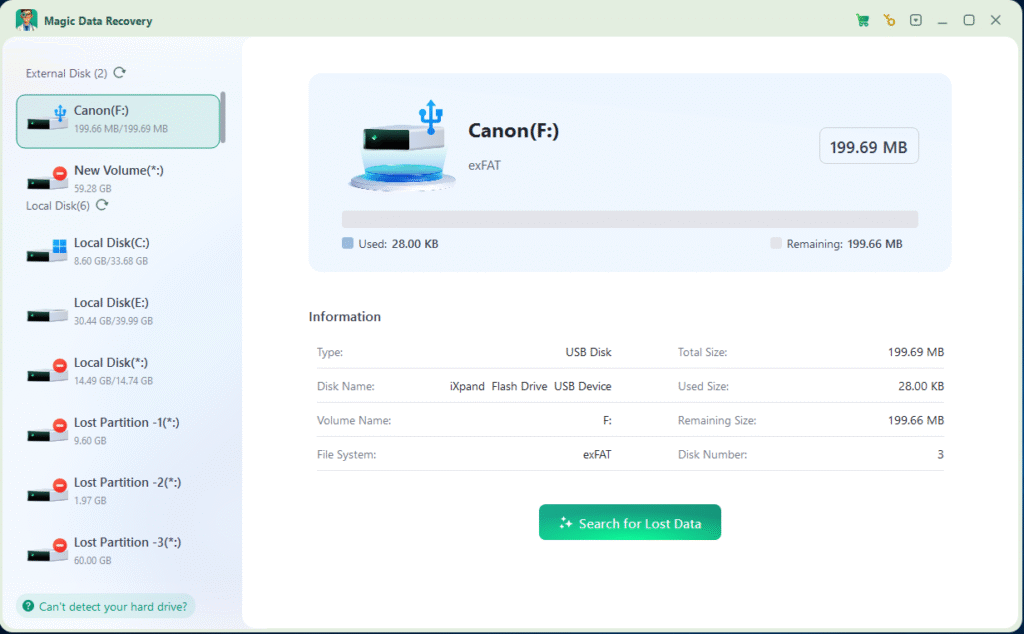
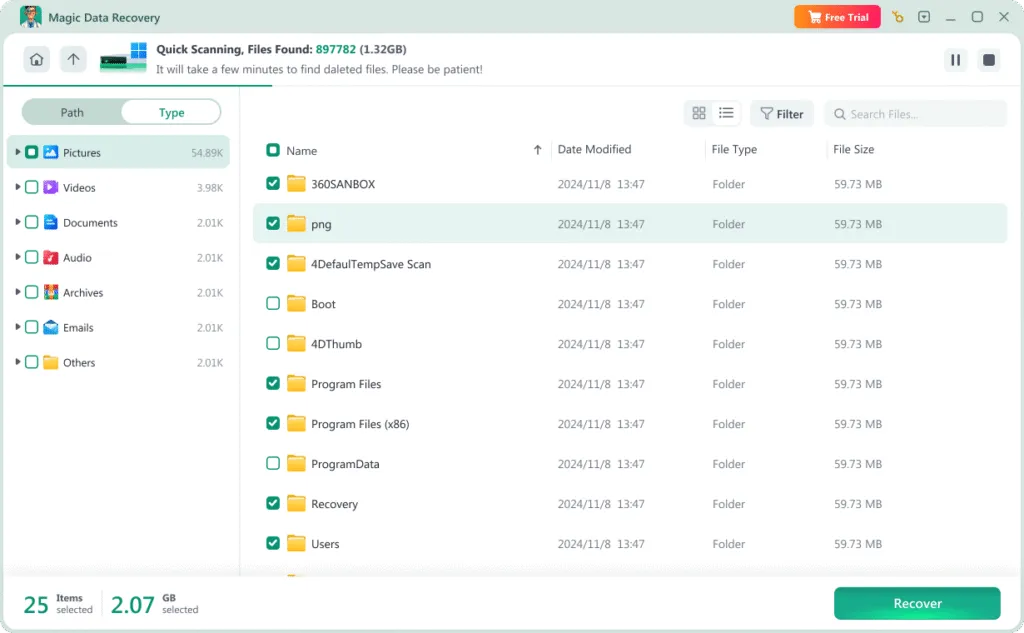
4.Preview recoverable files and select the data you need.


How to Fix a Hard Drive That Is Not Recognized
Method 1:Assign a Drive Letter
If the partition appears healthy in Disk Management but has no drive letter, right-click the partition, select Change Drive Letter and Paths, and add an unused letter. This does not recover deleted files, but it may make an otherwise healthy partition visible in File Explorer.
Method 2:Update or Reinstall the Driver
Open Device Manager, expand Disk drives, right-click the affected HDD, and select Update driver. If the issue started after a driver error, uninstalling the device and restarting Windows may allow the operating system to reinstall the driver automatically.
Method 3:Bring an Offline Disk Online
If Disk Management labels the HDD as Offline, right-click the disk label and select Online. Before doing so, confirm that it is the correct physical disk and that no storage or RAID configuration depends on its current offline status.
Method 4:Initialize or Format Only After Recovery
Initializing a disk, creating a New Simple Volume, or formatting a RAW partition may make the HDD usable again, but these operations do not recover the original files. Use them only after the required data has been recovered or when no existing data needs to be preserved.
Conclusion
Unrecognized HDD recovery begins with determining where the drive is still detectable. If the HDD appears in Disk Management with the correct capacity, the problem is often logical, and you may be able to recover data from the unreadable or undetected hard drive with Magic Data Recovery.
Perform only non-destructive connection checks before recovery. Do not initialize, format, repartition, or run CHKDSK with repair parameters until the important files have been saved to another drive.
If the HDD is absent from BIOS and Disk Management, repeatedly disconnects, or makes clicking or grinding noises, stop using it and consult a professional recovery service. Following the correct order—diagnose, recover, and then repair—provides the safest approach to hard drive recovery.
Supports Windows 7/8/10/11 and Windows Server
FAQs
Can you recover data from a hard drive that is not recognized?
How do I recover data from an undetected hard disk?
Can recovery software detect an HDD that is not shown in Disk Management?
What does an unrecognized file system mean?
Should I initialize an unrecognized hard drive?
Should I run CHKDSK before recovering data?
Why does my HDD appear in BIOS but not in File Explorer?
When should I use a professional HDD recovery service?

Vasilii is a data recovery specialist with around 10 years of hands-on experience in the field. Throughout his career, he has successfully solved thousands of complex cases involving deleted files, formatted drives, lost partitions, and RAW file systems. His expertise covers both manual recovery methods using professional tools like hex editors and advanced automated solutions with recovery software. Vasilii's mission is to make reliable data recovery knowledge accessible to both IT professionals and everyday users, helping them safeguard their valuable digital assets.