
A Complete Guide to Recovering Your Lost Data from HDD Logical Failure

An HDD logical failure occurs when the file system, partition table, boot records, or other data structures on a hard drive become damaged or unreadable. The drive may still power on and appear in Windows, but files, folders, or entire partitions can no longer be accessed normally.
Common signs include a hard drive appearing as RAW, a missing partition, an “Operating System not found” message, or Windows asking you to format the disk before using it.
Before trying to fix logical failure on an HDD, stop writing new data to the affected drive. If the files are important, recover or back them up before running repair commands, formatting the drive, or creating a new partition.
For users looking for a reliable HDD solution, the safest approach is to recover important files first and repair the drive afterward. Magic Data Recovery can scan logically damaged, RAW, formatted, or inaccessible hard drives and recover selected files to another storage device before further repair is attempted.
Important: If the HDD makes clicking, grinding, buzzing, or repeated spin-up sounds, disconnect it immediately. These symptoms may indicate physical failure rather than logical failure, and continued use could make the damage worse.
What is an HDD Logical Failure?
A logical hard drive failure is a software-level problem that prevents the operating system from correctly reading the data stored on an HDD.
The physical components of the drive may still be functioning, but Windows cannot interpret the file system or locate the files because important data structures have been corrupted, deleted, or overwritten.
A simple way to understand this is to imagine a library in which all the books are still on the shelves, but the catalog showing where each book belongs has been damaged. The information may still exist, but the system can no longer find or organize it correctly.
Logical failure can affect:
- The file system
- The partition table
- The Master File Table, or MFT
- The boot sector
- The Master Boot Record, or MBR
- The GUID Partition Table, or GPT
- File and folder records
- Operating-system boot information
Unlike a physically damaged hard drive, a logically damaged HDD can often be recovered without opening the drive. However, recovery success depends on the condition of the disk and whether new data has overwritten the original files.
Common Symptoms of HDD Logical Failure
The following symptoms may indicate logical damage.
1. The HDD Appears as RAW
A healthy Windows partition normally uses a recognized file system such as NTFS, FAT32, or exFAT.
If Windows displays the partition as RAW, the file system may be missing, damaged, or unreadable. You may also receive a message such as:
You need to format the disk in drive X: before you can use it.
Do not format the drive if you still need the files stored on it.
2. The Partition Becomes Unallocated
The HDD may appear in Disk Management, but some or all of its capacity is marked as Unallocated.
This can happen when a partition entry is deleted or the partition table becomes corrupted. The files may still remain on the disk even though Windows can no longer display the original partition.
Do not create a new volume in the unallocated space before recovering your data.
3. Files or Folders Become Inaccessible
You may be able to see the drive letter but receive an error when opening it, such as:
- The file or directory is corrupted and unreadable.
- Access is denied.
- The parameter is incorrect.
- The location is not available.
- The volume does not contain a recognized file system.
These errors may be caused by file-system corruption, damaged directory records, permission problems, or unreadable sectors.
4. A Partition or Drive Letter Disappears
A partition may no longer appear in File Explorer even though the HDD is visible in Disk Management.
In some cases, the partition is healthy but has lost its drive letter. In other cases, the partition itself has been deleted or damaged.
5. Windows Cannot Boot
If the logical failure affects the system drive, the computer may display messages such as:
- Operating System not found
- Boot device not found
- Invalid partition table
- A disk read error occurred
- No bootable device
A boot error does not automatically mean that the HDD is physically damaged. The boot records, system partition, or operating-system files may be corrupted.
6. Files Disappear or Show Incorrect Names and Sizes
Logical corruption can damage file records and directory information. Files may disappear, appear with unusual names, show a size of zero bytes, or be placed in unexpected folders.
7. Windows Repeatedly Checks the Drive
Windows may repeatedly request a disk check during startup if it detects file-system inconsistencies. This can indicate logical errors, but recurring checks can also be a warning that the drive is becoming unstable.
Logical vs. Physical Hard Drive Failure
Before attempting a repair, determine whether the problem is more likely logical or physical.
Symptom | Likely failure type | Recommended action |
HDD appears as RAW | Logical | Recover data before formatting or repairing |
Partition appears as unallocated | Logical | Do not create a new volume; scan for lost data |
Files are missing but the HDD is detected | Logical | Stop writing data and begin recovery |
Windows asks you to format the HDD | Logical | Cancel the format request |
HDD has no drive letter | Logical or configuration issue | Check Disk Management |
“Operating System not found” appears | Logical or physical | Check whether the HDD is detected and listen for unusual sounds |
HDD makes clicking or grinding sounds | Physical | Disconnect the drive |
HDD is not detected in BIOS or Disk Management | Possibly physical | Check the connection once, then consider professional help |
HDD repeatedly disconnects | Possibly physical | Stop using it if the data is important |
HDD causes severe freezing during reads | Possibly physical or bad sectors | Avoid repeated scans and consider creating a disk image |
Burning smell or visible electrical damage | Physical or electrical | Disconnect the drive immediately |
A drive can also have both logical corruption and physical degradation. For example, bad sectors may damage file-system metadata and cause a partition to appear as RAW.
For this reason, do not assume that a drive is physically healthy only because it still powers on.
Identifying the Symptoms of HDD Logical Failure
If you’re unsure what kind of hard drive error you have, look for these common symptoms of logical damage:
- RAW File System: Your computer shows the hard drive partition as “RAW” and asks, “You need to format the disk in drive X: before you can use it.” Do NOT format the drive.
- Missing or Disappeared Partitions: The drive appears in Disk Management but is shown as “Unallocated Space,” or partitions that were once there are now gone.
- Operating System Boot Failure: Your computer fails to boot, displaying messages like “Operating System not found” if the OS is on the affected drive.
If you are experiencing any of these issues, it is highly probable that you are dealing with an HDD logical failure.
How to fix a HDD with logical failure
We can use Windows’ built-in “disk doctor” tool — the chkdsk command to repair a corrupted USB drive. This command is Microsoft’s official, professional-level repair utility that comes pre-installed in every Windows system, making it one of the most trusted methods for fixing drive errors without third-party software. However, please note that this operation may carry certain risks, as it will make changes to the disk structure. In some cases, these changes could make subsequent data recovery more difficult.
Please ensure you have sufficient computer knowledge and have created a backup of the disk or partition before proceeding. The CHKDSK command will make changes to the disk’s structure, and in some cases, these changes could make subsequent data recovery more difficult.
Repair Steps:
1.Note the Drive Letter: Plug in the USB drive and open Disk Mamagement (right click Start Menu) to see what letter has been assigned to it (e.g., G:). RAW means the file system or the file allocation table is damaged.


3.Enter the Command:chkdsk G: /f /r
In the black command window, type the following command and press Enter. Be sure to replace G: with your USB drive’s actual letter.
- G: is your drive letter.
- /f tells the command to fix any errors it finds.
- /r tells it to locate bad sectors and recover readable information (this makes the process take longer but is more thorough).


The Safest Solution for an HDD Logical Failure
When faced with logical corruption, the most critical step is to stop using the drive immediately. Do not try to run repair utilities like CHKDSK or attempt to reformat it, as these actions can write new data over your old files, making recovery much more difficult or even impossible.
The safest and most effective HDD recovery solution is to use dedicated data recovery software. This type of software performs a read-only scan of the drive’s platters, bypassing the corrupted file system to locate and piece together your original files.
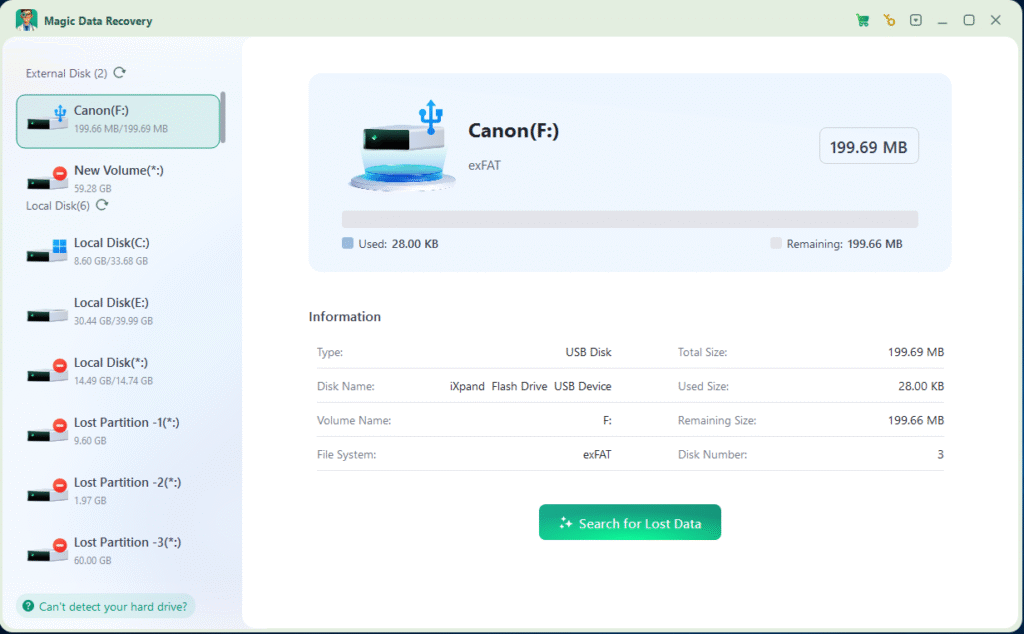
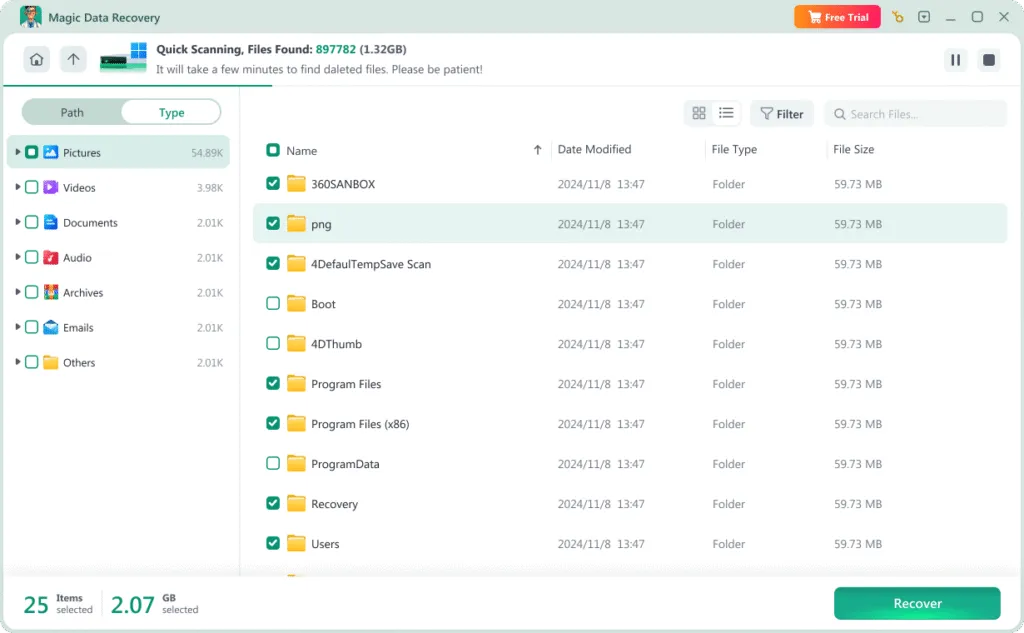
This is where Magic Data Recovery excels. It is designed specifically to handle these scenarios, offering a powerful yet user-friendly way to rescue your data from formatted, corrupted, or inaccessible hard drives.
Step-by-Step: Recover Data from an HDD with Logical Failure
Magic Data Recovery makes a complex process simple. Follow these steps to get your files back safely.
1.Stop All Activity: First and foremost, to prevent data overwriting, do not save any new files or install any programs onto the affected drive. If it’s your main system drive, it’s best to connect it to another computer as a secondary drive for recovery.
Supports Windows 7/8/10/11 and Windows Server
2.Download and Install the Software: Download Magic Data Recovery on a separate, working computer or a different drive. The installation is quick and straightforward.


Conclusion
An HDD logical failure does not always mean that the hard drive or its files are permanently lost. In many cases, the HDD is still detected, but Windows cannot access the stored data because the file system, partition table, boot information, or other logical structures have been damaged.
The safest HDD solution is to stop using the affected drive, check for signs of physical damage, recover important files to another storage device, and only then attempt to repair or format the original HDD. Magic Data Recovery can scan detected RAW, formatted, inaccessible, or logically damaged hard drives, preview recoverable files, and restore selected data to a safe location.
Avoid running repair commands, creating new partitions, or accepting a Windows format request before your important files have been recovered. If the HDD makes unusual sounds, disconnects repeatedly, or contains irreplaceable data, stop using it and contact a professional data recovery service.
Supports Windows 7/8/10/11 and Windows Server
FAQ
What is an HDD logical failure?
How do I know whether an HDD failure is logical or physical?
Can logical hard drive failure be fixed?
Can CHKDSK fix an HDD logical failure?
Should I run CHKDSK before recovering my files?
Should I format a RAW HDD?
Can data be recovered from an unallocated HDD?
Can I recover data from an HDD that is not detected?

Vasilii is a data recovery specialist with around 10 years of hands-on experience in the field. Throughout his career, he has successfully solved thousands of complex cases involving deleted files, formatted drives, lost partitions, and RAW file systems. His expertise covers both manual recovery methods using professional tools like hex editors and advanced automated solutions with recovery software. Vasilii's mission is to make reliable data recovery knowledge accessible to both IT professionals and everyday users, helping them safeguard their valuable digital assets.