
Lost Partition Recovery in Windows: Recover Lost or Deleted Partitions Safely

A partition may appear lost when its drive letter disappears, the partition table is damaged, or Windows displays the space as Unallocated, RAW, or Not Initialized. In many cases, the files still remain on the physical disk, but Windows can no longer locate or access the original volume.
Quick answer: Stop using the affected disk immediately. Do not format it, initialize it, create a new volume, or save new files to it. If the partition is still shown as Healthy in Disk Management but has no drive letter, assigning a drive letter may restore access. If it appears as Unallocated, RAW, or missing, scan the entire physical disk with lost partition recovery software and save recovered files to another drive.
Magic Data Recovery can scan the physical HDD, SSD, USB drive, or memory card that previously contained the lost partition. It focuses on locating and recovering files from inaccessible partition space rather than directly rewriting the original partition table.
This guide explains how to identify the type of partition problem, choose the correct recovery method, recover lost partition data safely, and avoid actions that may overwrite recoverable files.
Supports Windows 7/8/10/11 and Windows Server
Table of Contents
Is the Partition Really Lost?
Before starting lost partition recovery, open Disk Management and check how the affected disk or volume appears. Different statuses require different solutions.
| Disk Management status | What it may mean | Recommended action |
|---|---|---|
| Healthy, but no drive letter | The partition still exists but is not mounted in File Explorer | Assign an unused drive letter |
| Unallocated | The partition entry may have been deleted or the partition table may be damaged | Do not create a new volume; recover important files first |
| RAW | The partition exists, but Windows cannot recognize its file system | Do not format it; scan the physical disk for recoverable files |
| Not Initialized | Windows cannot read a valid disk structure, or the disk may be new | Do not initialize an old disk that contains important data |
| Offline | The disk may have been taken offline manually or may have a signature conflict | Check the disk status before making structural changes |
| Missing from Disk Management | Possible connection, power, controller, or physical disk failure | Check the hardware connection; stop if the drive makes unusual noises |
| Visible but inaccessible | Possible permissions, file system, encryption, or bad-sector problem | Confirm the actual cause before treating it as a lost partition |
A missing drive letter, a RAW volume, and an Unallocated partition are not the same problem. Correctly identifying the disk status helps prevent unnecessary formatting or partition changes.
What to Do Immediately After a Partition Is Lost
Take the following precautions before attempting to recover a lost partition:
- Stop writing new files to the affected disk.
- Do not format the partition when Windows asks you to format it.
- Do not initialize an old disk that contains important files.
- Do not create a New Simple Volume in Unallocated space.
- Do not install recovery software on the affected disk.
- Do not recover files back to the original disk.
- Avoid running CHKDSK when the partition is RAW, missing, or Unallocated.
- Stop software recovery if the HDD clicks, repeatedly disconnects, or reports severe read errors.
These precautions reduce the risk of overwriting file data, file system metadata, or the original partition boundaries.
What Causes a Partition to Become Lost or Deleted?
Accidental Partition Deletion
A partition may be deleted accidentally in Disk Management, DiskPart, Windows Setup, or third-party partition software. The partition entry disappears, but the files may remain on the disk until their sectors are overwritten.
Partition Table Corruption
Damage to the MBR or GPT partition table can prevent Windows from locating the original partition boundaries. The disk may show missing partitions, Unallocated space, or initialization prompts.
Failed Partition Resizing or Cloning
A power failure, crash, incorrect disk selection, or interrupted resizing, migration, or cloning operation can damage partition information.
Operating System Installation
Installing or reinstalling Windows or Linux may delete existing partitions, recreate the partition layout, or overwrite part of the original disk structure.
File System Damage
The partition may still exist, but damage to NTFS, FAT32, or exFAT metadata can cause it to appear RAW or inaccessible.
Power Failure or Unsafe Removal
Disconnecting an external drive or losing power during partition changes can leave disk structures incomplete or inconsistent.
Hardware Failure
Bad sectors, controller problems, unstable USB connections, or mechanical HDD failure can cause a partition to disappear or become unreadable.
Can a Lost or Deleted Partition Be Recovered?
Lost partition recovery is often possible when the original partition space has not been overwritten and the storage device remains physically readable. Deleting a partition usually removes or changes its partition-table entry rather than immediately erasing every file stored inside it.
Recovery results depend on:
- Whether a new partition was created in the same space
- Whether new files were written after the partition disappeared
- Whether the original file system metadata remains intact
- Whether the disk has physical read errors
- Whether the lost partition was encrypted
- Whether the correct physical disk is scanned
- Whether TRIM or other storage-management processes affected the deleted data
A recently deleted partition on a healthy HDD may retain much of its original folder structure. Recovery becomes more difficult after formatting, repartitioning, operating-system installation, continued disk use, or physical failure.
The safest approach is to recover important files to another disk before attempting to rewrite the partition table or recreate the volume.
Lost Partition Data Recovery vs. Partition Table Restoration
Lost partition data recovery and partition-table restoration are related, but they are not the same process.
| Method | What it does | Main consideration |
| File recovery software | Scans the physical disk and saves recoverable files to another disk | Does not directly restore the original partition entry |
| Partition-table recovery | Searches for old partition boundaries and writes selected entries back to MBR or GPT | Incorrect selections may affect other partitions |
| Assigning a drive letter | Makes an existing Healthy partition visible again | Works only when the partition still exists |
| Formatting or recreating a volume | Creates a new partition or file system | May overwrite original metadata and is not a recovery method |
Magic Data Recovery recovers files from the space previously occupied by the lost partition. It does not automatically restore the deleted partition entry or make the original drive letter reappear.
Recovering files first is usually the safer choice when the disk contains important data.
How to Recover a Lost Partition in Windows
Choose the method that matches the partition status shown in Disk Management.
Method 1. Assign a Drive Letter to an Existing Partition
Use this method only when the partition is still displayed as Healthy and shows a recognized file system such as NTFS, FAT32, or exFAT.
- Press
Windows + Xand select Disk Management. - Locate the partition that does not have a drive letter.
- Right-click the partition and select Change Drive Letter and Paths.
- Click Add.
- Select an unused drive letter.
- Click OK.
Open File Explorer and check whether the partition and files are accessible again.
Do not use this method when the space appears as Unallocated or when the partition is completely missing.
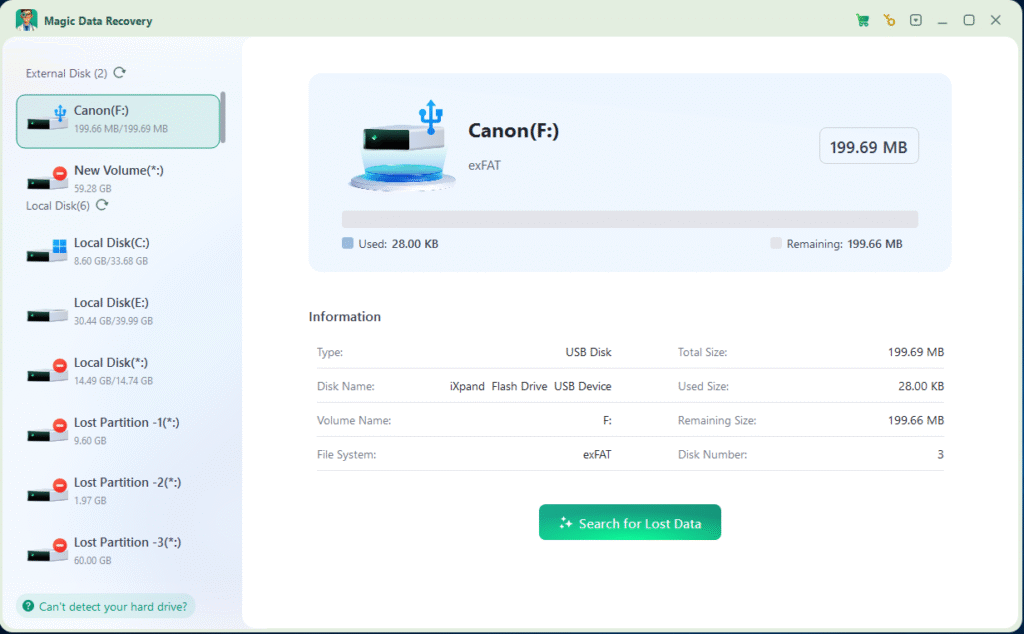
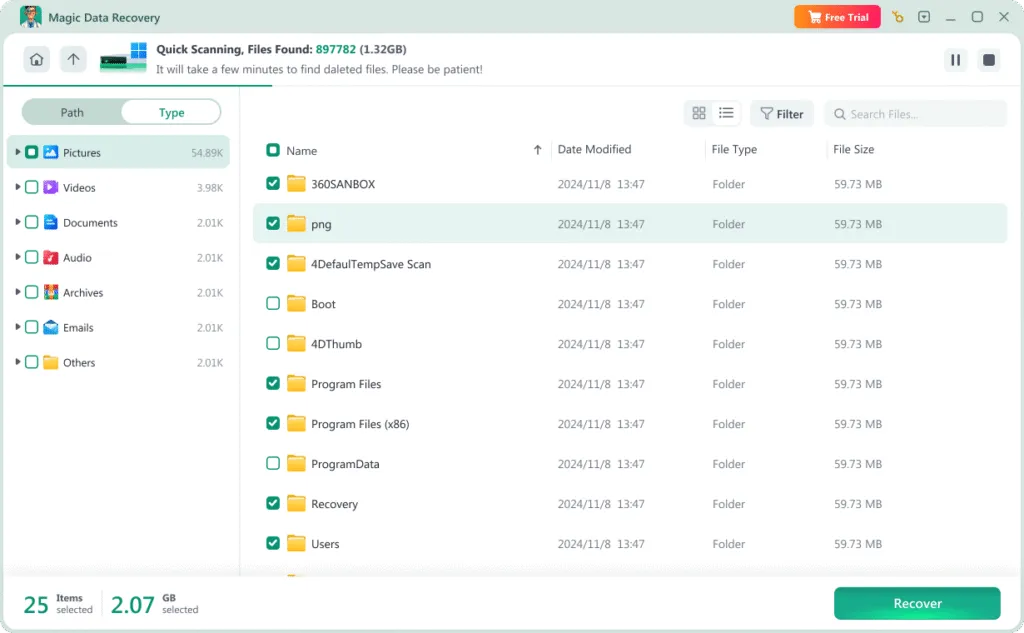
Method 2. Recover Lost Partition Data with Magic Data Recovery
Recovering deleted or lost partition with Magic Data Recovery is fast and straightforward. Below are the essential steps to get started.
1. Download and Install: Get Magic Data Recovery from the official website and install it on your computer.
Supports Windows 7/8/10/11 and Windows Server


Method 3. Restore the Partition Table with an Advanced Tool
Partition-table recovery tools such as TestDisk can search for deleted partition boundaries and write selected partition entries back to the MBR or GPT.
This method may be appropriate when:
- The original partition structure needs to be restored
- The detected partition boundaries are clear
- The disk is physically healthy
- Important files have already been backed up or recovered
- The user understands partition-table changes
Partition-table restoration modifies disk structures. Selecting an incorrect partition boundary or writing an incorrect table can make existing partitions inaccessible.
For disks containing important files, recover the files first before attempting to restore the original partition entry.
Which Lost Partition Recovery Method Should You Use?
| Situation | Recommended method |
|---|---|
| The partition is Healthy but has no drive letter | Assign a drive letter |
| The partition appears as Unallocated | Recover files from the physical disk first |
| The partition appears as RAW | Recover files before formatting or repair |
| The partition was accidentally deleted | Recover files first; consider partition-table restoration afterward |
| The original partition entry must be restored | Use an advanced partition-recovery tool after securing the data |
| The HDD clicks or repeatedly disconnects | Stop using software and contact a professional recovery service |
Recover Lost Partitions from Different Storage Devices
Hard Disk Lost Partition Recovery
HDD partition recovery may be possible when the disk is still detected and does not have serious mechanical damage. Stop using the disk and scan the complete physical drive rather than creating a new partition.
If the HDD clicks, grinds, spins up repeatedly, or disappears during scanning, stop using it and seek professional assistance.
External Hard Drive Partition Recovery
Check the USB cable, enclosure, power adapter, and another USB port before starting recovery. If the disk appears in Disk Management as RAW or Unallocated, recover files before formatting it.
Do not save recovered files back to the same external drive.
SSD Lost Partition Recovery
Stop using the SSD immediately. Continued use may reduce recovery chances because SSDs can process deleted blocks differently from traditional hard drives.
When possible, remove the SSD from active system use and scan it from another working Windows computer.
USB Drive and Memory Card Partition Recovery
USB drives and memory cards may display reduced capacity, RAW file systems, or Unallocated space after formatting errors or partition damage.
Avoid reformatting the device. Scan the complete physical device and save recovered files to a computer drive or another external disk.
When Software Cannot Recover a Lost Partition
Software recovery may not be suitable when:
- The HDD makes clicking, grinding, or repeated spin-up sounds
- The storage device is not detected by the BIOS, UEFI, or Disk Management
- The device repeatedly disconnects during scanning
- The drive has suffered water, fire, impact, or electrical damage
- Severe bad sectors prevent stable reading
- The controller or internal components have failed
In these situations, repeated software scans may place additional stress on the storage device. Stop using it and contact a professional data recovery service.
How to Prevent Partition Loss
The following practices can reduce the risk of losing partitions:
- Back up important files to a separate physical disk or cloud service
- Confirm the selected disk before using DiskPart or partition-management tools
- Avoid interrupting resizing, cloning, or operating-system installation
- Use reliable power during disk and partition operations
- Safely eject external drives before disconnecting them
- Monitor HDD and SSD health for read errors and SMART warnings
- Create a full backup before converting between MBR and GPT
- Avoid using untrusted partition, cloning, or system-optimization software
Final Thoughts
Lost partition recovery is often possible, but the correct method depends on how the partition appears in Windows.
A Healthy volume without a drive letter may only require a new drive letter. An Unallocated, RAW, deleted, or missing partition usually requires data recovery before structural repair.
Do not format, initialize, repartition, or write new files to the affected disk. Use Magic Data Recovery to scan the complete physical disk, preview recoverable files, and save them to another drive.
After confirming that the required files are safe, you can recreate the partition or use an advanced partition-table recovery method if necessary.
Take action now. Download Magic Data Recovery and give your lost data the best chance of a full recovery.
Supports Windows 7/8/10/11 and Windows Server
FAQs
Can a lost partition be recovered?
How do I recover a deleted partition in Windows?
Can I recover a lost partition without formatting?
Can Disk Management recover a lost partition?
Does Magic Data Recovery restore the original partition?
What is the difference between lost partition recovery and partition data recovery?
Can I recover files from a damaged or RAW partition?
When should I use a professional data recovery service?

Erin Smith is recognized as one of the most professional writers at Amagicsoft. She has continually honed her writing skills over the past 10 years and helped millions of readers solve their tech problems.