
Recover OneDrive Files: Best Restore Guide
Losing files in OneDrive can feel confusing because your data may exist in more than one place. A file might be in the OneDrive cloud, the OneDrive Recycle Bin, the Windows Recycle Bin, a synced local folder, or an older file version. That is why the best way to recover OneDrive files is to check each possible recovery path in the right order.
This guide explains how to restore OneDrive files using built-in Microsoft options first, and also covers practical deleted file recovery options when locally synced files are removed from your computer. You will learn how to recover deleted files from the OneDrive Recycle Bin, restore previous versions, roll back your OneDrive, and check your local computer. If these regular methods fail, and the files were once stored in your local OneDrive folder, Magic Data Recovery can help scan the local drive for recoverable data.
The goal is simple: avoid overwriting lost files, choose the correct recovery method, and improve your chance of getting important documents, photos, videos, spreadsheets, or work files back.
Supports Windows 7/8/10/11 and Windows Server
Table of Contents
Quick Answer: How to Recover OneDrive Files
The fastest way to recover OneDrive files is to sign in to OneDrive on the web, open Recycle Bin, select the deleted files, and click Restore. If the file still exists there, OneDrive will return it to its original folder.
However, not every data loss case works the same way. Use this order:
- Check the OneDrive Recycle Bin online.
- Check the Windows Recycle Bin or Mac Trash.
- Use OneDrive Version History for overwritten files.
- Use Restore your OneDrive for large-scale deletion, corruption, or ransomware changes.
- Check local backup tools such as File History.
- If the file once synced to your computer, scan the local drive with Magic Data Recovery.
This order matters because cloud recovery and local disk recovery solve different problems.
Before You Restore OneDrive Files: Stop Making Changes
Before trying to restore OneDrive files, stop using the affected device as much as possible. Do not create new files in the same OneDrive folder. Do not reinstall OneDrive. Do not download large files to the same drive. Also, avoid saving recovered files back to the original location.
Why? If the missing files existed locally, Windows may mark the deleted space as reusable. New data can overwrite that space. Once overwritten, recovery becomes much harder.
Also, pause OneDrive sync if you suspect a wrong deletion, ransomware attack, or accidental folder cleanup. This prevents more changes from syncing across your devices.
Method 1: Recover OneDrive Files from OneDrive Recycle Bin
The OneDrive Recycle Bin should be your first stop. It works for files deleted from the OneDrive cloud, OneDrive web app, or synced folders.
Steps to Recover Files from OneDrive Recycle Bin
- Go to OneDrive and sign in.
- Click Recycle Bin in the left sidebar.
- Select the files or folders you want to recover.
- Click Restore.
- Check the original folder after OneDrive finishes restoring the items.
This method works best when you deleted files recently and have not emptied the OneDrive Recycle Bin. For many users, this is the easiest way to recover OneDrive files without using extra software.
Important Notes
Personal OneDrive accounts usually keep deleted items for a limited time. Work or school accounts may keep deleted items longer, depending on the organization’s settings. If your Recycle Bin is full or the retention period has passed, older items may disappear automatically.
If you use Personal Vault, unlock it before checking deleted vault files. Otherwise, some deleted items may not appear.
Method 2: Restore OneDrive Files from Windows Recycle Bin or Mac Trash
If you deleted files from the local OneDrive folder on your computer, check the local Recycle Bin or Trash.
On Windows
- Open Recycle Bin from the desktop.
- Search for the missing file or folder.
- Right-click the item.
- Choose Restore.
Windows will return the file to its original local folder, including the OneDrive folder if that was the original location. If you already emptied the Windows Recycle Bin, you can also read this guide on how to recover deleted files from Recycle Bin after empty before moving to deeper local drive recovery.
On Mac
- Open Trash.
- Find the deleted file.
- Right-click it.
- Choose Put Back.
This method is useful when the deleted file was stored locally. However, online-only OneDrive files may not appear in your computer’s Recycle Bin because they were not fully stored on the device.
Method 3: Use Version History to Restore Overwritten OneDrive Files
Sometimes the file is not deleted. Instead, it has been changed, overwritten, corrupted, or saved incorrectly. In that case, Version History can help you restore OneDrive files to an earlier state.
Steps to Restore a Previous Version
- Sign in to OneDrive.
- Locate the file.
- Right-click the file.
- Select Version History.
- Review available versions.
- Open or restore the version you need.
This method works well for Word documents, Excel files, PowerPoint presentations, and other files that OneDrive tracks over time. It is especially helpful when you accidentally saved wrong changes or another user edited a shared file.
Best Use Cases
Use Version History when:
- A document was overwritten.
- A shared file was changed by someone else.
- A file became corrupted after editing.
- You need an older draft.
- You do not want to restore the entire OneDrive account.
Version History is more precise than a full OneDrive rollback because it targets one file at a time.
Method 4: Use “Restore Your OneDrive” for Large-Scale Problems
If many files were deleted, renamed, corrupted, or affected by malware, restoring files one by one may take too long. Microsoft 365 subscribers can use the “Restore your OneDrive” feature to roll back the entire OneDrive to an earlier point within the available restore window.
When to Use This Method
Use this option when:
- Many files disappeared at once.
- A ransomware attack changed multiple files.
- A sync error caused mass deletion.
- A folder structure was damaged.
- You need to undo many actions quickly.
How It Works
The restore feature lets you choose a date and time before the unwanted changes happened. OneDrive then reverses file actions after that point. This can help with serious data loss events, but it may also undo legitimate changes made after the selected restore time.
Therefore, check what changed before confirming the restore. If you share files with a team, tell other users before rolling back a large folder or account.
Method 5: Check Shared Folder and Admin Recovery Options
OneDrive shared folders can create confusion. If someone else shared a folder with you and removed it, you may not be able to restore the folder from your own OneDrive. However, if you owned the folder or deleted files inside a shared folder, you may still find them in your Recycle Bin.
For work or school accounts, contact your Microsoft 365 administrator if the standard recovery options fail. Admins may have additional recovery options for deleted users, SharePoint-connected libraries, or organizational retention policies.
This step is important for business users because OneDrive for Business often connects with SharePoint, Teams, and company-managed retention settings.
Method 6: Restore from Windows File History or Other Backups
If you enabled Windows File History, backup software, or system backup tools before the deletion, you may recover a previous copy from backup.
Try This on Windows
- Open File Explorer.
- Go to the original OneDrive folder location.
- Right-click the folder.
- Choose Restore previous versions.
- Select an available version.
- Restore it to a safe location.
This method depends on whether backup protection was active before the file disappeared. If you never enabled File History or another backup system, this option may not show usable versions.
Still, it is worth checking before moving to disk recovery software.
When Built-in Methods Fail: Can You Still Recover OneDrive Files?
Yes, but only in specific cases. OneDrive is a cloud service, so data recovery software cannot scan Microsoft’s cloud servers. A recovery tool can only scan storage devices you can access, such as your Windows hard drive, SSD, external drive, USB drive, or memory card.
To better understand why local recovery may still work, it helps to know how deleted file recovery works after Windows removes a file reference but before new data overwrites the original space.
This means local recovery may help only if the missing OneDrive files were once stored in your local OneDrive directory, such as:
- C:\Users\YourName\OneDrive
- Desktop, Documents, or Pictures folders backed up by OneDrive
- A local synced folder marked as “Always keep on this device”
- Files downloaded from OneDrive before deletion
- Files removed from a local OneDrive folder and then emptied from Recycle Bin
If the files were online-only and never downloaded to your computer, local recovery software cannot recover them from your disk.
Recover Locally Synced OneDrive Files with Magic Data Recovery
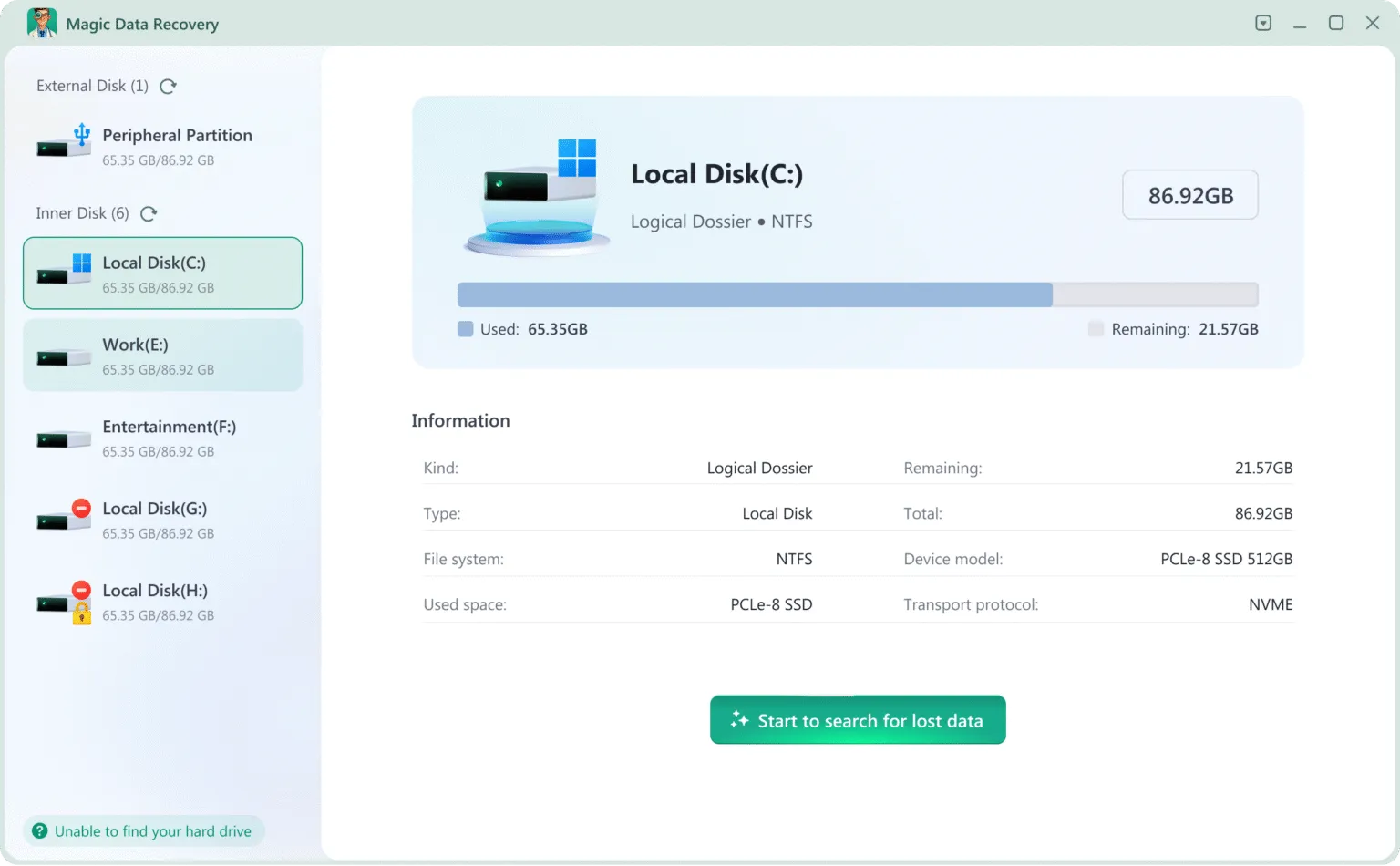
If regular OneDrive recovery methods fail and the lost files were stored in your local OneDrive folder, Magic Data Recovery offers a practical next step. It scans the physical storage device where the OneDrive folder was located and looks for recoverable file records and file content.
Magic Data Recovery is useful when you need to recover OneDrive files after local deletion, formatting, file system errors, system reinstallation, virus deletion, or accidental cleanup.
Core Pain Point It Solves
OneDrive’s built-in recovery options depend on cloud retention, Recycle Bin status, version history, and subscription features. Once those options fail, users often assume the files are gone forever. But if the files existed locally, the disk may still contain recoverable traces.
Magic Data Recovery helps bridge that gap by scanning the local drive instead of relying only on OneDrive’s cloud recovery tools.
Key Advantages
Magic Data Recovery can help in scenarios such as:
- Deleted files from the local OneDrive folder
- Emptied Windows Recycle Bin
- Lost files after formatting a drive
- Missing files after reinstalling Windows
- File loss caused by file system errors
- Data removed by virus or malware activity
- Lost documents, photos, videos, archives, and other common file types
It also provides file preview and selective recovery, so you can check whether the found files are the ones you need before saving them.
Why It Can Be More Reliable Than Random Fixes
Many online tutorials repeat the same advice: check the Recycle Bin, use Version History, or contact Microsoft support. Those are valid first steps. However, they do not solve local disk-level loss.
Magic Data Recovery focuses on the local storage layer. If OneDrive cannot restore the file and the file was once saved on your PC, scanning the original drive gives you another recovery path. This makes it more suitable for cases where cloud recovery and local Recycle Bin recovery both fail.
Supports Windows 7/8/10/11 and Windows Server
How to Use Magic Data Recovery for OneDrive Files
For a more detailed walkthrough, you can also follow the official Magic Data Recovery user guide before scanning the drive that contained your OneDrive folder.
- Stop using the drive where the OneDrive folder was stored.
- Install Magic Data Recovery on a different drive if possible.
- Launch the software.
- Select the drive that contained your OneDrive folder.
- Start a scan.
- Preview recoverable files.
- Select the files you need.
- Recover them to another safe drive.
Do not save recovered files back to the same location during recovery. Saving to another drive reduces the risk of overwriting other recoverable data.
If you are looking for a more efficient solution after OneDrive’s built-in methods fail, you can try Magic Data Recovery to scan the local storage where your OneDrive files once existed.
OneDrive Cloud Recovery vs Local Data Recovery
Recovery Method | Best For | Limitation |
OneDrive Recycle Bin | Recently deleted cloud files | Fails if retention expired or bin was emptied |
Windows Recycle Bin | Locally deleted synced files | Online-only files may not appear |
Version History | Overwritten or changed files | Works file by file |
Restore your OneDrive | Large-scale deletion, corruption, ransomware | Requires eligible Microsoft 365 features |
File History / Backups | Previously backed-up local files | Must be enabled before data loss |
Magic Data Recovery | Files once stored on local drive | Cannot scan OneDrive cloud-only files |
This comparison shows why the best way to restore OneDrive files depends on where the files existed before deletion.
Common Mistakes to Avoid
Emptying the Recycle Bin Too Soon
Many users delete files from OneDrive, then empty the Recycle Bin to free space. This can remove the easiest recovery path. Always confirm that you no longer need the files before emptying the bin.
Confusing Cloud Files with Local Files
A OneDrive file may look visible in File Explorer but still be online-only. If it was not downloaded locally, local recovery software cannot scan it from your drive.
Continuing to Use the Same Drive
If files were stored locally, new data can overwrite deleted file content. Stop using the drive and recover files to another location.
Restoring the Whole OneDrive Without Checking Changes
A full OneDrive rollback can reverse many actions. It may also undo useful edits made after the selected restore point. Review the activity timeline carefully.
Ignoring Ransomware Cleanup
If ransomware affected OneDrive files, clean all infected devices before restoring files. Otherwise, restored files may become encrypted again after sync resumes.
Best Practice: Build a Safer OneDrive Recovery Plan
To avoid future data loss, use OneDrive with a layered backup strategy. OneDrive sync is convenient, but sync is not the same as a full backup. If you delete a synced file, that deletion may sync across devices.
Follow these tips:
- Keep important files stored locally and in the cloud.
- Enable File History or another backup tool.
- Use “Always keep on this device” for critical folders.
- Review OneDrive sync settings regularly.
- Avoid deleting cloud files when you only want to stop syncing.
- Keep a separate external backup for business-critical files.
- Protect your computer with reliable security software.
These habits make it easier to recover OneDrive files when accidents happen.
Conclusion
The best way to recover OneDrive files is to start with the safest built-in options. First, check the OneDrive Recycle Bin. Next, check your computer’s Recycle Bin or Trash. Then, use Version History for overwritten files or Restore your OneDrive for large-scale damage. If backups exist, review them before trying anything else.
However, built-in tools cannot solve every situation. If the files disappeared from OneDrive and were previously stored in your local OneDrive folder, Magic Data Recovery gives you another practical recovery path. It can scan your local drive for deleted, formatted, corrupted, or virus-removed data and help recover files that OneDrive can no longer restore.
For users who need a clear, step-by-step solution after normal OneDrive options fail, Magic Data Recovery is a practical tool to try, especially when you need deleted file recovery software for files once stored in a local OneDrive folder.
Supports Windows 7/8/10/11 and Windows Server
FAQs
How do I recover OneDrive files after deleting them?
To recover OneDrive files after deletion, sign in to OneDrive on the web, open Recycle Bin, select the files or folders, and click Restore. If the files were deleted from a synced local folder, also check the Windows Recycle Bin or Mac Trash. Start with these built-in options before using recovery software.
Can I restore OneDrive files after emptying the Recycle Bin?
If you emptied the OneDrive Recycle Bin, recovery becomes harder. Microsoft’s built-in options may no longer show the deleted items. However, if the files were stored in your local OneDrive folder before deletion, a tool like Magic Data Recovery may scan your local drive and find recoverable data that still has not been overwritten.
How can I restore a previous version of a OneDrive file?
To restore OneDrive files to an earlier version, right-click the file in OneDrive and choose Version History. Review the available versions, then open or restore the version you need. This method works best for overwritten documents, wrong edits, shared file changes, or files corrupted after saving.
Can I recover OneDrive files after ransomware?
You may recover OneDrive files after ransomware by using OneDrive’s restore features, but clean infected devices first. If you restore files before removing malware, the same ransomware may encrypt them again. For locally synced files, Magic Data Recovery may help recover copies from the local drive if OneDrive restore options fail.
Why are deleted OneDrive files not in my computer’s Recycle Bin?
Deleted OneDrive files may not appear in your computer’s Recycle Bin if they were online-only files. Online-only files exist in the cloud and do not have full local content on your device. In that case, check the OneDrive web Recycle Bin instead of relying on local Windows or Mac recovery options.
Can data recovery software recover OneDrive cloud files?
Data recovery software cannot directly scan OneDrive cloud storage. It can only scan storage devices connected to your computer. Therefore, software recovery works only when the lost OneDrive files were once stored locally, such as in C:\Users\YourName\OneDrive, Desktop, Documents, Pictures, or another synced local folder.
Is Magic Data Recovery useful for OneDrive recovery?
Magic Data Recovery is useful when normal OneDrive recovery methods fail and the files were once saved on your local computer. It can scan the original drive for deleted, formatted, corrupted, or virus-removed files. It is not a replacement for OneDrive cloud recovery, but it provides another path for locally synced data.
What should I do first after losing OneDrive files?
First, stop making changes to the affected folder or drive. Then check the OneDrive Recycle Bin, local Recycle Bin, Version History, and available backups. If those methods fail and the files were stored locally, scan the original drive with Magic Data Recovery and save recovered files to a different storage device.

Jason has over 15 years of hands-on experience in the computer data security industry. He specializes in data recovery, backup and restoration, and file repair technologies, and has helped millions of users worldwide resolve complex data loss and security issues.