
How to Recover Temporary Files in Windows 11/10
Need to recover temp files after an app crash, accidental cleanup, or an unexpected shutdown? Do not clear the Temp folder again or keep working on the affected drive. A temporary copy may still exist, while a deleted one can be overwritten at any time. This guide starts with safe, built-in checks and then moves to deleted file recovery when Windows or the original application no longer shows the file. If the item was permanently deleted, formatted away, or lost after a file system error, Magic Data Recovery can scan the storage device for recoverable content.
The key is to identify what “temp file” means in your case. It could be an Office AutoRecover copy, a .tmp working file, a browser download fragment, or a normal document accidentally saved inside a temporary folder. These files require different recovery methods.
First-response rule: Stop using the source drive if a valuable file has been deleted. Do not download recovery software, create new documents, or save recovered data to that same drive unless you have no other option.
Supports Windows 7/8/10/11 and Windows Server
Table of Contents
What Are Temporary Files, and Can You Recover Them?
Windows and installed applications create temporary files to hold short-lived information. An installer may unpack working data into C:\Windows\Temp, while an application may write session data to your user Temp directory. Word, Excel, and PowerPoint also keep recovery information in application-specific locations.
In many cases, you can recover temporary files because the file still exists but is hidden behind an unfamiliar name or extension. If it was deleted, recovery depends on whether its disk space has been reused. This is why quick action matters.
However, a .tmp file is not automatically a backup of your missing document. Some temporary items contain only cache data, locks, logs, or part of a larger file. Even successful temp file recovery may produce an incomplete file if the application never finished writing it.
Common Reasons Temp Files Go Missing
- Windows or an application crashed before cleanup finished.
- You closed a document without saving it.
- Storage Sense, Disk Cleanup, or another cleanup utility removed old data.
- You manually deleted items from a Temp directory.
- Antivirus software quarantined a suspicious file.
- File system damage made the folder or its contents inaccessible.
- A drive was formatted or a partition became RAW.
Microsoft documents that Storage Sense and automatic maintenance can remove Temp content in certain conditions. Therefore, a file that was present yesterday may no longer appear today.
Choose the Right Way to Recover Temp Files
Start with the method that matches what happened. This prevents unnecessary disk scans and helps preserve the best available copy.
What happened | Best first method | Why |
Word, Excel, or PowerPoint crashed | Use the app’s Recover Unsaved option | The application understands its own recovery format |
The file may still be in a Temp folder | Search %temp% and app-specific locations | No deleted-file scan is needed |
You deleted the file in File Explorer | Check the Recycle Bin | Restoration keeps the original path and metadata |
A known folder had File History enabled | Restore a previous version | A backup copy is safer than undeleting disk data |
The Recycle Bin is empty | Use Windows File Recovery or Magic Data Recovery | The file’s directory entry may be gone |
The drive was formatted, became RAW, or reports errors | Scan with Magic Data Recovery before repairing it | Repair attempts may change recoverable structures |
Method 1: Recover Unsaved Files Inside the Original App
If your goal is unsaved file recovery, open the program that created the content before searching random system folders. Applications often store recovery copies in formats that Windows cannot identify from the filename alone.
Recover a Word Document
- Open Microsoft Word.
- Go to File > Info > Manage Document.
- Select Recover Unsaved Documents.
- Open the most recent relevant copy.
- Choose Save As and store it in a normal document folder.
This is also the procedure recommended in Microsoft’s official Word recovery guidance. For more Word-specific locations and file types, see Amagicsoft’s Word temp file recovery guide.
Recover an Unsaved Excel or PowerPoint File
In Excel, open File > Info > Manage Workbook > Recover Unsaved Workbooks. In PowerPoint, look for Recover Unsaved Presentations from the File or Home screen, depending on your Office version. Open each candidate and save the correct one immediately.
If Excel is the affected program, this detailed guide explains how to recover files in Excel after crashes, deletion, or overwriting.
Method 2: Find Existing Files in Windows Temp Folders
You do not need data recovery software when the temporary copy still exists. To recover temp files from the user folder:
- Press Windows + R.
- Enter %temp% and press Enter.
- In File Explorer, select View > Show > Hidden items in Windows 11. In Windows 10, use View > Hidden items.
- Switch to Details view and sort by Date modified.
- Search around the time the file was lost.
The usual Windows temp file location is:
C:\Users\<username>\AppData\Local\Temp
Windows also uses this system-level folder:
C:\Windows\Temp
You may need administrator permission to view parts of the system folder. Office may store unsaved items here:
%localappdata%\Microsoft\Office\UnsavedFiles
How to Inspect a TMP File Safely
Do not edit the only candidate. Copy it to another folder first, then work with the copy.
- Look at its modified date and size. A zero-byte file contains no recoverable document data.
- Turn on File name extensions in File Explorer.
- Try Open with and select the application that originally created the content.
- If you know the original format, test a copied file with the matching extension, such as .docx, .xlsx, .pptx, or .jpg.
- Save any file that opens correctly under a new name.
Changing an extension does not convert or repair a file; it only tells Windows which application should try to read it. If the copy will not open, keep the original candidate for later analysis.
Method 3: Restore Deleted Temp Files from the Recycle Bin
When you delete a temporary file manually in File Explorer, it may enter the Recycle Bin. Open the bin, switch to Details view, and sort by Date Deleted. If you recognize the item, right-click it and choose Restore.
This simple way to recover deleted temp files will not help when you used Shift+Delete, emptied the Recycle Bin, deleted data from some removable drives, or let a cleanup task remove it. Those actions often bypass the bin.
Method 4: Use File History or Previous Versions
File History can restore a protected folder only if it was configured before the loss. A Temp directory is not usually a sensible backup target, but the original Documents, Desktop, or project folder may contain an earlier copy.
- Open the folder where the original file should have been saved.
- Right-click inside it and select Properties.
- Open the Previous Versions tab.
- Select an available version and click Open first.
- Copy the needed file to a safe location, or select Restore if you are certain.
You can also open Control Panel > System and Security > File History > Restore personal files. If your document was synchronized with OneDrive, check its Recycle Bin and Version History as well. These options restore a known copy and are usually more reliable than trying to recover TMP files from unallocated disk space.
Method 5: Recover Temp Files with Windows File Recovery
Microsoft offers Windows File Recovery for local drives when a deleted item is no longer in the Recycle Bin. It is a command-line tool, and the source and destination must be different drives. Microsoft also advises minimizing computer use because new writes can overwrite deleted data.
After installing Windows File Recovery from the Microsoft Store, connect another drive—for example, drive E:—and run Command Prompt as administrator. A targeted NTFS search can follow this pattern:
- winfr C: E: /regular /n \Users\<username>\AppData\Local\Temp\*.tmp
Replace <username> with the actual Windows profile name. If the file was deleted longer ago or a regular scan finds nothing, use Extensive mode:
- winfr C: E: /extensive /n \Users\<username>\AppData\Local\Temp\*.tmp
You can replace *.tmp with a useful document filter such as *.docx. Review the official Windows File Recovery instructions before changing modes or filters. This method can recover temp files, but it requires precise commands and may return files with altered names or missing folder information.
Method 6: Recover Deleted Temp Files with Magic Data Recovery
Use recovery software when built-in application recovery, Temp-folder searches, the Recycle Bin, and backups do not contain the file. Magic Data Recovery is particularly useful when you need a visual workflow instead of command-line filters, or when the loss involves permanent deletion, formatting, a RAW drive, or file system errors.
It addresses several practical problems that make temp file recovery difficult:
- Temporary files often have meaningless generated names.
- The original directory entry may be missing after deletion.
- A quick folder search cannot see deleted disk records.
- The desired content may be a normal document rather than a .tmp file.
Magic Data Recovery scans HDDs, SSDs, USB drives, and memory cards and supports more than 5,000 file formats. Its file-type filters and preview workflow help you identify documents, images, videos, archives, and other content even when the original temp filename is unhelpful. It can also scan beyond ordinary deletion scenarios, including formatted or file-system-damaged storage.
Steps to Recover Temp Files with Magic Data Recovery
1. Stop writing new data to the source drive.
2. Download and install Magic Data Recovery. When practical, use a different physical drive to reduce writes to the affected one.
Supports Windows 7/8/10/11 and Windows Server
3. Launch the program and select the volume that held the missing file—usually C: for the user Temp folder.
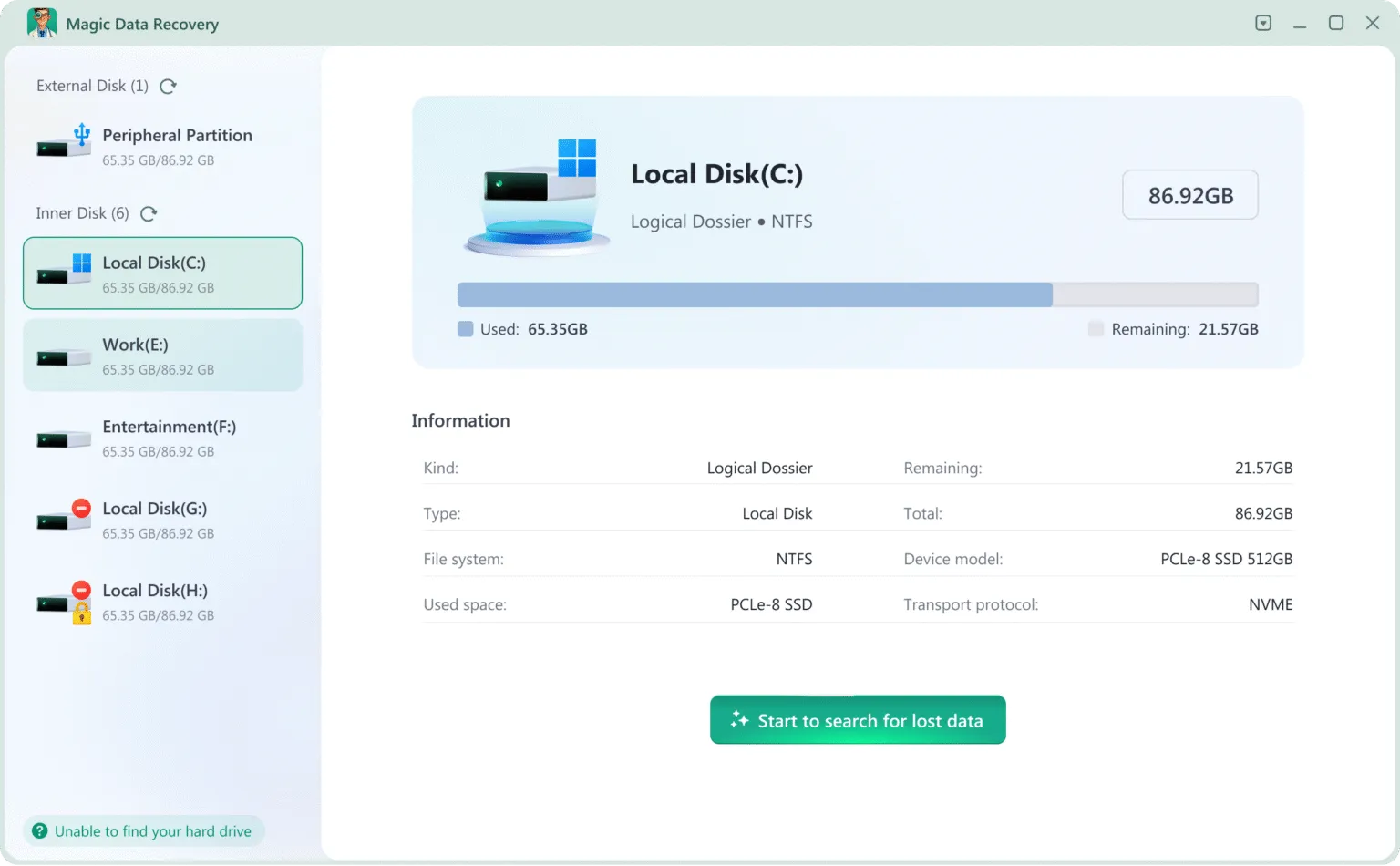
4. Start the scan and let it finish for the most complete result.
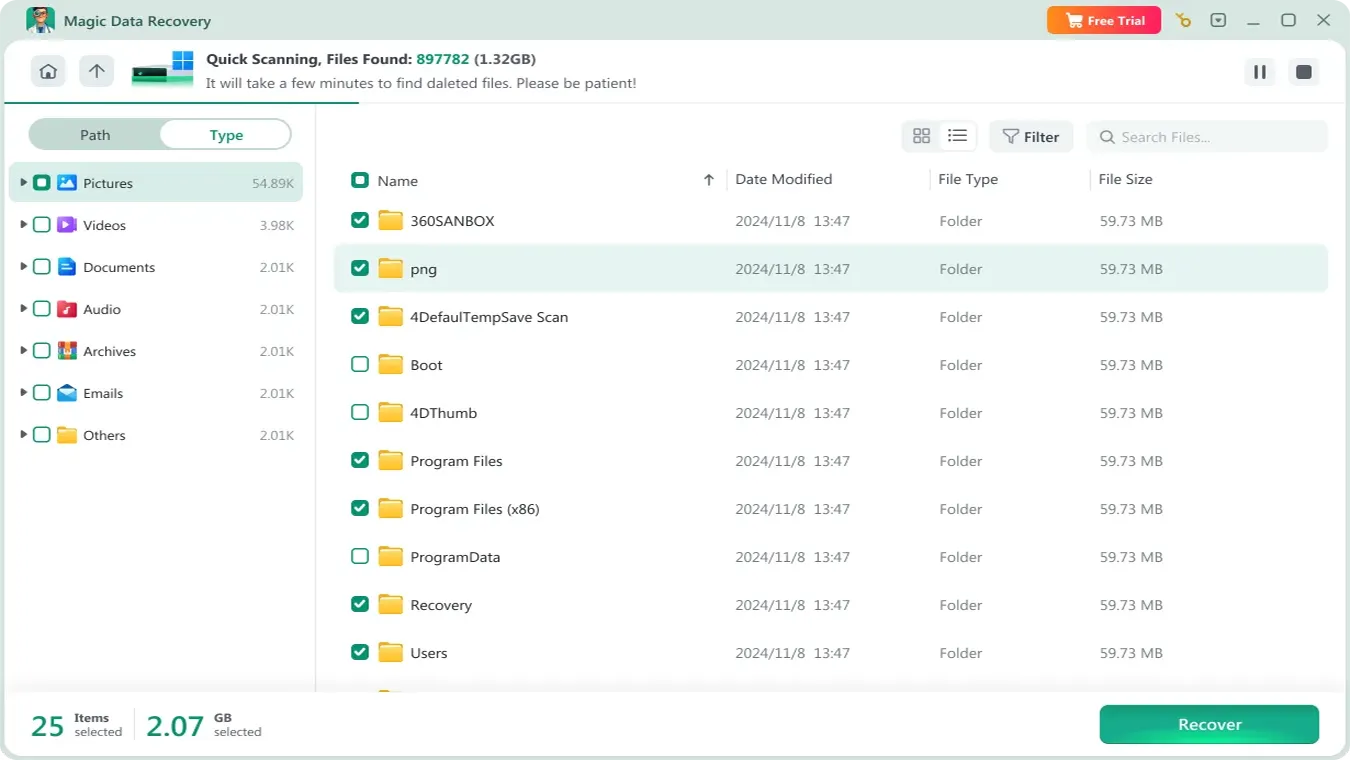
5. Filter by the likely file type, path, size, or date, then preview promising items.
6. Select the needed files and recover them to another physical drive.
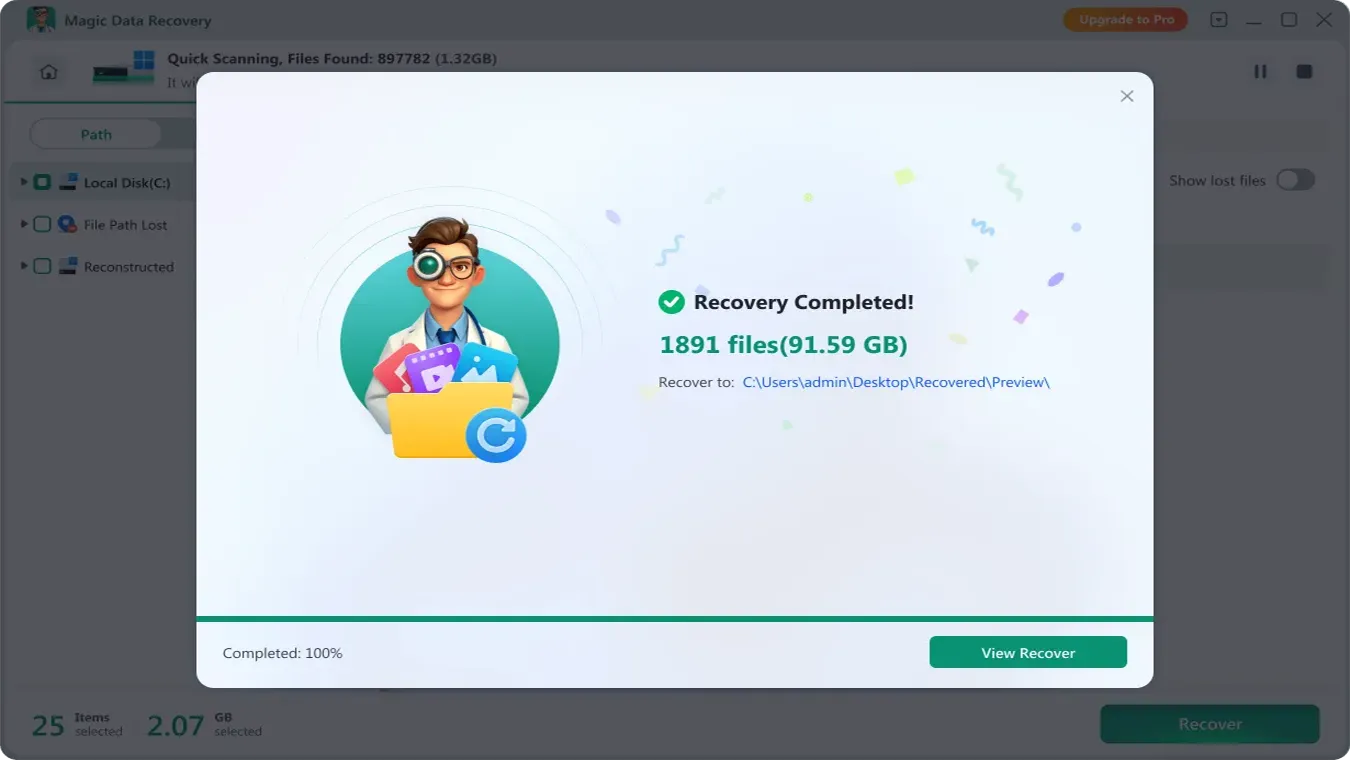
7. Open the recovered copies in their original application and save valid content under new names.
The Magic Data Recovery user guide provides the complete scan-and-recover workflow. Compared with a manual Temp-folder search, the tool can locate records that File Explorer no longer lists. Compared with Windows File Recovery, it offers previews and a graphical interface, which makes unidentified temporary content easier to assess.
Still, no tool can restore bytes that have already been overwritten. On SSDs, TRIM and routine background activity can further reduce the chance of recovering a permanently deleted file. A scan result is evidence of what remains—not a guarantee that every item will open intact.
Why Recovered Temporary Files May Not Open
Sometimes you successfully recover temp files, yet the application reports corruption or an unsupported format. Common explanations include:
- The temporary file held only part of the original content.
- The app used a proprietary cache structure rather than a normal document format.
- Windows or another program overwrote some disk clusters after deletion.
- The file extension no longer matches its internal format.
- The app encrypted, compressed, or split its working data across several files.
First, preserve the recovered copy. Then try opening it from within the original program instead of double-clicking it. For Office files, use File > Open > Browse, select the file, click the arrow beside Open, and choose Open and Repair. Never repair the only recovered copy.
How to Avoid Losing Useful Temp Data Again
Temporary folders are not reliable long-term storage. These habits reduce the need to recover temp files later:
- Turn on AutoSave or AutoRecover in important applications.
- Shorten the AutoRecover interval for active Office projects.
- Save working documents to Documents, OneDrive, or another backed-up folder early.
- Enable File History or a reputable backup routine for project folders.
- Review Storage Sense settings before allowing automatic cleanup.
- Close active applications before clearing Temp folders.
- Never use a cleanup utility as a substitute for reviewing important files.
Conclusion: The Safest Way to Recover Temp Files
To recover temp files in Windows 11 or 10, begin with the original application’s recovery feature. Next, inspect %temp%, the Office UnsavedFiles folder, the Recycle Bin, and available backups. These methods are quick and do not require a disk-level scan.
When the file has been permanently deleted or lost after formatting or file system damage, Magic Data Recovery is the recommended next step because it combines deep storage scanning, broad file-format support, filtering, and previews in an accessible interface. Follow a careful deleted file recovery workflow: stop using the source drive, scan it promptly, and save recovered data somewhere else. That approach gives you the best practical chance without overstating what recovery can do.
Supports Windows 7/8/10/11 and Windows Server
FAQs About How to Recover Temp Files
Where are temporary files stored in Windows 11 and 10?
Most user temporary files are stored in C:\Users\<username>\AppData\Local\Temp, which you can open by entering %temp% in Run. Windows also uses C:\Windows\Temp, while applications such as Microsoft Office maintain separate AutoRecover or UnsavedFiles folders.
Can I recover temp files after deleting them?
Yes, if the data has not been overwritten. Check the Recycle Bin and backups first. If they contain nothing, Windows File Recovery or Magic Data Recovery may find deleted records. Stop using the source drive and restore results to another drive.
How do I open a recovered .tmp file?
Copy the file before testing it. Use Open With and choose the program that likely created it. You may test a matching extension on the copy, but renaming does not convert the data. Some .tmp files are caches and cannot become complete documents.
Can I recover an unsaved Word document from the Temp folder?
Possibly, but first use Word's File > Info > Manage Document > Recover Unsaved Documents option. If it shows nothing, inspect %temp% and the Office UnsavedFiles folder. Sort candidates by modified time, copy them, and test them in Word.
Does Windows Storage Sense delete temporary files automatically?
It can. Storage Sense and maintenance tasks may remove qualifying temporary content to free disk space. Review Settings > System > Storage > Storage Sense before relying on a Temp folder. Store important work in a normal, backed-up location instead.
Why is my recovered temporary file corrupted?
The app may have written only part of the content, or Windows may have reused some of its disk space. A recovered item may also be a cache rather than a document. Keep the original recovered copy and test repair only on a duplicate.
Is Windows File Recovery suitable for temp file recovery?
Yes, especially for deleted local files that are absent from the Recycle Bin. However, it requires command-line filters and a destination drive different from the source. A graphical recovery tool is easier when filenames and extensions are unclear.
Can Magic Data Recovery restore temp files from a formatted drive?
Magic Data Recovery supports deletion, formatting, and file system error scenarios, so it can scan the affected volume for remaining file data. Recovery still depends on overwriting and SSD TRIM. Preview results when possible and save them to a different drive.

Jason is a data recovery and technical support specialist with over 15 years of hands-on experience. He has worked extensively with frontline users, troubleshooting difficult data loss cases and providing practical recovery solutions for accidental deletion, formatted drives, damaged file systems, lost partitions, system failures, and other recovery emergencies. His expertise also includes backup and restoration, file repair, and disaster recovery, with a strong emphasis on safe, reliable, and technically accurate guidance.