
How to Recover Deleted Files from Recycle Bin: 5 Ways
Deleted a file from the Recycle Bin or emptied it by mistake? If you want to know how to recover from Recycle Bin deleted files, the good news is that recovery may still be possible on Windows 11 or Windows 10 as long as the original data has not been overwritten. If the file is still in the Recycle Bin, use Restore first. If the bin has already been emptied, you can try File History, Previous Versions, Windows File Recovery, or other methods covered in our Recycle Bin recovery guide.
Most importantly, stop saving new files to the affected drive. Deleted file space may be reused by Windows, and new data can overwrite the files you want to recover. This guide explains five practical recovery methods, starting with built-in Windows options. If no backup is available and you prefer a graphical recovery solution, Magic Data Recovery can scan the affected drive and preview recoverable files before recovery.
Supports Windows 7/8/10/11 and Windows Server
Table of Contents
Which Recycle Bin Recovery Method Should You Use?
The best recovery method depends on whether the file is still in the Recycle Bin, whether the bin has already been emptied, and whether you have a backup. Use the table below to quickly choose the most suitable option.
| Situation | Best Recovery Method | Backup Required? |
|---|---|---|
| The file is still in the Recycle Bin | Restore it directly from the Recycle Bin | No |
| The Recycle Bin has already been emptied | File History or Previous Versions | Yes |
| The file was synced with OneDrive | Check the OneDrive Recycle Bin | No, if the file is still retained |
| No backup is available | Windows File Recovery | No |
| You prefer a graphical recovery tool | Magic Data Recovery | No |
| The file was deleted with Shift + Delete | Windows File Recovery or data recovery software | No |
| The file was deleted from an SSD | Stop using the drive and attempt recovery as soon as possible | No |
If the deleted files are no longer available in the Recycle Bin, avoid saving new data to the affected drive before attempting recovery. New writes may overwrite the deleted data and reduce the chance of successful recovery.
Can You Recover Files Deleted from Recycle Bin?
Yes, deleted Recycle Bin files may still be recoverable, but the result depends on how they were deleted. If a file is still inside the Recycle Bin, Windows can restore it immediately. After you empty the Recycle Bin or use Shift + Delete, the file is no longer available through the normal Windows interface.
On many file systems, deleted data may remain on the storage device until its space is reused. Recovery therefore becomes less likely as new data is written. SSDs require extra caution because TRIM and subsequent garbage collection can make deleted data unavailable much sooner than on a traditional HDD.
Key points to understand:
- Deleted files do not disappear immediately. They remain on the disk until new data overwrites them.
- Files deleted after emptying the Recycle Bin are harder to recover, but proper tools can still retrieve them.
- Recovery chances depend on file size, storage type (HDD vs SSD), and system usage after deletion.
Understanding these basics ensures you use the most effective recovery methods.
Method 1: Restore Deleted Files Directly from the Recycle Bin
If the deleted files are still in the Recycle Bin, restoring them is the easiest and safest option.
- Double-click the Recycle Bin icon on the desktop.
- Locate the file or folder you want to recover.
- Right-click the item and select Restore.
- Windows will return the file to its original location.
If you are unsure where the file came from, check the Original Location column in the Recycle Bin before restoring it.
This method only works if the file has not been permanently deleted or removed by emptying the Recycle Bin.
Method 2: Recover Deleted Files with File History or Previous Versions
If the Recycle Bin has already been emptied, Windows File History may help restore an earlier version of the deleted file or folder. However, this method only works if File History or another compatible backup was enabled before the deletion occurred.
Restore Files with File History
- Open Control Panel and go to System and Security > File History.
- Select Restore personal files.
- Browse through the available backups until you find the file you need.
- Select the file and click the Restore button.
Restore a Previous Version of a Folder
You can also check whether Windows has saved an earlier version of the folder that originally contained the deleted file.
- Open File Explorer.
- Navigate to the folder where the deleted file was previously stored.
- Right-click the folder and select Properties.
- Open the Previous Versions tab.
- Select an available version created before the file was deleted.
- Click Open to check its contents or Restore to recover it.
If no previous versions are listed, Windows may not have a suitable backup available.
Method 3: Check the OneDrive Recycle Bin
If your Desktop, Documents, Pictures, or another folder was synced with OneDrive, the deleted file may still be available in the OneDrive Recycle Bin even if it is no longer in the Windows Recycle Bin.
To check:
- Sign in to your OneDrive account in a web browser.
- Select Recycle bin from the left menu.
- Locate the deleted file or folder.
- Select it and click Restore.
The restored item will normally return to its original OneDrive location.
This method is especially useful if the file was stored in a folder protected by OneDrive backup or synchronization. If the file is no longer available in the OneDrive Recycle Bin, continue with the recovery methods below.
Method 4: Recover Deleted Files with Windows File Recovery
If you have emptied the Recycle Bin and do not have a usable backup, Windows File Recovery is a free command-line tool from Microsoft that can attempt to recover deleted files from local drives, external drives, and USB storage devices.
First, install Windows File Recovery from the Microsoft Store and run it as administrator.
The basic command format is:
winfr source-drive: destination-drive: [/mode] [/switches]
For example, to search for deleted files in the Documents folder on drive C: and save recovered files to drive E:, you can use:
winfr C: E: /regular /n \Users\<username>\Documents\
The source and destination drives must be different. Avoid saving recovered files back to the same drive because this may overwrite other deleted data.
If Regular mode does not find the files you need, you can try Extensive mode for a deeper scan:
winfr C: E: /extensive /n \Users\<username>\Documents\
Windows File Recovery can be effective, but it requires command-line input and may be less convenient for users who prefer a graphical interface.
Method 5: Recover Recycle Bin Deleted Files with Magic Data Recovery
If the Recycle Bin has been emptied, no backup is available, and you prefer a graphical recovery tool, Magic Data Recovery can scan the affected drive for deleted files and let you preview recoverable data before saving it.
It can also be used in other data-loss situations, including accidental deletion, formatting, and file system errors.
How to Use Magic Data Recovery
1.Install and launch Magic Data Recovery. If possible, install it on a different drive from the one containing the deleted files.
Supports Windows 7/8/10/11 and Windows Server

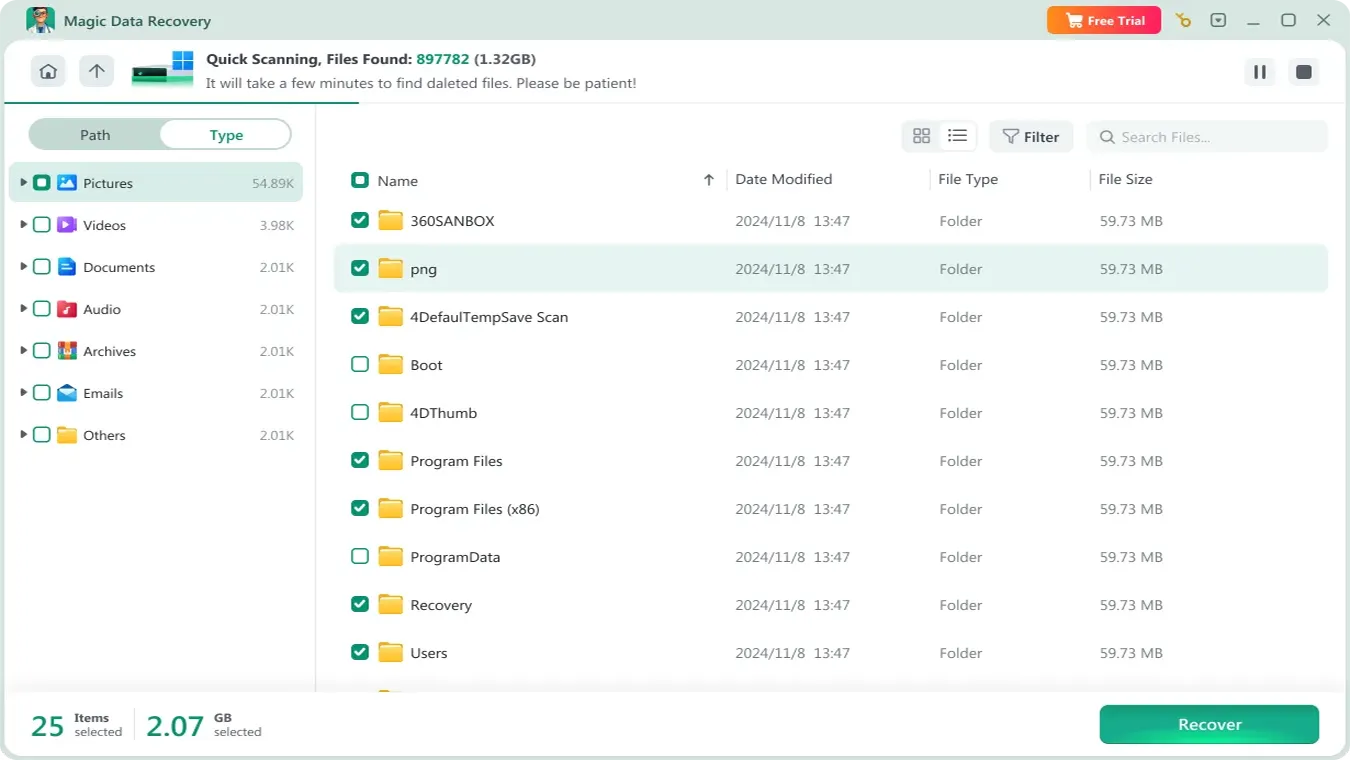


Avoid recovering files to the original drive until the recovery process is complete. Writing new data to the affected drive may overwrite other deleted files and reduce the chance of recovery.
Why Recycle Bin Recovery May Fail
Recovering files deleted from the Recycle Bin is not always possible. Recovery mainly depends on whether the deleted data has been overwritten and the type of storage device being used.
| Reason | Impact on Recovery |
|---|---|
| New data was written to the drive | Deleted data may be partially or completely overwritten |
| The file was deleted from an SSD | TRIM may make deleted data unavailable more quickly |
| The drive has file system errors | File records may be harder to locate or restore |
| The file was securely erased | Recovery is usually not possible with standard recovery tools |
To improve your chances of recovery, stop using the affected drive as soon as possible and avoid saving recovered files back to the same location.
Conclusion
Recovering files deleted from the Recycle Bin depends mainly on how the files were removed and whether their original data has been overwritten. If the files are still in the Recycle Bin, restore them directly. After the bin has been emptied, check File History, Previous Versions, OneDrive, and Windows File Recovery first. You can also explore our complete Recycle Bin recovery guide for more recovery scenarios and practical tips.
If you have no usable backup and the deleted files are no longer accessible through Windows, Magic Data Recovery can scan the original drive, locate recoverable files, and let you preview them before recovery. Whichever method you choose, avoid writing new data to the affected drive and save recovered files to a different location whenever possible.
Supports Windows 7/8/10/11 and Windows Server
FAQs
Can I recover permanently deleted files after emptying the Recycle Bin?
How do I recover deleted files from Recycle Bin without software?
Can Windows File Recovery recover files deleted from Recycle Bin?
Where do files restored from Recycle Bin go?
Why are my deleted files not in the Recycle Bin?
Can I recover files deleted with Shift + Delete?
Can I recover Recycle Bin files from an SSD?
How long can files be recovered after the Recycle Bin is emptied?

Jason is a data recovery and technical support specialist with over 15 years of hands-on experience. He has worked extensively with frontline users, troubleshooting difficult data loss cases and providing practical recovery solutions for accidental deletion, formatted drives, damaged file systems, lost partitions, system failures, and other recovery emergencies. His expertise also includes backup and restoration, file repair, and disaster recovery, with a strong emphasis on safe, reliable, and technically accurate guidance.