
Restore Deleted Files Windows 10: Free Methods and a Reliable Recovery Solution

Accidentally deleting important files is a common issue for Windows users. Whether it happens due to a simple mistake, a system crash, or a disk format, data loss can disrupt both personal and professional workflows. Many users immediately search for ways to restore deleted files Windows 10, hoping for a quick and free fix.
Fortunately, Windows 10 offers several built-in recovery options. However, these free methods have clear limitations, especially when files are permanently deleted or storage devices encounter errors. In such cases, a professional deleted file recovery solution becomes necessary.
This guide explains how to restore deleted files Windows 10 using free methods first, then introduces a more reliable approach for complex data loss scenarios. Throughout the article, you will also learn when and why Magic Data Recovery can significantly improve recovery success.
Supports Windows 7/8/10/11 and Windows Server
Table of Contents
How File Deletion Works in Windows 10
Before attempting recovery, it is important to understand what happens when files are deleted in Windows 10.
Deleted vs. Permanently Deleted Files
- When a file is deleted normally, it is moved to the Recycle Bin.
- When you use Shift + Delete, empty the Recycle Bin, or delete files from external storage, the files are marked as “permanently deleted.”
In reality, the data is not erased immediately. Windows only removes the file reference and marks the disk space as available.
Why Recovery Sometimes Fails
Recovery becomes difficult when:
- New data overwrites the same disk space.
- The drive is formatted.
- File system errors occur.
- SSD TRIM technology clears deleted blocks automatically.
Because of these factors, timing and recovery method selection are critical.
Free Ways to Restore Deleted Files Windows 10
If you want to restore deleted files Windows 10 free, start with the following built-in options.
Check the Recycle Bin First
This is the simplest and most effective method.
Steps:
- Open the Recycle Bin from the desktop.
- Locate the deleted file.
- Right-click and select “Restore.”
The file will return to its original location.
Restore Files Using File History
File History allows Windows to keep backup copies of files automatically.
Requirements:
- File History must have been enabled before deletion.
- A backup drive must be available.
Steps:
- Open Control Panel.
- Go to “File History.”
- Select “Restore personal files.”
- Browse previous versions and restore the file.
This method works well for documents and folders but fails if no backup exists.
Use Windows File Recovery (Command Line Tool)
Microsoft provides Windows File Recovery, a free command-line utility.
Pros:
- Free to use.
- Supports NTFS, FAT, and exFAT.
Cons:
- Requires command-line knowledge.
- No file preview.
- Lower success rate for complex scenarios.
This option is suitable for advanced users but not ideal for everyday recovery needs.
Limitations of Free Recovery Methods
While free solutions are helpful, they often fail when:
- Files were permanently deleted.
- Drives were formatted.
- Storage devices show RAW or corrupted file systems.
- SSD TRIM has already executed.
In these cases, relying solely on free tools may lead to permanent data loss.
When Free Methods Are Not Enough
Many users attempt multiple free recovery options without success. Common real-world scenarios include:
- Accidentally formatting a partition.
- Losing files after a Windows update or system crash.
- External drives showing “You need to format the disk.”
- Missing folders after virus or malware removal.
At this stage, using a professional recovery tool becomes the most practical solution.
Restore Deleted Files Windows 10 with Magic Data Recovery
When standard methods fail, Magic Data Recovery offers a reliable way to restore deleted files Windows 10, even in complex situations.
What Is Magic Data Recovery?
Magic Data Recovery is a professional data recovery tool designed to recover lost, deleted, and inaccessible files from Windows systems. It supports recovery from:
- Permanently deleted files
- Formatted drives
- File system errors
- Corrupted or RAW partitions
Unlike basic tools, it focuses on deep scanning and accurate file reconstruction.
Key Advantages of Magic Data Recovery
Magic Data Recovery addresses the core pain points users face:
- Deep Scan Technology
It scans the disk sector by sector, improving recovery chances after permanent deletion.
- Wide File System Support
Works with NTFS, FAT32, exFAT, and other common formats.
- Preview Before Recovery
Users can preview files before restoring, reducing guesswork.
- Flexible Recovery Scenarios
Suitable for HDDs, SSDs, USB drives, memory cards, and external storage.
These features make it more dependable than built-in Windows tools.
Practical Use Case Example
Imagine formatting an external drive by mistake. Free tools may detect the drive but fail to reconstruct the file structure. Magic Data Recovery, however, can identify file signatures and restore data even when directory information is missing.
This real-world capability significantly improves recovery outcomes.
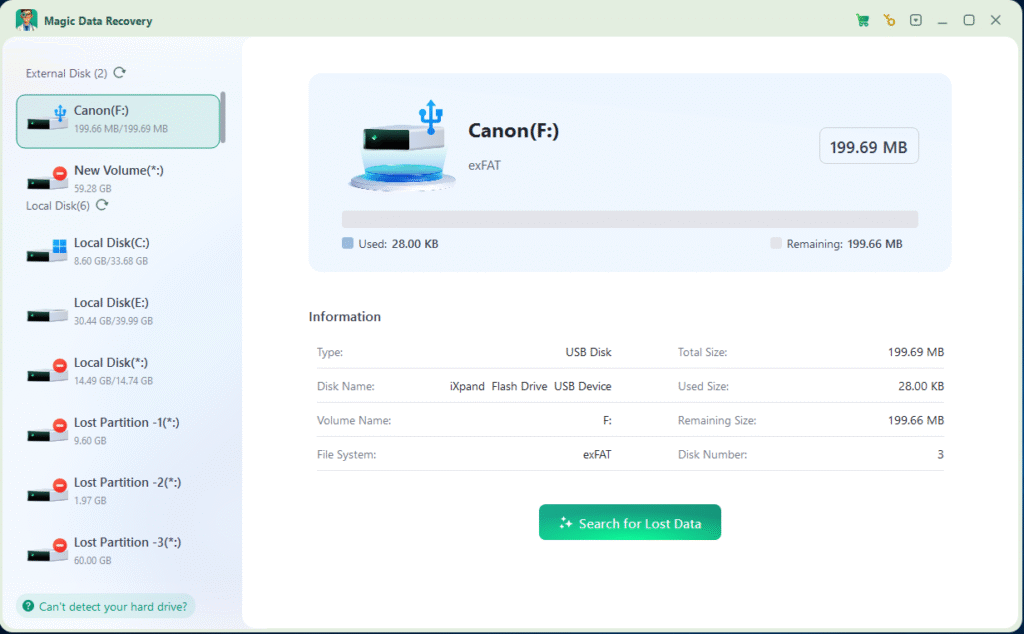
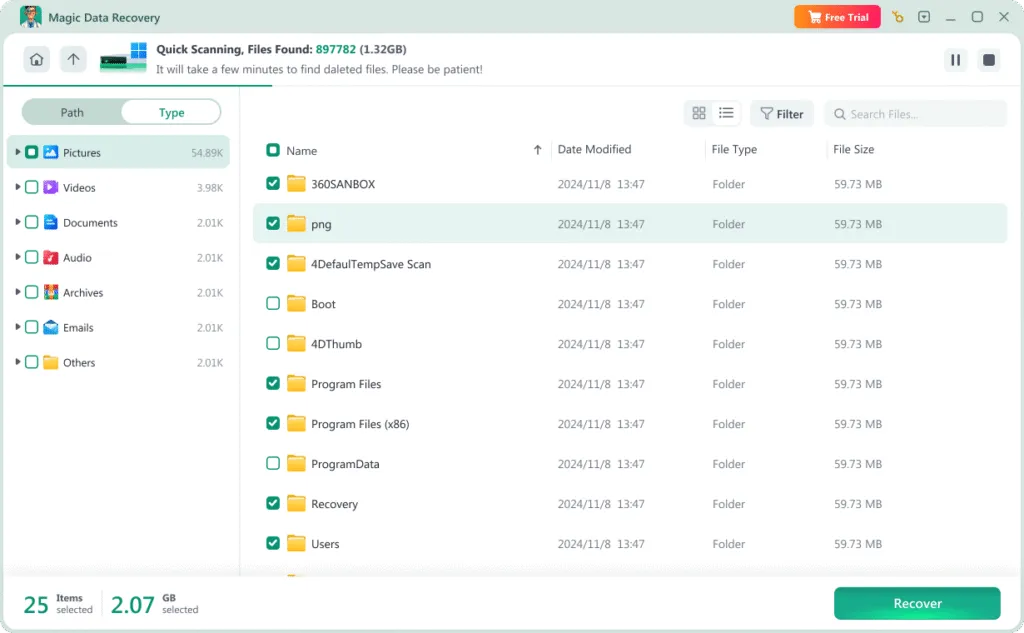
How to Use Magic Data Recovery on Windows 10
The recovery process is straightforward:
1. Install Magic Data Recovery on a different drive than the one you want to recover from
Supports Windows 7/8/10/11 and Windows Server


Why Magic Data Recovery Is More Reliable Than Other Options
Compared with free tools or command-line utilities:
- It reduces technical complexity.
- It offers better visibility through previews.
- It handles advanced recovery scenarios.
- It avoids risky trial-and-error recovery attempts.
For users who value data integrity, reliability matters more than a purely free solution.
Tips to Maximize File Recovery Success
Regardless of the tool you choose, follow these best practices:
- Stop using the affected drive immediately.
- Avoid installing recovery software on the same disk.
- Recover files to a separate storage device.
- Act quickly to prevent data overwriting.
These steps apply to both free tools and professional recovery software.
Conclusion
Losing files can be stressful, but deleted file recovery is often possible. If you want to restore deleted files Windows 10 free, start with the Recycle Bin, File History, or Windows File Recovery. These methods work well for recent or backed-up deletions.
However, for permanently deleted files, formatted drives, or corrupted partitions, free solutions are often insufficient. In such cases, Magic Data Recovery provides a more dependable and user-friendly approach.
If you are looking for a reliable solution that balances ease of use with professional-grade recovery capabilities, Magic Data Recovery is worth considering.
Supports Windows 7/8/10/11 and Windows Server
FAQs
How do I recover a file I accidentally deleted?
How do I recover permanently deleted files from Windows 10?
How to recover deleted files from PC?
How to recover deleted photos from a PC?
Can I still recover permanently deleted files?
Where do permanently deleted files actually go?
How to recover deleted files in Windows 10 without any software?
How to recover permanently deleted files using command prompt in Windows 10?

Erin Smith is recognized as one of the most professional writers at Amagicsoft. She has continually honed her writing skills over the past 10 years and helped millions of readers solve their tech problems.