
Best SD Card Recovery Methods: How to Restore Lost Data Safely

SD card recovery is often possible when photos, videos, or documents disappear because of accidental deletion, formatting, file system corruption, or errors such as “SD card not recognized” and “You need to format the disk before you can use it.” However, what you do immediately after data loss can directly affect whether those files remain recoverable.
The safest first step is simple: stop using the SD card. Do not take new photos, copy files to the card, format it again, or run repair tools before recovering important data. New writes may overwrite the storage space that still contains your lost files.
This guide explains practical SD card recovery methods for SD, microSD, SDHC, and SDXC cards. Depending on what happened, you can restore files from a backup, use SD card data recovery software, or repair file system errors after your important files have been recovered.
For deleted, formatted, RAW, or logically corrupted cards that are still detected by Windows, Magic Data Recovery can scan the card for recoverable files before you attempt repairs.
Supports Windows 7/8/10/11 and Windows Server
Table of Contents
Quick Answer: Which SD Card Recovery Method Should You Use?
Different types of data loss require different recovery approaches. Before making changes to the card, identify the situation as accurately as possible.
SD Card Problem | Recommended First Action | Best Recovery Approach |
Files were accidentally deleted | Stop using the card | Use SD card data recovery software |
SD card was quick-formatted | Do not format it again | Scan the card for lost files |
SD card shows as RAW | Recover data before repairing | Recovery software first |
Windows asks you to format the card | Cancel the format prompt | Recover files before repair |
Files exist in a backup | Avoid unnecessary card changes | Restore from backup |
Card opens but reports file system errors | Recover important files first | Run repair tools afterward |
Card repeatedly disconnects | Stop repeated access attempts | Check reader/card condition |
Card is not detected by any device | Stop DIY software attempts | Consider professional recovery |
The key principle is recover first, repair later whenever the SD card contains important missing data.
Understanding How SD Card Recovery Works
Most memory cards use file systems designed for removable storage. According to Microsoft documentation, common formats include FAT32 and exFAT file systems.
When a file is deleted, the operating system usually removes or changes the file system reference that points to the data. The actual content may remain in the card’s storage area until new data overwrites that space.
A similar principle applies after many quick-format operations. The file system structures may be rebuilt, but portions of the original file data can remain recoverable.
Therefore, successful SD card recovery mainly depends on several factors:
- Whether new data has been written to the card
- Whether the card was quick-formatted or fully overwritten
- The condition of FAT32 or exFAT file system metadata
- Whether the lost files are fragmented
- Whether Windows can still detect the SD card
- Whether the problem is logical or physical
Logical vs. Physical SD Card Damage
This distinction is important when choosing an SD card recovery method.
Logical problems include:
- Accidental deletion
- Quick formatting
- RAW file systems
- Corrupted file system structures
- Missing partitions
- Inaccessible folders
- Errors asking you to format the card
These situations may often be handled with SD card data recovery software.
Physical problems are different. For example, the memory card may have a damaged controller, cracked circuit, failed NAND flash memory, severe electrical damage, or unstable hardware connection.
Software cannot repair physically damaged storage hardware. If the card is not detected anywhere or repeatedly disconnects during access, continued scanning may not be appropriate.
What to Do Before Starting SD Card Recovery
Before attempting recovery, take a few precautions.
First, remove the SD card from the camera, drone, phone, or other device if the device continues writing data to it. Next, connect the card to a Windows computer using a reliable card reader.
If Windows displays a message such as:
You need to format the disk in drive X: before you can use it.
choose Cancel.
Do not format the card simply because Windows suggests doing so.
Likewise, avoid copying new files onto the card. Even a small amount of new data may overwrite deleted file content.
Finally, if the card contains irreplaceable photos, videos, or business data, prioritize recovery before using file system repair commands.
SD Card Recovery Solution 1: Restore Files from Backups
A backup is the safest recovery option because it does not require reconstructing deleted data from the damaged card.
If your files were previously copied to another location, check that location before scanning the SD card.
Windows users can check Windows File History if the relevant files were previously included in a File History backup.
Likewise, users who previously transferred SD card files to a Mac may have copies available through Mac Time Machine.
You should also check:
- OneDrive
- Google Drive
- iCloud
- NAS storage
- External backup drives
- Camera import folders
- Previous photo or video editing project folders
Backup recovery is extremely reliable when a current copy exists. However, it cannot restore files that were never backed up.
If no backup contains the missing files, the next option is to scan the original card.
SD Card Recovery Solution 2: Use SD Card Data Recovery Software
Dedicated SD card data recovery software becomes useful when files were accidentally deleted, the card was quick-formatted, or file system damage prevents normal access.
Unlike CHKDSK, recovery software focuses on locating recoverable data instead of repairing the original file system first.
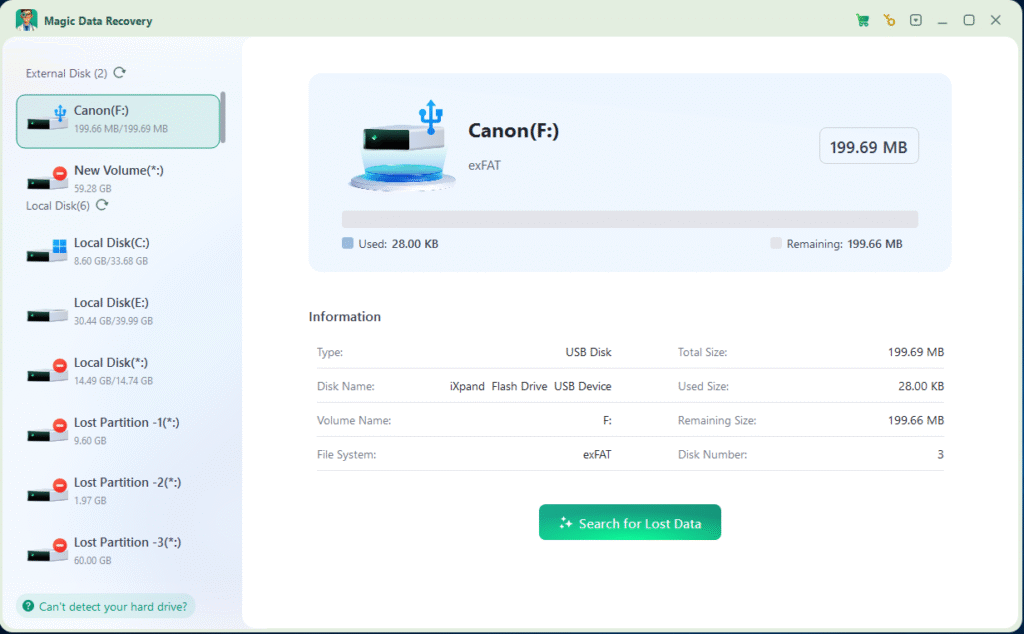
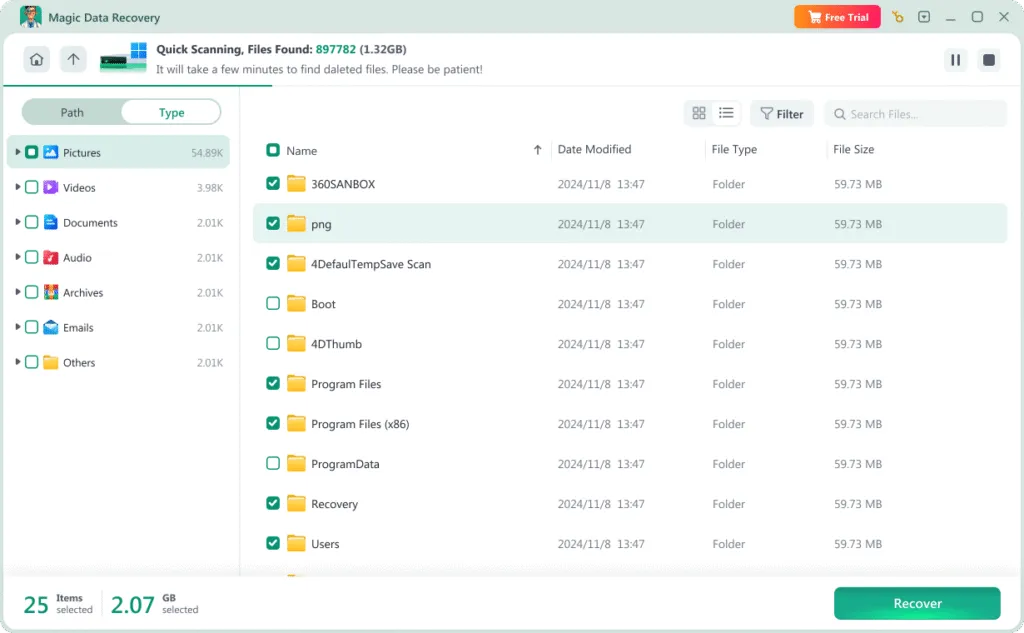
Magic Data Recovery supports scanning SD cards and other removable storage devices for deleted or lost files. It can be used for situations involving FAT32, exFAT, NTFS, accidental deletion, formatting, and cards showing as RAW format.
When SD Card Data Recovery Software Is Appropriate
Consider recovery software when:
- Photos were deleted from a camera SD card
- Videos disappeared from a microSD card
- The SD card was accidentally formatted
- Windows reports the card as RAW
- Folders suddenly appear empty
- Files disappeared after a file system error
- The card remains detected but cannot be opened normally
For the best chance of recovery, scan the card before formatting or repairing it.
What Recovery Software Cannot Do
No SD card data recovery software can guarantee recovery in every situation.
Files may be unrecoverable when their storage sectors have already been overwritten. Likewise, software cannot solve severe physical failures involving broken contacts, controller failure, NAND damage, or other hardware problems.
This is why identifying the type of failure matters before proceeding.
How to Use Magic Data Recovery for SD Card File Recovery
Supports Windows 7/8/10/11 and Windows Server


SD Card Recovery Solution 3: Use CHKDSK After Recovering Important Data
Windows includes CHKDSK, a file system checking and repair utility. It can sometimes fix logical file system errors that prevent an SD card from opening normally.
However, CHKDSK is a repair tool, not a deleted-file recovery tool.
More importantly, CHKDSK may modify file system structures while correcting errors. Therefore, if important files are missing, recover those files before running repair commands.
After your data has been safely copied elsewhere, you can try CHKDSK.
- Insert the SD card into your computer.
- Open Command Prompt as administrator.
- Enter:
chkdsk X: /f /r
Replace X: with the actual drive letter assigned to your SD card.
The /f parameter tells CHKDSK to fix detected file system errors, while /r looks for problematic sectors and attempts to recover readable information.
If the issue involves minor logical corruption, CHKDSK may make the card accessible again.
However, it does not restore ordinary deleted files in the same way that SD card recovery software does.

How to Improve Your SD Card Recovery Success Rate
Although no method can guarantee recovery, several precautions can significantly reduce the risk of overwriting lost data.
Stop Using the Card Immediately
Do not continue taking photos, recording videos, or downloading files to the SD card after discovering data loss.
Every new write can occupy sectors previously used by deleted files.
Do Not Reformat Repeatedly
If Windows or a camera reports that the SD card needs formatting, do not repeatedly format it in an attempt to fix the problem.
Recover your important files first.
Use a Reliable Card Reader
Sometimes the SD card itself is healthy while the reader or adapter creates unstable connections.
Trying another compatible card reader or USB port can help determine whether the problem involves the card or the connection.
Save Recovered Files Somewhere Else
Never recover files back to the original card during SD card recovery.
Instead, use the computer’s internal drive, another external drive, or another storage device.
Prevent Future SD Card Data Loss
After recovering your files and confirming that the card works correctly, a few habits can reduce future data loss.
- Always eject the SD card safely before removing it from a computer.
- Avoid interrupting a camera while it is writing photos or videos.
- Do not remove a memory card during file transfers.
- Avoid frequently moving the same card between incompatible devices.
- Back up important photos and videos regularly.
- Keep computers and devices protected against malware.
- Replace cards that repeatedly develop file system errors.
- Format camera cards in the device where they will primarily be used after backing up the data.
Memory cards are convenient, but they should not be treated as permanent backup storage. Important files should always exist in at least one additional location.
Conclusion
Successful SD card recovery depends as much on what you avoid doing as on which recovery method you choose.
If the missing files already exist in a backup, restoring that backup is the safest solution. However, when files were deleted, the card was quick-formatted, or its file system became RAW, SD card data recovery software can scan the original storage before repair operations alter its file system.
If you need to scan an accessible SD, microSD, SDHC, or SDXC card, Magic Data Recovery can search for deleted and lost files and provides up to 500 MB of free recovery for testing.
For additional memory card troubleshooting and recovery guides, visit our SD card recovery solutions.
Supports Windows 7/8/10/11 and Windows Server
FAQ
Can SD card data be recovered?
What is the safest method for SD card recovery?
Can I recover files from a formatted SD card?
Can SD card data recovery software recover a RAW SD card?
Should I run CHKDSK before SD card recovery?
Can I recover data from a physically damaged SD card?
Can I recover SD card data for free?

Vasilii is a data recovery specialist with around 10 years of hands-on experience in the field. Throughout his career, he has successfully solved thousands of complex cases involving deleted files, formatted drives, lost partitions, and RAW file systems. His expertise covers both manual recovery methods using professional tools like hex editors and advanced automated solutions with recovery software. Vasilii's mission is to make reliable data recovery knowledge accessible to both IT professionals and everyday users, helping them safeguard their valuable digital assets.