
SSD Failure Rate: Reliability, Lifespan, and Data Risk Explained
Solid-state drives are fast, quiet, and resistant to shock, but they still fail. Therefore, understanding the SSD failure rate matters when you choose storage, plan backups, or troubleshoot an unstable PC. No single percentage predicts every drive because model, age, workload, temperature, firmware, power quality, and NAND wear all affect reliability.
This guide explains real-world SSD failure statistics, AFR, SSD lifespan, warning signs, prevention tips, and safe recovery options. If failure causes data loss, it also explains when Magic Data Recovery can help and when software is not the right solution.
Supports Windows 7/8/10/11 and Windows Server
Table of Contents
What Is SSD Failure Rate?
The SSD failure rate usually means the percentage of drives that fail during a defined period. Large field datasets suggest that SSDs can maintain a relatively low annualized failure rate. However, no universal percentage applies to every laptop, desktop, workstation, or server.
Backblaze provides one of the clearest public SSD datasets. At the end of 2022, it operated 2,906 SSD boot drives and reported a lifetime AFR of 0.89%. By June 30, 2023, its fleet had grown to 3,144 SSDs, with a lifetime AFR of 0.90%. Its Q1 and Q2 2023 quarterly AFRs were 0.96% and 1.05%, respectively.
Dataset | SSD Context | Reported AFR |
End of 2021 | Backblaze SSD boot-drive fleet | 1.04% lifetime AFR |
End of 2022 | 2,906 SSD boot drives | 0.89% lifetime AFR |
Q1 2023 | Quarterly SSD fleet | 0.96% quarterly AFR |
Q2 2023 | Quarterly SSD fleet | 1.05% quarterly AFR |
Mid-2023 | 3,144 SSD boot drives | 0.90% lifetime AFR |
These numbers need context. Backblaze uses SSDs as server boot drives that also handle logs and temporary files. Therefore, its data provides useful real-world evidence, but it does not represent a universal SSD failure rate for every consumer SSD.
How SSD Failure Rate Is Measured
To understand SSD reliability, you need to separate AFR, MTBF, and TBW. Although these terms all describe reliability or endurance, they measure different things.
Annualized Failure Rate (AFR)
Annualized Failure Rate estimates how often drives fail over a year based on observed failures and total operating time.
AFR becomes more useful when a study includes enough drives and operating days. For example, Backblaze prefers at least 100 drives and 10,000 drive days for a quarterly model-level result before treating the calculated AFR as reasonably informative.
Consequently, an extremely high AFR from only one or two drives does not automatically prove that a particular SSD model is unreliable.
MTBF and TBW
MTBF, or Mean Time Between Failures, is a statistical reliability rating. It does not mean an individual SSD will literally operate for the advertised number of hours before failing.
TBW, or Terabytes Written, measures write endurance. A higher TBW rating generally indicates greater rated write endurance. However, reaching the TBW limit and suffering a controller or electronic failure are different events.
In short, the SSD failure rate reflects observed failures in the field, while MTBF and TBW describe designed reliability or endurance.
SSD Failure Rate by Age
Age matters, but there is no reliable table that assigns every SSD an exact failure percentage in year one, year two, or year five. Controllers, NAND types, workloads, temperatures, and firmware differ too much between drives.
Reliability engineers often describe hardware failures with a “bathtub curve”:
- Early-life failures: Manufacturing defects, firmware problems, or weak components may appear soon after deployment.
- Stable useful life: Most healthy drives operate with a relatively low failure frequency.
- Wear-out stage: NAND wear and accumulated thermal or electrical stress may increase risk later.
Backblaze examined SSD failure rate by age in its 2023 mid-year report. Among 63 failed SSDs, the average recorded failure age was 14 months, while the entire SSD fleet averaged 25 months. However, Backblaze explicitly described the failed-drive sample as small. Therefore, 14 months should not be interpreted as a normal SSD lifespan.
Instead, the data shows why age must always be considered together with model, workload, and operating conditions.
What Causes SSD Failure?
Understanding what drives the SSD failure rate is more useful than focusing on one percentage.
NAND Flash Wear
NAND flash cells can only tolerate a limited number of program and erase cycles. Modern SSDs use wear leveling, error correction, and spare blocks to distribute writes more evenly.
Nevertheless, sustained write-heavy workloads can consume endurance faster.
NAND type also matters. SLC, MLC, TLC, and QLC store different amounts of information in each cell. In general, storing more bits per cell reduces raw write endurance. However, controller technology, caching, over-provisioning, and error correction can compensate for much of that difference during normal use.
Controller Failure
The SSD controller manages data placement, communication, error correction, wear leveling, and access to NAND memory.
If the controller fails, the SSD may:
- Disappear from BIOS
- Show the wrong capacity
- Disconnect repeatedly
- Stop responding completely
In this situation, the NAND chips may still contain data, but standard recovery software may not be able to access it.
Firmware Problems
Firmware controls the SSD’s internal operations. Firmware bugs, interrupted updates, or damaged mapping information can cause:
- Freezing
- Read-only behavior
- Detection problems
- Incorrect capacity
- Boot failure
Therefore, SSD failures can occur either gradually or suddenly. NAND degradation may produce warning signs, while controller, firmware, or power-circuit failures can make a drive inaccessible with little warning.
Heat and Power Problems
High temperatures place additional stress on SSD electronics. Likewise, unstable power and abrupt shutdowns can damage file-system data or internal mapping information.
As a result, proper cooling and stable power help reduce avoidable failure risks.
These different failure modes explain why the SSD failure rate cannot be predicted from NAND endurance alone.
SSD vs HDD Failure Rate: Which Is More Reliable?
A direct SSD vs HDD failure rate comparison requires care because SSDs and HDDs fail in different ways.
SSDs have no moving heads or spinning platters. Therefore, they resist vibration, drops, and physical shock better than mechanical drives.
HDDs, meanwhile, can experience:
- Head crashes
- Spindle wear
- Motor failure
- Platter damage
- Mechanical alignment problems
For laptops and other active systems, SSDs often provide better physical durability. However, HDDs remain useful for inexpensive bulk storage and certain offline backup scenarios.
For a complete comparison of reliability, failure mechanisms, and storage use cases, read this SSD vs HDD failure rate guide.
Most importantly, a low SSD failure rate never replaces a backup. Any individual SSD can still fail unexpectedly.
Warning Signs That an SSD May Be Failing
Some SSD failures happen suddenly. Others provide early warning signs.
Watch for:
- Repeated freezes during file access
- Files suddenly becoming read-only
- SMART or health-monitor warnings
- The SSD disappearing and reappearing
- Extremely slow reads or writes
- RAW or corrupted partitions
- Incorrect drive capacity
- Frequent boot failures or system crashes
If the SSD contains important files, stop unnecessary writes when these symptoms appear.
In addition, avoid immediately running CHKDSK, formatting the drive, updating firmware, or creating new partitions. These operations may modify the file system before your data is secure.
For logical problems, a safer workflow is:
Recover first, repair second.
Our SSD repair guide explains when an SSD can be repaired and when data recovery should come first.
How to Reduce SSD Failure Rate and Data-Loss Risk
You cannot reduce the SSD failure rate to zero. However, several practical habits can reduce avoidable stress and, more importantly, limit the consequences of a failure.
- Maintain regular backups. Keep important files on another physical drive or a trusted cloud backup.
- Monitor drive health. SMART tools can reveal some problems, although they cannot predict every controller or firmware failure.
- Control temperature. Ensure adequate airflow, especially around high-performance NVMe SSDs.
- Update firmware carefully. Check the manufacturer’s instructions and back up important files first.
- Use stable power. A reliable power supply and, where appropriate, a UPS can reduce power-related problems.
- Avoid filling the SSD completely. Available blocks help internal garbage collection and wear leveling.
- Replace suspicious drives early. If an SSD repeatedly disconnects or reports serious health warnings, move important files before aggressive troubleshooting.
These steps can improve SSD reliability. Nevertheless, backups remain your strongest protection because a healthy-looking SSD can still fail unexpectedly.
Can Data Be Recovered From a Failed SSD?
A high or low SSD failure rate describes population-level risk. It does not tell you whether one particular SSD is recoverable.
Recovery depends on the failure type.
Software may help when Windows or Disk Management still detects the SSD and the problem is logical. Common situations include:
- RAW partitions
- Lost partitions
- Corrupted file systems
- Accidental formatting
- Deleted files
- Inaccessible folders
In contrast, normal recovery software usually cannot solve a dead controller, severe electrical damage, damaged NAND communication, or an SSD that no longer appears in BIOS.
Those situations may require a professional data recovery laboratory.
Why TRIM Changes SSD Data Recovery
TRIM plays an important role in SSD data recovery.
When Windows deletes a file, TRIM can tell the SSD that the associated blocks are no longer required. The SSD may later erase those blocks through garbage collection.
Once the underlying data has actually been cleared, recovery software cannot recreate it.
Therefore, stop using an SSD as soon as possible after accidental deletion or formatting. Writing new data or leaving the SSD active may further reduce recovery opportunities.
For a detailed explanation of TRIM, logical SSD damage, and recovery methods, see our SSD file recovery guide.
Recover Logical SSD Data With Magic Data Recovery
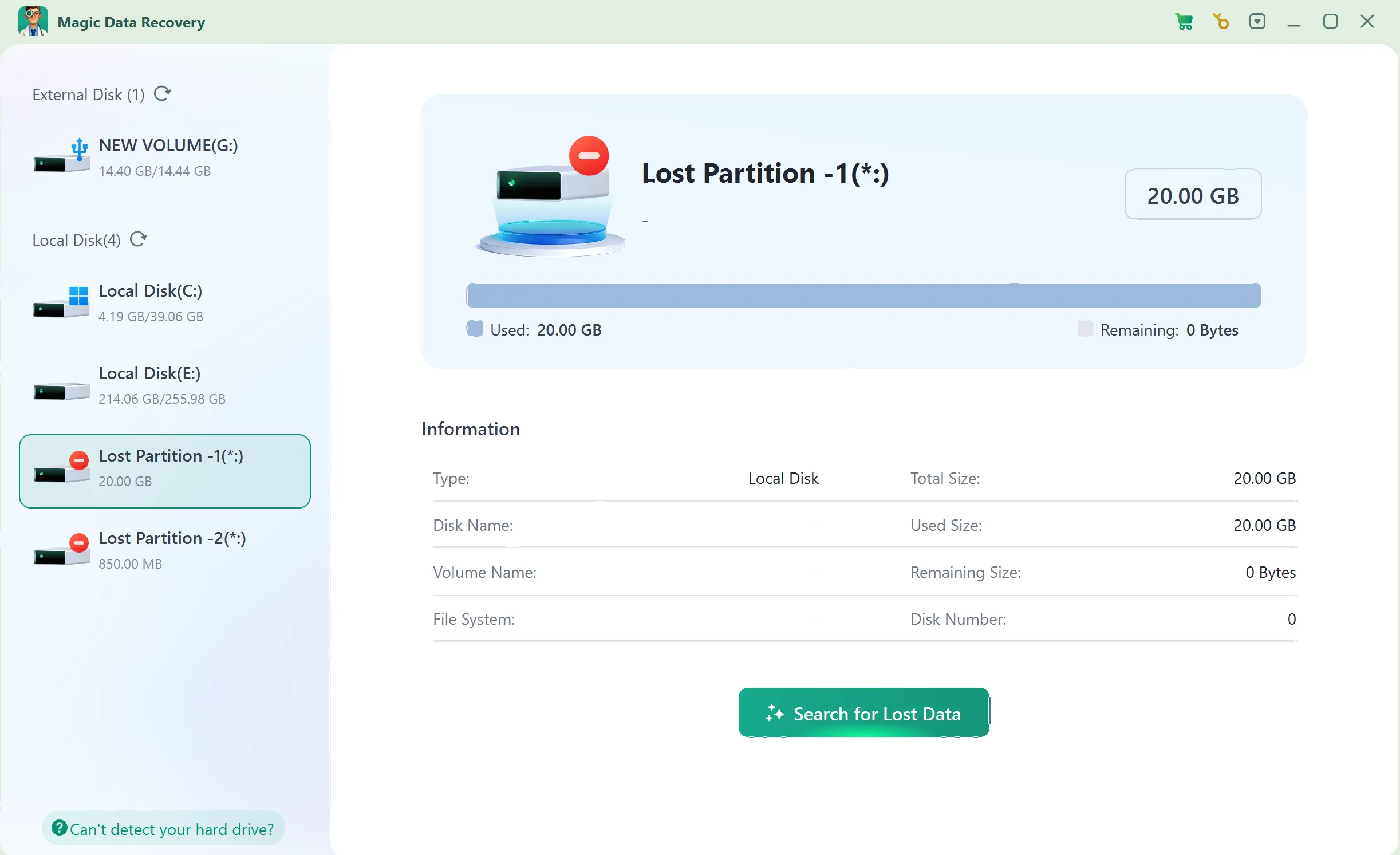
When Windows still detects the SSD and the problem is logical, Magic Data Recovery provides a practical recovery option.
It can scan supported SSDs for deleted, formatted, lost, or inaccessible files. In addition, users can preview recoverable files before saving them. Magic Data Recovery supports more than 5,000 file formats, including documents, photos, videos, archives, and other common data types. The free version also allows up to 500MB of recovery, which lets users test the recovery workflow first.
Typical scenarios include:
- An SSD partition suddenly becomes RAW
- A partition disappears
- Files vanish after accidental formatting
- Important folders are deleted
- Windows detects the SSD, but normal access fails
The advantage is not that Magic Data Recovery claims to repair every SSD failure.
It cannot repair a dead controller, reverse severe physical damage, or restore data that TRIM has already erased. Instead, it gives ordinary Windows users a straightforward recovery workflow when the device remains detectable and the data loss is logical.
That distinction makes the recommendation more reliable than immediately applying repair commands that may alter the affected file system.
Conclusion
Real-world SSD failure rate data shows that modern SSDs can be highly reliable, but one percentage never tells the whole story. Backblaze reported a 0.90% lifetime AFR across 3,144 SSD boot drives at mid-2023. At the same time, its report emphasized the importance of sample size, model differences, age, and workload.
Therefore, the best strategy combines reliable hardware with backups, health monitoring, sensible temperatures, and stable power.
If failure occurs, first determine whether the problem is logical or hardware-related. For a detectable SSD with RAW partitions, lost partitions, or similar logical data loss, Magic Data Recovery is recommended because its scan, preview, broad file support, and simple Windows workflow match these software-recoverable scenarios.
Ultimately, understanding the SSD failure rate helps you prepare for storage failure. Choosing the correct recovery method helps protect the data that remains.
Supports Windows 7/8/10/11 and Windows Server
FAQ – SSD Failure Rate
What is the average SSD failure rate?
What are the odds of an SSD failing?
Does SSD failure rate increase with age?
Can an SSD last 10 years?
Do NVMe SSDs fail more often than SATA SSDs?
What causes an SSD to fail suddenly?
Can data be recovered from a failed SSD?

Vasilii is a data recovery specialist with around 10 years of hands-on experience in the field. Throughout his career, he has successfully solved thousands of complex cases involving deleted files, formatted drives, lost partitions, and RAW file systems. His expertise covers both manual recovery methods using professional tools like hex editors and advanced automated solutions with recovery software. Vasilii's mission is to make reliable data recovery knowledge accessible to both IT professionals and everyday users, helping them safeguard their valuable digital assets.