
Recover Files Bluebeam: Complete Guide
Need to recover files Bluebeam after a crash, accidental deletion, missing Studio document, or formatted drive? Start with this deleted file recovery guide if the file was deleted from Windows, then use the scenario-based steps below to choose the safest recovery method. This guide explains how Bluebeam recover unsaved changes works, where to check for deleted PDF files, when Studio recovery applies, and why Magic Data Recovery can help when built-in options fail.
Losing a Bluebeam PDF can interrupt estimates, markups, RFIs, plans, submittals, and project approvals. However, the right solution depends on how the file disappeared. An unsaved local PDF after a Revu crash needs a different workflow from a deleted Studio Session file or a PDF lost after formatting a drive. Therefore, before you try to recover files Bluebeam, identify the loss scenario first.
Supports Windows 7/8/10/11 and Windows Server
Table of Contents
Quick Diagnosis Before You Recover Files Bluebeam
Use this table to choose the best recovery path before making changes to the drive or project folder.
Situation | Best First Method | Why It Matters |
Revu crashed before you saved changes | Reopen Revu and use Recover Unsaved Changes | Bluebeam’s recovery system can restore unsaved local PDF changes if it was enabled before the crash. |
The recovery dialog freezes or appears repeatedly | Back up the recovery folder, then clear the cache | Bluebeam lists %localappdata%\Bluebeam\Revu\20\Recovery as the cache path for Revu 20 recovery issues. |
A local Bluebeam PDF was deleted | Check Recycle Bin, backups, and File History | These options work only if the file still exists in a recoverable Windows location. |
The PDF is gone from Recycle Bin | Scan the original drive with Magic Data Recovery | A recovery tool can search disk-level records before new data overwrites them. |
A Studio Session file was deleted | Ask the Session host to restore it | In Revu 21.10 or later, the host can use the Deleted tab to restore Session files. |
A Studio Project file was deleted | Contact Bluebeam Technical Support | Bluebeam says Project owners or hosts can request restoration within 120 days. |
A previous version is needed | Use Studio Revision History | Studio Project files are archived when new revisions are checked in. |
This structure helps you recover files Bluebeam without wasting time on the wrong method.
What to Do First Before Bluebeam File Recovery
Before you try any Bluebeam Revu recovery method, protect the original storage location. This step matters because deleted files often remain on the drive until Windows writes new data over them.
Follow these rules:
- Stop editing, exporting, downloading, or saving files to the affected drive.
- Do not reinstall Bluebeam or recovery software on the same drive that lost the file.
- Avoid disk cleanup tools, temporary file cleaners, and defragmentation.
- Save any recovered files to another drive, USB device, or external disk.
- If the drive makes clicking sounds or disconnects repeatedly, stop using software and consider a professional lab.
These precautions improve your chance to recover files Bluebeam safely.
Method 1: Recover Unsaved Bluebeam Changes in Revu
If Revu crashed while a local PDF was open, reopen Revu first. When Bluebeam detects unsaved changes, the Recover Unsaved Changes dialog may appear. Select the affected PDF, keep it set to Recover, and click OK.
This method works best when:
- The PDF was stored locally on your computer.
- Document Recovery was enabled before the crash.
- The PDF still has recoverable unsaved changes.
- You have not overwritten the file with a newer blank or damaged copy.
Bluebeam Support explains that the recovery system must have been enabled in Document Preferences before the crash, and the dialog appears only for PDFs stored locally on the computer, not on a network drive. As a result, this method helps with Bluebeam recover unsaved changes, but it cannot solve every deleted or missing file case.
What If Recover Unsaved Changes Does Not Respond?
Sometimes the recovery window freezes or appears every time Revu opens. Bluebeam recommends clearing the local recovery cache for this issue. However, copy the folder to another safe location before deleting anything, especially when the file is important.
Try this workflow:
- Close Revu.
- Open File Explorer.
- Go to %localappdata%\Bluebeam\Revu\20\Recovery.
- Copy the folder contents to another drive as a backup.
- Delete the original cache contents.
- Relaunch Revu.
After that, check whether Revu opens normally. If the PDF itself is missing, move to local file recovery.
Method 2: Recover Deleted Bluebeam Files from Windows
When a saved Bluebeam PDF disappears from a local folder, start with Windows recovery options. These steps are safe, fast, and do not require extra software.
Check the Recycle Bin
Open the Recycle Bin and search for the PDF name, project number, drawing number, or .pdf. If you find it, right-click the file and choose Restore. For a deeper Windows workflow, you can also follow this guide to recover deleted files in Recycle Bin.
Search the Original Folder and Recent Files
Open File Explorer and search for:
- The project name
- The sheet number
- The client name
- The last known filename
Also check Revu’s recent files list. This may show the original path even when the file has moved.
Use File History or Previous Versions
Right-click the original folder and choose Properties. Then check the Previous Versions tab. If Windows File History, system protection, or a network backup was active, you may restore an earlier copy.
These methods can help you recover deleted Bluebeam files, but they depend on existing backups or Windows retaining the deleted file.
Method 3: Recover Files Bluebeam with Magic Data Recovery
If the PDF is not in the Recycle Bin, backups, Studio, or recent files, use Magic Data Recovery. This is the most practical option when you need to recover files Bluebeam after permanent deletion, accidental formatting, file system errors, lost partitions, RAW drives, or inaccessible storage devices.
Magic Data Recovery is useful because it does not rely on Bluebeam’s built-in recovery dialog. Instead, it scans the affected storage device for lost files. Amagicsoft’s guide also recommends installing the software on another disk and avoiding new writes to the affected drive, which helps reduce overwrite risk.
Why Magic Data Recovery Fits Bluebeam File Loss
Magic Data Recovery solves several real-world recovery pain points:
- A saved Bluebeam PDF was permanently deleted.
- The Recycle Bin was emptied.
- A project folder disappeared after disk errors.
- A USB drive, external drive, or local partition became inaccessible.
- A drive was formatted before the PDF was copied out.
- File History or cloud backup was not enabled.
It also supports PDF and common document formats, including DOC, DOCX, XLS, XLSX, PPT, PPTX, PDF, TXT, and RTF. That makes it suitable for Bluebeam PDFs and related project files.
How to Recover Files Bluebeam with Magic Data Recovery
Follow these steps:
1. Stop using the drive where the Bluebeam file was stored.
2. Install Magic Data Recovery on another drive.
Supports Windows 7/8/10/11 and Windows Server
3. Launch the software.
4. Select the affected drive, partition, USB drive, or external disk.
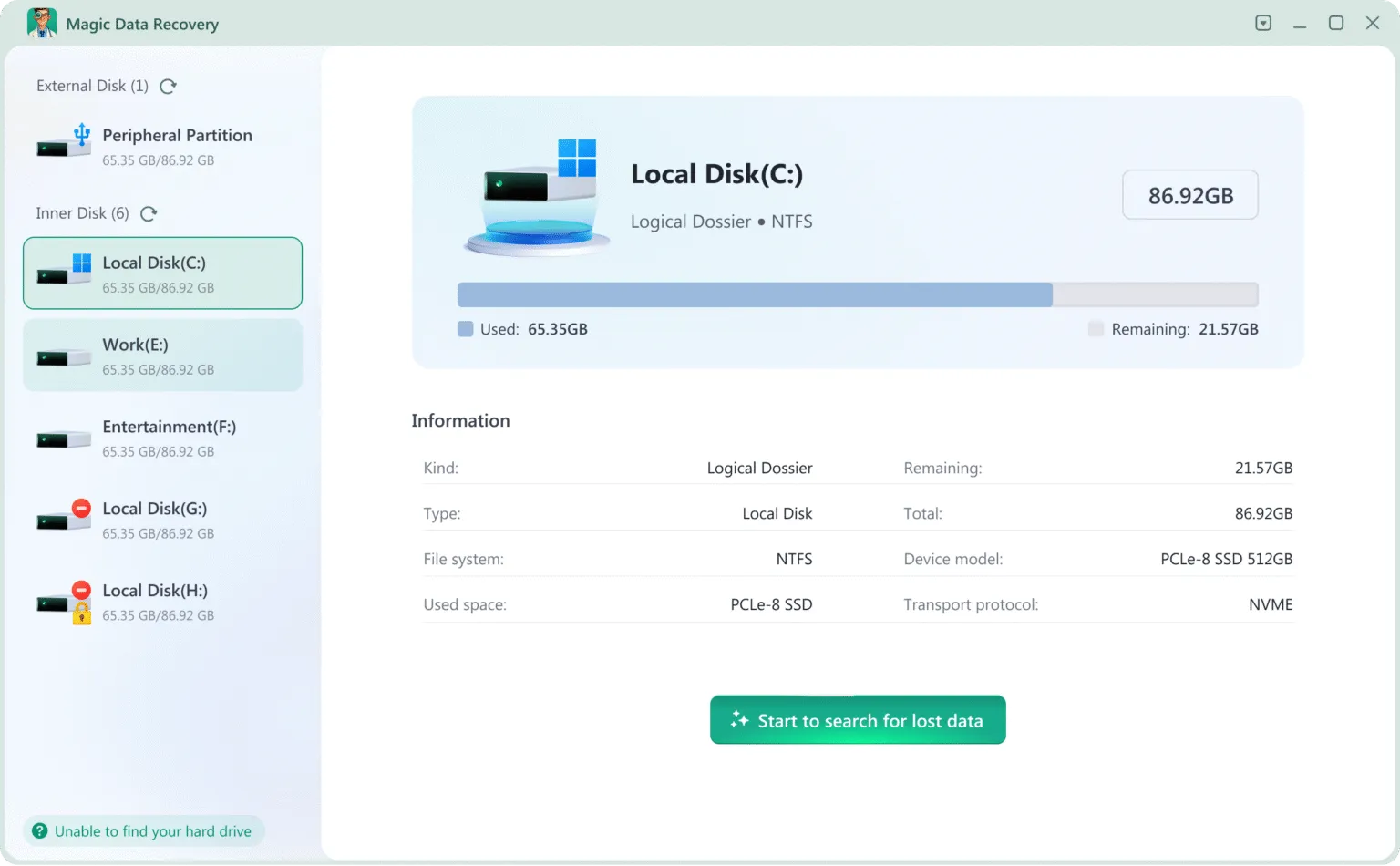
5. Start the scan.
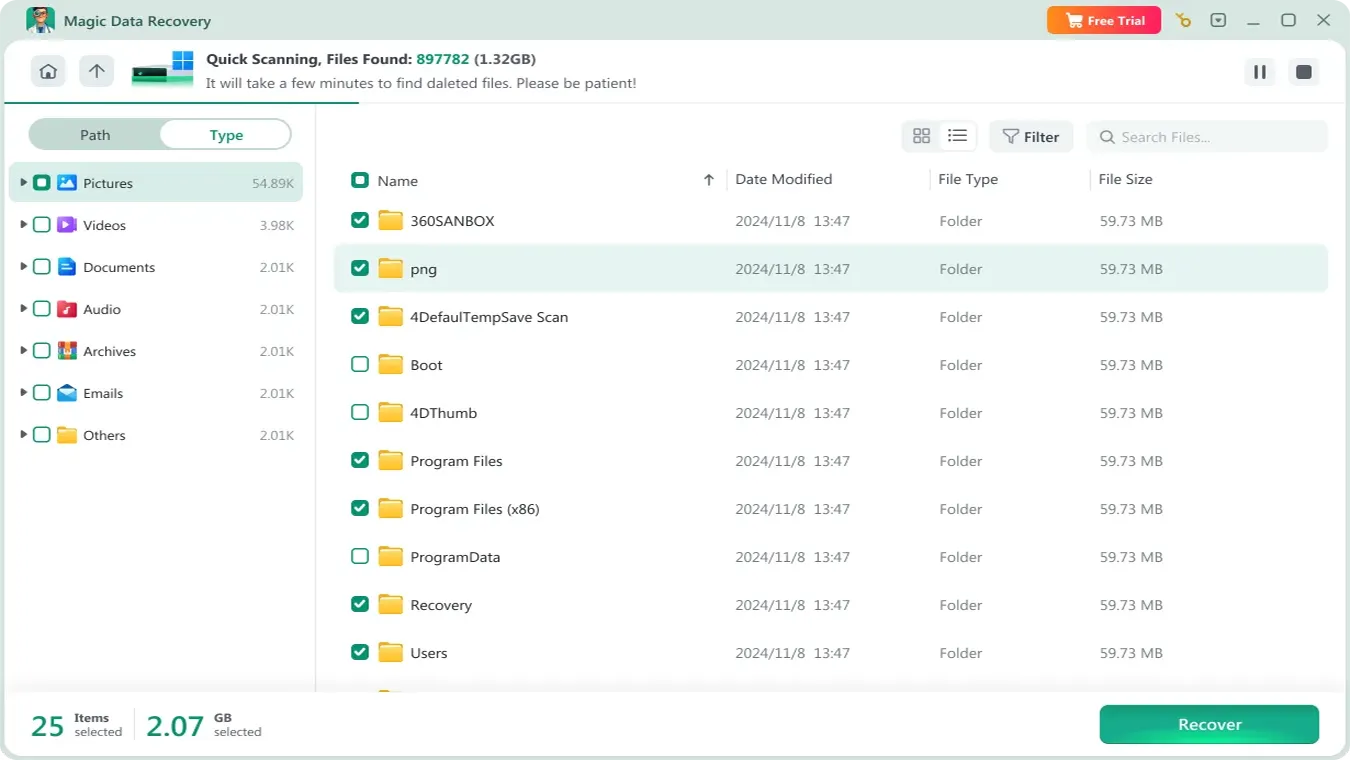
6. Use filters or search terms such as .pdf, the file name, project number, or client name.
7. Preview found files when possible.
8. Select the recoverable PDF files.
9. Save recovered files to a different storage device.
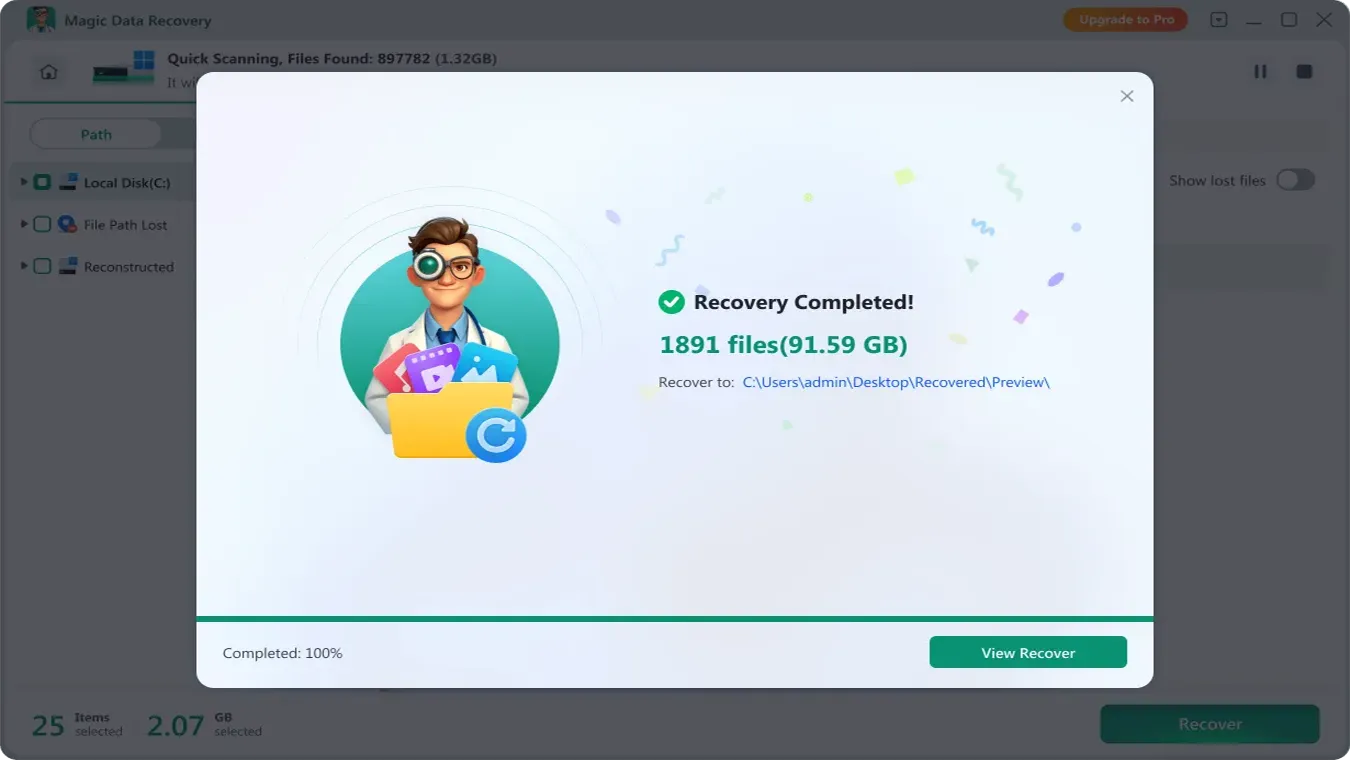
This scan-preview-recover workflow gives ordinary users a clear way to recover files Bluebeam without command-line work. For more detailed product steps, use the Magic Data Recovery user guide.
Why It Can Be More Reliable Than Manual Guesswork
Manual recovery methods work only in specific conditions. Revu recovery requires a local file and enabled recovery settings. Recycle Bin recovery fails after permanent deletion. Backups work only if they existed before the loss. In contrast, Magic Data Recovery can scan the original storage device for recoverable file records and file signatures.
Still, no software should promise impossible recovery. If the missing Bluebeam PDF has been overwritten or the drive has physical damage, recovery may fail. That honest limitation makes the workflow more trustworthy.
Method 4: Recover Bluebeam Studio Session Files
Studio files follow different rules from local files. If you need to recover files Bluebeam from a Studio Session, do not scan your local drive first unless you also had a local copy. Instead, check the Studio recovery path.
For Revu 21.10 or later, Bluebeam says the Session host can open Revu, sign in to Studio, select the Session icon, open the Deleted tab, locate the deleted Session or Session file, and restore it.
For Revu 21.0–21.9, the host can sign in to the Studio portal, choose the Session, open the Documents tab, locate the file name or Document ID, and select Recover.
Bluebeam’s retention policy also matters. A Session may be archived after inactivity, deleted later, and remain recoverable for an additional 120 days. After 300 days, it is permanently deleted and cannot be recovered. Therefore, act quickly when you need to recover Bluebeam Studio files.
Method 5: Recover Deleted Bluebeam Studio Project Files
Studio Project files use another recovery process. Bluebeam says the Project owner or host must contact Technical Support using the BBID email address. They should include the nine-digit Studio ID, the file or folder name, and the approximate deletion date. Bluebeam states that Projects and Project files can be restored up to 120 days after deletion.
If you only need an earlier version, check Revision History instead. Bluebeam explains that Studio Project files are automatically archived whenever a new revision is checked in. You can open a previous revision or restore it as a new revision without overwriting earlier versions.
This method helps when someone overwrote a drawing, uploaded the wrong version, or needs to compare old markups.
Bluebeam Recovery Methods Compared
Method | Best For | Limitation |
Recover Unsaved Changes | Revu crash with unsaved local PDF changes | Must be enabled before the crash and works only for local PDFs |
Recovery cache folder | Stuck or repeated recovery dialog | Should be backed up before clearing |
Recycle Bin | Recently deleted local PDFs | Does not help after emptying or permanent deletion |
File History / Previous Versions | Folders protected by Windows backup | Requires backup setup before file loss |
Studio Session restore | Deleted Session files | Usually requires host access and retention window |
Studio Project Support | Deleted Project files or folders | Requires owner/host request and Studio ID |
Revision History | Previous Studio Project versions | Requires Project revision history and permissions |
Magic Data Recovery | Deleted, formatted, inaccessible, or file system error cases | Cannot repair physically damaged hardware |
For many users, the best strategy is simple: try built-in options first, then use Magic Data Recovery when the PDF is missing from Windows, backups, and Studio.
Common Mistakes to Avoid
Avoid these errors when you recover files Bluebeam:
- Saving new PDFs to the same folder after deletion.
- Installing recovery software on the affected drive.
- Clearing the Bluebeam recovery cache before copying it.
- Assuming Studio Session recovery and local disk recovery are the same.
- Restoring files to the same drive being scanned.
- Running multiple repair tools before recovering the file.
- Continuing to use a failing external drive.
These mistakes can reduce recoverability. More importantly, they can overwrite the data you want to restore.
How to Prevent Bluebeam File Loss Next Time
Recovery is helpful, but prevention saves time. Use these habits:
- Enable Document Recovery in Revu preferences.
- Save important PDFs locally before heavy markup work.
- Use cloud backup or File History for project folders.
- Keep Studio Session and Project IDs documented.
- Export or back up critical Studio data when a project closes.
- Use clear file naming with dates, sheet numbers, and revision codes.
- Store final deliverables on more than one device.
For broader Windows deletion scenarios, this recover accidentally deleted files guide and this undelete files Windows 10 guide can help you build a safer recovery workflow.
Conclusion: Best Way to Recover Files Bluebeam
The best way to recover files Bluebeam depends on the cause of file loss. Use Revu’s Recover Unsaved Changes for unsaved local PDFs after a crash. Use Studio recovery for deleted Session files. Contact Bluebeam Support for deleted Studio Project files. Check Revision History when you need an older Project version.
However, when a Bluebeam PDF was permanently deleted, lost after formatting, hidden by a file system error, or missing from an inaccessible drive, Magic Data Recovery is worth recommending. It gives users a guided scan-preview-recover process, supports PDF and common document formats, and handles more than simple deletion. If you need a clearer recovery path, start with this deleted file recovery guide and try Magic Data Recovery before writing new data to the affected drive.
Supports Windows 7/8/10/11 and Windows Server
FAQs About Recover Files Bluebeam
Can I recover files Bluebeam after a crash?
Yes. You can recover files Bluebeam after a crash if Revu’s Document Recovery was enabled before the crash and the PDF was stored locally. Reopen Revu and check the Recover Unsaved Changes dialog. If the saved PDF itself disappeared from the drive, use Windows backup options or scan the original drive with recovery software.
Where are Bluebeam recovery files stored?
Bluebeam recovery cache files may appear under a local Revu recovery folder such as %localappdata%\Bluebeam\Revu\20\Recovery. Before deleting anything from this folder, copy it to another safe drive. Cache clearing can fix a stuck recovery dialog, but it is not the same as restoring a deleted PDF from disk.
Can I recover deleted Bluebeam files after emptying the Recycle Bin?
Yes, you may still recover deleted Bluebeam files after emptying the Recycle Bin if the original data has not been overwritten. Stop using the affected drive immediately. Then scan the original location with Magic Data Recovery, search for PDF files or project names, preview results, and save recovered files to another drive.
Why does Bluebeam Recover Unsaved Changes not appear?
The Recover Unsaved Changes dialog may not appear if Document Recovery was disabled, the PDF was stored on a network drive, the file was already saved or overwritten, or the recovery data no longer exists. In that case, search Windows backups, check Studio recovery options, or use file recovery software for local disk loss.
Can Magic Data Recovery recover Bluebeam PDF files from a formatted drive?
Magic Data Recovery can help recover Bluebeam PDF files from many formatted drives, especially after a quick format. It scans the storage device for remaining file records and file signatures. Success depends on whether new data has overwritten the old PDF content, so stop using the drive before scanning.
Can I recover Bluebeam Studio Session files?
Yes, but Studio Session recovery depends on permissions and retention. In current Revu versions, the Session host can restore deleted Sessions or Session files from the Deleted tab. Older Revu 21 versions may require the Studio portal. If the Session has passed the recoverable retention period, recovery may no longer be possible.
Should I clear the Bluebeam recovery cache?
Clear the Bluebeam recovery cache only when the Recover Unsaved Changes dialog freezes or keeps appearing after previous actions. First, close Revu and copy the recovery folder to another drive. Then clear the cache and reopen Revu. If the PDF is deleted from Windows, use file recovery instead.
What is the safest way to recover files Bluebeam without overwriting data?
The safest way to recover files Bluebeam is to stop using the affected drive, avoid saving new files there, and recover data to a separate storage device. Try Bluebeam’s built-in recovery, Recycle Bin, backups, and Studio options first. If those fail, scan the original drive with Magic Data Recovery.

Jason is a data recovery and technical support specialist with over 15 years of hands-on experience. He has worked extensively with frontline users, troubleshooting difficult data loss cases and providing practical recovery solutions for accidental deletion, formatted drives, damaged file systems, lost partitions, system failures, and other recovery emergencies. His expertise also includes backup and restoration, file repair, and disaster recovery, with a strong emphasis on safe, reliable, and technically accurate guidance.