
Where Do Deleted Files Go? Recovery Guide
If you have ever deleted an important photo, work document, or folder and immediately wondered where do deleted files go, the answer is more interesting than “they disappear.” On Windows, a normal deletion usually sends a file to the Recycle Bin. Even after permanent deletion, however, the underlying data may remain on the storage device for some time.
That does not mean every deleted file can be restored. Recovery depends heavily on how the file was deleted, whether its storage space has been overwritten, and whether the device is an HDD, SSD, USB drive, or memory card.
This guide explains what happens when you delete a file, where deleted data may remain, and how to choose the safest recovery method. For a broader overview, see Amagicsoft’s deleted file recovery guide. If the file is already missing from the Recycle Bin or no backup exists, Magic Data Recovery can scan accessible Windows storage for recoverable deleted data.
Important: If you need the deleted file back, stop writing new data to the affected drive. New files, downloads, updates, and software installations may overwrite deleted content.
Supports Windows 7/8/10/11 and Windows Server
Table of Contents
Quick Answer: Where Do Deleted Files Go?
So, where do deleted files go after you press Delete?
It depends on how and where you deleted them.
Situation | What Usually Happens | Recovery Option |
Normal Delete on an internal Windows drive | File moves to Recycle Bin | Restore directly |
Recycle Bin emptied | File reference is removed and space becomes reusable | Backup or recovery software |
Shift + Delete | File bypasses Recycle Bin | Backup or recovery software |
File deleted from USB/SD card | Often bypasses the PC Recycle Bin | Scan the original device |
File deleted from OneDrive | Moves to OneDrive Recycle Bin | Restore within available retention |
Data overwritten | Original blocks contain new data | Usually not recoverable |
File deleted from TRIM-enabled SSD | Blocks may be cleared by SSD processes | Recovery may be difficult |
In other words, deleting a file and physically erasing its data are not always the same event.
What Happens When You Delete a File?
Understanding where are deleted files stored requires a basic understanding of how Windows keeps track of files.
A storage device contains both file data and information describing that data, such as:
- file name;
- folder path;
- file size;
- timestamps;
- locations of the storage blocks containing the file.
When you delete something, Windows usually changes this file-system information before the physical contents themselves disappear.
Stage 1: The File Goes to the Recycle Bin
For a standard deletion from a local Windows drive, the file usually enters the Recycle Bin.
At this point, recovery is straightforward because Windows still retains enough information to return the file to its original folder.
To restore it:
- Open Recycle Bin.
- Locate the file.
- Right-click it.
- Select Restore.
If this matches your situation, you can also follow the detailed guide on recovering files from the Recycle Bin.
Stage 2: The Recycle Bin Is Emptied
Things change after you empty the bin.
Many people assume emptying it physically wipes every file. On conventional hard drives, that usually is not what happens immediately.
Instead, Windows marks the storage space previously occupied by the deleted file as available for reuse. The original content may remain there until new data replaces it.
This explains why the answer to are deleted files really gone is often “not immediately.”
However, the file is now vulnerable. Windows is free to use those blocks for downloads, temporary files, application data, updates, or almost anything else.
Stage 3: The Space Gets Reused
Once new data overwrites the storage blocks that contained the deleted file, software recovery becomes much less likely.
Suppose a deleted Word document occupied several disk sectors. If Windows later stores browser cache files in those same sectors, parts of the original document may be replaced.
A recovery program might still find:
- the old filename;
- partial metadata;
- fragments of the document.
But finding a file entry does not guarantee that the content remains readable.
That is why stopping drive activity matters so much.
Where Do Permanently Deleted Files Go?
Users often ask where do permanently deleted files go after using Shift + Delete or emptying the Recycle Bin.
Technically, they do not move to a hidden permanent-deletion folder.
Instead, Windows generally removes or updates the file-system information that points to them and treats their occupied space as free.
This distinction creates an opportunity for recovery tools to locate deleted entries or recognize surviving data by file signatures.
Files may become “permanently deleted” from the user’s point of view while some of the physical data still remains on the storage medium.
If you specifically deleted data with Shift + Delete, see the dedicated guide on how to recover Shift deleted files.
HDD vs. SSD: Deleted Files Behave Differently
One of the biggest weaknesses in many explanations of where do deleted files go is treating HDDs and SSDs as though they work the same way.
They do not.
Deleted Files on an HDD
A traditional hard disk drive stores data magnetically.
When a file is deleted, the HDD normally does not erase the old sectors merely because Windows has marked them as free. Therefore, the original data can remain until those sectors receive new information.
Imagine two drives:
- HDD A lost a folder yesterday but remained in daily use.
- HDD B lost the same folder six months ago and has been unplugged ever since.
HDD B may actually offer a better recovery situation despite the longer time period because it experienced fewer subsequent writes.
This is why elapsed time alone does not determine recovery success.
Deleted Files on an SSD
SSDs introduce another factor: TRIM.
TRIM allows the operating system to tell the SSD which blocks no longer contain needed data. The SSD can then prepare those blocks for future writes through its internal management processes.
As a result, deleted data on a modern SSD may disappear much sooner than similar data on an HDD.
You can learn more about the technology in Amagicsoft’s guide to what TRIM is and how it works.
Therefore, if an important file disappears from an SSD, stop using the drive as soon as possible and check backups before performing unnecessary disk operations.
Where Do Deleted Files Go on USB Drives and SD Cards?
Deletion from removable media often surprises users because files may not appear in the computer’s normal Recycle Bin.
When a file disappears from a USB flash drive or SD card, its file-system entry can be marked as deleted directly on that device. The underlying data may remain until new files reuse the same space.
For example, after accidentally deleting photos from an SD card:
- stop taking new photos;
- remove the card from the camera;
- do not format it;
- avoid copying new files onto it;
- connect it to a computer only when you are ready to recover data.
The same principle applies to USB flash drives.
Flash-based storage can also use controller-level cleanup processes, so recovery conditions differ between devices. There is no universal retention period for deleted content.
What About Files Deleted Months or Years Ago?
This is where the question where do deleted files go overlaps with another common misconception: that deleted files automatically expire after a certain number of days, months, or years.
Local storage does not work according to a simple countdown.
A file deleted three years ago from an external HDD that was stored unused afterward may still leave recoverable data. Meanwhile, a file deleted three days ago from a heavily used system SSD may already be difficult to retrieve.
The most important factors are:
- Overwrite activity — Has new data reused the old storage area?
- Storage type — HDD, SSD, USB flash, or SD card?
- TRIM and garbage collection — Relevant particularly to SSDs.
- Formatting or repartitioning — These can alter file-system metadata.
- Physical condition — Hardware failure changes the recovery strategy.
- Backups — A backup copy avoids raw disk recovery entirely.
If your specific problem involves very old files, see Recover Deleted Files 2 Years Ago: 5 Ways. That page focuses specifically on long-term deletion rather than the general mechanics covered here.
Can Deleted Files Be Recovered?
In many situations, yes.
However, the more accurate answer to can deleted files be recovered is: recovery remains possible when a usable copy exists somewhere or enough original data still survives on the storage device.
Use this quick assessment:
Condition | Recovery Outlook |
File still in Recycle Bin | Very favorable |
File History or another backup exists | Very favorable |
HDD stopped being used soon after deletion | Favorable |
External drive stayed unplugged | Often favorable |
HDD remained heavily used | Uncertain |
SSD with active TRIM | More difficult |
File was securely erased | Very poor |
Original sectors were overwritten | Usually impossible |
Drive has mechanical damage | Professional service recommended |
These are practical guidelines rather than guarantees. Data recovery depends on the actual condition of each device.
How to Recover Deleted Files Safely
Once you understand where do deleted files go, choose the least invasive recovery method first.
Do not immediately install several recovery applications and repeatedly scan the same drive.
Method 1: Check the Recycle Bin
Start with the obvious location.
Open the Recycle Bin and search by:
- filename;
- original location;
- file type;
- deletion date.
If the file appears, restore it directly.
This approach does not require scanning unused disk space and should always come before more advanced methods.
Method 2: Check File History or Previous Versions
If File History was configured before the deletion, Windows may contain an earlier backup.
To check:
- Open File Explorer.
- Navigate to the folder that previously contained the file.
- Right-click the folder.
- Select Properties.
- Open Previous Versions.
- Check whether an older copy exists.
You can also open Control Panel > System and Security > File History and choose Restore personal files.
File History is useful because it restores a separate copy instead of trying to reconstruct deleted disk data.
Its main limitation is simple: it must have been enabled before the loss occurred.
Method 3: Check Cloud Storage
If Desktop, Documents, Pictures, or another folder was synchronized with OneDrive, check the online Recycle Bin as well.
Cloud deletion is different from disk-level deletion. The provider controls how long deleted items remain available.
Therefore, when investigating where are deleted files stored, always establish whether the missing file was:
- local only;
- locally synchronized;
- online only;
- stored in a shared cloud folder.
A disk recovery program cannot directly recover a cloud-only file that never existed on the local drive.
Method 4: Scan the Drive with Magic Data Recovery
If the file no longer exists in the Recycle Bin and no useful backup is available, scanning the storage device becomes the next logical step.
Magic Data Recovery is designed for logical data-loss situations including:
- accidental deletion;
- Shift + Delete;
- emptied Recycle Bin;
- formatting;
- file-system errors;
- inaccessible storage;
- lost files on HDDs, SSDs, USB drives, and memory cards.
It supports more than 5,000 file types and provides file filtering and preview features. Previewing matters because an old filename alone cannot confirm that the underlying contents are still intact.
Supports Windows 7/8/10/11 and Windows Server
How to Use Magic Data Recovery
Step 1. Stop writing to the source drive
If the missing files were on another disk or removable device, leave that device unused until scanning.
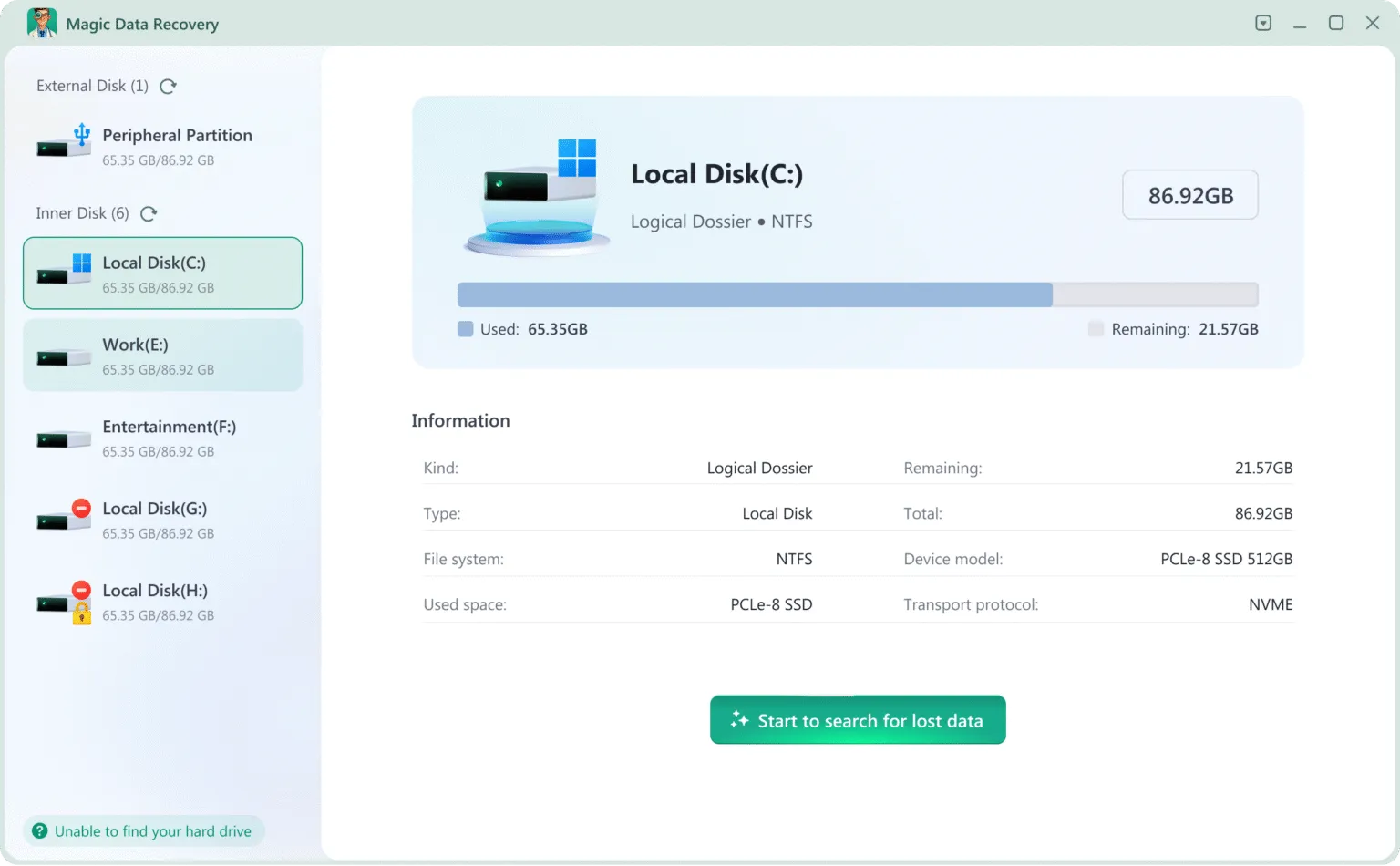
Step 2. Launch Magic Data Recovery
Select the drive or partition where the files originally existed.
Step 3. Scan and check the results
Allow the scan to search for deleted and lost data. Filter by file name, extension, type, or path when possible.
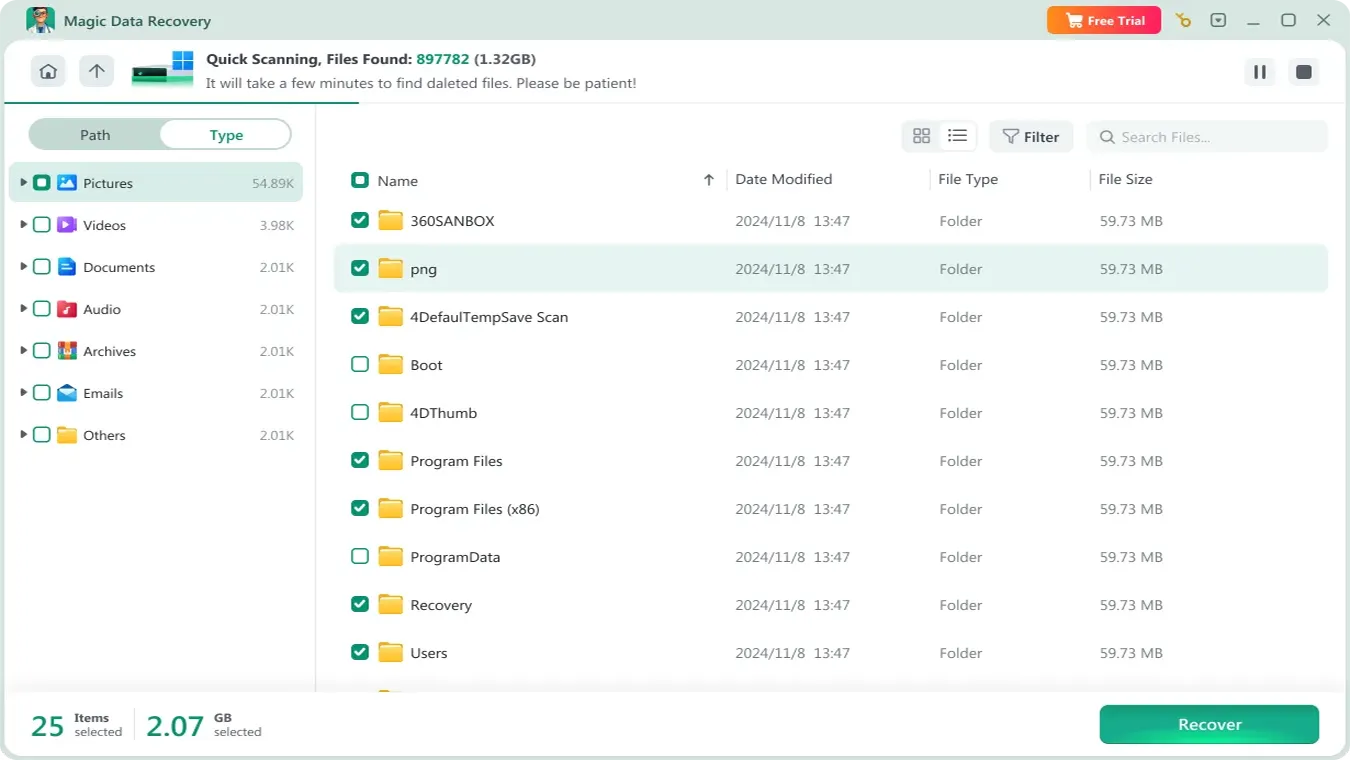
Step 4. Preview and recover
Preview important files before recovery, then save selected items to a different physical drive.
That last step is essential. Saving recovered data back to the source can overwrite other deleted files that have not yet been restored.

Magic Data Recovery offers a simpler graphical workflow than command-line utilities, particularly when users need to inspect many photos, documents, videos, or folders. Still, no software can reconstruct storage blocks that have genuinely been overwritten or erased by the device.
Method 5: Use Windows File Recovery
Windows File Recovery is Microsoft’s command-line recovery utility for local storage.
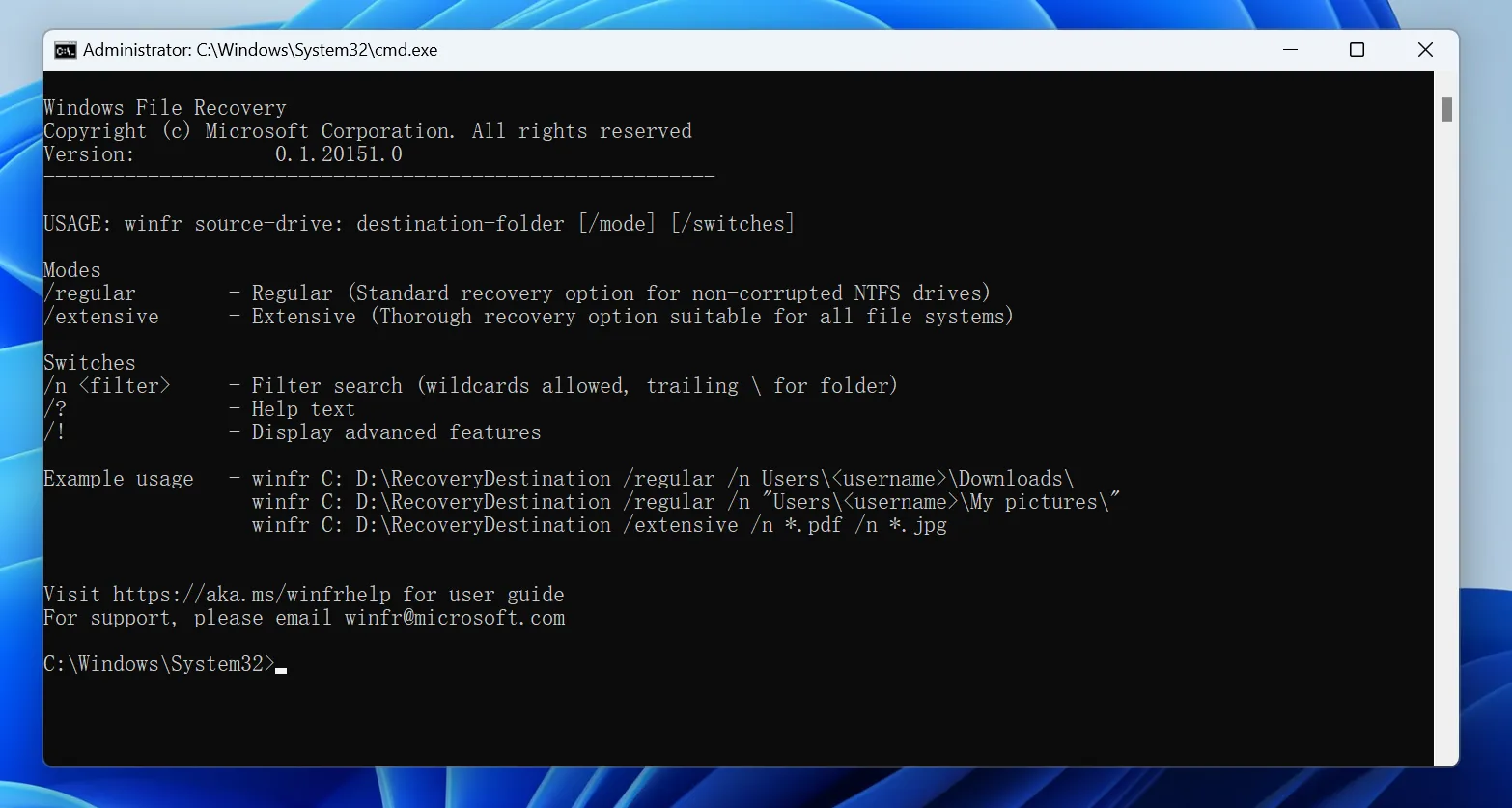
It can scan:
- internal drives;
- external hard drives;
- USB devices.
The source and destination should be different drives.
For example:
winfr C: E: /regular /n \Users\YourName\Documents\*.docx
For a more difficult case, you can use Extensive mode:
winfr C: E: /extensive /n *.pdf /n *.docx
Windows File Recovery is useful for users comfortable with command-line syntax. However, it does not provide the same visual browsing and preview workflow as graphical recovery software.
Mistakes to Avoid After File Deletion
Knowing what happens when you delete a file also explains why certain actions can hurt recovery chances.
Do Not Keep Using the Drive
Browsing the web, downloading files, installing software, and running Windows updates all generate disk writes.
Even seemingly harmless computer use can reuse storage marked as free.
Do Not Install Recovery Software on the Source
If deleted files were stored on D:, avoid installing your recovery program on D:.
Choose another physical drive whenever possible.
Do Not Recover Files Back to the Same Device
Recovering 20 files to the source drive could overwrite another 20 files you have not restored yet.
Use another internal disk or external storage destination.
Do Not Format the Drive Just to Make It Accessible
Windows may ask you to format a damaged or RAW drive.
If important data is still on it, recover the files first. Formatting changes storage structures and can complicate the recovery process.
Do Not Run CHKDSK as Your First Recovery Step
CHKDSK repairs file-system consistency. It is not designed as a deleted-file recovery utility.
When important data is missing, recovery or imaging should come before file-system repair.
When Are Deleted Files Really Gone?
Although normal deletion does not always erase the underlying data immediately, there are situations where recovery becomes impossible or extremely unlikely.
The Data Was Overwritten
This is the most important limitation.
If new information physically replaces the blocks containing the old file, a recovery application cannot recreate the original bytes.
Secure Erase Was Used
Secure deletion methods intentionally make old data inaccessible. Depending on the device, this may involve overwriting, cryptographic erase, or storage-specific erase commands.
SSD TRIM Removed the Blocks
A TRIM-enabled SSD may clear deleted blocks through internal garbage collection. Once those blocks no longer contain the original data, software scanning cannot restore it.
The Only Copy Was Cloud-Based and Retention Expired
Cloud services have their own deletion and retention rules.
If a cloud provider permanently removes a file from its servers and no synchronized local copy or backup exists, local disk recovery has nothing to scan.
How to Protect Files from Permanent Loss
After discovering where do deleted files go, the most useful long-term lesson is that recovery should never replace backups.
A practical backup strategy should include multiple copies of important data.
The widely used 3-2-1 principle recommends:
- keep 3 copies of important data;
- store them on 2 different types of storage;
- keep 1 copy off-site.
You can combine:
- your primary computer;
- an external backup drive;
- versioned cloud storage.
More importantly, test your backups occasionally. A backup has little value if you discover during an emergency that it cannot be restored.
Conclusion
So, where do deleted files go?
A normally deleted Windows file usually starts in the Recycle Bin. After permanent deletion, the operating system can mark its former storage space as available instead of instantly destroying every byte. On HDDs, recoverable data may remain until overwritten. On SSDs, TRIM can make recovery considerably harder.
If a file goes missing, start with backups, the Recycle Bin, Previous Versions, and cloud storage. When those methods cannot help, Magic Data Recovery provides a practical way to scan accessible Windows drives for deleted, formatted, or otherwise lost files while allowing you to preview recoverable content before saving it elsewhere.
For additional recovery scenarios and best practices, visit Amagicsoft’s deleted file recovery guide.
The most important rule remains simple: stop using the affected storage device as soon as you discover the loss. The less new data written afterward, the better the remaining recovery opportunity.
Supports Windows 7/8/10/11 and Windows Server
FAQs About Where Deleted Files Go
Where do deleted files go after emptying the Recycle Bin?
After you empty the Recycle Bin, Windows generally marks the storage space used by those files as available. On an HDD, the original data may remain until new information overwrites it. Therefore, recovery software may still find the files if enough of their original data survives.
Are deleted files really gone forever?
Not necessarily. Normal deletion often removes the file's reference before the actual contents disappear. However, files can become unrecoverable after overwriting, secure erasure, or SSD TRIM. Recovery success therefore depends more on the storage condition than on the Delete command itself.
Where do permanently deleted files go in Windows?
Permanently deleted files do not move to a secret folder. Windows usually removes their active file-system references and marks their storage space as reusable. Until that space is overwritten or cleared, recovery software may be able to detect remaining file records or data signatures.
Can deleted files be recovered after a long time?
Sometimes. Time alone does not determine recovery. A deleted file on an unused HDD may survive much longer than one on an actively used system drive. The key factors are subsequent writes, storage type, TRIM, formatting, and whether another backup copy exists.
Where do deleted files go on an SSD?
After deletion, the operating system can notify an SSD that specific blocks are no longer needed through TRIM. The SSD may later erase those blocks during internal garbage collection. Because of this process, permanently deleted files on modern SSDs are often harder to recover than files on HDDs.
Where do deleted files from a USB drive go?
Files deleted from USB drives may bypass the computer's normal Recycle Bin. Their entries can be marked as deleted directly on the USB file system. Stop using the drive immediately, because copying new data to it may overwrite the deleted files before recovery.
Does deleting a file actually free disk space?
Moving a file to the Recycle Bin usually does not immediately free all of its occupied space. After the Recycle Bin is emptied or the file is permanently deleted, Windows can mark that space as free and make it available for storing new data.
Can Magic Data Recovery recover permanently deleted files?
Magic Data Recovery can scan supported storage devices for deleted data that remains physically recoverable. It can help after permanent deletion, formatting, and file-system errors. However, like any recovery software, it cannot restore data that has already been completely overwritten or erased by storage-level processes.

Jason has over 15 years of hands-on experience in the computer data security industry. He specializes in data recovery, backup and restoration, and file repair technologies, and has helped millions of users worldwide resolve complex data loss and security issues.