
How to Check Disk Drive for Errors & Recover Data

Is your computer running slower than usual, freezing unexpectedly, or showing strange error messages? You might need to check your disk drive for errors. Hard drive issues can sneak up on any user, threatening the loss of precious photos, important work documents, and personal files. While many guides will show you how to run a basic scan, they often leave out a critical piece: what to do if the repair process itself causes data loss.
This comprehensive guide does more than just teach you to check and repair drive errors. We provide a complete roadmap. You will first master the proper use of the CHKDSK utility, from simple scans to advanced repairs. More importantly, we will then show you exactly how to handle a worst-case scenario and recover your files if they become inaccessible after a disk check. For this crucial recovery step, tools like Magic Data Recovery offer a professional solution specifically designed for such complex situations.
Supports Windows 7/8/10/11 and Windows Server
Table of Contents
Understanding Hard Disk Errors: Types and Warning Signs
Before you run any diagnostics, recognizing the problem is key. Hard disk errors generally fall into two categories: logical errors (software-related) and physical errors (hardware-related).
Common warning signs your drive may be failing include:
- Unusual noises like clicking, grinding, or whirring.
- Frequent system crashes, freezes, or the infamous Blue Screen of Death (BSOD).
- Files and folders becoming inaccessible, corrupted, or disappearing.
- Significantly slower computer performance, especially when accessing files.
- The operating system failing to boot, or prompts telling you a drive needs to be formatted.
Ignoring these symptoms can lead to complete drive failure. Therefore, checking your disk drive for errors at the first sign of trouble is crucial for preventing permanent data loss.
How to Use CHKDSK: A Step-by-Step Guide
The CHKDSK (Check Disk) utility is Windows’ primary tool for finding and fixing logical file system errors. Here’s how to use it effectively.
Method 1: Using the Graphical Interface (For All Users)
This method is straightforward and suitable for most users.
- Open File Explorer and navigate to “This PC.”
- Right-click on the drive you want to check (e.g., C:) and select Properties.
- Go to the Tools tab and click Check in the “Error checking” section.
- Follow the on-screen prompts. If no errors are found, Windows may tell you a scan isn’t needed, but you can still choose “Scan drive” for a deeper look.
Method 2: Using Command Prompt (For Full Control)
For more control and repair options, the Command Prompt method is superior. Always run Command Prompt as an Administrator.
- Press
Windows Key + Xand select “Terminal (Admin)” or “Command Prompt (Admin).” - To simply scan a drive without fixing errors, type:
chkdsk X:(replace X with your drive letter). - To CHKDSK and repair errors, use the
/f(fix) parameter:chkdsk X: /f - If the drive is in use, you will be asked to schedule the scan for the next restart. Type
Yand restart your computer.
The command will run before Windows loads, giving it full access to the disk.
CHKDSK Parameters: Should I Run CHKDSK /r or /f?
Users often confuse the /f and /r parameters. Here’s a clear breakdown:
Parameter | What It Does | Best For | Estimated Time |
| Fixes logical file system errors (e.g., corrupted file tables). | Common errors, corrupted folders, quick repairs. | Minutes to an hour. |
| Locates bad sectors and recovers readable information. It includes the functionality of | Suspected physical issues, scanning a HDD for bad sectors, recovering data from damaged areas. | Several hours (depends on drive size). |
| Forces the volume to dismount first, which is often combined with | When you need to ensure the drive is not in use during the scan. | Varies. |
Expert Tip: For a general repair, start with chkdsk /f. If problems persist or you suspect physical damage, then run the more comprehensive chkdsk /r. The /r scan takes much longer but is the most thorough check for a corrupted disk drive.
How to Interpret Your CHKDSK Report
After CHKDSK finishes, it provides a report. Understanding key terms helps assess your drive’s health:
- KB in bad sectors: This indicates physical damage. A small, static number may be normal for older drives, but a growing number is a critical warning.
- File records processed: Shows the number of filesystem entries scanned.
- Windows has made corrections to the file system: This is a positive sign that CHKDSK fixed corrupt files and logical errors.
The Limits of CHKDSK and Built-in Tools
While CHKDSK is powerful, it has clear boundaries. Primarily, it addresses logical file system errors. It cannot repair severe physical hardware damage, like a failed read/write head or motor.
Furthermore, the repair process itself carries risk. When CHKDSK fixes corrupt files, it might move data from bad sectors or restructure the file system. In severe corruption cases, this can make files appear lost or inaccessible to the operating system. This is a primary reason for data loss after running a disk repair.
What about SFC /SCANNOW?
The sfc /scannow command is a different tool. It scans and repairs corrupted Windows system files but does not scan for general hard disk errors or bad sectors. Can SFC scannow fix corrupted files? Yes, but only specific Windows system files, not your personal documents or applications.
The Data Recovery Guide: When CHKDSK Isn’t Enough
If CHKDSK fails, causes new access issues, or you discover missing files after a scan, immediately stop using the drive. Continuing to write new data can overwrite the lost files, making recovery impossible.
Recommended Solution: Magic Data Recovery
When faced with data loss after a failed disk repair, manual methods are often insufficient. This is where a dedicated tool like Magic Data Recovery provides a reliable, user-friendly solution.
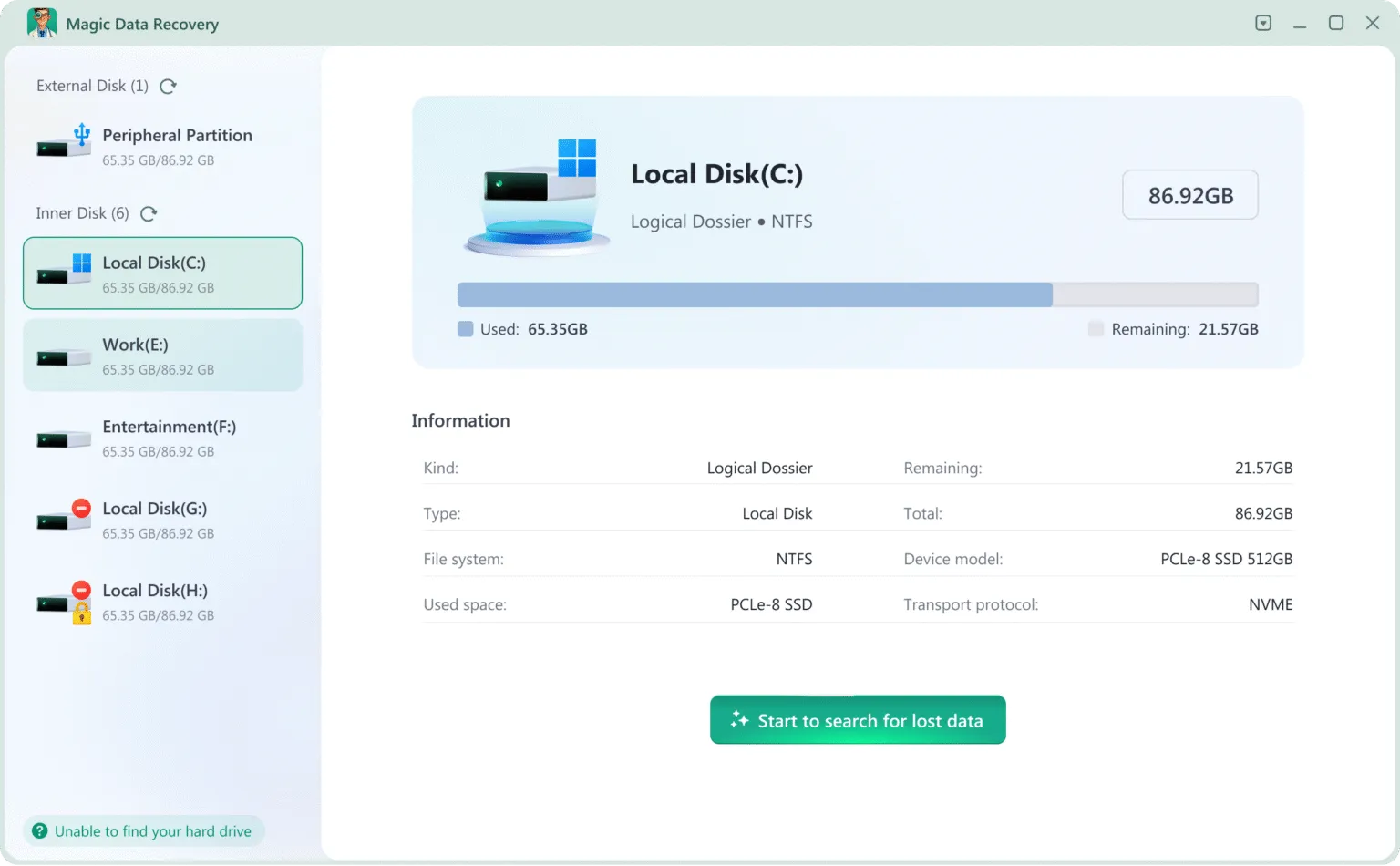
Why Magic Data Recovery Stands Out:
- Solves the Core Problem: It is engineered to handle complex data loss scenarios precisely like those caused by CHKDSK repairs, formatting, file system errors, and operating system reinstalls. It bypasses corrupted structures to locate and extract your original files.
- Key Advantages: The software employs deep-scan algorithms that go beyond basic file tables, recovering hundreds of file types from HDDs, SSDs, USB drives, and memory cards. A clear preview feature lets you see recoverable files before purchasing, ensuring confidence.
- Typical Use Case: After running
chkdsk /r, a user finds their “Documents” folder empty. Using Magic Data Recovery, they select the affected drive, run a “Search for lost data” filter the results for document files (.doc, .pdf), preview the found files, and safely recover them to a different, healthy drive. - A More Reliable Choice: Unlike free tools with limitations, Magic Data Recovery offers a higher success rate for severe cases and provides dedicated technical support. It follows the industry-best practice of non-destructive recovery, meaning it only reads from your drive without writing to it.
For anyone needing a robust solution after a failed disk check, trying Magic Data Recovery is a logical next step. You can download the tool to scan the drive and evaluate what can be recovered at no cost.
Supports Windows 7/8/10/11 and Windows Server
Advanced Scenarios and Final Options
Conclusion
Knowing how to check disk drive for errors with CHKDSK is a vital skill for any computer user. Start with the /f parameter for general fixes, and use /r for a more thorough scan for bad sectors. Always interpret the report and understand that while CHKDSK can fix corrupt files of a logical nature, it is not a cure for physical failure.
The most important lesson is to have a reliable backup strategy. No repair tool is a substitute for regular backups to an external drive or cloud service.
However, when prevention fails and repair attempts lead to data loss, having a professional recovery plan is essential. This is why we highlight Magic Data Recovery—it fills the critical gap left by system utilities, offering a specialized, effective, and trustworthy method to get your valuable data back when you need it most. For those facing data loss now, downloading and scanning with Magic Data Recovery is the most sensible first action to take.
Supports Windows 7/8/10/11 and Windows Server
FAQs
How to check disk drive for errors?
How to CHKDSK and repair?
How to check if a hard drive is corrupted?
Will CHKDSK fix corrupt files?
Should I run CHKDSK r or f?
How to scan a HDD for bad sectors?
How to repair a corrupted disk drive?
Can sfc scannow fix corrupted files?

Jason is a data recovery and technical support specialist with over 15 years of hands-on experience. He has worked extensively with frontline users, troubleshooting difficult data loss cases and providing practical recovery solutions for accidental deletion, formatted drives, damaged file systems, lost partitions, system failures, and other recovery emergencies. His expertise also includes backup and restoration, file repair, and disaster recovery, with a strong emphasis on safe, reliable, and technically accurate guidance.