
USB Drive Write Protected? How to Fix “The Disk Is Write Protected”
A USB drive write protected error can be especially frustrating when the drive was working normally just moments ago. Maybe you’re copying a file, deleting an old folder, or trying to format the USB for another device—and Windows suddenly stops the operation with “The disk is write protected.”
The good news is that this message does not automatically mean the USB drive is damaged or that your files are gone. The restriction may come from something as simple as a physical lock or a Windows read-only setting, but it can also point to a deeper device-level problem. Before changing anything, it helps to determine where the write protection is actually coming from.
Below, we’ll start with the safest checks, then move through DiskPart, Registry, Group Policy, and file-system troubleshooting only when the symptoms point in that direction. If a later step could affect stored data, we’ll stop first and protect the files.
For other USB-related problems, visit our USB Flash Drive Solutions. If important files are already missing or inaccessible, Magic Data Recovery may help retrieve recoverable data before further repairs.
Table of Contents
Quick Answer: How to Fix a Write-Protected USB Drive
If Windows reports “The disk is write protected,” start by checking the physical lock switch and testing the USB drive on another computer. If the restriction comes from a Windows read-only attribute, DiskPart may remove it without formatting the drive.
- Check whether the USB drive or its adapter has a physical Lock switch.
- Reconnect it using another USB port, then test it on another computer.
- Use DiskPart to inspect and clear the read-only disk attribute.
- If multiple USB drives are affected on one PC, check Registry and Group Policy restrictions.
- If the drive is still read-only, investigate volume attributes, BitLocker policies, and possible device-level problems.
Important: Do not format the USB drive simply because Windows reports write protection. Formatting cannot normally bypass an active hardware-level restriction, and it can remove access to existing files.
What Does “The Disk Is Write Protected” Mean?
A write-protected USB drive prevents Windows from modifying its stored data. Depending on the restriction, you may be unable to:
- Copy new files onto the USB drive.
- Delete or rename existing files and folders.
- Edit documents stored directly on the device.
- Create new folders.
- Format the USB drive.
However, existing files may still open normally. This distinction matters. A USB drive that allows reading but blocks writing is not necessarily experiencing the same problem as a drive that appears as RAW or cannot be opened.
If Windows instead asks you to format the disk before using it, see our guide on how to fix a corrupted USB drive.
Does Write Protection Mean the USB Drive Is Damaged?
Not necessarily. A USB drive can remain physically functional while a Windows setting prevents write operations. A physical switch or administrator policy may also intentionally restrict writing. In other cases, an internal device problem may cause persistent read-only behavior.
The most useful first diagnostic step is determining whether the restriction follows the USB drive or remains with the computer.
Before You Start: Protect Important Files
Write protection itself does not normally delete existing files. However, advanced repair operations can modify file-system information or remove stored data. Before changing disk settings, check whether your files are still accessible.
USB drive condition | Recommended action |
Files open normally | Copy important files to another drive |
Files are missing | Investigate data recovery before repair |
USB repeatedly disconnects | Stop unnecessary repair attempts |
Windows reports RAW | Protect recoverable files before file-system repair |
USB contains no important data | Continue with appropriate troubleshooting |
If your files remain readable, ordinary copying is the simplest way to protect them. Recovery software is not necessary just because Windows has blocked writing. If the device is unstable or contains irreplaceable files that cannot be accessed, avoid repeated scans and repair attempts.
Why Is My USB Drive Write Protected? Find the Cause First
Different symptoms point toward different sources of write protection. Instead of applying every fix blindly, use the following table to identify the most relevant troubleshooting path.
What you observe | Possible cause | Recommended direction |
USB has a Lock switch | Physical write protection | Check the switch |
Only one USB fails on one PC | Disk attribute or device restriction | Inspect DiskPart |
Every USB is read-only on one PC | Windows policy or configuration | Check Registry and Group Policy |
USB works normally on another PC | Local Windows restriction | Investigate the original computer |
DiskPart shows Read-only: Yes | Read-only disk attribute | Clear the attribute |
DiskPart shows Current Read-only State: Yes but Read-only: No | Another active restriction | Check volume state, policies, and device |
USB remains read-only across multiple PCs | Possible device-level issue | Protect data and investigate hardware |
These observations help narrow the problem, but no single symptom proves that a USB controller has failed. For example, if several removable drives become read-only on one computer, investigating Windows-wide restrictions is more useful than repeatedly formatting individual devices.
Fix 1. Check the Physical Write-Protection Switch
Best for: USB drives, memory cards, or adapters with a physical Lock switch.
Some removable storage devices include a small switch that prevents write operations. This feature is particularly common on SD card adapters, although certain USB devices also provide it.
- Safely disconnect the USB device.
- Inspect its casing or adapter for a Lock switch.
- Move the switch to the unlocked position, if present.
- Reconnect the device.
Expected result: Windows allows normal file operations again. If there is no physical switch, continue with the next check. Do not attempt to open the USB casing to search for an internal locking mechanism.
Fix 2. Try Another USB Port or Computer
Best for: A USB drive that suddenly becomes write protected on one computer.
This test helps distinguish a Windows configuration issue from a restriction associated with the USB device. First, connect the drive to another USB port. Avoid using an external USB hub during the test. Next, connect the same drive to another trusted computer.
Test result | What it suggests |
USB works normally on another PC | The original computer may have a configuration or policy issue |
USB remains read-only on both PCs | A device-level restriction becomes more plausible |
Several USB drives fail on one PC | Check Windows-wide restrictions |
USB repeatedly disconnects | Investigate connection or hardware stability |
If your files are already backed up, use a small disposable test file to check whether writing works. Do not use an important original file for testing.
Verification: If the USB works on another computer, focus on the Windows settings of the affected PC rather than formatting the device.
Fix 3. Remove USB Write Protection Using DiskPart
Best for: A USB drive with a Windows read-only disk attribute.
DiskPart is a built-in Windows command-line utility that can display and modify disk attributes. Microsoft documents the attributes disk command for displaying, setting, and clearing disk attributes. See Microsoft Attributes Disk documentation.
Step 1. Open Command Prompt as Administrator
Search for Command Prompt in the Start menu. Right-click the result and select Run as administrator.
Step 2. Start DiskPart
- diskpart
- list disk
Windows displays the available disks and their capacities. Identify the USB drive using its capacity. Do not assume that the USB is Disk 1 or Disk 2.
Step 3. Select the Correct USB Disk
- select disk X
- detail disk
Replace X with the correct disk number. Check the displayed device information before continuing. Selecting the wrong disk can cause later commands to affect a different storage device.
Step 4. Check the Read-Only Attributes
- attributes disk
- Current Read-only State : Yes
- Read-only : Yes
- Boot Disk : No
- Pagefile Disk : No
- Hibernation File Disk : No
- Crashdump Disk : No
- Clustered Disk : No
Illustrative DiskPart output. Actual results depend on the selected device and system configuration.
If Read-only is set to Yes, the selected disk has a read-only attribute.
Step 5. Clear the Read-Only Attribute
- attributes disk clear readonly
- attributes disk
- exit
If the command succeeds, DiskPart may display “Disk attributes cleared successfully.” Reconnect the USB drive and test whether normal writing has returned.
What this command changes: It clears the selected disk’s read-only attribute. It does not format the disk, delete partitions, or recover missing files.
What If DiskPart Says the Attributes Were Cleared but the USB Is Still Read-Only?
This is an important diagnostic result. The following two fields are related, but they do not mean exactly the same thing.
DiskPart output | Meaning |
Read-only: Yes | The disk’s read-only attribute is set |
Read-only: No | The DiskPart read-only disk attribute is not set |
Current Read-only State: Yes | Windows currently detects the disk as read-only |
Current Read-only State: No | Windows does not currently report the disk as read-only |
- DISKPART> attributes disk
- Current Read-only State : Yes
- Read-only : No
Illustrative example—not an actual device test result. Here, the disk’s read-only attribute is not set, but Windows still detects an active read-only condition. Running attributes disk clear readonly repeatedly is unlikely to resolve a restriction originating elsewhere. Check the volume attributes, Windows policies, and physical device instead.
Technical Note: Disk Attributes and Volume Attributes Are Different
DiskPart manages disk-level and volume-level attributes separately. Clearing the disk’s read-only attribute does not necessarily resolve every restriction affecting the selected volume. If attributes disk reports Read-only: No while Windows still prevents writing, inspect the volume attributes before changing unrelated system settings.
- diskpart
- list volume
- select volume N
- attributes volume
Replace N with the correct volume number. If the selected volume has a read-only attribute, you can clear it with:
- attributes volume clear readonly
Important: Microsoft notes that on basic MBR disks, certain volume attributes, including readonly, apply to all volumes on the disk. On basic GPT disks, the corresponding attributes apply to the selected volume. Confirm the disk layout before changing volume attributes. See Microsoft Attributes Volume documentation.
Verification: Reconnect the USB drive and attempt the original file operation again. If writing remains blocked, continue with the relevant system-policy checks rather than repeating DiskPart commands.
Fix 4. Check the Windows Registry WriteProtect Setting
Best for: USB drives that work elsewhere, or multiple removable drives that become restricted on the same computer.
A Windows registry configuration may contribute to removable-storage write restrictions. Before making changes, back up the relevant registry key. Incorrect registry modifications can affect other system behavior.
Step 1. Back Up the Registry
Microsoft recommends exporting the relevant registry key before modifying it. The exported file can be imported later if restoration is necessary. See Microsoft guidance for backing up and restoring the Registry.
- Press Win + R.
- Type regedit and press Enter.
- Locate the registry key you intend to modify.
- Select File > Export.
- Save the exported .reg file to a safe location.
- Record the original value before making changes.
If you need to restore the saved configuration, open Registry Editor and select File > Import.
Step 2. Locate the WriteProtect Setting
- HKEY_LOCAL_MACHINE\SYSTEM\CurrentControlSet\Control\StorageDevicePolicies
Look for a DWORD value named WriteProtect. If the value exists and is set to 1, change it to 0 only when you have confirmed that this configuration is causing an unintended restriction. Close Registry Editor and restart Windows.
What If StorageDevicePolicies Does Not Exist?
Do not automatically create the missing key. Its absence does not establish that the registry is responsible for the error. The restriction may originate from Group Policy, BitLocker requirements, or the USB device itself. Check those possibilities before creating additional registry entries.
Expected result: If this registry setting was responsible, Windows should allow writing after the change takes effect. If the USB remains read-only, continue with the relevant policy checks.
Fix 5. Check Group Policy Restrictions
Best for: Multiple USB drives becoming write protected on the same Windows computer.
Windows can restrict access to removable storage through Group Policy. Microsoft documents a removable storage policy framework that includes write-access restrictions. See Microsoft Removable Storage policy documentation.
- Press Win + R.
- Enter gpedit.msc.
- Navigate to Computer Configuration > Administrative Templates > System > Removable Storage Access.
- Find Removable Disks: Deny write access.
- Check whether the policy is enabled.
If the computer is personally managed and the restriction was enabled unintentionally, change it to Disabled or Not Configured as appropriate. Also check the corresponding setting under User Configuration when applicable.
Note: The standard Group Policy Editor interface is generally unavailable in Windows Home editions. If this is an organization-managed computer, contact the administrator instead of attempting to override its security policies.
Verification: Allow the policy change to take effect, then reconnect the USB drive. If several removable drives become writable again, the restriction was likely associated with the Windows configuration. If other USB drives work normally but the original device remains read-only, investigate the device-specific path.
Fix 6. Check BitLocker Write Restrictions
Best for: An unencrypted USB drive that becomes read-only on a computer requiring encrypted removable storage.
BitLocker policies can require removable storage devices to be encrypted before Windows permits writing. One relevant setting is “Deny write access to removable drives not protected by BitLocker.” See Microsoft BitLocker configuration documentation.
Computer Configuration
Administrative Templates
Windows Components
BitLocker Drive Encryption
Removable Data Drives
Locate the policy and inspect its configuration. If the drive belongs to an organization, follow its encryption requirements or contact the administrator. Do not decrypt an existing BitLocker-protected drive simply to troubleshoot a write-protection message.
Expected result: Once the device satisfies the applicable policy requirements, normal write access may become available.
Fix 7. Check NTFS Permissions
Best for: A USB volume using NTFS when Windows reports Access Denied rather than a disk-level write-protection error.
File permissions and disk write protection are different restrictions. NTFS permissions can prevent a user account from modifying files even when the storage device itself remains writable.
- Right-click the USB drive in File Explorer.
- Select Properties.
- Open the Security tab.
- Select your user account.
- Inspect the relevant write permissions.
If permissions are incorrectly configured and you own or administer the device, correct the affected permissions. Do not indiscriminately grant Full Control to every user account.
Important: FAT32 and exFAT do not use NTFS access-control permissions in the same way. If your USB uses one of these file systems, this method does not apply. If Windows explicitly reports “The disk is write protected,” changing NTFS permissions is unlikely to resolve a disk-level restriction.
Why Is My USB Still Write Protected After DiskPart?
If DiskPart reports success but writing remains blocked, the original read-only attribute may not have been the actual cause. The next step depends on what Windows reports and how the USB behaves on another computer.
Diagnostic result | Recommended direction |
Read-only: Yes returns after reconnecting | Check whether another setting is reapplying the restriction |
Read-only: No, but current state remains Yes | Investigate other active restrictions |
USB works on another computer | Check the original PC’s policies and settings |
All USB drives fail on one computer | Check Registry, Group Policy, and BitLocker restrictions |
USB remains read-only on multiple computers | Protect data and investigate the device |
USB shows 0 Bytes or No Media | Stop ordinary software repair attempts |
A particularly useful distinction is whether Windows can still read the existing files. If the contents remain accessible, copy important files to another storage device before continuing. If the drive is intermittently detected, reports an incorrect capacity, or becomes increasingly unstable, avoid repeated scans and repair commands.
Can a USB Controller Force Read-Only Mode?
Some flash storage devices can enter a read-only condition when their internal storage or controller encounters a serious problem. In this situation, Windows may detect the device and allow existing files to be read while preventing new data from being written.
However, persistent write protection alone does not prove NAND wear or controller failure. Test the USB on another independent computer and examine its reported capacity and stability before reaching that conclusion. If the device consistently remains read-only across multiple systems, software-level fixes may not restore normal operation.
Data Protection Checkpoint: Before Using Repair or Format Commands
The following operations can modify the file system or remove stored data. Before proceeding, confirm that important files have been protected.
Current condition | Recommended action |
Files are accessible | Copy them to another drive |
Files are missing or inaccessible | Consider data recovery before repair |
USB is unstable or repeatedly disconnects | Stop unnecessary operations |
Important files are already backed up | Continue with appropriate repairs |
Data is no longer needed | Formatting may be considered if the device permits writing |
What If Important Files Are Missing?
If the USB is consistently detected and remains readable, Magic Data Recovery may help recover files lost through accidental deletion, formatting, or logical file-system problems. Use recovery software only for the data-loss branch—not as a way to remove write protection.
Supports Windows 7/8/10/11 and Windows Server
Here are the steps:
1. Connect the affected USB drive to Windows.
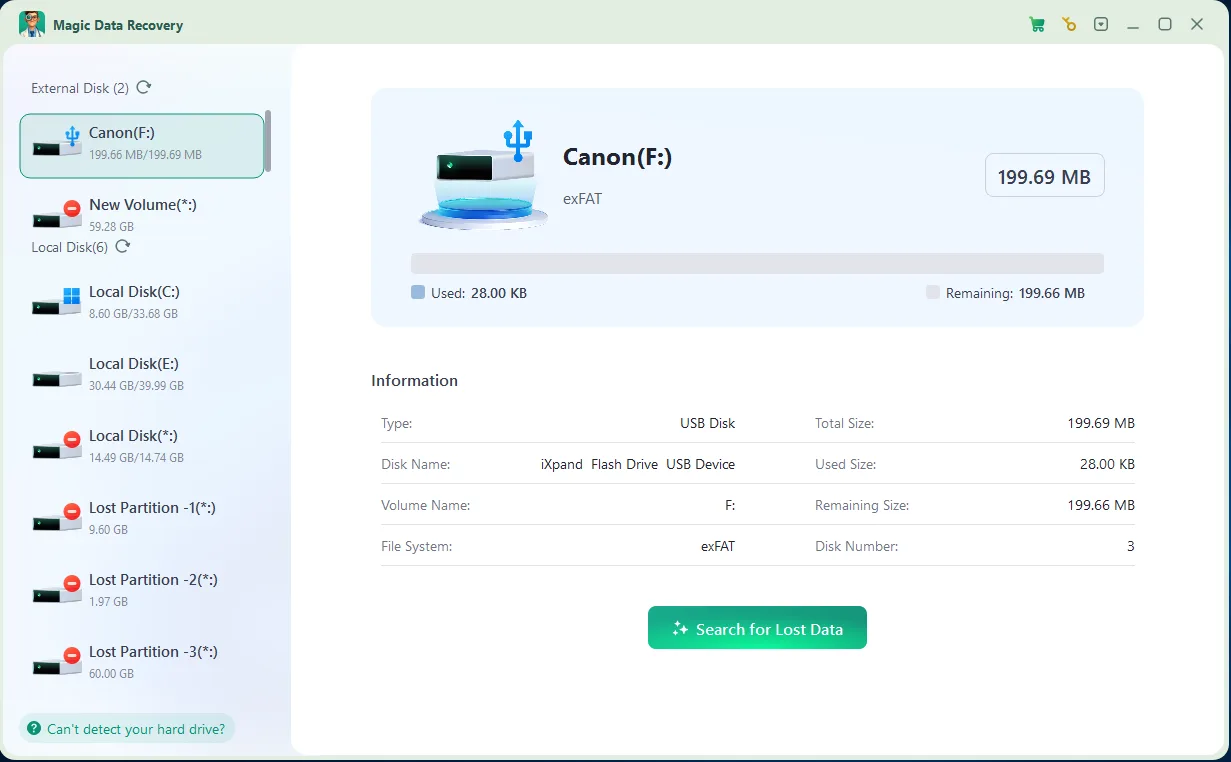
2. Scan the affected device for recoverable files.

3. Preview or verify files where possible.
4. Save recovered files to a different storage device.
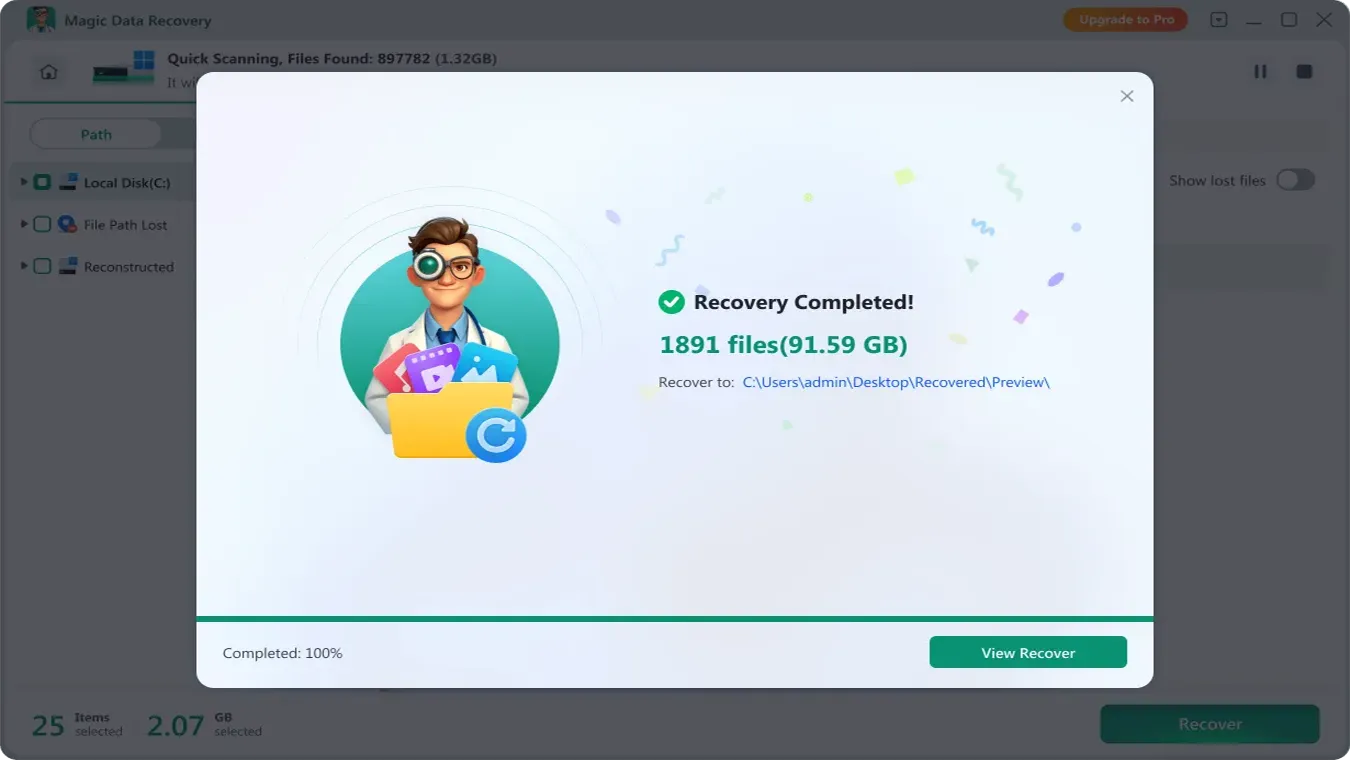
For a more detailed workflow, see our USB Drive Data Recovery Guide.
Do not save recovered files back to the problem USB. If the device is physically unstable, repeatedly disconnects, or cannot be read reliably, software recovery may not be appropriate; stop DIY attempts and consider professional recovery assistance.
Fix 8. Check File-System Errors with CHKDSK
Best for: A stable USB drive that shows file-system problems in addition to write protection.
What CHKDSK Can—and Cannot—Fix
CHKDSK checks a volume’s file system and metadata for errors. Running it without repair parameters reports the volume’s condition, while the /f parameter attempts to correct detected file-system errors. See Microsoft CHKDSK documentation.
However, CHKDSK does not remove a physical write-protection switch, override organizational storage policies, or repair a failing USB controller. If the restriction prevents Windows from writing to the device, CHKDSK may be unable to complete a requested repair.
Safety: If important files are not backed up, protect them before using CHKDSK with repair parameters. Do not run repair commands on a drive that repeatedly disconnects or shows unstable hardware behavior.
Step 1. Check the File System Without Repairing It
- chkdsk X:
Replace X with the USB drive letter. Without repair parameters, CHKDSK checks the volume and reports its condition.
Step 2. Review the Result
If CHKDSK reports no file-system errors, do not run a repair command just because the drive remains write protected. Return to the write-protection diagnosis. If logical file-system errors are reported and your data is secure, a repair may be appropriate.
Step 3. Repair File-System Errors When Appropriate
- chkdsk X: /f
The /f parameter instructs CHKDSK to repair file-system errors and can modify file-system metadata. If CHKDSK reports that the media is write protected, the active write restriction must be addressed separately.
Expected result: If the problem involved repairable logical file-system errors and the device allows writes, normal file-system behavior may return. If write protection remains, do not repeatedly run CHKDSK; return to the device or policy diagnosis.
Fix 9. Format the USB Drive as a Last Resort
Best for: A stable USB drive with no data that still needs to be preserved, after the active write restriction has been removed.
Formatting creates a new file-system structure. It is not a reliable way to bypass active hardware write protection, and it should not be used as the first response to a write-protection message.
Before Formatting
- Important files have been copied or recovered.
- The USB is consistently detected.
- The reported capacity is correct.
- There is no evidence of ongoing hardware instability.
- The active write restriction has been removed.
Warning: Formatting removes the existing file-system structure. If the drive contains data you still need, stop and secure it first.
Format in File Explorer
- Open File Explorer.
- Right-click the USB drive.
- Select Format.
- Choose an appropriate file system.
- Start formatting.
For removable storage shared between modern operating systems, exFAT is often practical; FAT32 may be needed for compatibility with older devices. Choose the file system according to the target device. For Windows format command behavior, see Microsoft Format documentation.
What If Windows Says “Cannot Format USB Drive — The Disk Is Write Protected”?
Do not repeatedly attempt formatting. A persistent write restriction may prevent Windows from creating the new file system.
Result | Next action |
USB formats successfully | Verify normal read/write behavior |
USB works on another PC | Investigate the original Windows configuration |
DiskPart still shows current read-only state | Investigate remaining restrictions |
Formatting fails on multiple computers | Evaluate possible device failure |
USB shows 0 Bytes or No Media | Stop ordinary formatting attempts |
Avoid: Do not use DiskPart clean as a general write-protection fix. The command removes partition information and can destroy access to existing data while doing nothing to resolve device-enforced write protection.
When Should You Stop Trying to Fix the USB Drive?
Not every write-protection problem can be resolved through Windows settings. Stop ordinary software troubleshooting when:
- The drive repeatedly disconnects during reading.
- Windows reports 0 Bytes or No Media.
- The reported capacity is inconsistent.
- The device is not reliably recognized on multiple computers.
- Important files are the only existing copy and cannot be accessed safely.
In these situations, repeatedly running repair commands or formatting the device is unlikely to provide a useful diagnosis. If the data is valuable, consider professional recovery assistance. If important files have already been copied and the USB remains permanently read-only, replacing the device is generally more practical than continuing to rely on it for storage.
How to Prevent USB Write-Protection Problems
Not every write-protection event is preventable, especially when the underlying cause is hardware-related. These practices can reduce avoidable problems:
- Safely eject the USB drive before unplugging it.
- Avoid disconnecting the device during active file transfers.
- Keep important files backed up elsewhere.
- Avoid changing Windows storage policies without understanding their purpose.
- Replace USB drives that repeatedly disconnect or develop persistent read errors.
- Use updated security software when transferring files between computers.
If Windows repeatedly reports write-protection errors on different USB drives, investigate the computer configuration before replacing multiple devices.
Conclusion
A USB drive write protected error can originate from a physical lock, Windows disk attributes, system policies, file-system conditions, or the storage device itself. The most useful first step is not formatting—it is determining whether the restriction follows the USB drive or stays with one computer.
If DiskPart shows a read-only attribute, clear it and verify the result. If several USB drives are restricted on the same computer, investigate Registry, Group Policy, and BitLocker settings. If the same USB remains read-only across multiple systems, protect accessible files and consider a device-level problem.
For more USB troubleshooting topics, visit our USB Flash Drive Solutions. If files are missing or inaccessible on a stable device, Magic Data Recovery can help retrieve recoverable data before high-impact repair operations.
Supports Windows 7/8/10/11 and Windows Server
FAQs
Why did my USB drive suddenly become write protected?
Can I remove USB write protection without formatting?
Why does DiskPart show Current Read-only State: Yes but Read-only: No?
Why does DiskPart report Access Is Denied when clearing the read-only attribute?
Why can’t Windows format my write-protected USB drive?
What does “The media is write protected” mean?
Can a write-protected USB drive be caused by hardware failure?
Can I recover files from a write-protected USB drive?

Vasilii is a data recovery specialist with around 10 years of hands-on experience in the field. Throughout his career, he has successfully solved thousands of complex cases involving deleted files, formatted drives, lost partitions, and RAW file systems. His expertise covers both manual recovery methods using professional tools like hex editors and advanced automated solutions with recovery software. Vasilii's mission is to make reliable data recovery knowledge accessible to both IT professionals and everyday users, helping them safeguard their valuable digital assets.