
Where to Find Excel Recovery Files

Losing an Excel file can ruin a workday fast. You close a workbook without saving, Excel crashes during editing, or a file disappears after deletion or formatting. In each case, the first question is the same: where to find Excel recovery files. The good news is that Excel, Windows, macOS, and cloud storage all offer recovery paths. When those built-in options fail, a professional recovery tool can help retrieve files lost in more serious scenarios such as deletion, formatting, corruption, or file system errors. Microsoft notes that Document Recovery can reopen recovered files after an unexpected shutdown, and AutoRecover on Office for Mac saves a recovery copy every 10 minutes by default.
Supports Windows 7/8/10/11 and Windows Server
Table of Contents
What are Excel recovery files?
Excel recovery files are temporary or auto-saved copies that help restore work after a crash, freeze, or accidental closure. They are not always the same as your original workbook. In practice, users may see:
- AutoRecover files
- Unsaved workbook versions
- Document Recovery entries
- Temporary files
- OneDrive or SharePoint version history
- Previous file versions in Windows or cloud storage
That distinction matters. If you only closed Excel without saving, built-in recovery may work. If you deleted the workbook, formatted the drive, or hit a file system issue, you usually need a deeper recovery method. Microsoft also distinguishes AutoRecover from AutoSave, and recommends regular saving or cloud-backed AutoSave for better protection.
Where to find Excel recovery files on Windows
If you are using Excel on Windows, start with Excel itself before searching folders manually.
1. Check Recover Unsaved Workbooks
This is the fastest option when you closed a workbook without saving.

Steps:
- Open Excel.
- Go to File > Info.
- Look for Manage Workbook.
- Select Recover Unsaved Workbooks.
Microsoft states that under Manage Workbook, you may find the version marked “when I closed without saving.” That is often the quickest route for unsaved workbooks.
2. Check the Document Recovery pane
If Excel or Windows crashed, reopen Excel immediately. Document Recovery may appear automatically and show available recovered versions. Microsoft explains that this pane can list files recovered from the most recent manual save, AutoSave, or AutoRecover point, and each entry includes time information to help you choose the latest version.
3. Search common recovery folders
Many high-ranking guides also point users to the common local recovery paths below, which are often worth checking when the Excel interface does not show the file:
- C:\Users\Username\AppData\Roaming\Microsoft\Excel
- C:\Users\Username\AppData\Roaming\Microsoft\Office\Recent
- C:\Users\Username\AppData\Local\Microsoft\Office\UnsavedFiles
These locations can contain temporary or unsaved Excel files, especially after a crash.
4. Review Previous Versions
If the workbook was saved before and later changed, corrupted, or overwritten, Windows may offer older versions through file history or system restore points. Several top-ranking articles include this step because it can recover earlier states of a file without third-party software.
Where to find Excel recovery files on Mac
Mac users can also recover Excel data, but the workflow looks slightly different.
Microsoft explains that Office for Mac uses AutoRecover and saves a recovery file every 10 minutes by default. After an unexpected shutdown, the app often detects the AutoRecover file and opens it the next time you launch Excel. If that happens, save the recovered copy right away before editing it further.
Mac recovery tips
- Reopen Excel after the crash
- Look for the automatically opened recovery file
- Save the recovered version immediately
- Use Finder to look for AutoRecovered files if Excel does not reopen them automatically
One important detail: Microsoft says AutoRecover is not a substitute for manual saving or AutoSave. That means Mac users should not rely on it as their only protection.
When built-in Excel recovery works best
Built-in recovery methods usually work well in these situations:
- You closed Excel without saving
- Excel froze or crashed unexpectedly
- Your PC restarted during editing
- You stored the file in OneDrive or SharePoint and can use version history
- You need an earlier workbook version rather than a fully deleted file
If your issue matches one of those cases, always try built-in recovery first. It is faster, safer, and keeps the original workflow simple.
When built-in recovery usually fails
This is where many competing articles stop too early. In real-world use, Excel data loss often goes beyond “unsaved file” scenarios.
Built-in Excel recovery may fail when:
- You permanently deleted the workbook
- You emptied the Recycle Bin or Trash
- You formatted the drive, partition, or USB device
- The file system became corrupted
- The workbook lived on an inaccessible external drive
- The Excel file disappeared after partition loss
- The workbook became unreadable after storage errors
In these cases, you are no longer just asking where to find Excel recovery files. You are trying to recover lost file data from the storage layer itself. That requires a different solution.
Best methods to recover lost Excel files step by step
Method 1: Recover unsaved workbooks inside Excel
Use this first if the file was never saved properly.
Best for: accidental closure, app crash, unsaved edits
How to do it:
- Open Excel
- Go to File > Info
- Click Manage Workbook
- Open Recover Unsaved Workbooks
- Save the recovered file with a new name
Method 2: Use Document Recovery after a crash
Use this when Excel closed unexpectedly.
Best for: crash recovery
How to do it:
- Relaunch Excel
- Check the left-side Document Recovery pane
- Open the latest timestamped version
- Save it immediately
Method 3: Restore a previous version from cloud storage
Microsoft recommends storing Microsoft 365 files in OneDrive or SharePoint and using AutoSave. That setup also gives users access to safer version recovery workflows.
Best for: overwritten files, corrupted recent changes, collaboration errors
Method 4: Search temp or unsaved file folders
Use this when Excel shows nothing but you suspect the system created a temporary recovery copy.
Best for: hidden temporary files, incomplete recovery
Where to look:
- AppData Excel folder
- Office Recent folder
- UnsavedFiles folder
Method 5: Use a professional recovery tool for deleted or formatted Excel files
This method is the most practical when the loss goes beyond unsaved workbooks.
Best for:
- deleted Excel files
- formatted drives
- file system errors
- lost partitions
- inaccessible storage
- severe data loss after a crash
Why Magic Data Recovery is a strong solution for Excel file loss
If you only need to restore an unsaved workbook, Excel’s own tools may be enough. However, many users lose spreadsheets in harder situations. They delete the file, format the wrong drive, unplug external storage during transfer, or discover that the partition itself has file system errors. In those cases, Magic Data Recovery makes more sense because it is designed for storage-level recovery rather than just Excel-session recovery.
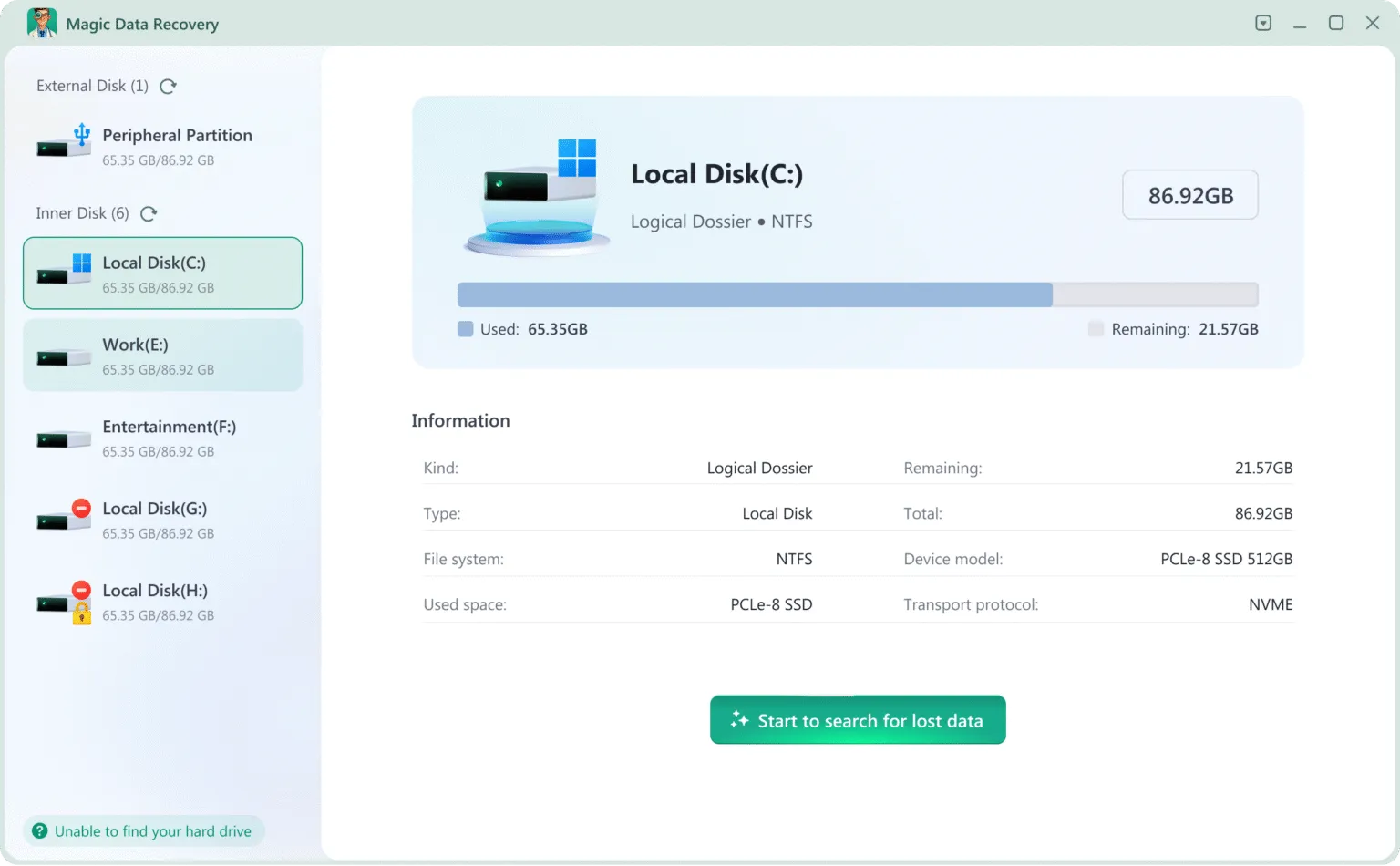
What core pain points does Magic Data Recovery solve?
Magic Data Recovery helps recover lost data when:
- files were deleted by mistake
- a drive or partition was formatted
- the file system became damaged or inaccessible
- important Excel workbooks disappeared after storage issues
That matters because Excel cannot recover what the operating system no longer sees as an available workbook.
Unique selling points of Magic Data Recovery
Here is why the product fits naturally in this topic:
- Covers more than unsaved-file recovery
- Supports deleted, formatted, and file-system-error scenarios
- Gives users a practical path when local Excel recovery folders are empty
- Works as a broader data recovery solution, not just an Office workaround
Real-world usage examples
For example, imagine a finance team stores monthly reports on a removable drive. A staff member formats that drive by mistake before archiving. Excel cannot recover those files from its UnsavedFiles folder because the workbooks are no longer “unsaved session files.” A storage-level recovery tool is the right next step.
Another common case involves a workbook saved on a partition that suddenly shows file system errors. Even if Excel opens, the original file may not. In that situation, Magic Data Recovery offers a more reliable route than repeating built-in Excel recovery steps that were never designed for partition damage.
Why it can be more reliable than other options
Many “free fix” articles keep users inside Excel for too long. That works for unsaved content, but not for deleted or formatted data. A dedicated recovery tool is more reliable in those scenarios because it targets the underlying storage problem instead of only searching Excel’s temporary workspace.
If you are looking for a more efficient solution after deletion, formatting, or file system damage, Magic Data Recovery is worth trying.
Supports Windows 7/8/10/11 and Windows Server
Common mistakes to avoid
Do not keep using the same drive heavily
When a file is deleted or a partition is damaged, new writes can overwrite recoverable data. Stop copying files to that drive as soon as possible.
Do not assume AutoRecover stores everything
Microsoft clearly notes that AutoRecover is not a replacement for manual saving or AutoSave. It helps, but it does not guarantee complete recovery.
Do not wait too long after data loss
The longer you use the device, the lower your recovery chances may become, especially after deletion or formatting.
Do not confuse unsaved recovery with deleted file recovery
This is one of the biggest user mistakes. Unsaved workbook recovery happens inside Excel. Deleted or formatted file recovery happens at the storage level.
Quick checklist: how to recover an Excel file fast
If you need a simple decision path, use this:
- Reopen Excel and check Document Recovery
- Go to File > Info > Manage Workbook > Recover Unsaved Workbooks
- Search common local recovery folders
- Check OneDrive, SharePoint, or previous versions
- If the file was deleted, formatted, or lost after file system errors, switch to Magic Data Recovery
Conclusion
If you are searching where to find Excel recovery files, start with Excel’s built-in tools. Check Recover Unsaved Workbooks, review the Document Recovery pane, and inspect local recovery folders or cloud version history. Those methods work well for unsaved files and recent crashes.
However, when the problem involves deleted files, formatted storage, or file system errors, built-in recovery often reaches its limit. That is why I recommend Magic Data Recovery. It addresses the broader data-loss scenarios that standard Excel recovery methods do not handle well, and it does so from a problem-solving angle rather than a marketing angle. For users who need a practical next step after serious Excel file loss, it is the more dependable choice.
Supports Windows 7/8/10/11 and Windows Server
FAQs
Where are Excel recovery files usually stored?
Excel recovery files are often found through File > Info > Manage Workbook > Recover Unsaved Workbooks or in local folders such as AppData-based Excel and UnsavedFiles directories on Windows. After a crash, Excel may also show them in the Document Recovery pane instead of a normal folder view.
Can I recover an Excel file I closed without saving?
Yes, in many cases you can. Excel may keep an unsaved version that appears under Recover Unsaved Workbooks, especially if AutoRecover had time to create a backup copy. Your chances are better if the workbook stayed open long enough for Excel to save a recovery version.
Does Excel AutoRecover save files automatically?
Yes, but AutoRecover is not the same as full-time file protection. Microsoft says Office for Mac saves AutoRecover files every 10 minutes by default, and Microsoft 365 apps can also use AutoSave when files are stored in OneDrive or SharePoint. Manual saving still matters for safer version control.
What should I do if Excel recovery files are missing?
Start by checking Excel’s built-in recovery options, then search the common recovery folders manually. If nothing appears, consider whether the workbook was actually deleted, the drive was formatted, or the file system became damaged. In those cases, a dedicated tool like Magic Data Recovery is usually the more suitable next step.
Can I recover permanently deleted Excel files?
Sometimes, yes. Once a file is permanently deleted or the Recycle Bin is emptied, Excel’s built-in unsaved-file tools usually stop helping because the workbook no longer exists as a normal Office recovery item. A storage-level recovery tool is a better option for restoring deleted Excel files from the drive itself.
Can formatted drives still contain lost Excel files?
Yes, formatted drives may still contain recoverable data until new data overwrites the old file records. That is why users should stop writing new files to the affected drive immediately. For Excel workbooks lost after formatting, Magic Data Recovery is more relevant than Excel’s internal AutoRecover features.
Is OneDrive better for Excel file recovery?
For many users, yes. Microsoft recommends storing Microsoft 365 files in OneDrive or SharePoint and using AutoSave because that setup adds version history and better recovery options. It is especially useful when you need to restore an earlier version rather than recover a fully deleted workbook.
Why recommend Magic Data Recovery instead of only using Excel tools?
Excel tools work best for unsaved sessions, crash recovery, and recent versions. They are less effective for deletion, formatting, file system errors, partition loss, or inaccessible storage. Magic Data Recovery fits those tougher scenarios better because it focuses on retrieving lost data from the storage level, not only from Excel’s temporary recovery system.

Jason is a data recovery and technical support specialist with over 15 years of hands-on experience. He has worked extensively with frontline users, troubleshooting difficult data loss cases and providing practical recovery solutions for accidental deletion, formatted drives, damaged file systems, lost partitions, system failures, and other recovery emergencies. His expertise also includes backup and restoration, file repair, and disaster recovery, with a strong emphasis on safe, reliable, and technically accurate guidance.