
Dropbox Recover Files: 7 Safe Methods

Losing a work folder, family photo collection, or project file from Dropbox can feel final because a deletion may sync across every connected device. However, the correct Dropbox recover files method depends on where the file existed, when it disappeared, and whether it was stored locally or only in the cloud. This guide starts with Dropbox’s built-in tools, then explains local recovery options when the cloud copy is unavailable. For a broader recovery workflow, see Amagicsoft’s deleted file recovery guide.
Dropbox can often restore deleted files, earlier file versions, and large groups of unwanted changes. Yet its recovery period depends on your plan. In addition, Dropbox cannot restore a file after it has been marked for permanent deletion on its servers. A local copy may still be recoverable if it previously occupied space on a Windows drive and has not been overwritten. In that situation, Magic Data Recovery can scan the local storage device rather than the Dropbox account.
Supports Windows 7/8/10/11 and Windows Server
Table of Contents
Quick Answer: Can Dropbox Recover Files?
Yes, but the best Dropbox recover files solution changes with the loss scenario.
File-loss situation | Best first method | Important limitation |
File deleted recently | Dropbox Deleted files page | Must remain inside the plan’s recovery period |
File overwritten or edited incorrectly | Version history | The file must not be permanently deleted |
Many files changed, renamed, or deleted | Dropbox Rewind | Availability and history range depend on the plan |
File deleted within the last few days | Dropbox cache folder | Cache is temporary and normally cleared every three days |
Synced file removed from a computer | Recycle Bin, Trash, File History, or Time Machine | Works only if the operating system kept a copy |
Another computer has not synced the deletion | Disconnect it and copy the local file | Reconnecting too early may sync the deletion |
Cloud copy is unavailable, but the file was stored locally | Magic Data Recovery | It cannot scan Dropbox servers or recover cloud-only placeholders |
For most users, the Dropbox recover files decision begins with one question: is the recoverable copy still in the cloud or only on a device?
The key principle is simple: use Dropbox’s own recovery features first. If they fail, determine whether a complete local copy ever existed. This distinction makes the Dropbox recover files process more accurate and prevents users from expecting disk software to recover data that never lived on the disk.
Before You Recover Files from Dropbox
Before trying any method, take several precautions:
- Stop making changes inside the affected Dropbox folder.
- Pause Dropbox syncing on the computer that previously stored the file.
- Do not empty the Recycle Bin, Trash, or Dropbox cache.
- Avoid installing recovery software on the same drive that held the Dropbox folder.
- Save recovered files to another drive or external storage device.
A rushed Dropbox recover files attempt can reduce the chance of local recovery. These steps matter because local data recovery depends on the original disk blocks remaining unchanged.
New downloads, application updates, browser caches, and normal Dropbox syncing can overwrite deleted data. Therefore, a careful Dropbox recover files attempt should begin as soon as the loss is discovered.
Understand Dropbox File Recovery Limits
Dropbox stores deleted files and previous versions for a limited period. As of July 2026, according to Dropbox’s current data retention policy, the standard recovery windows are:
Dropbox plan | Standard recovery period |
Basic, Plus, and Family | 30 days |
Professional, Essentials, Standard, and Business | 180 days |
Advanced, Business Plus, and Enterprise | 365 days |
Optional extended version-history features may change the available period. Team data-disposition policies may also remove files earlier. For that reason, check the account plan and administrator settings before assuming a file is recoverable.
The Dropbox recover files window is therefore a retention limit, not a permanent archive. A plan upgrade does not automatically bring back all older history that had already expired.
Likewise, Dropbox states that files cannot be restored after they have been marked for permanent deletion. However, this cloud limitation does not always answer whether a former local copy can be recovered from a computer.
Cloud Files vs. Locally Stored Files
This is the most important technical difference in the Dropbox recover files workflow:
- Available offline files contain complete file data on the computer.
- Online-only files mainly use local placeholders while the complete content remains in Dropbox’s cloud.
- Files opened or edited locally may have created temporary or cached data.
- Selective sync may have prevented a folder from existing on a particular computer.
A disk recovery tool has the best chance when a complete file was available offline or previously downloaded. It generally cannot reconstruct an online-only file from a small placeholder because the original content was never fully stored on that drive.
Method 1: Dropbox Recover Files from Deleted Files
The Deleted files page is the fastest and safest place to begin.
- Sign in to Dropbox through a web browser.
- Select Deleted files in the left sidebar.
- Use filters or search to locate the missing file or folder.
- Select one or several items.
- Click Restore.
- Wait for Dropbox to return the items to their original folders.
Dropbox also lets users display deleted items inside their former folder through Folder settings. This helps when the Deleted files page contains many unrelated items.
A recent deletion is the simplest Dropbox recover files case. This Dropbox recover files method works well for accidental deletion, a removed shared folder, or a file deleted from a synced desktop folder.
However, it does not work after permanent deletion or after the plan’s recovery period expires.
Method 2: Restore an Earlier Dropbox File Version
A file may still exist but contain the wrong edits. For example, a spreadsheet may have been overwritten, a design may have been saved incorrectly, or ransomware may have changed a document. In those cases, do not delete the current file. Restore a previous version instead.
- Sign in to dropbox.com.
- Find the affected file.
- Click the three-dot menu.
- Select Activity or Version history.
- Preview the available versions.
- Choose the correct version and click Restore.
Dropbox version history can record edits, renames, moves, uploads, and deletions within the account’s history period. It cannot restore the history of a file that has already been permanently deleted.
When the file still exists, the Dropbox recover files goal is to restore content rather than undelete an item. For a single damaged or overwritten document, this Dropbox recover files technique is usually safer than restoring a whole folder.
It changes only the selected item and leaves unrelated work untouched.
Method 3: Use Dropbox Rewind for Widespread Changes
Dropbox Rewind can roll a folder or account back to an earlier point. It is useful after ransomware, a faulty sync, accidental mass deletion, or a large batch of unwanted edits.
- Sign in to Dropbox.
- Open the affected folder, or go to All files for personal account content.
- Open Folder settings.
- Choose Rewind this folder.
- Select a date immediately before the incident.
- Review the activity graph and fine-tune the earliest change to undo.
- Confirm the rewind.
Rewind affects many changes, so review the timeline carefully. It does not extend beyond the plan’s version-history window, and it cannot bring back content that was permanently deleted. For one missing file, use Deleted files or Version history instead.
For a mass incident, the Dropbox recover files scope can include an entire folder tree. When hundreds of files changed at once, Rewind offers a more efficient Dropbox recover files solution than restoring each item manually.
Method 4: Check the Hidden Dropbox Cache
The Dropbox desktop app uses a hidden .dropbox.cache folder for temporary uploads and downloads. Dropbox normally clears this cache every three days, so check it quickly.
On Windows
- Quit the Dropbox desktop app.
- Open File Explorer.
- Enter %HOMEPATH%\Dropbox\.dropbox.cache in the address bar.
- Search the dated subfolders for the missing file.
- Copy any useful file to a safe folder outside Dropbox.
On older non-File Provider macOS setups and Linux, the cache also appears inside the root Dropbox folder. Newer File Provider setups let the operating system manage the cache location, so the folder may not be directly accessible in the same way.
The Dropbox recover files value of the cache is limited by time and file completeness. The cache is not a reliable backup. Still, it can provide a fast Dropbox recover files option when a recent upload, download, or deletion left a temporary copy behind.
Method 5: Use the Recycle Bin, Trash, or Local Backup
A file deleted through the Dropbox desktop folder may also appear in the operating system’s deletion area.
On Windows
Open the Recycle Bin, search for the filename, right-click it, and select Restore.
If Windows File History was enabled, right-click the original Dropbox folder, open Properties, and check Previous Versions.
On macOS
Open Trash and choose Put Back.
If Time Machine protected the Dropbox folder, browse to the date before the loss and restore a copy.
From a Separate Backup
Check external drives, NAS snapshots, backup software, email attachments, collaboration platforms, and exported project archives. A duplicate copy is safer and faster than a forensic scan.
A complete Dropbox recover files check should include operating-system recovery points. This method is often overlooked because users assume Dropbox is the only location involved.
In practice, a good Dropbox recover files investigation checks both cloud history and ordinary local backups.
Method 6: Check Another Synced Device Before It Reconnects
A laptop or office computer that has remained offline may still hold the old local file. Do not open Dropbox while that device is connected to the internet because the pending deletion may sync immediately.
Instead:
- Disconnect Wi-Fi and Ethernet.
- Start the computer while it remains offline.
- Open the local Dropbox folder.
- Copy the needed file to a folder outside Dropbox or to an external drive.
- Verify that the copied file opens correctly.
- Reconnect only after securing the copy.
An offline computer can become the safest Dropbox recover files source when the cloud has already registered the deletion. This Dropbox recover files method is especially useful for travel laptops, archived workstations, or team computers that have not synced recently.
It only works when the file was available offline on that device.
For team folders, an administrator should also review member activity, retention settings, deleted files, and available support options. Dropbox Support may help investigate missing or corrupted data, but support cannot override permanent deletion or an expired recovery window.
Method 7: Recover Locally Synced Files with Magic Data Recovery
The final Dropbox recover files stage focuses on the physical drive, not the cloud account. Use local recovery software only after Dropbox’s cloud tools, cache, backups, and other devices fail.
Magic Data Recovery does not log in to Dropbox or scan Dropbox servers. Instead, it scans the Windows drive where a synchronized or downloaded Dropbox file previously existed.
That makes it suitable for cases such as:
- A locally available Dropbox file was deleted and the Recycle Bin was emptied.
- A Dropbox folder disappeared after formatting or a file-system error.
- A synchronized drive became RAW or inaccessible.
- Windows was reinstalled and former Dropbox files were not fully resynced.
- The cloud recovery period expired, but a complete local copy had existed.
Magic Data Recovery supports recovery from deletion, formatting, file-system errors, partition loss, system problems, and other logical data-loss scenarios. It recognizes more than 5,000 file types, including DOCX, XLSX, PDF, PSD, JPG, RAW images, MP4, MOV, ZIP, and PST.
Preview and filtering features help users verify files before saving them.
How to Run the Dropbox Recover Files Scan
1. Pause Dropbox syncing and stop using the affected drive.
2. Download Magic Data Recovery to another drive whenever possible.
Supports Windows 7/8/10/11 and Windows Server
3. Launch the program and select the drive that contained the Dropbox folder.
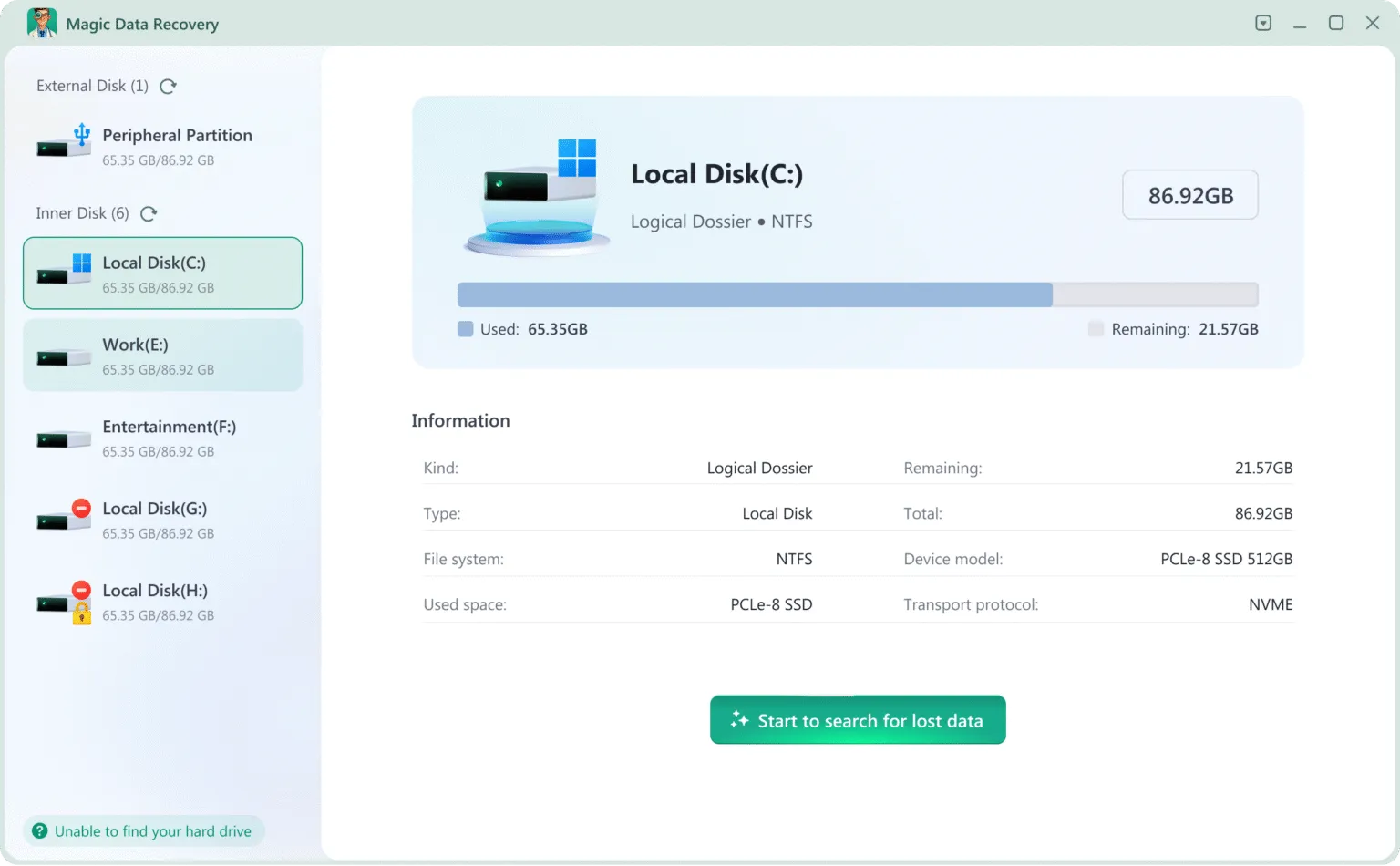
4. Start the scan and allow the advanced scan to finish.
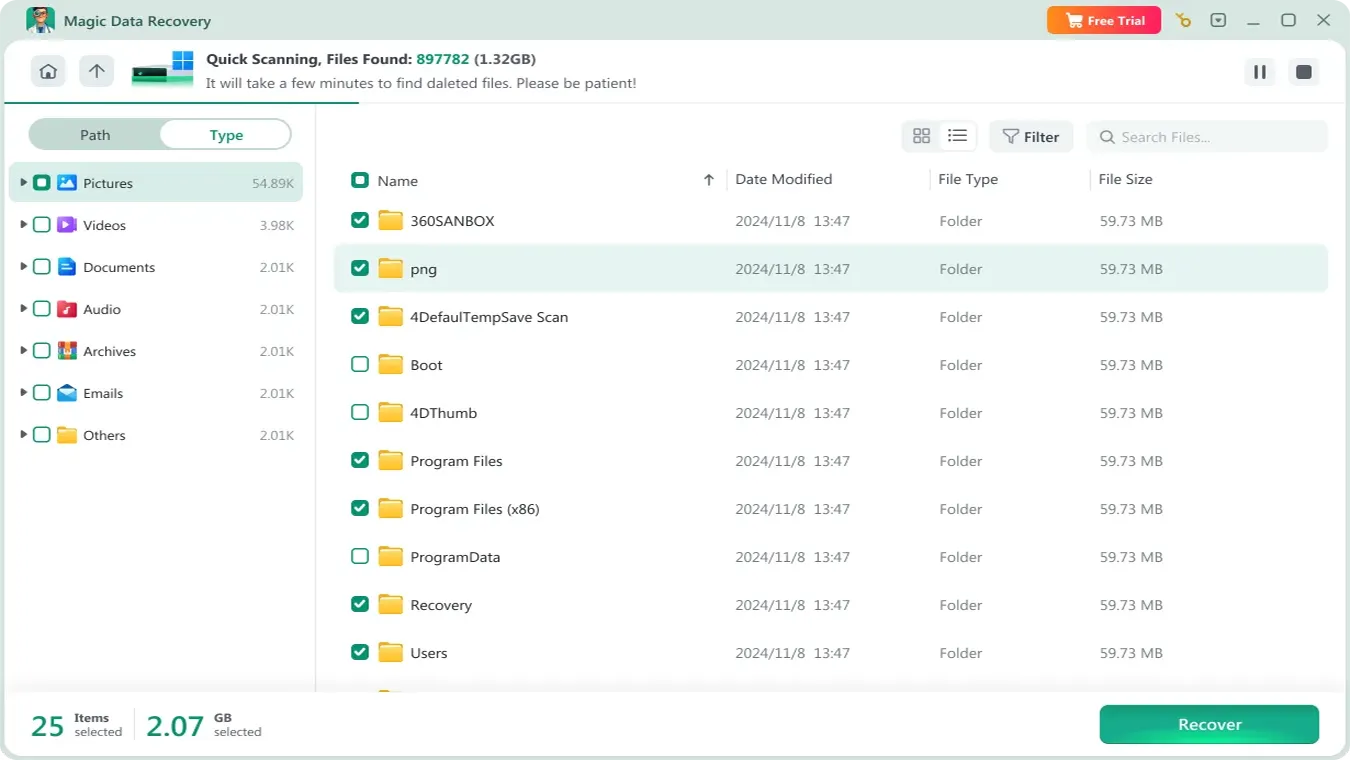
5. Search by filename, extension, file type, or original path.
6. Preview recoverable documents, photos, videos, and archives.
7. Save selected files to a different drive.
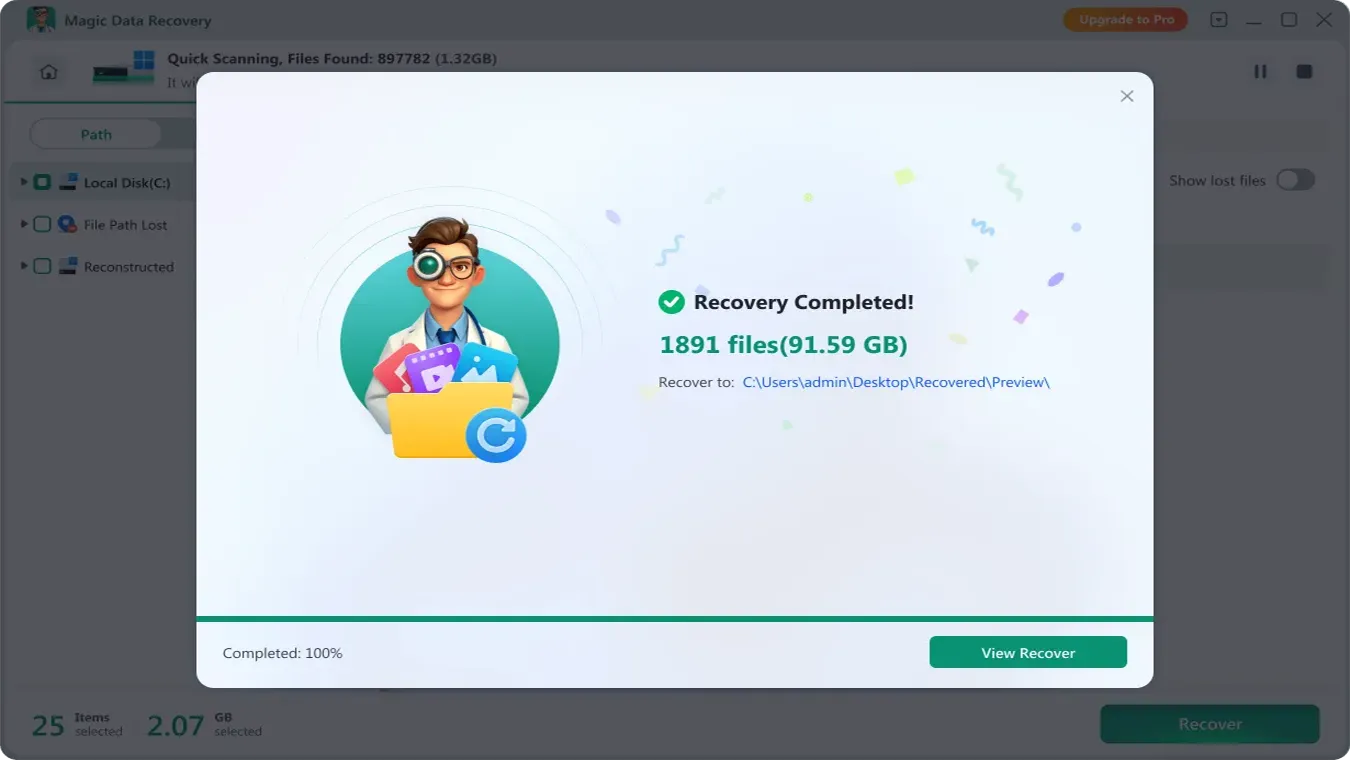
For detailed interface instructions, follow the Magic Data Recovery user guide.
Why This Method Can Be More Reliable Than Manual Disk Searches
Manual searches can only find files that remain visible to Windows. Magic Data Recovery reads file-system records and disk sectors to locate deleted or inaccessible data. Therefore, it can help when the filename no longer appears in File Explorer.
However, no local recovery tool can guarantee success. Overwriting, SSD TRIM, physical drive failure, encryption, and online-only storage can prevent recovery.
This limitation is why the Dropbox recover files process should start with low-risk cloud restoration and move to disk scanning only when necessary.
If the deletion occurred beyond the cloud retention period, see the focused guide on how to restore deleted Dropbox files after 30 days.
Dropbox Recovery Methods Compared
Method | Best for | Works after cloud recovery period? | Main risk or limit |
Deleted files | Recent deletion | No | Must be inside retention period |
Version history | Overwritten or edited files | No | Permanent deletion removes access |
Rewind | Mass deletion or ransomware changes | No | Rolls back many changes |
Dropbox cache | Very recent temporary copies | Sometimes | Automatically cleared; files may be incomplete |
Recycle Bin or local backup | Local deletion | Yes, if a copy exists | Backup may be outdated |
Offline synced device | Unsynced local copy | Yes | Reconnection may delete the copy |
Magic Data Recovery | Deleted or inaccessible local data | Potentially | Requires former local content that has not been overwritten |
This comparison prevents a common error: treating all Dropbox losses as cloud losses. The best Dropbox recover files method depends on the actual data location, not only the application where the file was last seen.
Common Dropbox Recovery Mistakes
Continuing to Sync
Dropbox may propagate the deletion or unwanted edit to every connected device. Pause syncing until you understand the problem.
Reinstalling Dropbox Immediately
Reinstallation can create new data and change local folders. Diagnose the cloud account and protect remaining local copies first.
Saving Recovered Files to the Same Drive
Writing restored data back to the affected disk may overwrite other recoverable files. Use another partition or external drive.
Assuming Online-Only Files Exist Locally
An online-only placeholder is not the complete file. Local disk recovery has little value when the content never downloaded.
Upgrading a Plan After History Has Expired
A longer recovery period helps with future recovery, but it may not recreate history that had already expired under the previous plan.
Using “Delete Forever” During Cleanup
Permanent deletion removes Dropbox’s normal restoration path. Confirm that backups exist before clearing Deleted files.
Avoiding these mistakes improves the Dropbox recover files workflow and reduces the chance of turning a recoverable incident into permanent loss.
How to Prevent Future Dropbox File Loss
Use several layers instead of relying on one service:
- Keep critical folders available offline on at least one protected computer.
- Maintain an independent backup on an external drive or another backup platform.
- Review the version-history period included with the Dropbox plan.
- Use multi-factor authentication and audit unfamiliar account activity.
- Limit deletion permissions in shared team folders.
- Test backups by opening several restored files.
- Pause sync immediately after ransomware or accidental mass deletion.
- Export final versions of important projects outside the active sync folder.
Dropbox sync improves availability, but synchronization is not the same as an independent backup. A deletion, corruption event, or encryption change can spread quickly.
A layered approach gives the Dropbox recover files process more recovery points.
Conclusion
A successful Dropbox recover files result depends on choosing the right recovery layer. The safest Dropbox recover files strategy follows a clear order: check Deleted files, restore a previous version, use Rewind for widespread changes, inspect the cache, search local backups, protect offline devices, and only then scan the former local storage.
Magic Data Recovery is recommended when the cloud copy is unavailable but a complete Dropbox file previously existed on a Windows drive. It addresses deleted files, formatted drives, file-system errors, and inaccessible storage while offering file preview and support for more than 5,000 formats.
It does not claim to scan Dropbox servers, which makes its role clear and technically realistic.
For more recovery scenarios and practical safeguards, return to Amagicsoft’s deleted file recovery solution. If you need an efficient local option, try Magic Data Recovery before new data overwrites the affected drive.
Supports Windows 7/8/10/11 and Windows Server
FAQs About Dropbox Recover Files
Can Dropbox recover permanently deleted files?
Dropbox cannot restore a file after it has been marked for permanent deletion on its servers. However, a separate local copy may still exist in the Recycle Bin, Trash, Dropbox cache, a backup, or an offline synced device. Disk recovery software may help only when complete file data previously existed on the local drive and has not been overwritten.
How long does Dropbox keep deleted files?
The normal recovery period depends on the plan. Basic, Plus, and Family accounts generally receive 30 days. Professional, Essentials, Standard, and Business plans receive 180 days, while Advanced, Business Plus, and Enterprise plans receive 365 days. Add-ons or team policies can change these periods, so confirm the current account settings before starting recovery.
How can I recover Dropbox files after 30 days?
First, check whether your plan includes a 180-day or 365-day recovery period. If the applicable period has expired, inspect local backups, offline computers, the Recycle Bin, Time Machine, File History, and any downloaded copies. Magic Data Recovery may scan a Windows drive that previously stored the complete file, but it cannot retrieve expired content directly from Dropbox servers.
Can data recovery software scan my Dropbox account?
No. Standard disk recovery software scans local storage devices, not a Dropbox cloud account. It may recover files that were synchronized, downloaded, or available offline on the computer. It cannot reconstruct a cloud-only file from an online-only placeholder. Always try Dropbox Deleted files, Version history, and Rewind before scanning a local drive.
Can I recover an online-only Dropbox file from my hard drive?
Usually not through disk recovery because an online-only file does not store the complete content on the hard drive. The local item is mainly a placeholder. Recovery remains possible through Dropbox’s cloud history, another device that downloaded the file, an application cache, or an independent backup. A locally opened copy may also exist elsewhere, depending on the application.
Does Dropbox Rewind recover only one file?
Rewind is designed to reverse many folder or account changes from a selected point in time. For one deleted file, use the Deleted files page. For one overwritten file, use Version history. Choosing the narrowest method reduces unintended changes and makes the Dropbox recover files process easier to verify before normal work resumes.
Can I recover a previous version of a Dropbox file?
Yes, provided the file remains in Dropbox and the desired version falls inside the account’s version-history period. Open the file’s menu, select Version history, preview the available versions, and restore the correct one. Version history cannot restore a file after permanent deletion, and web-based documents may follow different versioning rules.
Does SSD TRIM affect Dropbox file recovery?
Yes. If a locally stored Dropbox file was deleted from an SSD, TRIM may allow the drive to clear the underlying data blocks, making disk recovery difficult or impossible. Pause Dropbox, minimize drive use, and scan quickly. Cloud restoration, version history, backups, or another synced device should always be checked before relying on SSD-level recovery.

Jason has over 15 years of hands-on experience in the computer data security industry. He specializes in data recovery, backup and restoration, and file repair technologies, and has helped millions of users worldwide resolve complex data loss and security issues.