
M3 RAW Drive Recovery Alternative
When a hard drive, USB drive, SD card, or external disk suddenly becomes RAW, Windows may ask you to format it before use. Many users search for M3 RAW Drive Recovery because they want to recover files before making the problem worse. However, the recovery software landscape has changed. M3 RAW Drive Recovery is now closely related to iBoysoft Data Recovery, and users who search for the old name often end up comparing iBoysoft with newer alternatives.
This guide explains what happened to M3 RAW Drive Recovery, how it connects with iBoysoft Data Recovery, and why Magic Data Recovery can be a better choice for broader raw data recovery needs. You will also learn how to recover data from a RAW drive safely without formatting it first.
Supports Windows 7/8/10/11 and Windows Server
Table of Contents
What Is M3 RAW Drive Recovery?
M3 RAW Drive Recovery was known as a Windows data recovery tool for RAW drives and inaccessible partitions. Its main purpose was simple: help users recover files from a drive that Windows could no longer recognize as NTFS, FAT32, or exFAT.
Today, M3 RAW Drive Recovery should not be treated as a completely separate modern product. Its RAW recovery function is now closely tied to iBoysoft Data Recovery. In practical terms, users searching for M3 RAW Drive Recovery are often looking at iBoysoft Data Recovery’s RAW drive recovery module.
This distinction matters for SEO and user intent. People are not only asking, “Where can I download M3?” They are usually asking a more urgent question: “How can I recover files from a RAW drive safely?”
Why Does a Drive Become RAW?
A RAW drive means the operating system cannot recognize the file system. The drive may still contain data, but Windows cannot read the file structure correctly. As a result, you may see errors such as:
- “You need to format the disk before you can use it.”
- “The volume does not contain a recognized file system.”
- The drive appears as RAW in Disk Management.
- The partition becomes inaccessible.
- Files and folders disappear suddenly.
Common causes include unsafe removal, file system corruption, bad sectors, partition table damage, virus attacks, failed formatting, power interruption, or system crashes. In these cases, raw data recovery should come before any repair attempt.
The most important rule is clear: do not format the RAW drive before recovering your files.
M3 RAW Drive Recovery and iBoysoft Data Recovery: What Changed?
Many users still use the keyword M3 RAW Drive Recovery, but the current product experience often leads them to iBoysoft Data Recovery. iBoysoft includes different recovery modules, such as general data recovery, RAW drive recovery, and BitLocker recovery.
This module-based structure can help advanced users who already know the exact cause of data loss. For example, if the drive is clearly a RAW partition, the RAW recovery module may be useful. If the drive uses BitLocker encryption, the BitLocker module may be more relevant.
However, ordinary users often do not know what happened. A drive may look RAW after deletion, formatting, partition damage, virus infection, or file system failure. When the cause is unclear, users need a recovery workflow that reduces decision-making and helps them find recoverable files faster.
That is where Magic Data Recovery has a stronger advantage.
M3 RAW Drive Recovery vs iBoysoft vs Magic Data Recovery
The best recovery software should help users recover data safely, quickly, and clearly. A tool should not force users to understand every technical reason behind a RAW drive before they begin.
Here is a practical comparison:
Feature | M3 / iBoysoft Data Recovery | Magic Data Recovery |
Product focus | Module-based recovery, including RAW drive recovery | Broader recovery workflow for common data loss cases |
RAW drive recovery | Supported through RAW recovery functions | Supported through direct disk scanning |
Deleted file recovery | Supported | Supported |
Formatted drive recovery | Supported | Supported |
File system error recovery | Supported | Supported |
System reinstallation recovery | Less direct for ordinary users | Supported as a common recovery scenario |
User experience | May require users to choose the right module | Simpler select-scan-preview-recover workflow |
Recovery speed | Depends on module and scan mode | Designed for faster practical scanning and file filtering |
Best for | Users who understand the problem type | Users who want a clearer all-in-one recovery process |
This does not mean iBoysoft cannot recover data. It can help in many RAW and lost file cases. However, compared with M3 RAW Drive Recovery and iBoysoft’s module-based approach, Magic Data Recovery is easier to recommend when users want a more direct solution for RAW drives, deleted files, formatted disks, file system errors, and inaccessible devices.
Why Magic Data Recovery Is a Better Alternative
Magic Data Recovery is a practical alternative for users who search for M3 RAW Drive Recovery but need more than RAW partition recovery. It supports multiple data loss scenarios, including accidental deletion, formatted drives, file system errors, system reinstallation, virus damage, corrupted partitions, and inaccessible storage devices.
This broader recovery ability matters because RAW drive errors often come with other problems. For example, a USB drive may become RAW after unsafe removal. An external hard drive may become inaccessible after a failed format. A Windows reinstall may make old files difficult to locate. In these cases, users need software that can handle more than one recovery path.
Magic Data Recovery also improves the user experience. Instead of asking users to diagnose the exact failure first, it gives them a clear process:
- Select the affected drive.
- Scan for lost files.
- Preview recoverable data.
- Filter the results.
- Recover files to another safe location.
This workflow makes raw data recovery more approachable for non-technical users.
Recovery Ability: Why Broader Coverage Matters
A RAW drive is only one symptom. The real cause may be much more complicated. If software focuses too narrowly on RAW partitions, users may miss other recoverable data types or spend time choosing the wrong function.
Magic Data Recovery is more suitable for mixed data loss cases because it can scan storage devices affected by:
- Accidental deletion
- Quick formatting
- RAW file system errors
- Corrupted partitions
- Windows reinstallation
- Virus or malware damage
- Inaccessible external drives
- Lost or damaged file structures
Compared with M3 RAW Drive Recovery, this broader coverage gives users a more flexible recovery path. It also reduces the risk of stopping too early because the drive problem does not fit one exact category.
Product Experience: Simpler for Ordinary Users
Data recovery software should be clear under pressure. When users cannot open a drive, they usually feel anxious. A complex interface or too many recovery modules can slow them down.
iBoysoft’s module-based design may work for users who understand storage problems. However, users who only know that “my drive became RAW” may need a more guided experience.
Magic Data Recovery focuses on a simpler workflow. Users do not need to decide whether the issue is RAW, deleted, formatted, corrupted, or caused by system reinstallation before starting. They can scan the device first and check the recoverable results.
This is one reason Magic Data Recovery can offer a better product experience than a traditional M3 RAW Drive Recovery approach.
Recovery Speed: Faster Practical Results
Recovery speed does not only mean how fast software scans sectors. It also depends on how quickly users can find the files they need.
A tool may complete a scan, but if the results are difficult to filter, the overall recovery process still feels slow. Magic Data Recovery helps improve practical recovery speed through a more direct workflow, preview support, and file filtering. Users can narrow results by file type, name, size, or location, then recover the most important files first.
Compared with M3 RAW Drive Recovery and iBoysoft’s module-based structure, Magic Data Recovery can feel faster because it reduces setup time, lowers confusion, and helps users move from scanning to recovery with fewer steps.
How to Recover Files from a RAW Drive with Magic Data Recovery
Follow these steps before formatting or repairing the RAW drive.
Step 1: Stop Using the RAW Drive
Disconnect the affected drive if possible. Do not copy new files to it. Do not format it. Do not run repair commands if the files are important. Any new write operation may overwrite recoverable data.
Step 2: Install Magic Data Recovery on a Healthy Drive
Install Magic Data Recovery on another disk, not on the RAW drive. For example, if your external hard drive became RAW, install the software on your computer’s internal drive. If the internal drive has data loss, use another computer or boot from a safe environment when possible.
Supports Windows 7/8/10/11 and Windows Server
Step 3: Select the RAW or Inaccessible Device
Open Magic Data Recovery and choose the affected storage device. Check the capacity and drive label carefully. This helps avoid scanning the wrong partition.
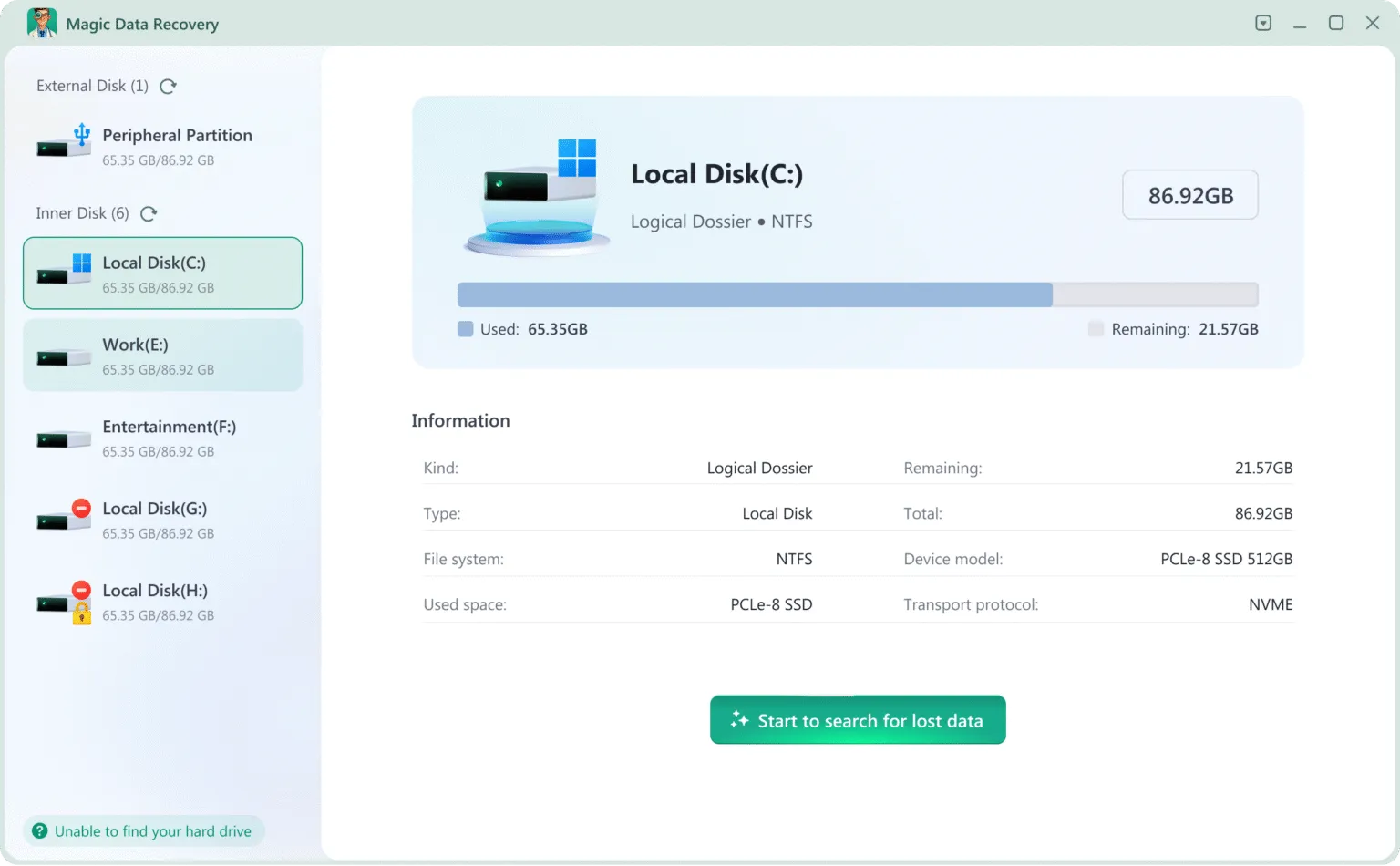
Step 4: Scan for Lost Files
Start the scan. The software will search for files that can still be recovered from the RAW, formatted, corrupted, or inaccessible drive. If the file system is badly damaged, a deeper scan may take longer but can find more results.
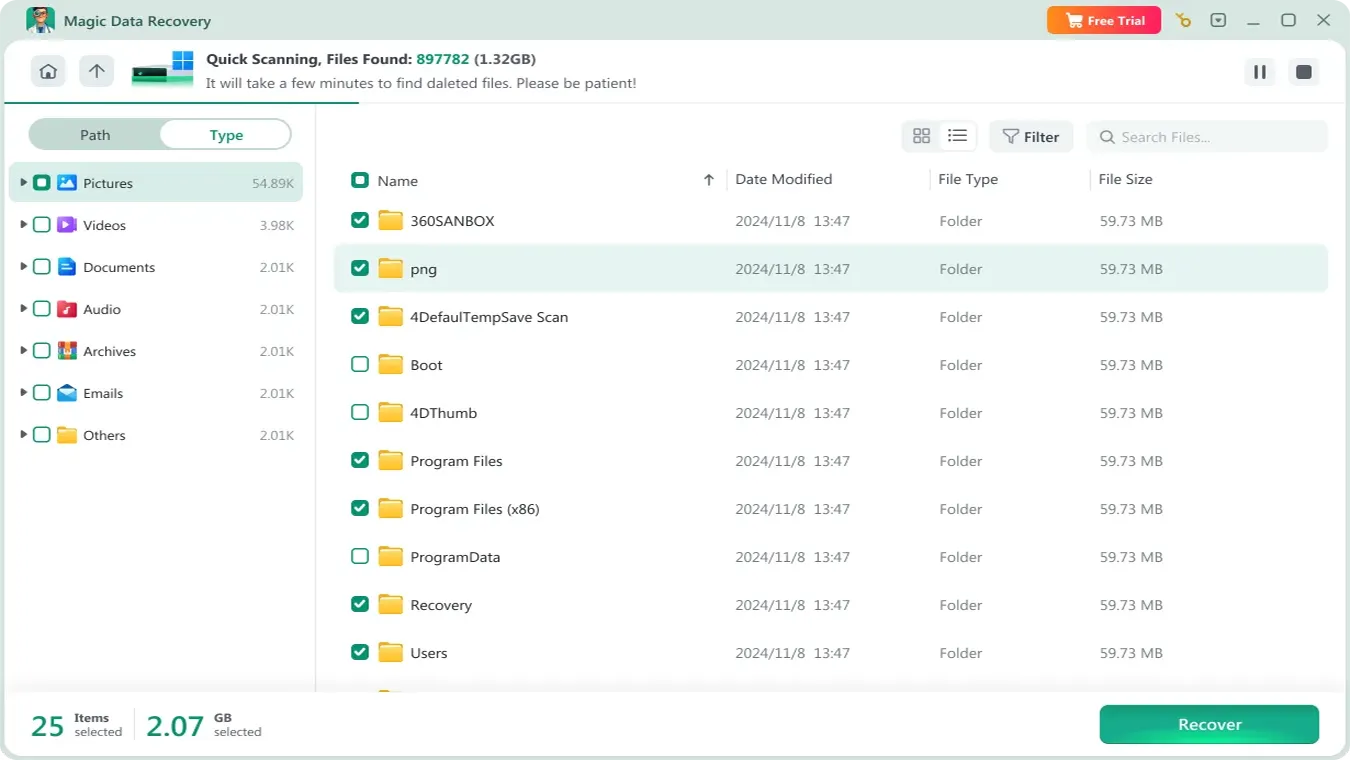
Step 5: Preview and Filter Results
Preview documents, photos, videos, and other files when possible. Then use filters to locate important data faster. This step is especially useful during raw data recovery, because deep scans may find many files.

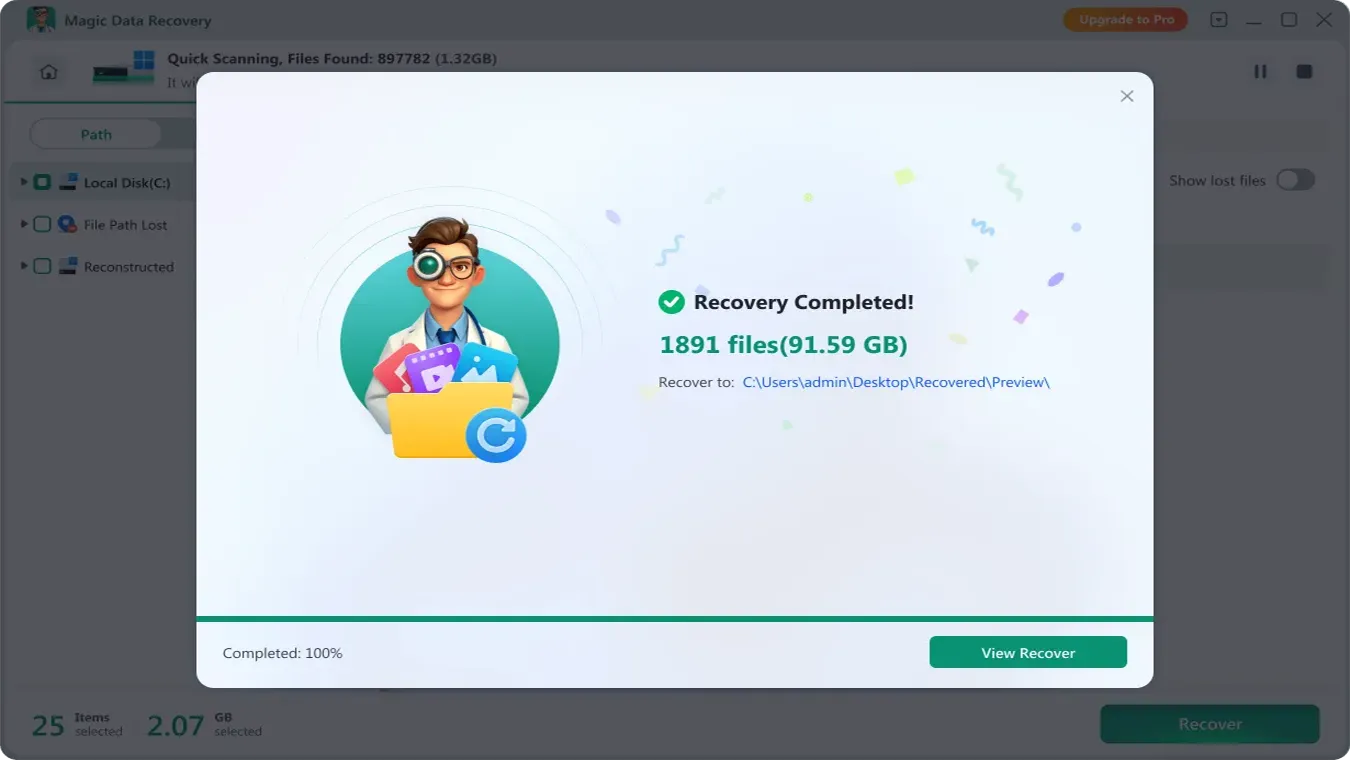
Step 6: Recover Files to Another Drive
Save the recovered files to a different healthy drive. Never recover files back to the RAW drive during the same process. After you confirm that the recovered files open correctly, you can format or repair the original drive.
What Not to Do During Raw Data Recovery
To improve your recovery chance, avoid these common mistakes:
- Do not format the RAW drive first.
- Do not save recovered files to the same drive.
- Do not install recovery software on the affected partition.
- Do not run CHKDSK before recovering important files.
- Do not keep using a drive that disconnects repeatedly.
- Do not scan a physically damaged drive for too long.
If the drive clicks, overheats, smells burnt, or disappears from BIOS or Disk Management, stop using software and contact a professional recovery lab. Software tools are best for logical data loss, not physical damage.
When Should You Choose Magic Data Recovery?
Choose Magic Data Recovery instead of relying only on M3 RAW Drive Recovery or iBoysoft when:
- You are not sure why the drive became RAW.
- You need to recover files from a formatted drive.
- You lost files after reinstalling Windows.
- You deleted important documents, photos, or videos.
- Your external drive or USB drive became inaccessible.
- You want a simpler recovery workflow.
- You need faster filtering and preview during recovery.
- You want one tool for several data loss scenarios.
For many ordinary users, Magic Data Recovery is the more practical option because it focuses on the real goal: finding and recovering lost files safely.
M3 RAW Drive Recovery Alternative: Final Verdict
M3 RAW Drive Recovery remains an important keyword because many users remember the old RAW drive recovery tool. However, today it is better understood in connection with iBoysoft Data Recovery. If you are searching for M3 RAW Drive Recovery, you are likely trying to solve a RAW, inaccessible, formatted, or corrupted drive problem.
iBoysoft can help in some recovery cases, especially when users know which module to choose. Still, Magic Data Recovery is a stronger alternative for many users because it offers broader recovery ability, a clearer product experience, and a more efficient scan-preview-recover workflow.
If your drive has become RAW, do not format it first. Start with a safe recovery process. For users who want a more complete and user-friendly raw data recovery solution, Magic Data Recovery is the better choice to try.
Supports Windows 7/8/10/11 and Windows Server
FAQs
Is M3 RAW Drive Recovery the same as iBoysoft Data Recovery?
M3 RAW Drive Recovery is now closely related to iBoysoft Data Recovery, especially through its RAW drive recovery function. Many users who search for the old M3 name are actually looking for the RAW recovery capability now associated with iBoysoft. However, users should compare current tools based on recovery ability, usability, speed, and supported data loss scenarios.
Can M3 RAW Drive Recovery recover files from a RAW drive?
Yes, M3 RAW Drive Recovery was designed for RAW drive recovery, and its related function can help recover files from inaccessible RAW partitions. However, RAW errors may come from several causes, such as formatting, corruption, partition damage, or virus attacks. A broader tool like Magic Data Recovery can be more practical when the exact cause is unclear.
Why is Magic Data Recovery a better alternative to iBoysoft?
Magic Data Recovery is easier for many ordinary users because it provides a direct select-scan-preview-recover workflow. It supports RAW drives, deleted files, formatted disks, file system errors, virus damage, corrupted partitions, and system reinstallation cases. Compared with a module-based workflow, this approach reduces confusion and helps users focus on recovering files safely.
Should I format my RAW drive before using recovery software?
No. You should not format a RAW drive before recovery. Formatting may make the drive usable again, but it can also overwrite or remove file system information needed for recovery. First, scan the RAW drive with recovery software, preview the recoverable files, and save them to another healthy storage device.
What is raw data recovery?
Raw data recovery means recovering files when the normal file system structure is damaged, missing, or unreadable. Software may scan the storage device sector by sector and identify files through signatures or remaining metadata. This method can help with RAW drives, formatted disks, corrupted partitions, and inaccessible devices, but recovery quality depends on overwrite status.
Is Magic Data Recovery faster than iBoysoft Data Recovery?
Recovery speed depends on drive size, connection type, damage level, and scan mode. However, Magic Data Recovery can deliver faster practical results for many users because it offers a simpler workflow, preview options, and filtering tools. Users can locate important files more efficiently instead of spending extra time choosing modules or sorting unclear results.
Can I recover files after Windows reinstallation?
Yes, recovery may be possible after Windows reinstallation if the old files have not been overwritten. Stop using the computer as soon as possible and avoid installing software on the affected partition. Magic Data Recovery can scan the drive for remaining recoverable files and save them to another storage device.
When should I stop using software and contact a recovery lab?
Stop using software if the drive clicks, makes unusual noises, overheats, smells burnt, disconnects repeatedly, or does not appear in BIOS or Disk Management. These signs may indicate physical damage. In that case, repeated scanning can make the situation worse. A professional recovery lab is safer for physically damaged drives.

Jason is a data recovery and technical support specialist with over 15 years of hands-on experience. He has worked extensively with frontline users, troubleshooting difficult data loss cases and providing practical recovery solutions for accidental deletion, formatted drives, damaged file systems, lost partitions, system failures, and other recovery emergencies. His expertise also includes backup and restoration, file repair, and disaster recovery, with a strong emphasis on safe, reliable, and technically accurate guidance.