
Recover Files from SD Card Free: 5 Ways
Accidentally deleting camera photos, formatting a microSD card, or seeing a “You need to format the disk” message can make important files appear permanently lost. Fortunately, you may still be able to recover files from SD card free if the card remains detectable and new data has not overwritten the missing files. Start by stopping all use of the card, then follow a safe deleted file recovery workflow before attempting repairs.
This guide compares five practical recovery methods, including backups, Windows File Recovery, Recuva, PhotoRec, and Magic Data Recovery. You will learn which option fits accidental deletion, formatting, file system errors, and other common SD card problems. You will also see why “free” may mean unlimited recovery, limited recovery, or free scanning, depending on the tool.
Supports Windows 7/8/10/11 and Windows Server
Table of Contents
Can You Recover Files from SD Card Free?
Yes, you can often recover files from SD card free, especially after accidental deletion or a quick format. Deleting a file usually removes its directory reference and marks the occupied space as available. The underlying content may remain until the card stores new photos, videos, documents, or app data in the same area.
Recovery becomes less likely after continued use, repeated formatting, secure erasure, or physical damage. Therefore, remove the SD card from the camera, phone, drone, dashcam, or game console as soon as you notice the loss. Do not take another photo “to test the card,” because even a small write can overwrite recoverable content.
Choose the Best Free SD Card Recovery Method
Data loss situation | Best first method | Main limitation |
Files were copied or backed up earlier | Check backups and imported folders | Works only when another copy exists |
Files were recently deleted on Windows | Windows File Recovery or Recuva | Results depend on overwriting and card condition |
The SD card was formatted | PhotoRec or Magic Data Recovery | Original names and folders may not always survive |
The card is RAW or asks to be formatted | Scan with recovery software before repair | Do not run repair tools first |
The card disconnects, overheats, or is not detected anywhere | Professional recovery service | Software cannot repair physical damage |
The fastest way to recover files from SD card free is not always the most technical option. Begin with existing copies, then use a recovery tool that matches the card’s condition.
What to Do Before Free SD Card Recovery
Your actions after data loss can matter more than the software you choose. Follow these rules before scanning:
- Stop using the SD card immediately. Do not capture new photos, record video, download files, or let a phone continue writing app data.
- Remove the card safely. Power off the device first when practical, especially for cameras, drones, and dashcams.
- Use a reliable card reader. A poor reader or unstable USB port can cause disconnects and incomplete scans.
- Do not format the card. If Windows asks you to format it, select Cancel.
- Avoid CHKDSK before recovery. CHKDSK repairs file system structures; it is not a file recovery tool and may change damaged metadata.
- Save recovered files elsewhere. Use the computer’s internal drive or another external disk, never the affected SD card.
For an SD card that shows file system errors, use a recovery-first process. This corrupted SD card recovery guide explains why data should be secured before repair or reformatting.
Method 1: Recover Files from SD Card Free with Backups
Before installing software, look for copies that may already exist. This is the safest way to recover files from SD card free because it does not scan or modify the original card.
Check these locations:
- The Pictures, Videos, Downloads, and DCIM folders on your computer
- A camera manufacturer’s import folder
- OneDrive, Google Photos, iCloud Photos, Dropbox, or another cloud service
- A phone gallery trash folder
- An external backup drive
- Editing software catalogs and export folders
- Files previously sent through email or messaging apps
A common real-world example involves photographers who import a shoot, edit several images, and later format the card. Even when the original folder is missing, exported JPEGs, preview files, or cloud-synced copies may still exist.
However, files deleted directly from a removable SD card usually do not enter the Windows Recycle Bin. If no backup or imported copy exists, move to a recovery tool without writing anything to the card.
Method 2: Recover Files from SD Card Free with Windows File Recovery
Microsoft’s Windows File Recovery is a free command-line utility for recovering deleted files from local storage devices. It can scan an SD card that appears with a drive letter in Windows. Microsoft describes it as a command-line app, so it is better suited to users who are comfortable entering commands.
To use it:
- Insert the SD card into a card reader.
- Note its drive letter in File Explorer, such as E:.
- Connect a different destination drive, such as D:.
- Install Windows File Recovery from the Microsoft Store.
- Open Command Prompt or Windows Terminal as administrator.
- Run a command such as:
winfr E: D: /extensive /n *.jpg /n *.jpeg /n *.png /n *.mp4
Replace E: with the SD card and D: with a different destination drive. The /extensive mode is appropriate when the file system is not NTFS or when the card has been formatted or corrupted.
Advantages
- Completely free from Microsoft
- Useful for targeted file extensions
- No need to buy a license
Limitations
- No standard graphical interface
- No thumbnail preview before recovery
- Commands can be confusing for beginners
- Recovered names and folders may be incomplete
Windows File Recovery can help you recover files from SD card free, but it works best when the card is stable, correctly detected, and not physically damaged.
Method 3: Recover Files from SD Card Free with Recuva
Recuva offers a free Windows edition and supports recovery from digital camera cards and other removable storage. Its wizard-based interface makes it easier than a command-line tool for users who mainly need to recover deleted files from SD card.
Follow this process:
- Install Recuva on the computer, not on the SD card.
- Connect the card through a reliable reader.
- Choose the file category, such as Pictures, Video, Documents, or All Files.
- Select the SD card location.
- Run a standard scan first.
- Enable Deep Scan if the first scan misses the files.
- Recover selected items to another drive.
Recuva is a practical option after a simple deletion when the SD card still opens normally. It may be less suitable for a RAW card, extensive file system damage, or a complex formatted-card case. In addition, preview and folder reconstruction results vary with the condition of the deleted metadata.
For users who want to recover files from SD card free without entering commands, Recuva provides a simpler starting point. However, move to a deeper scanning tool when the card was formatted or Windows cannot read its file system.
Method 4: Recover Files from SD Card Free with PhotoRec
PhotoRec is free and open-source software from CGSecurity. It uses file signatures instead of relying only on the damaged file system, which helps it find files after formatting or severe logical corruption. The official documentation notes that PhotoRec can work even when a file system is badly damaged or reformatted.
This makes PhotoRec useful when you need to recover files from SD card free and graphical tools cannot read the original folder structure.
Basic workflow:
- Download TestDisk and PhotoRec from CGSecurity.
- Extract the package to your computer.
- Launch QPhotoRec for a graphical interface or PhotoRec for the console interface.
- Select the physical SD card carefully.
- Choose the relevant partition or entire card.
- Limit the file types when possible.
- Select a destination folder on another drive.
- Start the scan and review the recovered folders.
PhotoRec Strengths
- Free and open source
- Available for Windows, macOS, and Linux
- Effective for formatted and corrupted file systems
- Supports many photo, video, document, and archive signatures
PhotoRec Limitations
PhotoRec is a file carver. Therefore, it often cannot preserve original file names or folder paths. Its documentation also warns users not to write recovered files back to the source file system because doing so may overwrite lost data.
Use PhotoRec when file content matters more than the original organization. For example, it can be valuable for recovering a folder of camera images when manually sorting renamed files is acceptable.
Method 5: Recover Up to 500MB Free with Magic Data Recovery
Free tools can solve straightforward deletion cases. However, users often struggle when the SD card was formatted, the file system became RAW, the folders disappeared, or command-line tools returned hundreds of files with unclear names. In these cases, Magic Data Recovery provides a more guided way to recover files from SD card free on Windows.
The free version allows recovery of up to 500MB, which lets you test actual recoverability rather than relying only on a scan result. The software supports deleted, formatted, and otherwise lost files, and Amagicsoft states that it can recognize more than 5,000 file types.
Why Magic Data Recovery Fits SD Card Recovery
Magic Data Recovery addresses four common pain points:
- Accidental deletion: It searches for files whose directory entries were removed.
- Formatting: It performs deeper scanning when the original file table is missing.
- File system errors: It can scan cards that appear RAW or inaccessible but remain detectable.
- Mixed file collections: It supports photos, videos, documents, audio, archives, and many specialized formats.
Compared with basic free utilities, it offers a visual drive-selection process, categorized scan results, filters, and file preview. These features reduce the risk of recovering the wrong files or wasting the free allowance on unusable data.
How to Recover Files from SD Card Free with Magic Data Recovery
1. Connect the SD card. Insert it into a stable card reader and connect it to a Windows computer.
2. Install the software on the computer. Download Magic Data Recovery and install it on the internal drive, not the affected card.
Supports Windows 7/8/10/11 and Windows Server
3. Select the SD card. Confirm the capacity and drive letter before starting.
4. Scan for lost data. Allow the scan to finish for the most complete result, particularly after formatting or corruption.
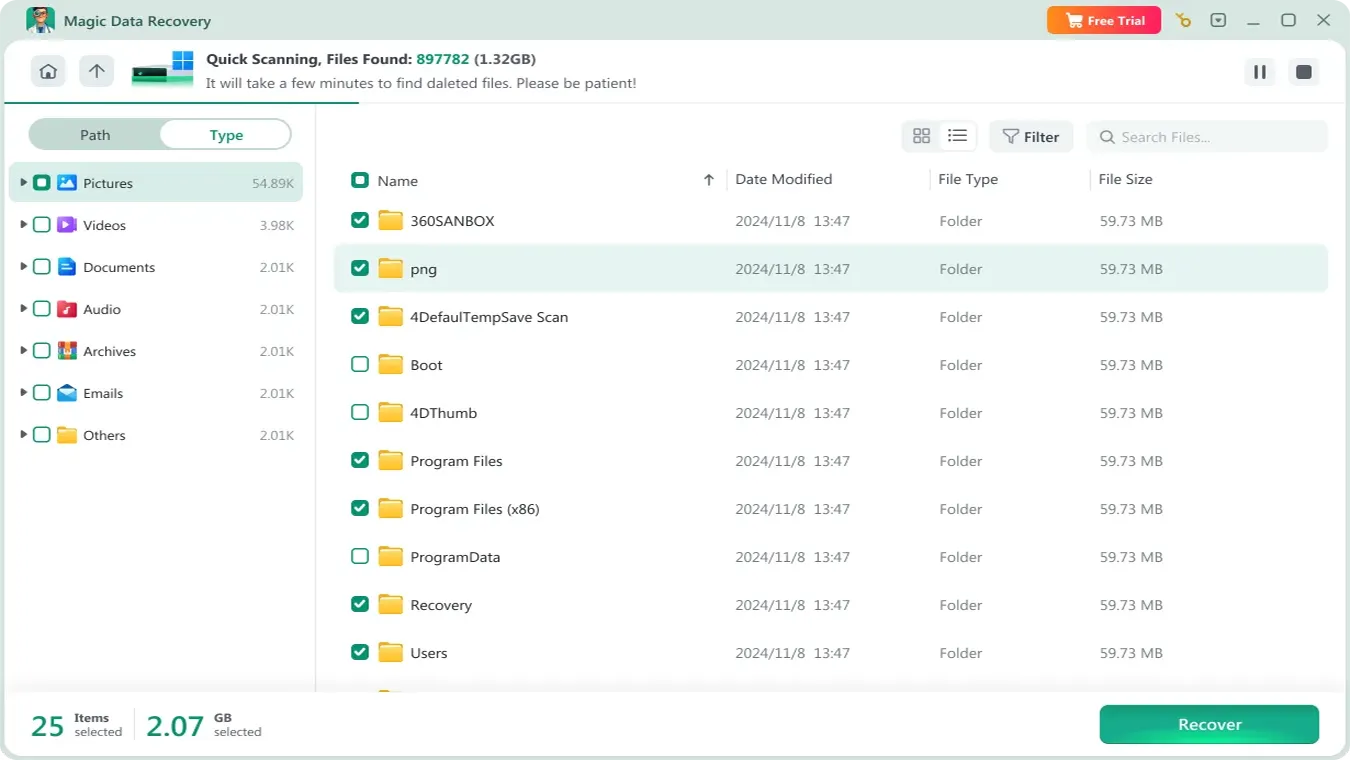
5. Filter and preview files. Search by file name, extension, size, or category. Preview important photos and documents when supported.

6. Choose the required files. Start with the most valuable items if the total exceeds the free recovery allowance.
7. Recover to another drive. Save the files to the computer or an external disk.
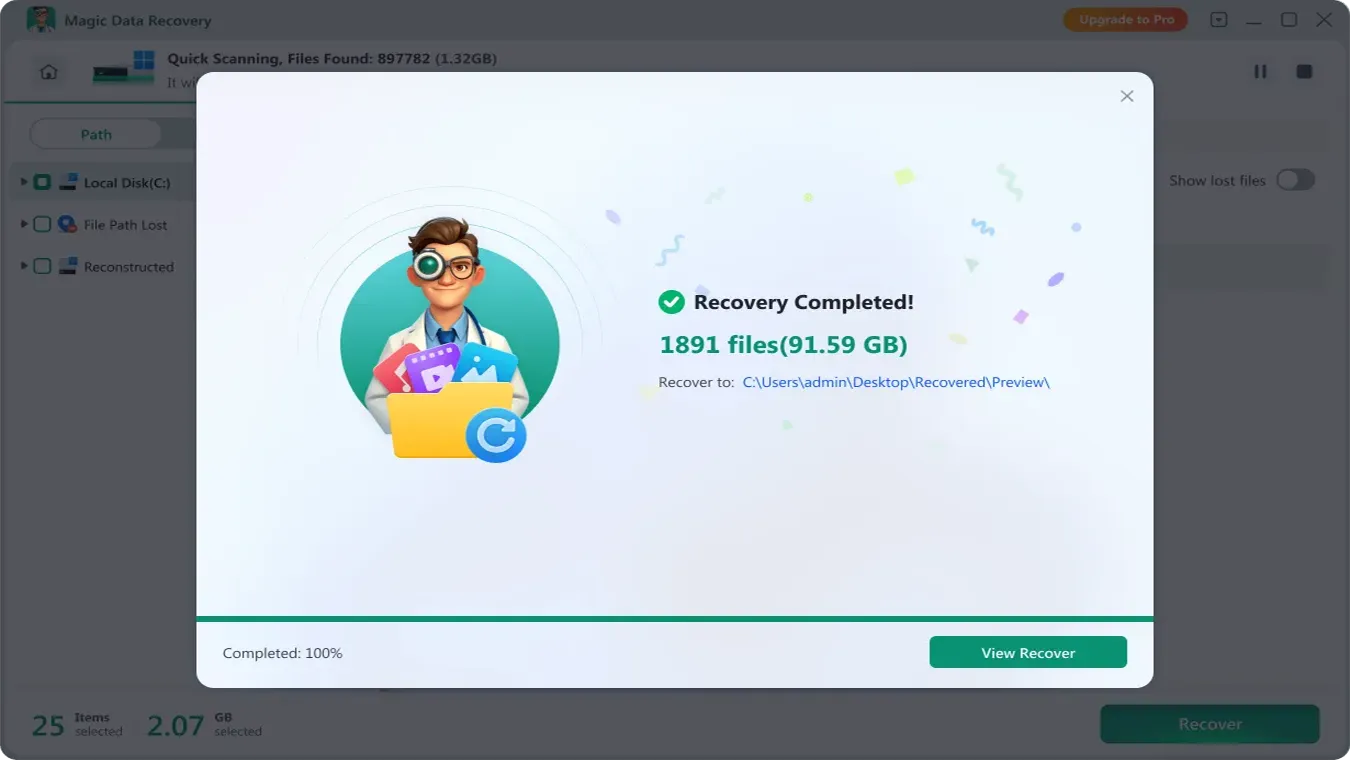
For interface details and scan instructions, see the Magic Data Recovery user guide.
Practical Use Cases
Consider three common situations:
- A photographer accidentally formats a 128GB SDXC card during an event. A deep scan can search for image and video signatures even when the original directory is gone.
- A dashcam card becomes RAW after an unsafe power interruption. Recovery software can scan the card before it is reformatted for reuse.
- A user deletes a document folder from a microSD card connected to a laptop. Preview helps confirm the correct files before recovery.
Magic Data Recovery does not make overwritten files recoverable, and software cannot repair broken flash memory. Still, its combination of deep scanning, previews, broad file support, and a 500MB free recovery allowance makes it a practical middle ground between technical freeware and immediate paid recovery.
Recover Files from SD Card Free: Software Comparison
Tool | Free recovery | Best for | Preview | Main drawback |
Windows File Recovery | Free | Targeted recovery on Windows | No | Command-line interface |
Recuva | Free edition | Recent deletion on an accessible card | Limited by file type and condition | Weaker fit for complex corruption |
PhotoRec | Free and open source | Formatted or corrupted cards | Basic QPhotoRec workflow | Usually loses names and folder structure |
Magic Data Recovery | Up to 500MB | Deletion, formatting, and file system errors | Yes, when supported | Windows only; larger recovery requires a license |
The decision to recover files from SD card free should start with the loss scenario. Users who only need a few recently deleted images may start with Recuva. Technical users who accept renamed results can try PhotoRec. Those who need previews and a simpler workflow can use Magic Data Recovery to recover files from SD card free up to the stated limit.
Can You Recover Files from a Formatted SD Card Free?
Users asking how to recover files from SD card free after formatting should know that a quick format often removes file system references without immediately overwriting every data block. Therefore, recovery may remain possible if you stop using the card quickly. A full overwrite, secure erase, or continued recording can make some or all files unrecoverable.
Do not format the card again, even if Windows or the camera requests it. Instead, connect it to a computer and scan it. PhotoRec is suitable when you accept reconstructed files without original names. Magic Data Recovery is easier when you want categorized results and previews.
For a detailed scenario-based workflow, read how to recover files from a formatted SD card.
Can You Recover Files from a Corrupted or RAW SD Card?
When an SD card becomes RAW, you can sometimes recover files from SD card free before repair. Recovery may also succeed when the card displays an access error or asks to be formatted. These symptoms often indicate logical file system damage rather than broken flash memory.
Use this order:
- Test one reliable card reader and another USB port.
- Check whether Disk Management shows the correct card capacity.
- If the card appears, scan it before running CHKDSK or formatting.
- Save recovered files to another drive.
- Repair, test, or replace the card only after the data is secure.
Stop software recovery if the card disconnects repeatedly, becomes unusually hot, reports the wrong capacity, or fails to appear in Disk Management and other devices. Those signs may point to controller, connector, or NAND flash failure.
Common Mistakes That Reduce Recovery Chances
Even the best free SD card recovery software cannot reverse overwriting. Avoid these mistakes:
- Continuing to shoot photos or record video
- Installing a recovery app onto the affected card
- Recovering files back to the same card
- Formatting because Windows suggests it
- Running repair commands before copying important data
- Scanning a physically unstable card repeatedly
- Using cracked recovery software from untrusted websites
- Assuming a successful preview guarantees every byte is intact
A preview is strong evidence that a file can be read, but large videos and fragmented files may still contain damaged sections. Open recovered files from the destination drive and verify them before reusing the card.
When Free Methods Are Not Enough
Stop trying to recover files from SD card free with software when the card has physical damage. Professional help may be appropriate when:
- The card is cracked, bent, burned, or water-damaged
- The contacts are missing or heavily corroded
- No computer, camera, or card reader detects it
- The reported capacity is incorrect
- The card disconnects during every scan
- The files have exceptional personal, legal, or commercial value
Repeated scans can stress an unstable device. When the content is irreplaceable, preserve the card and contact a professional laboratory instead of experimenting with repair commands.
How to Prevent Future SD Card Data Loss
Recovery is never as reliable as a verified backup. After you recover the files:
- Keep at least two copies of important photos and documents.
- Import camera cards after each project.
- Format cards in the device that will use them, but only after backup verification.
- Eject the card safely before removing it.
- Avoid filling the card completely.
- Replace cards that show recurring errors.
- Use reputable card readers and memory cards.
- Test backups by opening several copied files.
These habits reduce the need to search for recover files from SD card free after every deletion, format, or file system error.
Conclusion
You can often recover files from SD card free when the card is still detectable and the missing data has not been overwritten. Start with backups, then choose Windows File Recovery or Recuva for simple deletion. PhotoRec works well for users who need a completely free file-carving tool, while Magic Data Recovery offers a clearer workflow for deleted, formatted, and corrupted SD cards.
Magic Data Recovery is recommended because it combines deep scanning, file filtering, preview, support for more than 5,000 file types, and up to 500MB of free recovery. It does not promise impossible results, but it gives ordinary Windows users a practical way to evaluate and restore recoverable data.
For more recovery principles and related solutions, visit Amagicsoft’s deleted file recovery.
Supports Windows 7/8/10/11 and Windows Server
FAQs About Recover Files from SD Card Free
Can I recover files from SD card free after deletion?
Yes. You can use Recuva, PhotoRec, Windows File Recovery, or the free allowance in Magic Data Recovery. Stop using the card immediately and save restored files to another drive. Results depend on whether new data has overwritten the deleted content and whether the card has logical or physical damage.
What is the best tool to recover files from SD card free?
The best choice depends on the problem. Recuva suits recent deletion, Windows File Recovery suits command-line users, and PhotoRec helps with formatted or corrupted cards. Magic Data Recovery is easier for users who need previews, filters, and support for several loss scenarios, with up to 500MB of free recovery.
Can I recover files from SD card free after formatting?
Often, yes. A quick format usually removes file system references before the underlying data is overwritten. Stop using the card, avoid formatting it again, and run a deep scan. Recovery may lose original names or folders, especially when signature-based tools rebuild files without usable file system metadata.
Why should I not recover files to the same SD card?
Writing recovered files back to the source card can overwrite other deleted data that has not yet been restored. This can turn recoverable files into permanently damaged ones. Always choose a computer drive, external hard drive, or different memory card as the recovery destination, then verify the restored files before reusing the original card.
Can CHKDSK recover deleted photos from an SD card?
CHKDSK repairs file system structures; it does not function as dedicated deleted-file recovery software. In some corrupted-card cases, it may change directory records or create fragments, which can complicate later recovery. Scan and save important files first. Run CHKDSK only after recovery when you no longer need data from the original card.
Can I recover files from SD card free if it is not detected?
Software requires the card to appear as a storage device with a valid capacity. First test another reader, USB port, and computer. If the card remains absent, shows zero capacity, overheats, or disconnects constantly, physical failure may be involved. A professional recovery laboratory may be safer than repeated software scans.
Can I recover deleted SD card files on an Android phone?
Recovery directly on Android is limited, especially without root access. Remove the card and connect it to a computer through a reader whenever possible. If Android used the card as encrypted internal storage, another computer may not read it normally. Check cloud backups and the gallery trash before attempting desktop recovery.
Is it safe to recover files from SD card free?
It is generally safe when the software comes from a trusted official source and scans without writing to the affected card. Avoid cracked programs, forced repair operations, and recovery to the same device. For an unstable, damaged, or repeatedly disconnecting card, stop scanning and consider professional help to prevent further deterioration.

Jason has over 15 years of hands-on experience in the computer data security industry. He specializes in data recovery, backup and restoration, and file repair technologies, and has helped millions of users worldwide resolve complex data loss and security issues.