
Cost of Data Loss Statistics: 2026 Business Cost Analysis
Cost of data loss statistics are often reduced to one scary number. That is the wrong way to read them. A serious data loss event does not create just one bill. It creates a stack of bills: incident response, downtime, missed revenue, legal work, customer remediation, delayed releases, backup restoration, and the long tail of rebuilding trust. That is why the smartest way to analyze data loss is to separate breach cost, downtime cost, and recovery cost instead of treating them as the same thing.
The best current benchmarks already show how large that stack can become. IBM put the global average cost of a data breach at USD 4.4 million in 2025. Uptime Institute found that 54% of respondents said their most recent significant outage cost more than USD 100,000, and 16% said it cost more than USD 1 million. Splunk and Oxford Economics estimated that downtime costs Global 2000 firms USD 400 billion per year, while Sophos reported an average ransomware recovery cost of USD 1.53 million in 2025. Taken together, these figures show that the cost of data loss is not one average. It is an overlapping system of financial damage.
Table of Contents
Quick cost of data loss statistics
- The global average cost of a data breach was USD 4.4 million in 2025, and extensive use of AI in security correlated with USD 1.9 million in savings.
- In IBM’s 2024 study, the global average breach cost hit USD 4.88 million, while 70% of breached organizations said the disruption was significant or very significant.
- 54% of surveyed operators said their most recent significant outage cost more than USD 100,000, and 16% said it exceeded USD 1 million.
- Splunk estimated downtime costs Global 2000 companies USD 400 billion annually, or roughly 9% of profits.
- Verizon found ransomware in 44% of breaches in 2025, up from 32%, while 64% of victim organizations did not pay the ransom.
- Sophos reported that average ransomware recovery costs fell from USD 2.73 million in 2024 to USD 1.53 million in 2025, but the median ransom payment was still USD 1 million.
- Spanning and Kaseya both highlighted a recoverability gap: more than 60% of organizations believed they could recover from downtime within hours or under a day, but only 35% could do so in reality.
- Veeam found that after ransomware attacks, only 10% of affected organizations recovered more than 90% of their data, while 57% recovered less than 50%.
Why most cost of data loss statistics are misunderstood
Most articles ranking for this topic make one basic mistake: they combine unlike-for-like numbers. A breach benchmark from IBM is not measuring the same thing as an outage benchmark from Uptime, a downtime benchmark from Splunk, or a ransomware recovery benchmark from Sophos. When those figures are mixed without explanation, readers get drama, not clarity.
A better model has four layers. First, there is direct incident cost: investigation, containment, forensics, legal, notifications, and remediation. Second, there is downtime cost: lost revenue, SLA penalties, overtime, and operational paralysis. Third, there is recovery cost: backup restoration, data validation, staff time, external responders, and rebuilt infrastructure. Finally, there is hidden strategic cost: customer churn, lower lifetime value, damaged partner relationships, slower product delivery, and higher future security spending. Splunk’s findings on stock price pressure, customer lifetime value, and time-to-market delays make that last category impossible to ignore.
The direct incident cost is still brutally high
If you only want the headline number, IBM is still the cleanest benchmark. The company’s 2025 Cost of a Data Breach Report put the global average at USD 4.4 million, while its 2024 study put the average at USD 4.88 million, the largest year-over-year jump since the pandemic. In the 2024 report, 70% of breached organizations said the breach caused significant or very significant disruption, and even among the small minority that fully recovered, recovery usually took more than 100 days. In other words, the dollar amount understates the duration of the pain.
The 2025 decline from USD 4.88 million to USD 4.4 million should not be read as “problem solved.” IBM’s own explanation is that organizations were identifying and containing incidents faster. The same report still found that 31% of studied organizations experienced operational disruption, that 20% experienced breaches linked to shadow AI, and that those shadow AI breaches added as much as USD 670,000 to average breach cost. That means cost pressure did not disappear. It became more dependent on speed, governance, and visibility.
This is one of the most useful lessons hidden inside current cost of data loss statistics: time is the cost multiplier. In IBM’s 2024 research, organizations that used security AI and automation extensively identified and contained incidents 98 days faster and saw USD 2.2 million less in breach costs. Internal detection also mattered. Breaches detected by an organization’s own team or tools shortened the lifecycle by 61 days and saved nearly USD 1 million compared with attacker disclosure. Put simply, faster detection is not just an operational win. It is a margin-protection strategy.
Downtime turns data loss into a revenue event
A lot of executives think about data loss as an IT failure. The better way to think about it is as a revenue interruption event. Uptime Institute’s 2024 outage analysis found that more than half of respondents said their most recent significant outage cost over USD 100,000, and 16% said the bill passed USD 1 million. Even more revealing, four in five respondents said their most recent serious outage could have been prevented with better management, processes, and configuration. That is a polite way of saying many expensive outages are avoidable management failures.
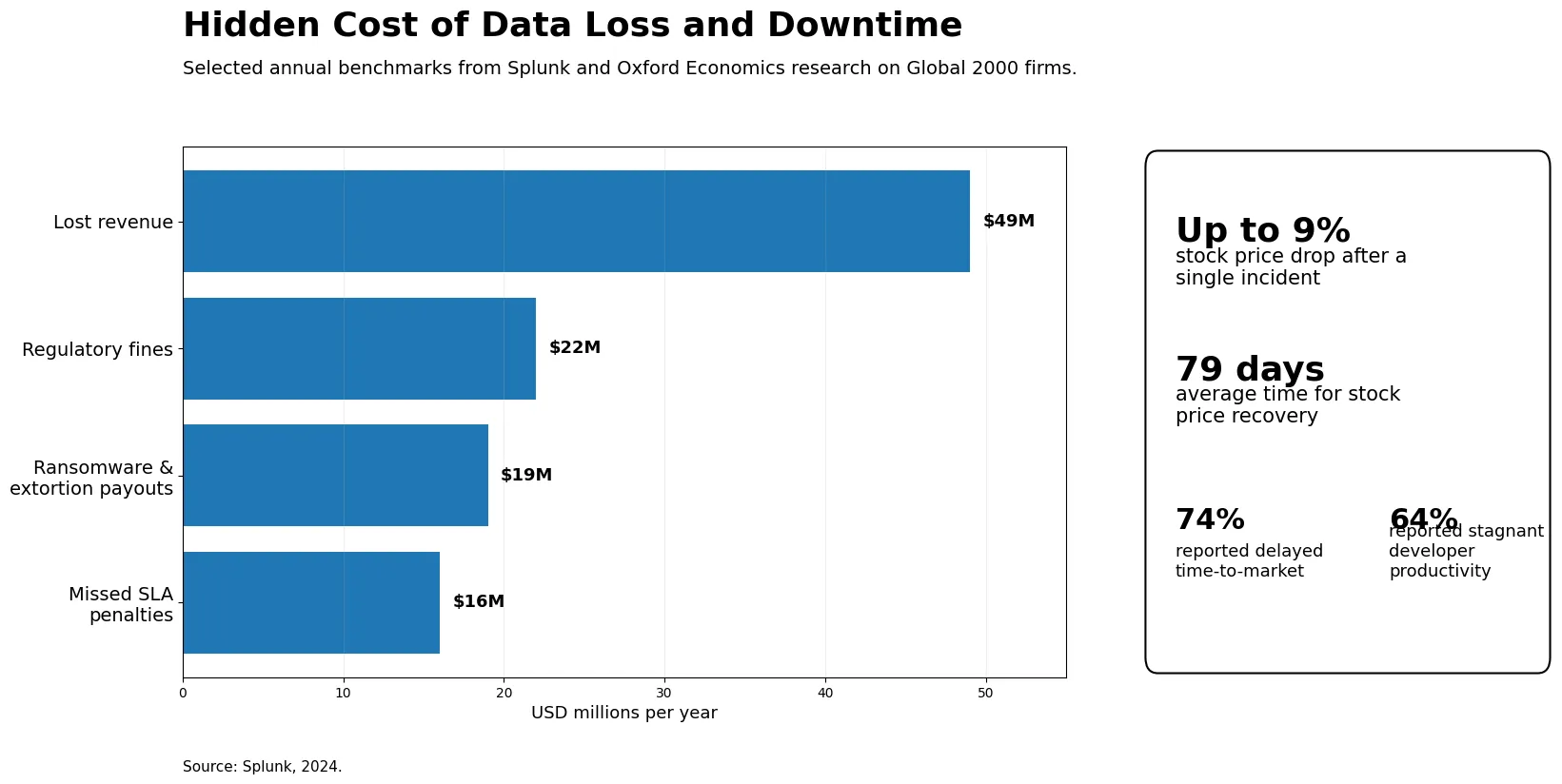
Splunk’s downtime research makes the financial cascade even clearer. Across Global 2000 companies, the total annual cost of downtime was estimated at USD 400 billion, or about 9% of profits. The largest direct cost was lost revenue, averaging USD 49 million annually, followed by regulatory fines at USD 22 million and missed SLA penalties at USD 16 million. That is why data loss cost should never be framed as a pure security line item. It hits sales, compliance, finance, and customer operations all at once.
The same Splunk study also quantified the costs most articles leave out. Stock price can fall by as much as 9% after a single incident and take 79 days to recover. 74% of technology executives reported delayed time-to-market, 64% reported stagnant developer productivity, 40% of CMOs said downtime hurt customer lifetime value, and another 40% said it damaged reseller or partner relationships. These are not side effects. They are core economic losses. They are also why shallow listicles understate the real business cost of data loss.
Recovery readiness is usually worse than leadership thinks
One of the strongest patterns across recent studies is the confidence gap. Spanning’s 2025 State of SaaS Backup and Recovery report, based on more than 3,000 IT and information security professionals worldwide, found that more than 60% of organizations believed they could recover from a downtime event within hours. In reality, only 35% could. Only 40% were confident that their backup and recovery solution could sufficiently protect critical digital assets in a disaster, and 25% had no policies or controls in place to prevent malicious access to backup infrastructure. That is a dangerous combination: confidence, weak controls, and unproven recovery.
Kaseya’s 2025 backup and recovery survey reached a very similar conclusion. More than 3,000 IT professionals were surveyed, and only 10% of businesses reported zero outages last year. 60% believed they could recover in under a day, but only 35% could in reality. About 40% could recover lost SaaS data in hours, while another 35% needed days or weeks. Even worse, 8% were unsure of their recovery time and 2% did not believe they could recover any lost SaaS data at all. That is not a backup maturity issue. That is a recoverability crisis.
This matters because the cost of data loss rises sharply when recovery is uncertain. A company that can restore clean data fast suffers one kind of loss. A company that spends days figuring out what is intact, what is corrupt, and what is missing suffers a very different kind of loss. The first company pays for interruption. The second company pays for interruption, rework, customer frustration, executive escalation, and often new emergency spending. That is why backup should be measured by restore speed and restore completeness, not by whether a job ran overnight.
Hybrid and multi-environment data is more expensive to lose
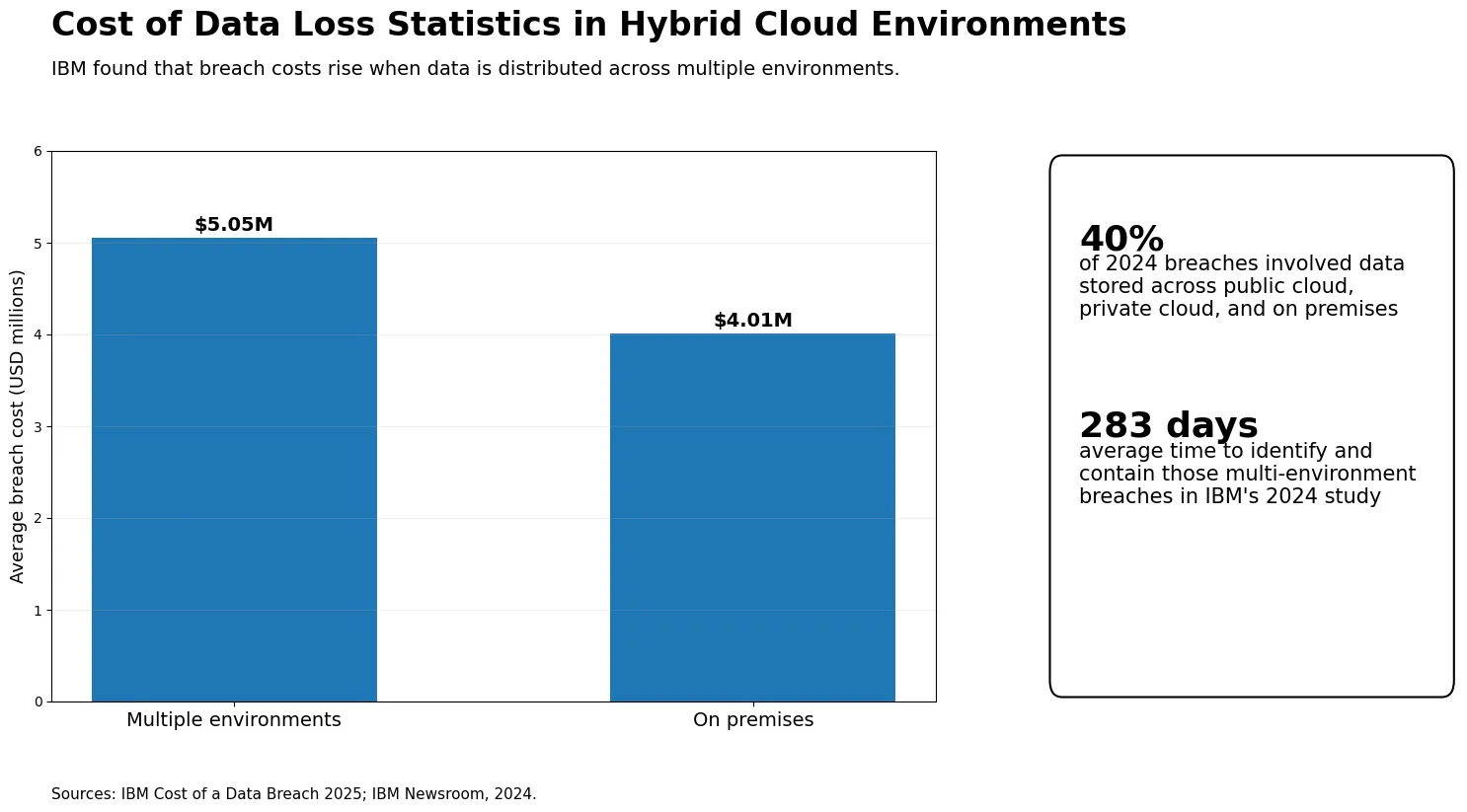
Hybrid IT makes data more useful. It also makes data loss more expensive. IBM’s 2024 research found that 40% of breaches involved data stored across multiple environments such as public cloud, private cloud, and on-premises systems. Those incidents cost more than USD 5 million on average and took 283 days to identify and contain. IBM’s 2025 report sharpened the picture further: breaches involving data distributed across multiple environments averaged USD 5.05 million, compared with USD 4.01 million for data breached on premises. Complexity has a price tag.
The reason is straightforward. Hybrid environments create more permissions, more integrations, more retention policies, more storage locations, and more room for unclear ownership. When data is fragmented, the cost of losing it rises because the cost of understanding it rises first. Security teams have to answer basic questions under pressure: Which copy is clean? Which system is authoritative? Which integration propagated corruption? Which records are subject to notification rules? Hybrid architecture does not automatically create data loss, but it raises the cost of recovery and containment when something goes wrong.
Ransomware keeps turning data loss into a finance problem
Ransomware is no longer a niche security topic inside cost of data loss statistics. It is one of the main ways those costs are generated. Verizon’s 2025 DBIR found ransomware in 44% of all reviewed breaches, up from 32% the year before. The median amount paid fell to USD 115,000, and 64% of victim organizations did not pay. That sounds encouraging until you notice the broader pattern: ransomware is still appearing in almost half of breaches, and smaller businesses are hit much harder. In larger organizations, ransomware was involved in 39% of breaches; in SMBs, it was 88%.
Sophos adds another crucial layer. In its 2025 ransomware study of 3,400 IT and cybersecurity leaders across 17 countries, the median ransom payment was USD 1 million, and the average recovery cost was USD 1.53 million, even after a decline from USD 2.73 million the year before. More than half of organizations recovered within a week, but 18% still took more than a month. That tells us something important: even when payment levels change, the real economic burden still sits in recovery, not just extortion.
Veeam’s 2025 ransomware data pushes the point further. Among 1,300 surveyed organizations, 69% had experienced a ransomware attack in the past year. Of those attacked, only 10% recovered more than 90% of their data, while 57% recovered less than 50%. Meanwhile, 94% of attacked organizations were increasing recovery budgets and 95% planned to increase prevention spending. In plain English, ransomware is not only forcing organizations to absorb incident costs now; it is also reshaping next year’s budget.
The hidden costs are what most articles ignore
This is the section where most ranking articles go thin. They mention breach cost, maybe outage cost, and stop. But hidden costs are where many businesses actually feel the damage longest. Splunk’s work shows that downtime can hit shareholder value, slow engineering output, delay launches, and weaken customer trust. IBM’s 2024 report adds another downstream effect: 63% of organizations said they would increase the cost of goods or services because of the breach. That means the cost of data loss does not just hit the victim organization. It often gets redistributed through pricing, contracts, and customer experience.
There is also a people cost. IBM found severe or high-level security staffing shortages pushed breach costs up by USD 1.76 million on average. Sophos found 63% of organizations said resourcing issues were a factor in their ransomware victimization. Uptime’s human-factor data showed that staff failing to follow procedure and incorrect processes were leading contributors to outage events caused by human error. In other words, the cost of data loss is often an organizational design problem before it becomes a technical problem.
Which sectors feel the highest costs?
Industry matters because the value of the data, the regulatory burden, and the operational consequences are different. IBM’s 2024 newsroom release said healthcare had the highest breach costs for the 14th straight year at USD 9.77 million. IBM’s 2024 finance analysis put the average breach cost for financial firms at USD 6.08 million, or 22% higher than the global average. Finance also had the second-highest breach cost of any industry. These sectors are expensive because they combine sensitive records, strict compliance pressure, and little tolerance for downtime.
The broader lesson is not just “regulated sectors pay more.” It is that data becomes more expensive to lose when it is tied directly to human wellbeing, payment systems, regulated reporting, or high-trust customer relationships. That is why leaders should not ask only, “How much data do we have?” They should ask, “How expensive is each hour of unavailability, each day of delayed containment, and each record that triggers legal or customer action?” The value of the data determines the cost curve after loss.
What these cost of data loss statistics mean for strategy
First, shorten the time between compromise and containment. IBM’s recent reports consistently show that speed has one of the strongest cost correlations in the dataset. Faster containment, internal detection, AI-driven security operations, and better governance all reduce economic damage. Verizon’s 2025 DBIR supports the same conclusion from the attack side: exploited vulnerabilities accounted for 20% of breach initial access, up 34%, yet only about 54% of edge device vulnerabilities were fully remediated throughout the year. The cheaper incident is usually the one you closed faster.
Second, test recovery as aggressively as you test prevention. Kaseya found only 15% of organizations tested backups daily and 11% tested disaster recovery daily. Spanning found the backup confidence gap remained large, while 25% lacked policies to prevent malicious access to backup infrastructure. A backup environment that is not tested, segmented, and protected is not an insurance policy. It is a hope strategy. Hope is expensive.
Third, treat resilience spend as profit protection rather than overhead. Veeam’s data on rising recovery and prevention budgets, IBM’s evidence on AI-driven savings, and Splunk’s proof that downtime destroys revenue all point in the same direction: resilience is not a cost center in opposition to growth. It is what protects growth from being erased in a single quarter by one avoidable event. That is the real board-level meaning behind today’s cost of data loss statistics.
Conclusion
The biggest takeaway from current cost of data loss statistics is simple: data loss is rarely expensive because of one isolated technical failure. It becomes expensive when four forces combine—operational disruption, slow recovery, hybrid complexity, and hidden commercial damage. That is why shallow “50 stats” articles underperform serious decision-making. They tell you the price tag. They do not explain the invoice. The organizations that outperform after data loss are usually the ones that cut containment time, prove recoverability in advance, and protect backup and hybrid environments as seriously as production systems.
From Data Loss Statistics to Practical Recovery
Cost of data loss statistics make one thing clear: the longer critical files remain unavailable, the more expensive the incident becomes. While large-scale breaches and prolonged outages require broader security and continuity planning, many real-world data loss incidents begin with a more immediate problem—deleted files, formatted drives, corrupted storage, or inaccessible devices.
For readers facing those file-recovery scenarios, Amagicsoft’s Magic Data Recovery is a practical option to evaluate. Designed for Windows users, it helps recover deleted, formatted, or corrupted files from common storage devices such as hard drives, SSDs, USB drives, and SD cards through a simple scan, preview, and recover workflow.
If your goal is to shorten recovery time and restore important files before downtime, rework, and secondary business costs grow further, Magic Data Recovery is worth considering as a practical next step.
Supports Windows 7/8/10/11 and Windows Server
FAQs
What is the average cost of data loss for a business?
There is no single universal benchmark because different studies measure different events. IBM’s 2025 global average breach cost was USD 4.4 million, Uptime found 54% of significant outages cost more than USD 100,000, and Sophos put average ransomware recovery at USD 1.53 million. The safest conclusion is that data loss cost is a range, not one number.
Is data loss the same as a data breach?
No. A data breach is one type of data loss event, but not the only one. Data loss can also come from outages, ransomware encryption, accidental deletion, bad integrations, hardware failure, or failed recovery. That is why IBM, Uptime, Splunk, and Sophos report different “cost” numbers that should not be treated as interchangeable.
Why does downtime make data loss so expensive?
Downtime converts technical failure into business loss. Splunk estimated USD 400 billion in annual downtime costs for Global 2000 firms, with lost revenue, regulatory fines, and SLA penalties leading the bill. Uptime also found that more than half of significant outages cost over USD 100,000. When systems stop, revenue and trust stop with them.
Does paying the ransom solve the data loss problem?
Not really. Verizon found 64% of victim organizations did not pay ransoms, while Sophos still reported an average ransomware recovery cost of USD 1.53 million in 2025 and a median ransom payment of USD 1 million. Even when money changes hands, restoration, validation, cleanup, and business recovery still create major costs.
Which industries usually suffer the highest data loss costs?
Healthcare and finance are among the most expensive sectors. IBM reported healthcare breach costs at USD 9.77 million in 2024, while financial firms averaged USD 6.08 million. These industries combine sensitive data, strict compliance obligations, and very low tolerance for downtime, which pushes both direct and hidden costs higher after incidents.
Why do hybrid cloud environments increase the cost of data loss?
Hybrid environments spread data across public cloud, private cloud, and on-premises systems. IBM found breaches involving multiple environments cost USD 5.05 million on average in 2025, versus USD 4.01 million for on-premises breaches, and the 2024 report showed those cases also took the longest to identify and contain. More complexity usually means more expensive recovery.
Why do companies overestimate their recovery readiness?
Because many measure backup existence instead of restore performance. Spanning found that more than 60% believed they could recover from downtime within hours, but only 35% actually could. Kaseya found the same 35% reality gap for under-a-day recovery. Confidence is common. Proven recoverability is much rarer.
What is the fastest way to reduce the cost of data loss?
The strongest lever is reducing time. IBM found extensive use of security AI and automation correlated with faster containment and lower breach costs, while internal detection shortened breach lifecycles and saved nearly USD 1 million. In practice, that means faster detection, protected backups, regular restore testing, and tighter control over hybrid environments.

Jason is a data recovery and technical support specialist with over 15 years of hands-on experience. He has worked extensively with frontline users, troubleshooting difficult data loss cases and providing practical recovery solutions for accidental deletion, formatted drives, damaged file systems, lost partitions, system failures, and other recovery emergencies. His expertise also includes backup and restoration, file repair, and disaster recovery, with a strong emphasis on safe, reliable, and technically accurate guidance.