
Best Software to Recover Files: 7 Picks
Losing a work document, family photo, project archive, or an entire folder can quickly become stressful. The good news is that deletion does not always erase file content immediately. The right best software to recover files can scan storage for recoverable records before new data overwrites them. This guide explains how to compare recovery tools, which options fit different situations, and how to use software safely. For a broader recovery workflow, start with this deleted file recovery guide.
Table of Contents
Quick Answer: What Is the Best Software to Recover Files?
For most Windows users, Magic Data Recovery is our recommended best software to recover files because it combines a simple scan-preview-recover workflow with support for accidental deletion, formatted storage, file system errors, inaccessible drives, system reinstallation, and virus-related loss. It works best for logical data loss, where the device still appears in Windows and has no clear signs of physical failure.
Other tools remain useful in specific cases. Recuva is suitable for straightforward undelete tasks. Windows File Recovery is a free command-line option. PhotoRec can carve files from badly damaged file systems, although it may not preserve original names or folders. R-Studio offers deeper controls for experienced users. Therefore, the right choice depends on how the files disappeared, your operating system, and your technical comfort.
How We Chose the Best Software to Recover Files
A trustworthy comparison should evaluate more than a long feature list. We used the following practical criteria to identify the best software to recover files for common home and office situations.
Recovery Scenario Coverage
Good file recovery software should address more than files deleted from the Recycle Bin. We looked for support for permanent deletion, quick formatting, RAW or inaccessible partitions, file system errors, lost folders, and removable storage.
Scan Quality and Result Organization
A quick scan can locate recently deleted file records, while a deeper scan searches more of the device. However, finding thousands of files is not enough. The best data recovery software for Windows should also provide filters, search tools, file categories, or folder views that help users locate the correct data.
File Preview Before Recovery
Previewing a photo, document, video, or archive helps confirm that a file is usable before recovery. This is especially important after formatting or file system corruption, when filenames and directory structures may be incomplete.
Ease of Use and Technical Control
Beginners usually need a clear graphical interface. Advanced users may prefer disk images, file-system parameters, RAID controls, or raw carving options. We considered both needs rather than declaring one interface style ideal for everyone.
Safe Recovery Workflow
The best software to recover files should encourage users to install the program away from the affected drive and save recovered data to another location. These steps reduce the risk of overwriting files that are still recoverable.
Before Using Any File Recovery Tool
Your actions after data loss can matter as much as the program you choose. Follow these steps before running the best software to recover files you selected.
- Stop using the affected device. Do not download files, install programs, edit documents, take new photos, or copy data to it.
- Do not format an inaccessible drive. A Windows prompt to format a disk does not mean formatting is the safest first action.
- Avoid CHKDSK before recovery. Repair operations can change file-system structures. Recover important files first, then repair the device.
- Use another drive for installation and recovered files. For example, recover from a USB drive to the computer, or from the system disk to an external drive.
- Check for physical warning signs. Stop DIY recovery if a hard drive clicks, repeatedly disconnects, does not spin, smells burned, or is not detected consistently. A professional laboratory is safer in those cases.
7 Best Software to Recover Files Options Compared
Software | Best For | Main Strength | Main Limitation |
Magic Data Recovery | Most Windows users | Broad logical-loss coverage with a guided workflow | Windows-focused |
Recuva | Simple deleted-file recovery | Lightweight and easy to start | Less suitable for complex corruption |
Windows File Recovery | Free Microsoft command-line recovery | No third-party purchase required | Commands can be difficult for beginners |
PhotoRec/TestDisk | Open-source recovery and damaged file systems | Signature-based carving and partition tools | Names and folder structures may be lost |
Disk Drill | Polished interface and extra disk utilities | Preview, filtering, and broad device support | Free recovery allowance is limited |
EaseUS Data Recovery Wizard | Guided cross-platform recovery | Beginner-friendly workflow and broad scenarios | Full recovery may require a paid plan |
R-Studio | Technicians and advanced cases | Detailed file-system, imaging, and network controls | Steeper learning curve |
1. Magic Data Recovery — Best Overall for Windows Users
Magic Data Recovery is the best software to recover files for users who need one practical Windows solution across several logical data-loss scenarios. Instead of limiting recovery to recently deleted items, it can scan for files lost after deletion, formatting, file system errors, inaccessible storage, Windows reinstallation, or virus damage.
The official product workflow centers on selecting a drive, scanning, previewing files, and recovering them to a safe destination.
Core Problems It Solves
Magic Data Recovery can help when you:
- Emptied the Recycle Bin or used Shift+Delete
- Formatted the wrong hard drive, USB drive, or memory card
- Cannot open a drive because Windows reports a file system error
- Lost files after reinstalling Windows
- Need to scan an internal disk, external drive, USB device, or SD card
For a deletion-specific workflow, see how to recover permanently deleted files in Windows 10. If formatting caused the loss, follow this guide to recover files from a formatted hard drive.
Why It Is a Reliable First Choice
The software balances recovery coverage with accessibility. Users do not need to build command syntax or choose complex file-system parameters before scanning. Preview also helps users verify important files before saving them.
Compared with basic undelete utilities, Magic Data Recovery addresses a wider range of logical-loss situations. Compared with technician-oriented tools, it reduces the number of decisions that can confuse an ordinary user.
That does not mean every file will be recoverable. Overwritten data, securely erased storage, SSD TRIM activity, severe physical damage, and some encryption cases can prevent software recovery. A credible best software to recover files recommendation should state these limits clearly.
Best for: Windows users who want a direct solution for deleted, formatted, corrupted, RAW, or inaccessible storage.
CTA: If you need a more efficient recovery path, try Magic Data Recovery, preview the scan results, and save recoverable files to another drive.
Supports Windows 7/8/10/11 and Windows Server
2. Recuva — Best for Basic Undelete Tasks
Recuva is a familiar Windows utility for recovering deleted photos, music, documents, videos, emails, and other files from computers and rewritable media such as memory cards, external hard drives, and USB drives. Its simple interface makes it a reasonable first attempt when a file was recently deleted and the storage remains healthy.
However, a basic undelete tool may be less appropriate when a partition is RAW, the device was formatted, or the file system is badly damaged. In those cases, the best software to recover files should provide broader scan coverage and a clearer way to inspect complex results.
Best for: Recent deletion from a healthy Windows drive.
3. Windows File Recovery — Best Free Microsoft Tool
Windows File Recovery is Microsoft’s command-line app for recovering files deleted from local storage, including internal drives, external drives, and USB devices. It does not recover from cloud storage or network shares.
Because it uses commands rather than a standard graphical interface, users must identify source and destination drives and enter the correct recovery syntax.
This option can be useful when budget is the priority and you are comfortable with Terminal or Command Prompt. Still, it is not the best software to recover files for users who want previews, visual filtering, or a guided interface.
Best for: Technical Windows users seeking a free official utility.
4. PhotoRec and TestDisk — Best Open-Source Recovery Toolkit
PhotoRec ignores the damaged file system and searches underlying storage for known file signatures. This approach can recover documents, archives, videos, and photos from formatted or severely corrupted media.
TestDisk focuses more on lost partitions, boot sectors, and certain file-system recovery tasks. Both tools are free and open source.
The trade-off is organization. PhotoRec may recover content without original filenames or folder structures, which creates substantial sorting work. It can be a powerful fallback, but many ordinary users will prefer best software to recover files with a visual preview and easier result management.
Best for: Experienced users who prioritize open-source tools and raw file carving.
5. Disk Drill — Best for a Polished Interface
Disk Drill offers a modern visual workflow for deleted files, formatted devices, external storage, and other logical-loss cases. Its Windows version provides file previews, filters, broad storage support, and additional utilities such as disk imaging and drive-health features.
The free Windows edition can scan and preview files, while the amount of data it can restore without upgrading is limited.
Disk Drill is a strong option for people who value design and extra disk tools. Nevertheless, users comparing the best software to recover files should check the current license terms and confirm that their required recovery volume fits the chosen edition.
Best for: Users who value interface quality and supporting disk utilities.
6. EaseUS Data Recovery Wizard — Best Guided Cross-Platform Option
EaseUS Data Recovery Wizard supports Windows and macOS editions and addresses deletion, formatting, operating-system crashes, virus-related loss, and common storage devices. Its graphical workflow, categories, filtering, and previews make it approachable for beginners.
The official Windows free edition advertises a limited free recovery allowance, so larger jobs may require an upgrade.
EaseUS is useful when you need a well-established guided product on more than one desktop platform. For Windows-only users, Magic Data Recovery may offer a more focused path without unnecessary platform considerations.
Best for: Beginners who want a guided Windows or macOS solution.
7. R-Studio — Best for Advanced Users and Technicians
R-Studio supports many Windows, macOS, and Linux file systems and includes raw file recovery for heavily damaged or unknown structures. It also offers advanced capabilities for disk images, unbootable systems, RAID configurations, and network recovery.
These controls make it valuable for technicians and experienced users.
The same depth can make the interface harder for beginners. R-Studio may be the best software to recover files in a complex professional workflow, but it is not always the fastest route for a home user who only needs to restore deleted documents from one Windows drive.
Best for: Technicians, system administrators, and advanced recovery cases.
How to Recover Files with Magic Data Recovery
The following workflow reduces avoidable mistakes and shows why Magic Data Recovery is our best software to recover files recommendation for everyday Windows recovery.
Step 1: Stop Writing Data to the Source Drive
Close programs that use the affected disk. Disconnect an external device if you are not ready to scan it. Continued use may overwrite deleted or formatted content.
Step 2: Install the Software on a Safe Drive
Install Magic Data Recovery on a different physical drive whenever possible. Never install it onto the USB drive, partition, or disk that contains the lost files.
Supports Windows 7/8/10/11 and Windows Server
For more background on free and paid approaches, compare data recovery freeware and undelete freeware.
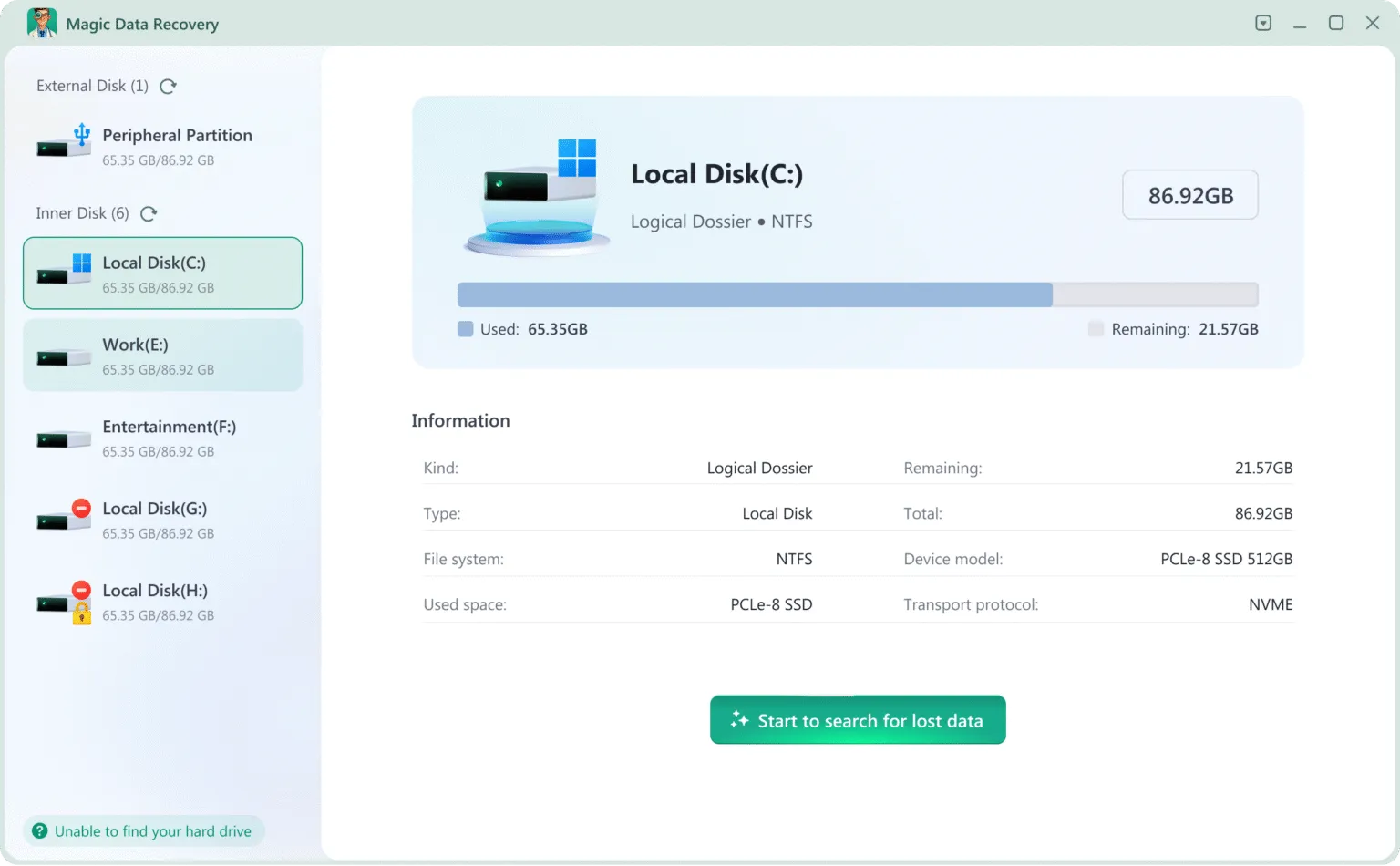
Step 3: Select the Correct Device
Launch the program and choose the disk or partition where the files were stored. Check the capacity and drive label carefully, especially when several external devices are connected.
Step 4: Run the Scan
Start scanning and allow the process to complete when the loss involves formatting, corruption, or an inaccessible file system. Recently deleted files may appear earlier, while complex cases need a more thorough search.
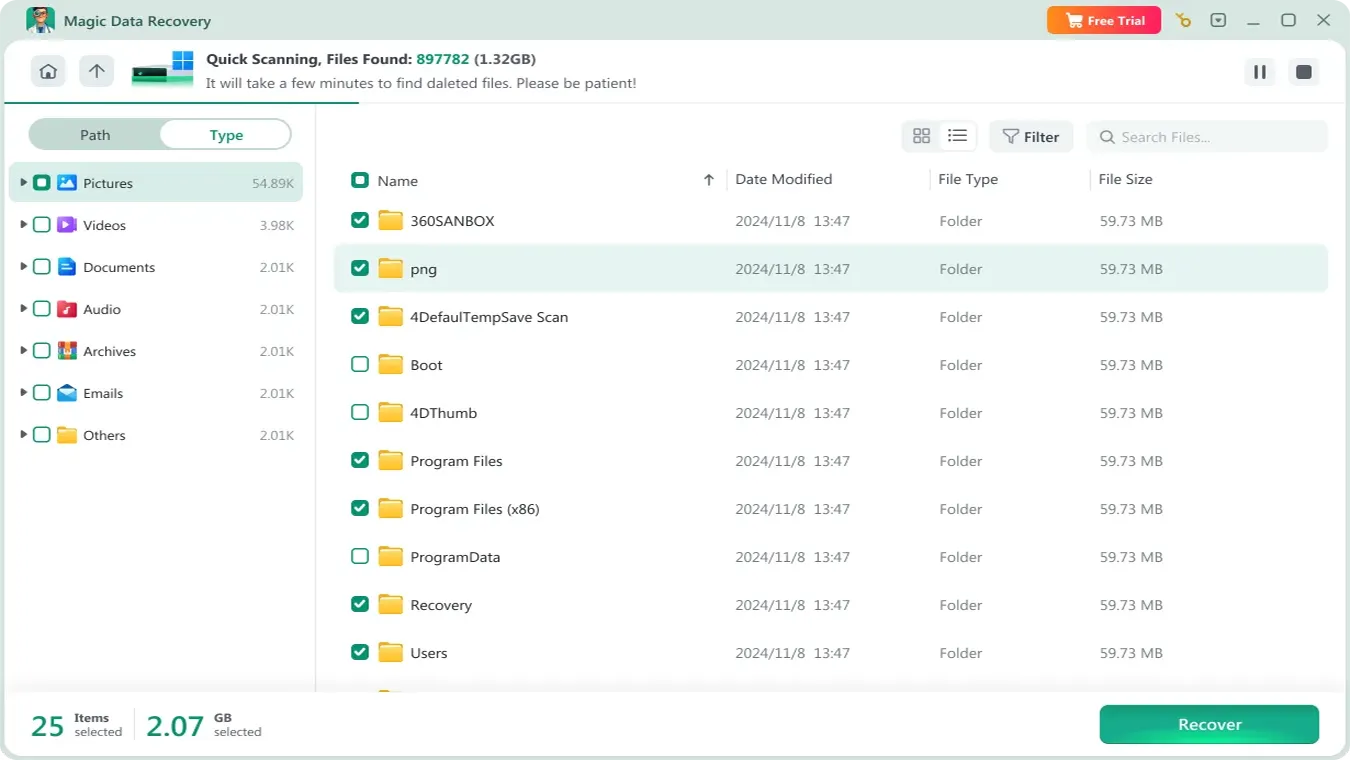
Step 5: Filter and Preview Files
Search by filename or extension when metadata remains available. Use file categories and preview important documents, photos, or videos.
A successful preview is a useful sign, although it cannot guarantee that every recovered file will open perfectly.
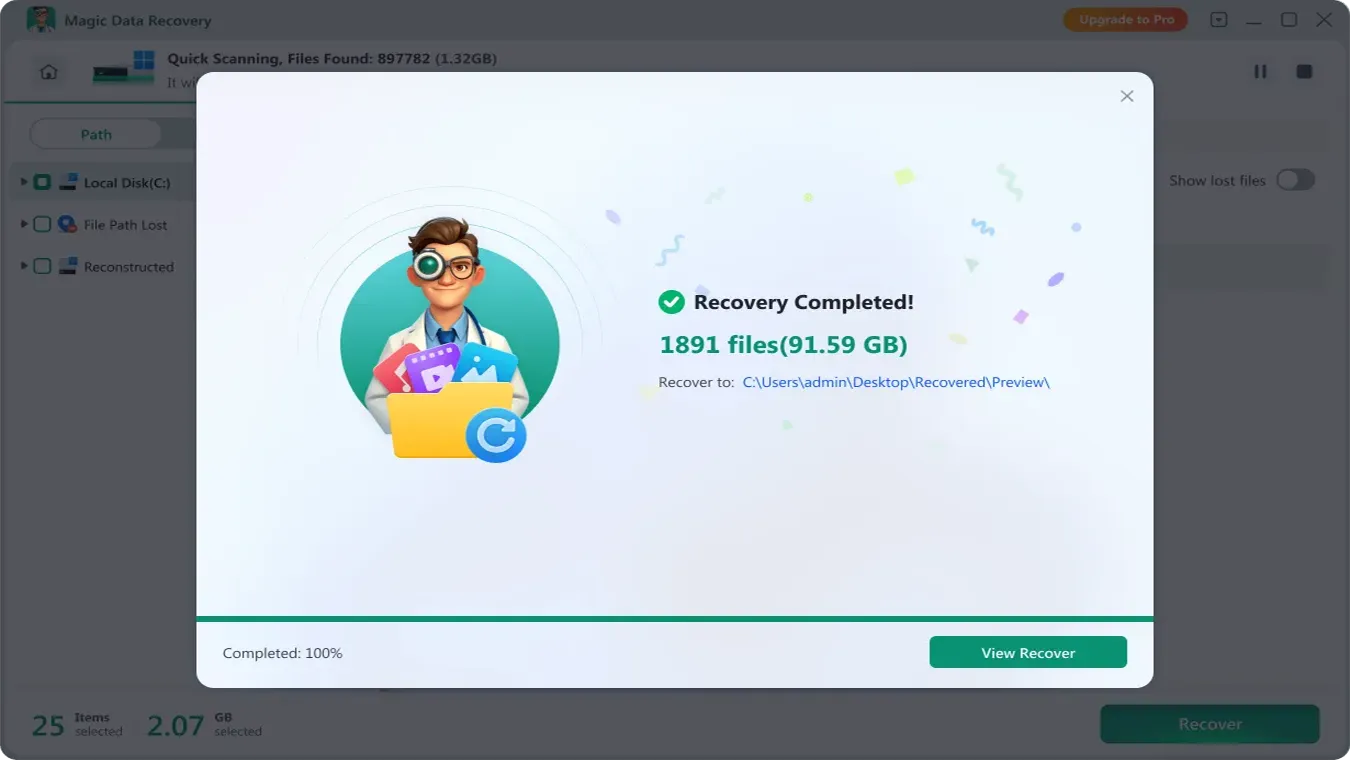
Step 6: Recover to Another Drive
Select a healthy destination with enough free space. Never restore data to the same source before you have completed recovery and verified the files.
Which Recovery Software Should You Choose?
Use this scenario-based guide instead of choosing the first program labeled best software to recover files.
Data-Loss Scenario | Recommended Starting Point | Why |
Recently deleted file in Recycle Bin | Recycle Bin restore | Fastest and does not require scanning |
Permanently deleted Windows files | Magic Data Recovery or Recuva | Visual scanning and straightforward recovery |
Formatted drive or memory card | Magic Data Recovery | Broader logical-loss support and preview workflow |
RAW or inaccessible Windows drive | Magic Data Recovery | Can scan before risky formatting or repair attempts |
No budget and comfortable with commands | Windows File Recovery | Free Microsoft command-line tool |
Severely corrupted file system | PhotoRec | Signature-based carving can bypass file-system metadata |
RAID, disk image, or network recovery | R-Studio | Advanced controls for professional workflows |
Clicking or physically unstable hard drive | Professional recovery laboratory | DIY scans can add stress or fail to detect the device |
When a drive shows as RAW, recover important files before trying to repair it. This RAW recovery software guide explains the situation in more detail.
Common Mistakes That Reduce Recovery Chances
Even the best software to recover files cannot reverse every mistake. Avoid these common problems:
- Installing recovery software on the affected drive
- Saving recovered files back to the source
- Continuing to use a camera card, USB drive, or computer after deletion
- Formatting an inaccessible drive because Windows recommends it
- Running repair commands before extracting important files
- Scanning a clicking or repeatedly disconnecting hard drive
- Expecting overwritten or securely erased files to return
- Buying software before confirming that the scan can locate the needed data
A sensible process starts with diagnosis, protects the source, verifies previewable results, and writes recovered data elsewhere.
Conclusion: Our Best Software to Recover Files Recommendation
The best software to recover files is not simply the tool with the longest feature list. It must match the data-loss scenario, protect the source drive, organize scan results, and help users verify files before recovery.
Magic Data Recovery is our recommended choice for most Windows users because it addresses the problems people encounter most often: deleted files, formatted storage, file system errors, RAW or inaccessible drives, reinstalled systems, and virus-related loss.
Its guided scan, preview, and recovery workflow provides a practical balance between broad coverage and ease of use. Recuva, Windows File Recovery, PhotoRec, Disk Drill, EaseUS, and R-Studio remain valuable when their specific strengths match the case.
Act quickly, stop using the affected storage, and recover files to another device. For additional methods and safety guidance, return to the deleted file recovery.
Supports Windows 7/8/10/11 and Windows Server
FAQs About the Best Software to Recover Files
What is the best software to recover files on Windows?
For most Windows users, Magic Data Recovery is a strong best software to recover files choice because it covers deletion, formatting, file system errors, inaccessible drives, system reinstallation, and virus-related loss in one guided interface. The right tool still depends on the case. R-Studio suits experts, while Recuva can handle simpler deletion jobs.
Can recovery software restore permanently deleted files?
Yes, recovery software may restore permanently deleted files when new data has not overwritten their storage space. Stop using the affected drive immediately and scan it from another disk. The best software to recover files should let you preview results and save recovered items elsewhere. Recovery becomes less likely after heavy use, secure erasure, or SSD TRIM.
Can the best software to recover files restore a formatted drive?
The best software to recover files can often restore data after a quick format because the operation may rebuild file-system records without immediately overwriting all file content. Do not save anything to the formatted device. Run a thorough scan, preview the results, and recover files to another drive. Full formats and overwritten sectors are much harder to recover.
Is free file recovery software good enough?
Free tools can be enough for a recently deleted document, a small recovery job, or a user comfortable with commands. Recuva, Windows File Recovery, and PhotoRec each have useful roles. However, free editions may limit recovery volume, previews, support, or result organization. Compare the actual scenario and scan results before deciding whether an upgrade is worthwhile.
Can file recovery software recover data from an SSD?
Sometimes. SSD recovery depends heavily on TRIM, device activity, connection type, and how the data was lost. TRIM may clear deleted blocks quickly, leaving no content for software to restore. Stop using the SSD immediately. The best software to recover files can scan what remains, but no legitimate program should promise recovery after the blocks have been erased.
Is it safe to install recovery software on the same drive?
No. Installing software on the affected drive can overwrite the exact sectors that contain deleted or formatted files. Install the best software to recover files on another physical disk when possible. Likewise, save recovered data to a separate drive. If the system disk is affected, consider connecting it to another computer before scanning.
Can software recover files from a physically damaged hard drive?
Software only works when the computer can read the device reliably enough to scan it. Stop immediately if the drive clicks, grinds, disappears repeatedly, does not spin, or shows other physical failure signs. Running the best software to recover files against unstable hardware may waste time or add stress. A professional data recovery laboratory is the safer option.
Where should I save recovered files?
Always save recovered files to a healthy drive that is different from the source. For example, restore files from an SD card to a computer, or recover data from the internal system disk to an external drive. Even the best software to recover files cannot protect remaining data if you overwrite the source during the recovery process.

Jason is a data recovery and technical support specialist with over 15 years of hands-on experience. He has worked extensively with frontline users, troubleshooting difficult data loss cases and providing practical recovery solutions for accidental deletion, formatted drives, damaged file systems, lost partitions, system failures, and other recovery emergencies. His expertise also includes backup and restoration, file repair, and disaster recovery, with a strong emphasis on safe, reliable, and technically accurate guidance.