
8 Ways to Recover Permanently Deleted Files in Windows 10
Accidentally deleting important files is one of the most common problems Windows users face. In many cases, files are removed using Shift + Delete, the Recycle Bin is emptied, or data is lost after formatting or file system errors. At that point, most users believe their data is gone forever. However, recover permanently deleted files Windows 10 is often still possible—if the right steps are taken quickly and correctly.
This guide explains how file deletion actually works in Windows, what recovery options are available, and which solutions are most effective in different scenarios. Whether you want to restore permanently deleted files Windows 10using built-in tools, Command Prompt, backups, or professional recovery software like Magic Data Recovery, this article provides practical, proven deleted file recovery methods you can follow with confidence.
Supports Windows 7/8/10/11 and Windows Server
Table of Contents
How File Deletion Works in Windows 10
Before attempting recovery, it helps to understand what “permanently deleted” really means.
When a file is deleted in Windows 10:
- The file entry is removed from the file system index
- The actual data remains on the disk until it is overwritten
- Windows marks the space as available for new data
Because of this behavior, permanently deleted files are often recoverable, as long as the storage area has not been reused. This is especially true for HDDs, USB drives, and external disks. SSDs, on the other hand, may trigger TRIM, which can reduce recovery success.
What to Do Immediately After Permanent Deletion
Taking the right actions early can significantly improve recovery chances.
- Stop using the affected drive immediately
- Avoid installing software on the same disk
- Do not copy new files to the location
- Choose a recovery method based on your situation
With that in mind, let’s explore the most effective recovery methods.
Method 1: Recover Permanently Deleted Files with Magic Data Recovery
When files are deleted without a backup, professional recovery software is often the most reliable solution. Magic Data Recovery is designed specifically for complex data loss scenarios.
Why Magic Data Recovery Works
Magic Data Recovery can recover data lost due to:
- Permanent deletion (Shift + Delete)
- Emptied Recycle Bin
- Disk formatting
- File system errors
- Corrupted or inaccessible partitions
Key Advantages
- Supports thousands of file types
- Works with HDDs, SSDs, USB drives, and memory cards
- Offers both quick scan and deep scan modes
- Allows preview before recovery
Typical Use Case
For example, if important documents were deleted from a Windows 10 PC and no backup exists, Magic Data Recoverycan scan the disk, reconstruct file structures, and restore accessible data safely.
If you are looking for a reliable and efficient solution, Magic Data Recovery provides a balanced combination of usability and technical depth.
How to Recover Deleted Files Using Magic Data Recovery
Follow these steps to recover your data safely:
Step 1: Stop Using the Hard Drive
Continued use may overwrite deleted data. Disconnect the drive immediately and reconnect it after installing data recovery software.
Step 2: Install a Professional HDD Recovery Software
Install the tool on a different disk (not the affected one). A reliable choice is Magic Data Recovery, known for its deep-scan engine and high recovery success rate.
Supports Windows 7/8/10/11 and Windows Server
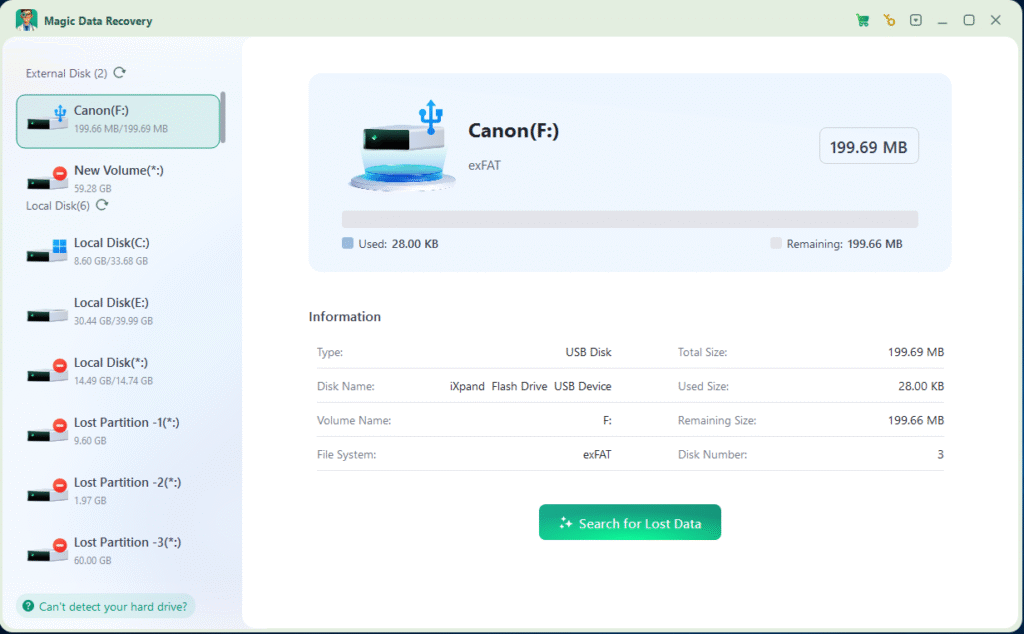
Step 3: Select the HDD
Open the software and choose the damaged drive from the device list.
Step 4: Run a Full Scan
Start with a quick scan and it will list some files, then proceed with a deep scan for maximum recovery.
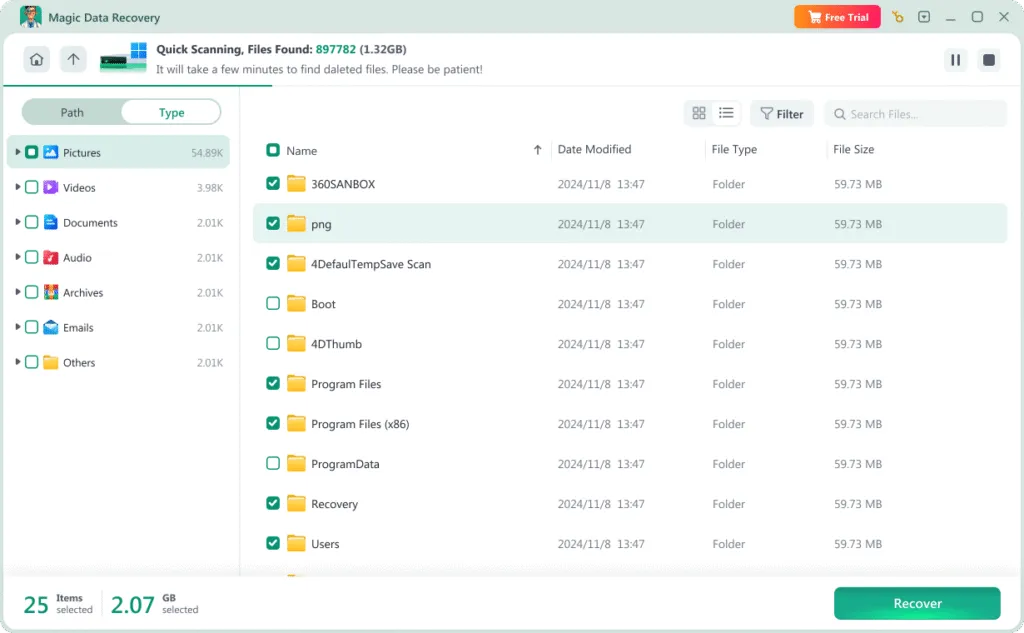
Step 5: Preview and Restore
Preview files, select the ones you need, and save them to another drive. This prevents overwriting original sectors and increases the safety of your restored data.

Method 2: Use Windows File Recovery (Microsoft Tool)
Windows File Recovery is a command-line utility provided by Microsoft. It can recover deleted files from local storage devices.
When This Method Helps
- Files were deleted recently
- The disk has not been heavily used since deletion
Limitations
- Command-line only (not beginner-friendly)
- Limited success in formatted or corrupted drives
This option is best suited for advanced users who are comfortable with command syntax.
Method 3: Restore Files from File History
If File History was enabled before deletion, recovery is straightforward.
Steps
- Open Settings → Update & Security
- Select Backup
- Click More options → Restore files
- Browse and restore the required files
This method only works if backups were configured in advance.
Method 4: Restore Previous Versions
Windows may store shadow copies of files or folders.
How to Use It
- Right-click the folder where the file was located
- Choose Properties
- Open the Previous Versions tab
- Restore an earlier version
This approach depends on system protection settings and may not always be available.
Method 5: Recover Using Backup and Restore (Windows 10)
Windows 10 includes a built-in backup feature known as Backup and Restore (Windows 10).
How It Works
- Open Control Panel
- Go to System and Security
- Select Backup and Restore (Windows 10)
- Click Restore my files
- Choose files and restore location
This method is reliable when system backups were created regularly.
Method 6: Recover Files from Cloud Backups
Cloud services often provide version history and deletion protection.
Supported services include:
- OneDrive
- Google Drive
- Dropbox
Check the cloud recycle bin or version history before attempting disk recovery.
Method 7: Use Professional Data Recovery Services
When software fails or the drive is physically damaged, professional recovery services may be required.
When to Consider This
- Drive makes unusual noises
- Disk is not recognized
- Severe file system corruption
While effective, this option is costly and time-consuming.
Method 8: Restore Permanently Deleted Files Using Command Prompt (CMD)
Command Prompt can help restore access to files hidden by file system errors.
Steps to Use CMD in Windows 10
- Right-click Start → Windows PowerShell (Admin)
- Run the command:
chkdsk X: /f
Replace X with the drive letter.
- After completion, run:
ATTRIB -H -R -S /S /D X:*.*
Important Notes
- This method does not recover overwritten data
- It is useful for hidden or inaccessible files
- Avoid interrupting CHKDSK during execution
CMD recovery is a practical last step before using dedicated recovery software.
Conclusion
Recovering permanently deleted files in Windows 10 depends on how the data was lost and what actions were taken afterward. Built-in tools and CMD methods may help in limited cases, especially when backups or logical errors are involved.
However, when files are truly deleted and no backup exists, Magic Data Recovery offers a more dependable solution. Its ability to handle deletion, formatting, and file system issues makes it a practical choice for both everyday users and professionals.
If you are searching for an efficient way to recover permanently deleted files Windows 10, using a dedicated recovery tool can save time and reduce the risk of further data loss.
Supports Windows 7/8/10/11 and Windows Server
FAQs
Can permanently deleted files be recovered in Windows 10?
Can permanently deleted files be recovered?
Where do permanently deleted files go in Windows 10?
Are permanently deleted files actually deleted?
How to permanently delete files so they cannot be recovered?
How to restore permanently deleted files in Windows 10 command?
When you delete a file from your computer, is it gone forever?
Are deleted files permanently stored in the Recycle Bin?

Erin Smith is recognized as one of the most professional writers at Amagicsoft. She has continually honed her writing skills over the past 10 years and helped millions of readers solve their tech problems.