
DiskInternals Partition Recovery: Safer Guide
If you are searching for diskinternals partition recovery, you may already be dealing with a missing partition, an inaccessible drive, or a disk that suddenly appears as unallocated. This situation feels urgent because the files may still exist, but Windows can no longer locate the partition structure correctly. Before you try direct partition repair, it is safer to understand how lost partition data recovery works and why recovering important files first can reduce the risk of secondary damage.
Many partition recovery tools try to rebuild partition tables or restore lost volumes. That can help in simple cases. However, if the wrong partition structure is restored, the disk may become harder to recover later. Therefore, this guide compares DiskInternals Partition Recovery with a safer file-first strategy. You will learn what DiskInternals does, when it may help, what risks to consider, and why Magic Data Recovery can be a better first step when your files matter more than restoring the partition itself.
Supports Windows 7/8/10/11 and Windows Server
Table of Contents
What Is DiskInternals Partition Recovery?
DiskInternals Partition Recovery is a Windows-based partition recovery tool designed to recover files from deleted, damaged, formatted, or inaccessible partitions. It provides a wizard-style workflow, which helps users select a drive, choose a scan mode, preview found files, and recover data.
In simple terms, the software tries to locate lost file system structures and make the data readable again. It may help when a partition was deleted by mistake, a partition table was damaged, or a drive appears unreadable because of file system errors.
However, users should understand one important point. DiskInternals Partition Recovery is not only about file recovery. It also focuses on partition-level recovery. That means the tool may be used in cases where the disk structure itself has problems. This is powerful, but it also requires caution.
Why Partition Recovery Needs Extra Care
A deleted file recovery case is usually easier to control. The software scans the file records and saves recovered files to another location. Partition recovery is different. A lost partition often involves file system metadata, partition tables, boot sectors, or volume boundaries.
If a partition recovery tool restores the wrong structure, several problems may happen:
Potential Problem | Why It Matters |
Original file paths become harder to read | Incorrect partition metadata may make folder structures incomplete or confusing. |
Recoverable data may be overwritten | New partition records or repair actions may write data to sensitive disk areas. |
The damaged partition may become worse | A partial repair can sometimes create more logical corruption. |
Later recovery may become more difficult | Professional recovery or deep scan tools may have fewer usable records to analyze. |
That is why experienced technicians often follow a simple rule: recover important files first, then repair the partition later. This approach protects the data before any disk-level changes are made.
If you want a deeper explanation of how this risk works, you can read this guide about choosing a safe disk partition recovery tool.
DiskInternals Partition Recovery Review: Strengths and Limits
Main Strengths
DiskInternals Partition Recovery has several advantages for users who understand partition recovery basics.
First, it supports multiple recovery scenarios, including deleted partitions, formatted partitions, damaged drives, and inaccessible volumes. This makes it more advanced than simple undelete tools.
Second, the wizard-based interface can guide users through the scan process. For users who do not want to configure technical settings manually, this workflow is helpful.
Third, the tool supports several file systems and storage types. This can be useful when recovering data from older Windows drives, external drives, or storage devices with damaged file systems.
Practical Limits
Although DiskInternals Partition Recovery can be useful, it may not be the best first choice for every user.
The main issue is risk control. If your goal is to recover irreplaceable documents, photos, videos, or work files, rebuilding a partition too early can create unnecessary danger. You may regain access to a partition, but you may also damage the data structure if the recovery result is incorrect.
Another issue is complexity. Partition recovery requires users to understand which disk, partition, and scan result are correct. If several lost partitions appear after scanning, choosing the wrong one may lead to confusion.
Finally, some users may only need file recovery, not partition repair. In that case, a file-first tool is often simpler and safer.
DiskInternals Partition Recovery vs Magic Data Recovery
The key difference is recovery strategy.
DiskInternals Partition Recovery focuses on lost partition recovery and partition-level data access. Magic Data Recovery focuses on recovering files safely from deleted, formatted, file system error, lost partition, and virus-damaged scenarios before you attempt risky disk repair.
Comparison Point | DiskInternals Partition Recovery | Magic Data Recovery |
Main purpose | Partition-level recovery and data access | File-first recovery from multiple data loss scenarios |
Best for | Users who want to inspect or recover lost partitions | Users who want to recover important files safely first |
Lost partition recovery | Supported | Supported |
Deleted file recovery | Supported | Supported |
Formatted drive recovery | Supported | Supported |
File system error recovery | Supported in many cases | Supported |
Virus-damaged data recovery | Limited by case | Supported in common file-loss scenarios |
Direct partition repair focus | Stronger focus | Not the main focus |
Risk control | Depends on user operation | Safer because it encourages recovering files before repair |
Ease of use for beginners | Moderate | Easier scan-preview-recover workflow |
Best recovery order | Scan and recover, then decide repair actions | Recover important files first, then repair partition if needed |
This comparison does not mean DiskInternals Partition Recovery is bad. It means users should choose based on their real goal. If you want to rebuild a partition and already have a backup, DiskInternals may be useful. If you want to protect important files before making disk changes, Magic Data Recovery is the safer starting point.
Supports Windows 7/8/10/11 and Windows Server
Why Recover Files Before Restoring a Partition?
When a partition disappears, many users immediately try to restore it. This reaction is understandable. A missing partition looks like a disk structure problem, so restoring the partition seems logical.
However, data safety should come first.
Imagine that a partition was lost after a power failure. The file system metadata may already be unstable. If a recovery tool writes a wrong partition entry or restores an incomplete structure, the files may become harder to locate. In another case, a user may accidentally create a new partition in the same unallocated space. That action can overwrite old metadata and reduce recovery chances.
A safer workflow looks like this:
1. Stop using the affected drive immediately.
This prevents new data from overwriting recoverable files.
2. Do not format the disk.
Formatting may rewrite file system structures and make recovery more difficult.
3. Do not create a new partition.
A new partition may overwrite old partition records or damage the original partition layout.
4. Scan the whole disk, not only visible drive letters.
Lost partitions may not appear as normal drive letters, so a full-disk scan gives recovery software a better chance to locate the missing data.
5. Preview important files before recovery.
Previewing helps confirm whether the files are recoverable and usable.
6. Save recovered files to another healthy drive.
This avoids overwriting remaining recoverable data on the affected disk.
7. Repair or recreate the partition only after your files are safe.
This keeps your data protected before any risky disk-level operation.
This file-first method is especially important when the lost data includes business files, family photos, school documents, design projects, videos, or database files.
For more recovery-focused guidance, you can also read this article about lost partition data recovery.
When Should You Use DiskInternals Partition Recovery?
DiskInternals Partition Recovery may be suitable in these cases:
Situation | Why DiskInternals May Help |
You understand partition recovery basics | You can make better decisions when multiple scan results appear. |
You want to inspect a damaged or missing partition | The tool focuses on partition-level recovery. |
You need to recover files from older Windows file systems | It supports common Windows file system scenarios. |
You already have a backup | Partition repair risk becomes less serious when data is already safe. |
You are comfortable choosing scan results manually | The process may require judgment when several partitions are detected. |
It may also help if the partition was recently deleted and no new data has been written to the drive. In this situation, partition structure recovery may be simpler.
However, avoid rushing into partition repair if the data is extremely important. Instead, scan and recover files first. After that, you can decide whether to rebuild the partition, recreate it, or replace the disk.
When Is Magic Data Recovery the Safer Choice?
Magic Data Recovery is a better first step when your priority is safe file recovery rather than direct partition repair. It helps recover files from deleted, formatted, file system error, lost partition, and virus-damaged data loss scenarios.
Data Loss Scenario | Why Magic Data Recovery Fits |
Partition becomes unallocated | It can scan the disk area where lost files may still exist. |
Drive asks to be formatted | It helps recover files before formatting or repair. |
Partition disappears after resizing | It can search for files without rebuilding the partition first. |
Virus damages file system structures | It can scan for recoverable files after logical damage. |
Files are lost after accidental formatting | It supports formatted drive recovery scenarios. |
Disk shows RAW or inaccessible status | It can scan the drive even when normal access fails. |
Unlike tools that focus heavily on rebuilding the partition itself, Magic Data Recovery lets users scan the affected disk, preview recoverable files, and save them to another safe location. This helps protect the most valuable data before any repair attempt.
Its main advantages include:
Advantage | Practical Value |
File-first recovery workflow | You recover important files before changing disk structures. |
Deep scan capability | The software can search for files from deleted, formatted, corrupted, and lost partitions. |
Preview before recovery | You can confirm whether files are usable before saving them. |
Beginner-friendly process | Ordinary Windows users can follow the scan-preview-recover workflow. |
Multiple storage support | It works with hard drives, SSDs, USB drives, memory cards, and other storage devices. |
This approach is more reliable for many users because it focuses on what matters most: getting the files back safely.
How to Recover Lost Partition Files Safely with Magic Data Recovery
Before using DiskInternals Partition Recovery or any direct partition repair tool, follow this safer process with Magic Data Recovery.
Step 1: Stop Using the Affected Drive
Do not copy files to the drive. Do not install software on it. Do not format it. Also, avoid creating a new partition in the unallocated space. Every write operation may overwrite recoverable data.
Step 2: Install Magic Data Recovery on a Healthy Drive
Install Magic Data Recovery on another drive or another computer. This reduces overwrite risk and keeps the affected disk unchanged.
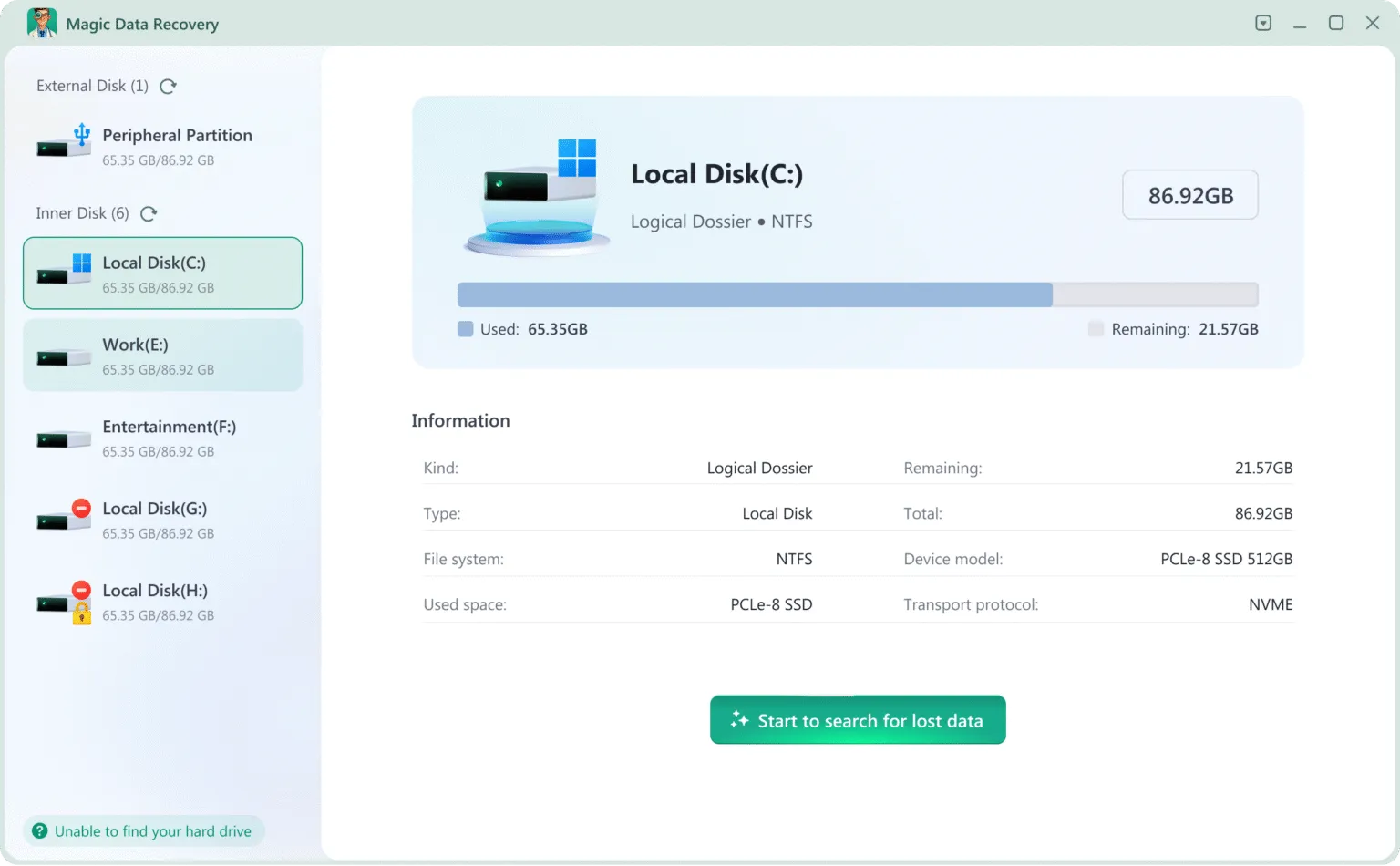
Step 3: Select the Lost Partition or Whole Disk
Launch the software and select the affected drive. If the original partition no longer appears, choose the whole disk. This allows the software to scan the storage area where the lost partition data may still exist.
Step 4: Run a Deep Scan
Start the scan. A quick scan may find recently deleted files, while a deeper scan can locate files from lost, formatted, RAW, or corrupted partitions.
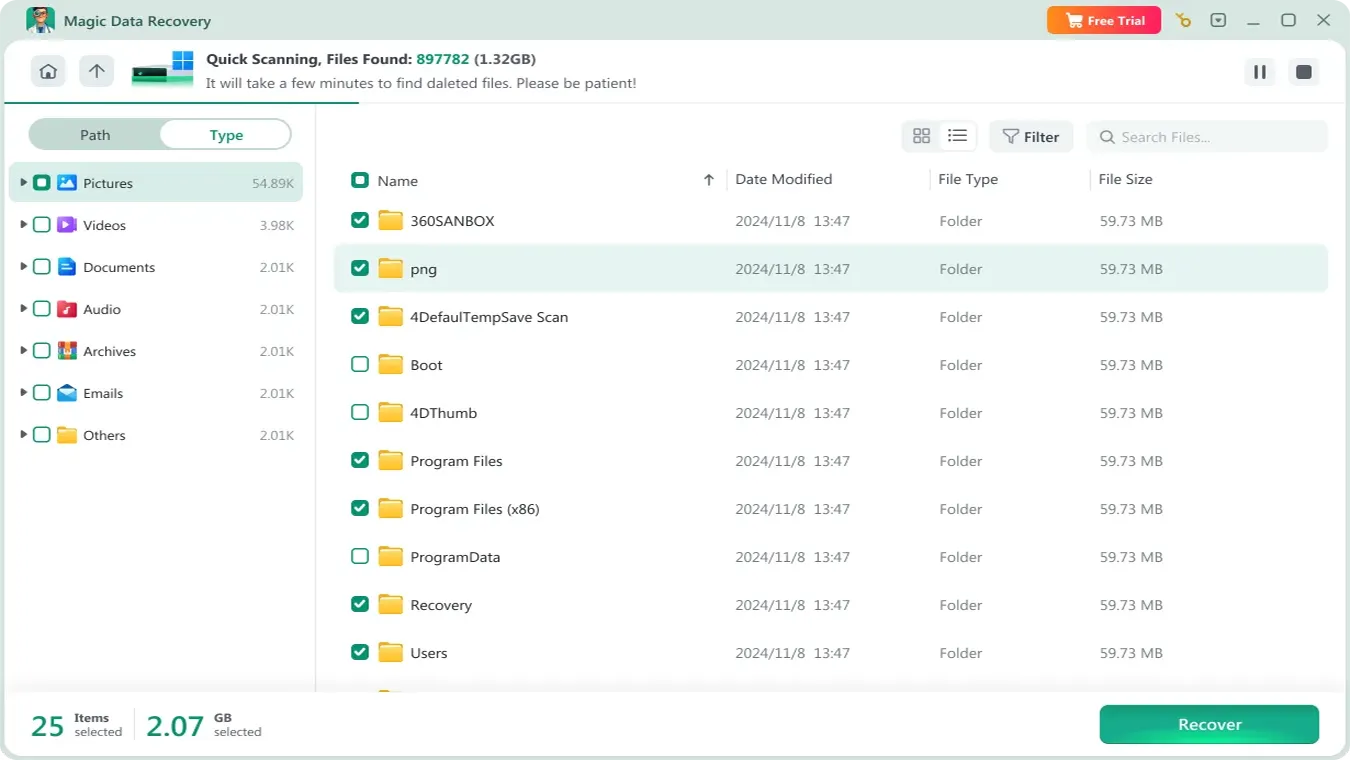
Step 5: Preview Important Files
Preview documents, photos, videos, archives, and other files before recovery. This step helps you confirm file quality and avoid recovering unnecessary data.

Step 6: Recover Files to Another Drive
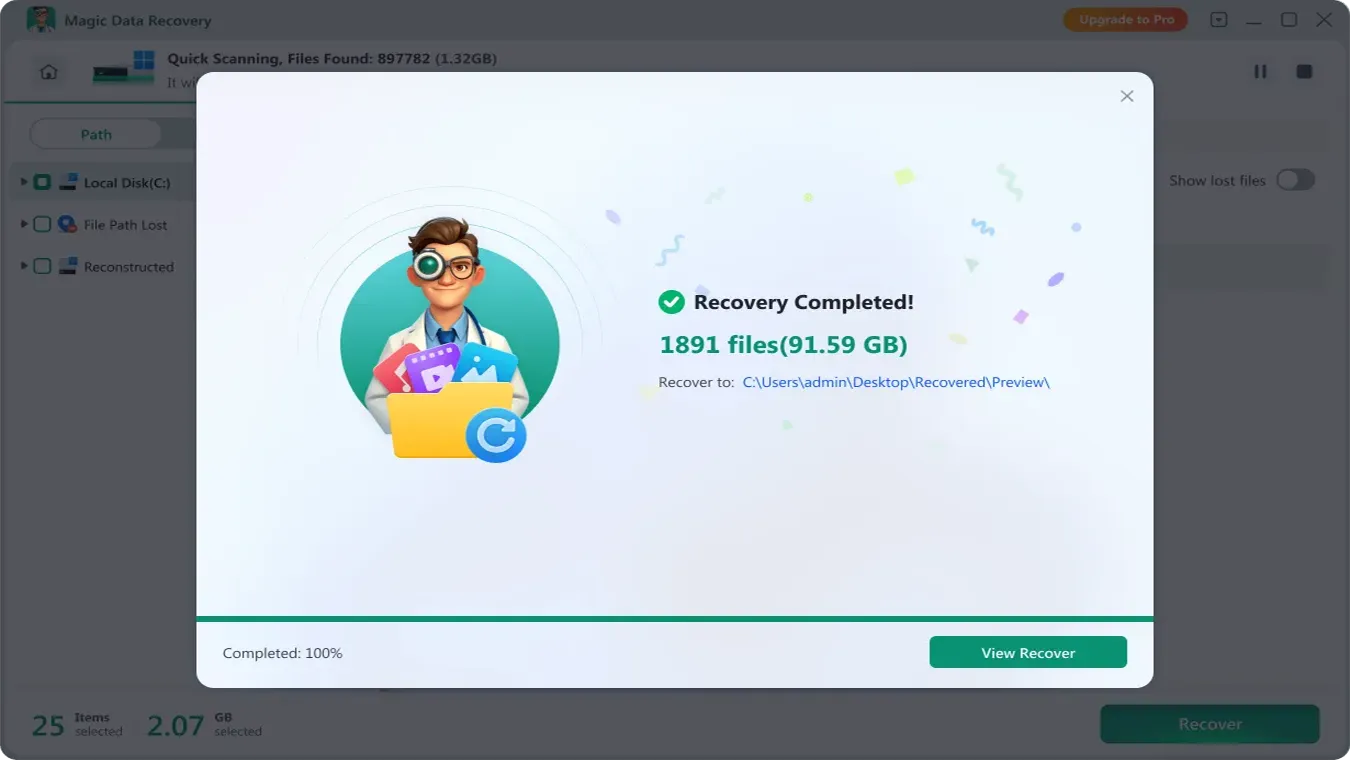
Save recovered files to a different healthy drive. Do not save them back to the lost partition or the same damaged disk. After your files are safe, you can repair, recreate, or format the partition if needed.
The Golden Rule: Stop Using It Immediately!
The moment you realize there’s a problem with your USB drive, stop all read and write activity immediately. This is the most critical step for successful data recovery.
- Eject It Now: Don’t try to open, copy, or write any more files. “Safely Eject” the drive from your computer right away in case of any changes on the drive.
- Do Not Format: If your computer prompts you with a message like “You need to format the disk before you can use it,” do not click “Format disk”! Formatting erases the drive’s file allocation table which is the “address book” for the files, making data recovery difficult.
- Try Another Computer: Sometimes, the issue might be with your computer’s USB port or drivers. Plugging the drive into a different computer can help you quickly determine if the problem is with the drive itself.
For detailed product operation steps, you can check the Magic Data Recovery user guide.
Common Mistakes to Avoid During Partition Recovery
Many failed recovery cases happen because users act too quickly. Avoid these mistakes:
Mistake | Why You Should Avoid It |
Clicking “Format disk” when Windows prompts you | Formatting may rewrite file system structures and reduce recovery chances. |
Creating a new partition in unallocated space | This may overwrite old partition metadata. |
Running CHKDSK before file recovery | CHKDSK may modify file system records during repair. |
Installing recovery software on the affected drive | Installation files may overwrite recoverable data. |
Saving recovered files to the same disk | This can overwrite other files that are still recoverable. |
Trying many repair tools without a plan | Repeated repair attempts may make the disk structure worse. |
These actions may seem helpful, but they can modify disk structures and reduce the chance of successful recovery. Instead, use a controlled recovery workflow.
Best Practice: File Recovery First, Partition Repair Later
A safe diskinternals partition recovery strategy should not start with aggressive repair. It should start with data protection.
Recovery Stage | Recommended Action |
Stage 1 | Recover important files. |
Stage 2 | Verify the recovered files. |
Stage 3 | Back up the recovered data. |
Stage 4 | Repair or recreate the partition. |
Stage 5 | Test the disk health. |
Stage 6 | Replace the drive if it shows signs of failure. |
This order gives you more control. Even if partition repair fails later, your important files are already safe.
Final Verdict: Is DiskInternals Partition Recovery Worth It?
DiskInternals Partition Recovery can be useful for users who need partition-level recovery and understand the risks. It offers a structured workflow and can help with deleted, damaged, or inaccessible partitions. However, partition recovery is not risk-free. If the wrong structure is restored, the disk may suffer further logical damage.
For most ordinary users, a safer strategy is to recover files first. Magic Data Recovery is recommended because it focuses on retrieving important data before making disk-level changes. It supports deleted, formatted, file system error, lost partition, and virus-damaged recovery scenarios. It also provides a simple scan-preview-recover workflow that helps users avoid unnecessary mistakes.
If you are comparing diskinternals partition recovery with a safer lost partition solution, start with Magic Data Recovery. Then, after your files are secure, you can decide whether partition repair is still necessary. For a broader recovery path, visit the lost partition data recovery guide from Amagicsoft.
Supports Windows 7/8/10/11 and Windows Server
FAQs About DiskInternals Partition Recovery
Is DiskInternals Partition Recovery safe to use?
DiskInternals Partition Recovery can be safe when you use it carefully and avoid writing recovered data to the same damaged drive. However, partition-level recovery always carries some risk because the disk structure may already be unstable. If your files are important, recover them first with a file-first tool before trying partition repair.
What is the main risk of partition recovery?
The main risk is secondary damage. If a tool restores the wrong partition structure or writes new metadata to the disk, existing recoverable files may become harder to recover. This is why many technicians recommend scanning and saving important files first, then repairing or recreating the partition after the data is safe.
Can Magic Data Recovery recover files from a lost partition?
Yes. Magic Data Recovery can scan disks with lost, deleted, formatted, RAW, inaccessible, or corrupted partitions. It focuses on finding recoverable files and saving them to another healthy location. This file-first method helps users protect important data before they attempt any partition repair or disk management operation.
Should I use DiskInternals Partition Recovery or Magic Data Recovery first?
Use Magic Data Recovery first if your main goal is to protect important files. It lets you scan, preview, and recover data before making disk-level changes. You may consider DiskInternals Partition Recovery later if you still need to inspect or rebuild the partition structure after the files are already safe.
Can I recover data after deleting a partition?
In many cases, yes. Deleted partition data may remain on the disk until new data overwrites it. Stop using the drive immediately, avoid formatting or creating new partitions, and scan the whole disk with recovery software. The sooner you act, the better your chance of locating recoverable files.
Is it safe to run CHKDSK on a lost partition?
It is not recommended to run CHKDSK before recovering important files from a lost or damaged partition. CHKDSK can modify file system records while trying to repair errors. In some cases, that may make recovery harder. Recover your files first, then use repair tools after creating a backup.
Why should recovered files be saved to another drive?
Saving recovered files to the same affected drive may overwrite other recoverable data. This is especially risky when the partition is lost, RAW, or corrupted. Always save recovered files to another healthy disk, external drive, or secure storage location so the original data area remains unchanged during recovery.
Does partition recovery work if the drive has physical damage?
Software recovery may work only if the drive is still detected and can be read normally. If the drive makes clicking noises, disconnects often, overheats, or does not appear in BIOS or Disk Management, stop using it. In physical failure cases, a professional data recovery lab is usually safer than software recovery.

Jason has over 15 years of hands-on experience in the computer data security industry. He specializes in data recovery, backup and restoration, and file repair technologies, and has helped millions of users worldwide resolve complex data loss and security issues.