
External Hard Drive Failure Rates: Statistics & Solutions
External hard drives remain one of the most common tools for storing backups, photos, and work documents. However, many users eventually worry about one key question: how high are external hard drive failure rates and what should you do if a drive suddenly stops working?
In reality, every storage device has a limited lifespan. Mechanical wear, accidental drops, unstable power, and overheating can gradually increase drive failure rates. As a result, even well-maintained drives may fail without warning. Consequently, users often face two urgent problems: protecting their remaining data and restoring files that have already disappeared.
Therefore, understanding external hard drive failure rates helps users reduce risk and respond quickly when failures occur. This guide explains typical failure statistics, common causes of drive damage, early warning signs, and practical methods that extend drive lifespan. In addition, it also introduces a reliable HDD recovery method to restore data if a drive becomes inaccessible.
Table of Contents
What Are External Hard Drive Failure Rates?
External hard drive failure rates describes how frequently external storage devices fail during a given time period. Most reliability studies measure this using Annualized Failure Rate (AFR).
AFR estimates the percentage of drives expected to fail each year.
For example:
- AFR of 1% means roughly 1 drive out of 100 fails annually
- AFR of 3% means about 3 drives out of 100 fail each year
Although the exact number varies between manufacturers and models, AFR provides a useful benchmark. Furthermore, because most external drives contain standard internal hard disks, their reliability patterns usually follow the same trends.
Consequently, environmental conditions such as temperature, vibration, and workload strongly influence drive failure rates.
Average External Hard Drive Failure Rates in Real-World Usage
Large storage studies provide helpful insights into real external hard drive failure rates. While results vary between environments, several general patterns appear consistently.
Typical observations include:
- Most drives show 1%–3% annual failure rates
- Reliability decreases as drives age
- Heavy workloads increase failure probability
Moreover, environmental factors also matter. For instance, drives used for continuous video editing or large data transfers experience more stress. Therefore, heavy workloads may gradually increase external hard drive failure rates compared with occasional backup usage.
HDD vs SSD Reliability
External drives generally use either HDD or SSD storage technology.
External HDD
- mechanical components
- lower cost per terabyte
- sensitive to physical shock
- higher mechanical wear over time
External SSD
- no moving parts
- faster read and write speeds
- better resistance to vibration
- possible controller or firmware issues
Although SSDs eliminate mechanical movement, electronic components can still fail. Consequently, users should still consider external hard drive failure rates regardless of the storage technology.
External Hard Drive Lifespan and Failure Risk
Drive lifespan directly affects external hard drive failure rates. Most consumer drives operate reliably for several years. However, hardware wear gradually increases the probability of failure.
Typical lifespan estimates include:
Drive Type | Average Lifespan |
External HDD | 3–5 years |
External SSD | 5–10 years |
Nevertheless, real lifespan often depends on usage patterns.
For example, a photographer who transfers large RAW images every day stresses a drive far more than someone who performs weekly backups. Similarly, drives stored in hot environments degrade faster because high temperatures accelerate hardware aging.
Therefore, long-term storage strategies should always account for rising external hard drive failure rates as drives grow older.
Common Causes That Increase External Hard Drive Failure Rates
Several technical and environmental factors contribute to higher external hard drive failure rates. Understanding these causes helps users prevent many failures.
Mechanical Wear
Traditional HDDs rely on spinning platters and moving read heads. Over time, these parts gradually wear down.
As a result, drives may eventually develop:
- read errors
- head alignment issues
- spindle motor failures
These problems often appear as clicking sounds or repeated file access failures.
Physical Damage
External drives are portable. Consequently, they are more vulnerable to accidental impacts.
Dropping a drive while it operates may cause severe internal damage. Even minor shocks can disrupt the delicate alignment of mechanical components.
Bad Sectors
Bad sectors occur when small portions of a disk become unreadable. Although a few bad sectors may not cause immediate problems, increasing numbers usually signal declining hardware health.
Power Instability
Power surges or unstable USB connections can damage drive electronics. In addition, disconnecting a drive during file transfers may corrupt the file system.
Overheating
Continuous heavy workloads generate heat. Without proper ventilation, internal temperatures may exceed safe limits. Over time, excessive heat accelerates component degradation and contributes to rising external hard drive failure rates.
Warning Signs of Rising External Hard Drive Failure Rates
Early detection plays an important role in preventing permanent data loss. Therefore, users should pay attention to warning signs that indicate possible drive failure.
Common symptoms include:
- unusual clicking or grinding noises
- extremely slow file access
- disappearing folders
- corrupted files
- a drive appearing as RAW in Disk Management
- frequent connection interruptions
For example, many users suddenly see a message that their drive must be formatted before use. In many situations, the files still exist on the disk but the file system becomes damaged.
Consequently, the safest response is to stop using the drive immediately and begin recovery procedures.
Practical Ways to Reduce External Hard Drive Failure Rates
Although no storage device lasts forever, several best practices significantly reduce external hard drive failure rates.
Follow the 3-2-1 Backup Strategy
Maintain three copies of important files:
- the original data
- one local backup
- one off-site backup
Because this strategy distributes risk, it protects data even if a drive fails.
Safely Remove External Drives
Always eject external drives using the operating system’s safe removal option. This step ensures that all write operations finish before disconnection.
Protect Drives From Physical Shock
Use protective cases when transporting drives. Additionally, avoid moving the device while it operates.
Monitor Disk Health
SMART monitoring tools track indicators such as:
- reallocated sectors
- read error rates
- drive temperature
Therefore, monitoring helps detect early problems before failure occurs.
Recovering Data After External Hard Drive Failure Rates Become Reality
Even when users follow best practices, drive failures still happen. Fortunately, many failures involve logical problems rather than irreversible hardware damage.
Common recoverable situations include:
- accidental deletion
- formatted drives
- corrupted partitions
- RAW file systems
In these cases, recovery software can scan the disk and reconstruct file structures.
However, writing new data to the affected drive may overwrite recoverable files. Therefore, starting recovery as soon as possible greatly improves the chances of success.
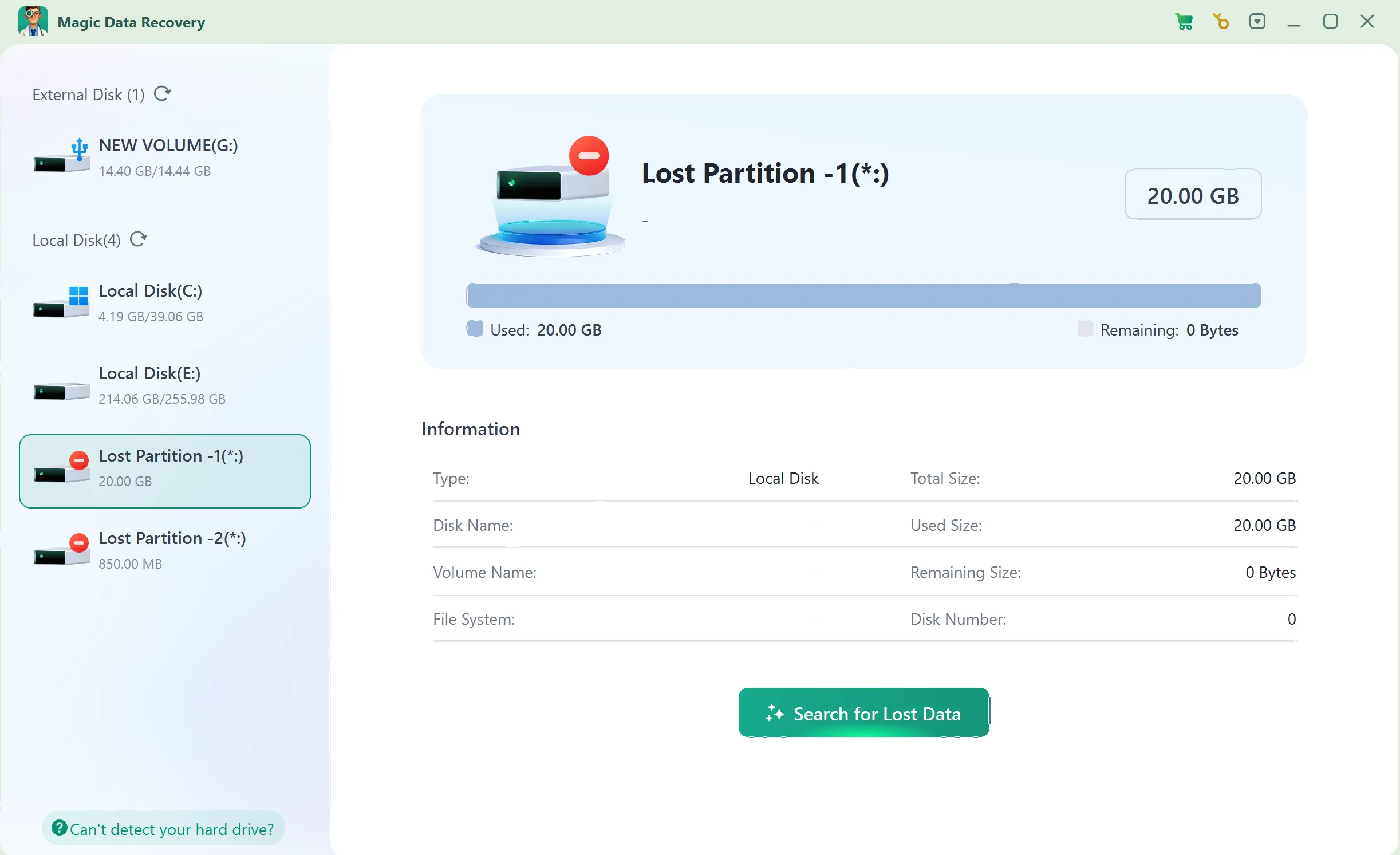
Recover Lost Files Using Magic Data Recovery
When external hard drive failure rates lead to unexpected data loss, specialized recovery software becomes essential. Magic Data Recovery provides a practical solution for retrieving files from damaged or inaccessible drives.
The software performs a deep scan of the storage device and identifies recoverable data structures. Because the process analyzes the disk in read-only mode, it avoids additional damage to the original data.
Key Advantages
Magic Data Recovery offers several important features:
- deep scan technology for damaged partitions
- recovery of photos, videos, documents, and archives
- preview feature before file restoration
- support for HDDs, SSDs, USB drives, and memory cards
Example Recovery Scenario
Consider a typical situation.
A user connects an external drive containing several years of personal photos. Suddenly, the operating system reports that the drive must be formatted.
Instead of formatting the disk, the user launches Magic Data Recovery. The software scans the drive, detects the previous file system structure, and allows the user to restore important photos.
Therefore, when external hard drive failure rates lead to inaccessible drives or missing files, this tool provides a reliable and efficient recovery solution.
If you are currently facing a similar problem, trying Magic Data Recovery may help restore valuable files quickly and safely.
Conclusion
Understanding external hard drive failure rates helps users make better decisions about data protection. While modern storage devices remain reliable for years, mechanical wear, physical damage, and environmental factors can still lead to unexpected failures.
Therefore, combining preventive practices with reliable recovery strategies offers the best protection. Regular backups, careful handling, and disk health monitoring reduce the likelihood of failure.
Nevertheless, when failures do occur, recovery tools become essential. In situations where drives become inaccessible or files disappear, Magic Data Recovery provides a dependable method for restoring lost data from hard drives while minimizing further risk.
Supports Windows 7/8/10/11 and Windows Server
FAQs About External Hard Drive Failure Rates
What are typical external hard drive failure rates?
Most studies show that external hard drive failure rates typically range between 1% and 3% per year, although results vary depending on usage conditions and hardware quality.
Do external SSDs fail less often than HDDs?
External SSDs resist physical shock better because they contain no moving parts. However, controller failures or firmware problems can still cause data loss.
How long do external hard drives usually last?
Most external HDDs operate reliably for 3–5 years, while SSDs may last 5–10 years depending on workload and environmental conditions.
What are the most common causes of drive failure?
Common causes include mechanical wear, accidental drops, overheating, bad sectors, and unstable power connections.
Can data be recovered after a drive failure?
Yes. Many failures involve logical problems rather than physical destruction. In these situations, recovery software can often restore lost files.
Should I keep using a drive that shows warning signs?
No. If a drive shows unusual noises, corrupted files, or connection errors, stop using it immediately and begin backup or recovery procedures.
What is the safest way to recover files from a failed drive?
Using specialized recovery software is usually the safest approach. Tools such as Magic Data Recovery scan the disk and allow users to restore files without modifying the original data structure.

Vasilii is a data recovery specialist with around 10 years of hands-on experience in the field. Throughout his career, he has successfully solved thousands of complex cases involving deleted files, formatted drives, lost partitions, and RAW file systems. His expertise covers both manual recovery methods using professional tools like hex editors and advanced automated solutions with recovery software. Vasilii's mission is to make reliable data recovery knowledge accessible to both IT professionals and everyday users, helping them safeguard their valuable digital assets.