
How to Recover Deleted Folder: A Comprehensive Guide

Supports Windows 7/8/10/11 and Windows Server
Table of Contents
What Happens to Your Data After You Delete a Folder?
When you delete a folder from your computer, the data inside doesn’t disappear immediately. Instead, the operating system simply marks the space occupied by the deleted folder as available for new data. This means the files remain recoverable until new data overwrites them.
However, if you empty the Recycle Bin, perform a quick format, or face a file system error, recovery can become more challenging but not impossible. In these cases, tools like Magic Data Recovery can be used to recover lost files effectively.
Which Folder Recovery Method Should You Use?
Choose a method based on how the folder disappeared.
Situation | Recommended method |
The folder may have been moved or hidden | Search File Explorer |
You deleted it moments ago | Press Ctrl+Z |
You used the normal Delete option | Check the Recycle Bin |
The folder was synchronized with OneDrive | Check OneDrive Recycle Bin |
File History was previously enabled | Restore a previous version |
You used Shift+Delete | Windows File Recovery |
No backup is available | Magic Data Recovery |
Start with the simplest method. Use recovery software only when the folder is not available in the Recycle Bin or an existing backup.
Method 1: Search for a Moved or Hidden Folder
The folder may have been moved, renamed, or hidden instead of deleted.
Search in File Explorer
- Press Windows + E.
- Select This PC.
- Enter the folder name in the search box.
- Wait for Windows to finish searching.
- Right-click a result and select Open file location.
If you do not remember the folder name, search for a file that was stored inside it. You can also search by extension:
*.docx
*.xlsx
*.pdf
*.jpg
Show Hidden Folders
On Windows 11:
- Open File Explorer.
- Select View > Show.
- Enable Hidden items.
On Windows 10, open the View tab and select Hidden items.
If the missing folder appears faded, right-click it, select Properties, clear Hidden, and click Apply.
Method 2: Undo the Deletion with Ctrl+Z
If you deleted the folder moments ago, Windows may still let you reverse the action.
- Open the location where the folder was stored.
- Press Ctrl+Z.
- Check whether the folder reappears.
Alternatively, right-click an empty area and select Undo Delete when the option is available.
This method works best immediately after deletion. It may stop working after restarting Windows or performing several other file operations.
Method 3: Recover a Deleted Folder from the Recycle Bin
If you used the normal Delete option, check the Recycle Bin first.
- Open the Recycle Bin.
- Search for the folder by name.
- Check its Original Location and Date Deleted.
- Right-click the folder.
- Select Restore.
Windows will return the folder to its original location.
Why Is the Folder Not in the Recycle Bin?
A deleted folder may bypass the Recycle Bin when:
- You pressed Shift+Delete
- You emptied the Recycle Bin
- The folder was too large
- It was deleted from a network drive
- It was removed through Command Prompt
- The Recycle Bin was disabled
- It was deleted from certain removable devices
In these cases, try a backup or recovery tool.
Method 4: Restore a Folder from OneDrive
If your Desktop, Documents, or Pictures folders were synchronized with OneDrive, the deleted folder may be stored in the online OneDrive Recycle Bin.
- Sign in to OneDrive in a browser.
- Open Recycle bin.
- Locate the deleted folder.
- Select it.
- Click Restore.
The restored folder should return to its previous cloud location and synchronize back to your computer.
For personal OneDrive accounts, deleted items are generally retained for a limited period. Therefore, check the online Recycle Bin as soon as possible.
If you used Google Drive, Dropbox, or another cloud service, check its Trash or Deleted Files section as well.
Method 5: Recover a Deleted Folder with File History
File History can restore earlier copies of folders, but it must have been enabled before the deletion occurred.
Restore a Previous Version
- Open File Explorer.
- Go to the location that previously contained the folder.
- Right-click the parent folder.
- Select Restore previous versions.
- Choose a version created before the deletion.
- Click Open to inspect it.
- Select Restore to.
- Save the folder to a safe location.
For example, if this folder was deleted:
C:\Users\YourName\Documents\Projects
Right-click the Documents folder and check its previous versions.
Choose Restore to rather than immediately replacing the current folder. This lets you inspect the backup before copying it back.
If no previous versions appear, File History may not have been enabled, the backup drive may be disconnected, or no backup may contain the deleted folder.
Method 6: Use Windows File Recovery
Windows File Recovery is Microsoft’s command-line tool for recovering deleted data from internal drives, external hard drives, and USB devices.
It can help when you need to recover a deleted folder that is no longer in the Recycle Bin.
You need:
- A source drive containing the deleted folder
- A different destination drive for recovered data
The source and destination cannot be the same partition.
Suppose a folder was deleted from:
C:\Users\YourName\Documents\DeletedFolder
To recover it from drive C: to drive E:, use:
winfr C: E: /regular /n \Users\YourName\Documents\DeletedFolder\
For a deeper scan, use:
winfr C: E: /extensive /n \Users\YourName\Documents\DeletedFolder\
Regular mode is suitable for recently deleted files on a healthy NTFS drive. Extensive mode is better when the folder was deleted longer ago, the drive was formatted, or the file system is damaged.
If the original folder structure cannot be found, search by file type:
winfr C: E: /extensive /n *.docx /n *.xlsx /n *.pdf
Windows File Recovery is free, but its command-line interface may be difficult for inexperienced users.
Method 7: Recover Deleted Folder Data with Magic Data Recovery
If you’ve deleted a folder by mistake or your data was lost due to system errors or formatting, Magic Data Recoveryprovides an effective solution for restoring lost files.
Step-by-Step Guide for Windows Users:
Step 1: Stop Using the Hard Drive
Continued use may overwrite deleted data. Disconnect the drive immediately.
Step 2: Install a Professional HDD Recovery Software
Install the tool on a different disk (not the affected one). A reliable choice is Magic Data Recovery, known for its deep-scan engine and high recovery success rate.
Supports Windows 7/8/10/11 and Windows Server
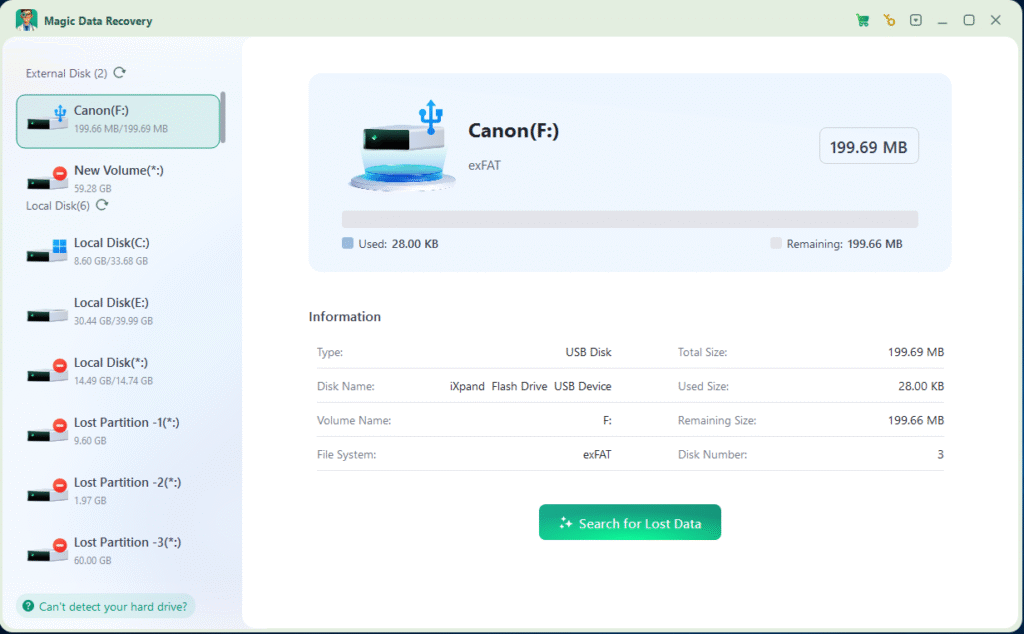
Step 3: Select the HDD
Open the software and choose the damaged drive from the device list.
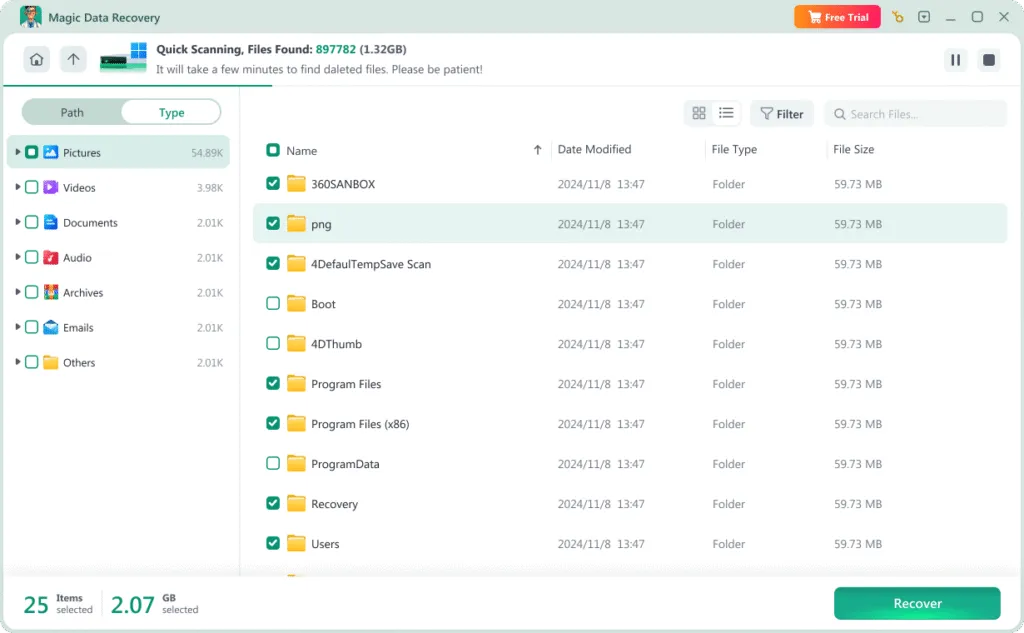
Step 4: Run a Full Scan
Start with a quick scan and it will list some files, then proceed with a deep scan for maximum recovery.
Step 5: Preview and Restore
Preview files, select the ones you need, and save them to another drive. This prevents overwriting original sectors and increases the safety of your restored data.

You can also watch the video to learn about the usage steps of Magic Data Recovery.
What to Do When Your Folder Is Lost
Partition errors and file system corruption can make your files unreadable, but these issues don’t mean your data is gone forever. Magic Data Recovery offers solutions for both partition loss and file system corruption.
- Partition Recovery: If the partition containing your files becomes corrupted or lost, Magic Data Recovery can scan the disk and restore your data.
- File System Error: Corrupt file systems can also be recovered using Magic Data Recovery, it is able to scan RAW partition or other error partition to get your lost data back.
Best Practices to Avoid Losing Your Data
To avoid the pain of losing your files, follow these simple tips:
- Regular Backups: Always back up important files to external drives or cloud storage to ensure they’re protected.
- Reliable Storage Devices: Invest in high-quality storage devices like SSDs to reduce the risk of data loss.
- Caution with Formatting and System Changes: Avoid accidental formatting or changes to system files that might result in data loss.
Conclusion: Why We Recommend Magic Data Recovery
Magic Data Recovery is the most reliable tool for recovering deleted folder in various data loss scenarios. Whether you’ve accidentally deleted a folder, lost data after formatting, or faced file system errors, this powerful tool offers an easy, efficient solution for recovery. With features like deleted file recovery, lost partition data recovery, and RAW partition data recovery, Magic Data Recovery is the most comprehensive solution available.
If you’re looking for an efficient way to recover your lost folders, Magic Data Recovery provides a seamless, user-friendly experience that outperforms other data recovery tools on the market.
Supports Windows 7/8/10/11 and Windows Server
FAQs
How to recover permanently deleted folder?
How to find the recently deleted folde?
How do you recover a deleted folder that is not in the Recycle Bin?
How to recover suddenly deleted files?
Are permanently deleted files actually deleted?
How to restore a deleted folder on the desktop?
What do you do if you accidentally delete an entire folder?
How to check file deletion history?

Erin Smith is recognized as one of the most professional writers at Amagicsoft. She has continually honed her writing skills over the past 10 years and helped millions of readers solve their tech problems.